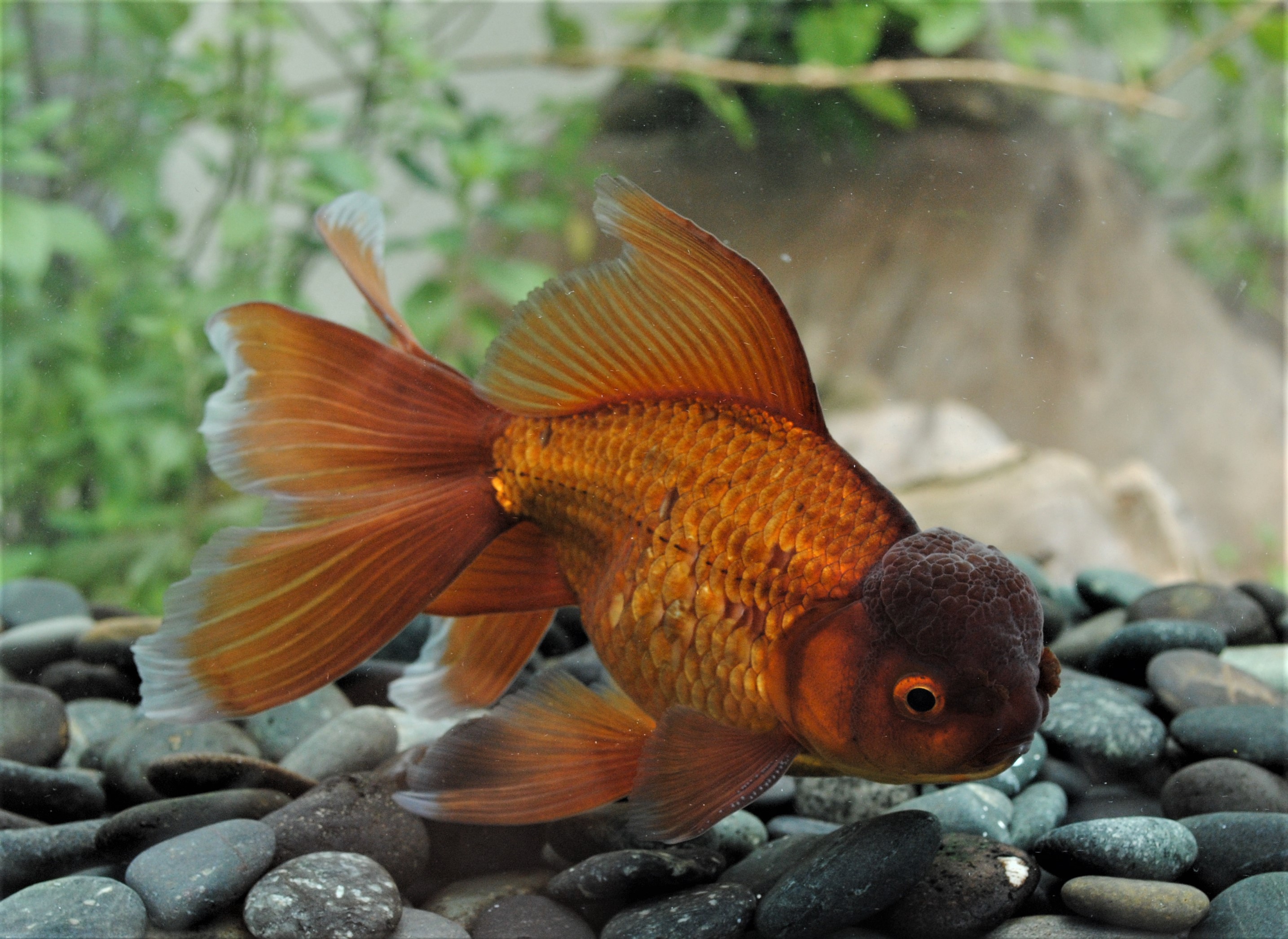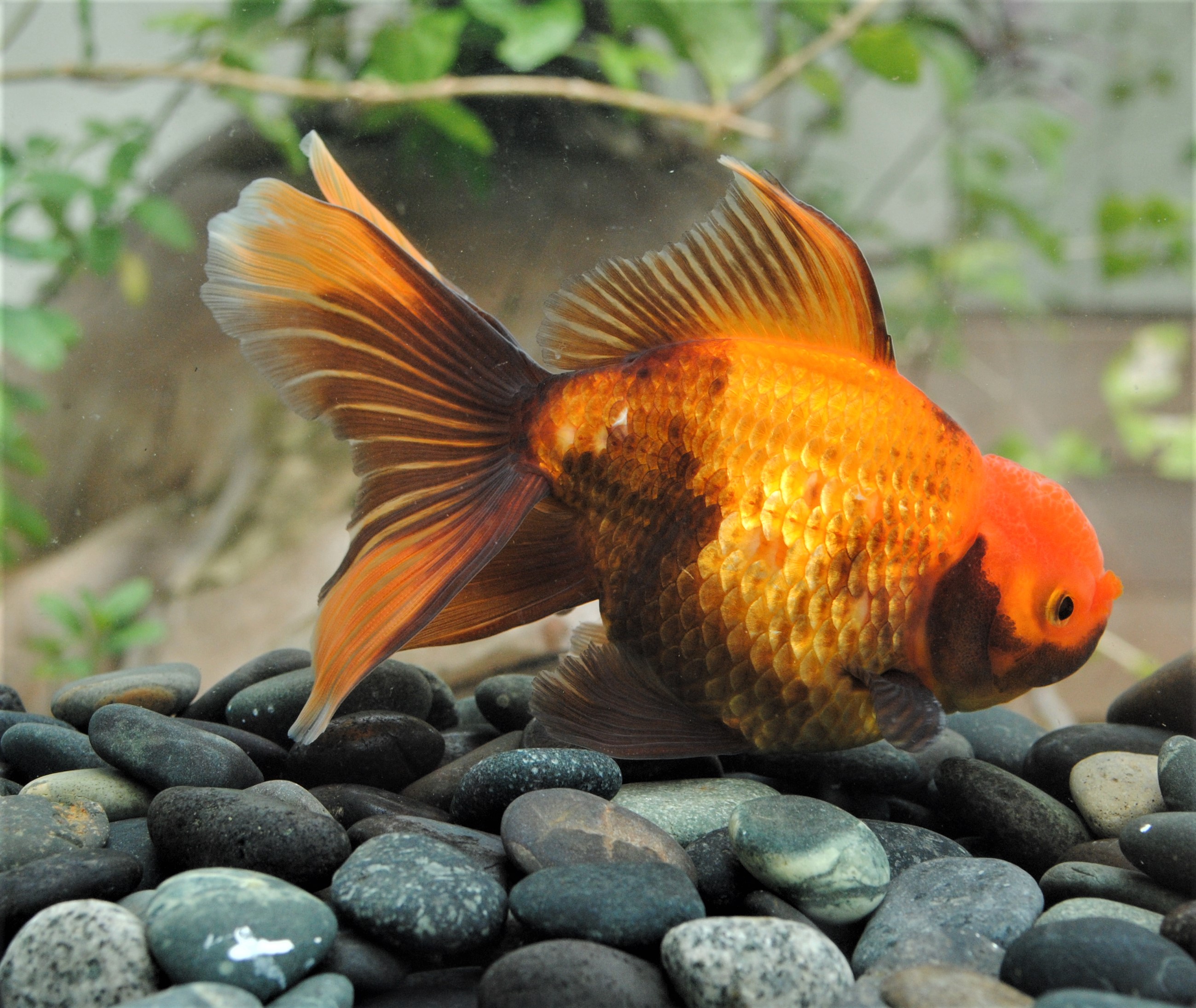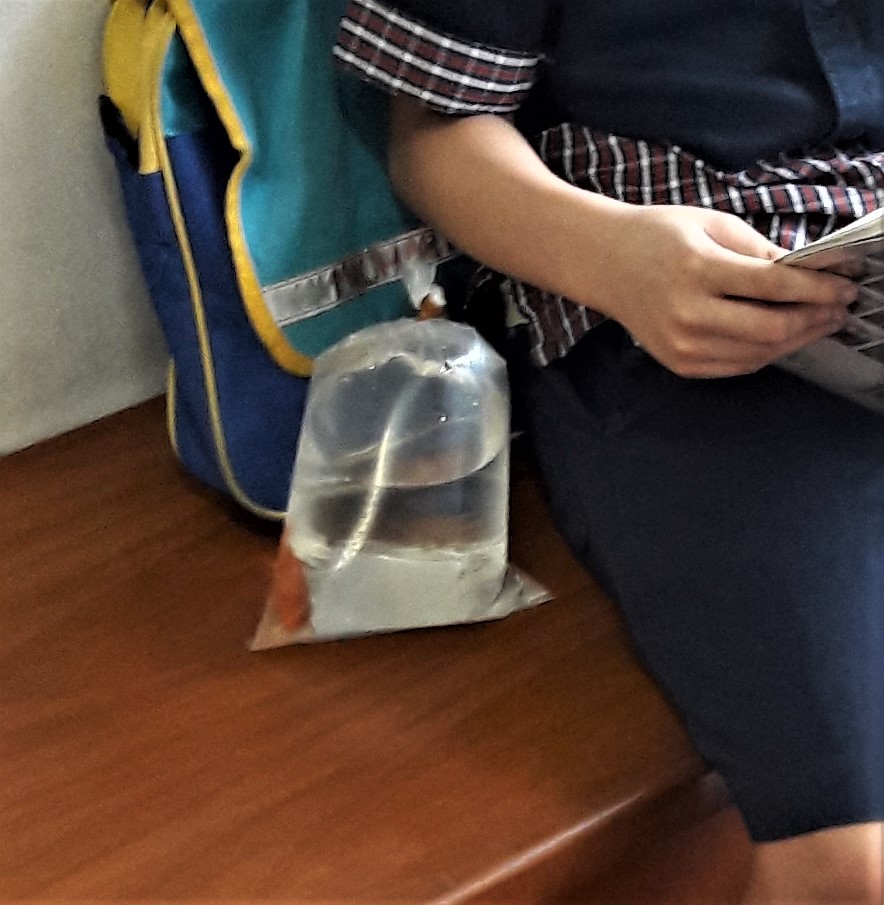
kehidupan dalam air

Beli Ikan

Sewaktu kecil, ketika uang jajan pas-pasan, mampir ke toko ikan dengan perasaan minder. Ikannya bagus-bagus, tapi duit di kantong tidak memadai. Apa daya. Jadi saya lebih banyak ke toko ikan untuk berkunjung saja, melihat-lihat, tapi tidak beli. Untung pemilik toko ikan di Jl Bangka, Malang, waktu itu sabar. Orang dipersilahkan datang, minim tegur sapa, dan tidak beli pun tidak apa-apa.

Saya juga pernah menjadi pembeli yang aneh. Di sebuah toko ikan yang lain, yang sekarang sudah tutup, saya melihat burayak ikan koki ditaruh di aquarium di sebuah rak bagian bawah. Ikan koki di toko itu mahal-mahal, jadi sebagai seorang bocah yang naif, saya berpikir burayak-burayak itu pastilah akan menjadi ikan yang bagus. Karena itu saya berniat membelinya dengan penuh harap harganya tidak mahal. Tapi sang pemilik toko mengatakan itu tidak dijual. Dia tidak tahu burayak 1 cm mau dihargai berapa. Tapi sy terus menerus merayu dia. Saya yang membuka harga. Saya berikan uang jajan saya seminggu untuk membeli 1 ekor burayak tersebut. Mungkin karena merasa terganggu, akhirnya ia menjual satu ekor burayak koki kepada saya, anak kecil yang rewel ini. Saya senang sekali. Burayak itu saya taruh kolam bersama koki2 saya yang lain. Besoknya, burayak itu sudah lenyap.

Ketika saya dewasa dan memulai karir di Surabaya, saya kembali mulai berburu ikan mas koki. Saya mencarinya di iklan jitu koran Jawa Pos. Mendatangi rumah-rumah pedagang sambilan itu membuat hati deg-deg an juga. Harga ikannya mahal-mahal. Dan saya merasa dinilai oleh penjualnya, orang ini punya uang atau tidak. Jika saya memberi kesan tidak mampu beli, sikap mereka menjadi ketus. Biasanya saya tidak datang lagi ke tempat mereka. Hanya kepada penjual yang saya merasa cocok, yang enak diajak ngobrol dan tidak menghakimi, saya bisa menjadi langganan.

Akhirnya itu menjadi kebiasaan saya dalam bertransaksi. Kalau merasa tidak cocok dengan karakter seorang penjual, ya sudah, diam-diam saja menjauh. Saya pikir saya tidak rugi apa-apa. Malah penjual itu yang rugi karena kehilangan calon pembeli masa depan.

Calon pembeli masa depan? Iya. Bukankah kondisi selalu berubah? Seseorang yang hari ini tidak mampu beli ikan, suatu saat bisa jadi mampu. Jika penjual sudah mengusirnya pada waktu dia tidak mampu, bukankah berarti ia sedang menutup masa depannya dari rejeki? Tapi meski seseorang berkelakuan aneh (seperti saya waktu kecil) atau tidak mampu beli saat ini (seperti sy juga dulu) namun tetap dilayani dengan baik, tetap dimaklumi, tetap dijadikan kawan, suatu saat mungkin ia bakal beli, atau menjadi customer besar.

Hanya sekali saya marah. Waktu itu ikan yang saya ingin beli, dikatakan tidak lagi dijual. Tapi jika saya benar-benar menginginkan, maka akan dipertimbangkan untuk dijual. Kesan saya waktu itu, saya disuruh mengemis-ngemis dahulu untuk diijinkan membeli ikan itu. Saya marah besar. Dalam bahasa Jawa saya berteriak “ga tuku iwakmu ga patek-en.” Tapi dalam hati saja saya mengatakannya. Yang pasti, saya putus hubungan dengan penjual itu untuk seterusnya.

Ketika saya makin menekuni breeding, mau tak mau saya harus menjual ikan saya juga. Kalau terlalu banyak, mau diapakan lagi selain dijual? Jadi saya juga berada dalam posisi sebagai penjual. Memang pengalaman sebagai pembeli itu membekas dalam hati. Saya tidak ingin memperlakukan pembeli seperti saya diperlakukan oleh penjual-penjual yang ketus dan sok. Saya merasa calon pembeli berhak mendapat informasi sejelas-jelasnya tentang ikan yang mau dibeli. Calon pembeli juga berhak untuk tidak cocok / tidak jadi membeli. Yang pasti, saya akan melayani mereka dengan ramah. Jika mereka tidak membeli sekarang, mereka tetap adalah calon pembeli saya di masa depan. Mengapa saya harus menutup pintu masa depan saya hanya karena mereka berlaku aneh atau tidak jadi membeli?

Selama suatu transaksi belum deal, maka tidak ada ikatan. Namun jika sudah deal, meski sebatas ucapan, maka itu harus dipegang. Selama belum deal, tidak ada wanprestasi. Tapi jika sudah deal dan tidak ditepati, itu barulah wanprestasi. Sudah janji membayar, tapi tidak kunjung membayar. Sudah memenangkan lelang, tapi membatalkan. Itu wanprestasi. Bisa di blacklist. Tapi bisa juga dimaklumi. Siapa tahu ada sesuatu dibalik itu. Siapa tahu suatu saat yang bersangkutan berubah dan menjadi customer masa depan. Bukankah rejeki di tangan Tuhan? Kalau Tuhan belum memberikannya sekarang, dan kita marah-marah kepada calon customer tersebut, yang rugi masih tetap kita. Rugi perasaan, setidaknya. Lebih baik untuk melupakan dan move on, menjajaki calon pembeli selanjutnya ketimbang tinggal dalam kubangan pikiran penuh emosi itu.

Dalam pertarungan pedang antara Miyamoto Musashi melawan Sasaki Kojiro, Kojiro mencabut pedangnya dan membuang sarung pedangnya ke pasir. Melihat tindakan itu, Musashi sudah tahu bahwa Kojiro bakal kalah. Mengapa? Karena ia sudah mengenakan attitude orang kalah. Dari mana Musashi menyimpulkan hal itu? Karena Kojiro membuang sarung pedangnya. Itu berarti di bawah sadarnya ia tidak berpikir untuk dapat menyimpan pedangnya kembali. Pikirannya sudah kalah sebelum benar-benar bertarung. Dan benar, Kojiro pun terkapar berlumuran darah di pantai itu. Sekarat. Saya berpikir, penjual yang sudah meragukan calon pembelinya di awal adalah seperti Sasaki Kojiro yang sudah membuang sarung pedangnya di awal. Bukan pikiran pemenang.

Hermanto

23 September 2020
Standard
cow ranchu

Update on Cow Ranchu Project 2020

In the previous blog (see: https://hermantogoldfish.com/category/cow-ranchu/) I talked about buying several cow ranchus and crossed them with several ranchu variants. Since then, most of my cow ranchus have died due to illness and accident. I was left with one beautiful male and one unproductive female. This female laid eggs often, but none hatched. After several failures, I let the female go (I sold her). It occurred to my mind the possibility that the female had undergone a certain treatment to make her unproductive. I was glad to have two pure offspring which I posted on the previous blog.

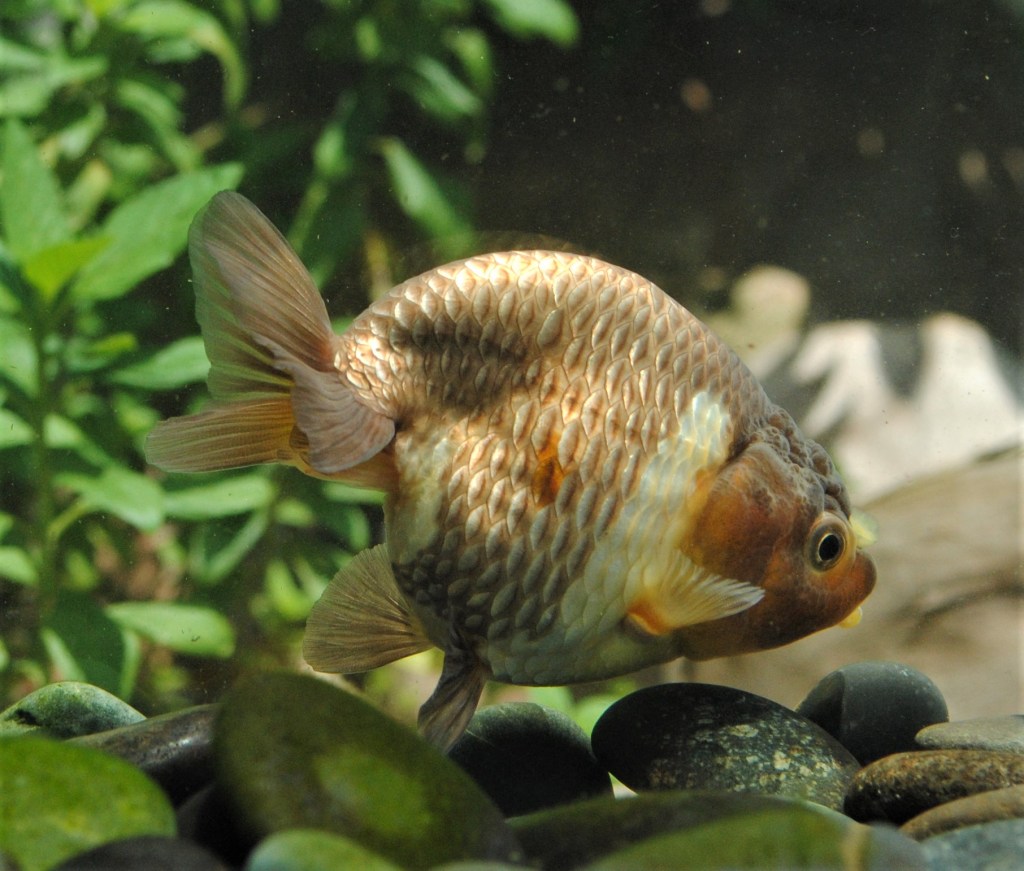
I must admit that the two offspring were weak. One of them could not keep her balance which resulted in stunted growth. I was forced to terminate it early. The remaining one was female, which I keep until now. It had slight imbalance which grew more and more acute. It might not survive long. Here she is:

The good news is I had the chance to mate her with her uncle (the remaining male cow ranchu that I bought in the first place). I am raising two batches right now and will post them in the coming months when they are ready. It is my interest to see if they will breed true or if they will just be calicos.

From the cross between the cow ranchu and the common calico, I kept one female:

For sure the deportment is better than the pure cow ranchu offspring. She grows well, yet she lays no eggs until now. It has past her due time. I still hope she will lay eggs soon. My plan is to mate it back with the “uncle” (the initial cow ranchu).

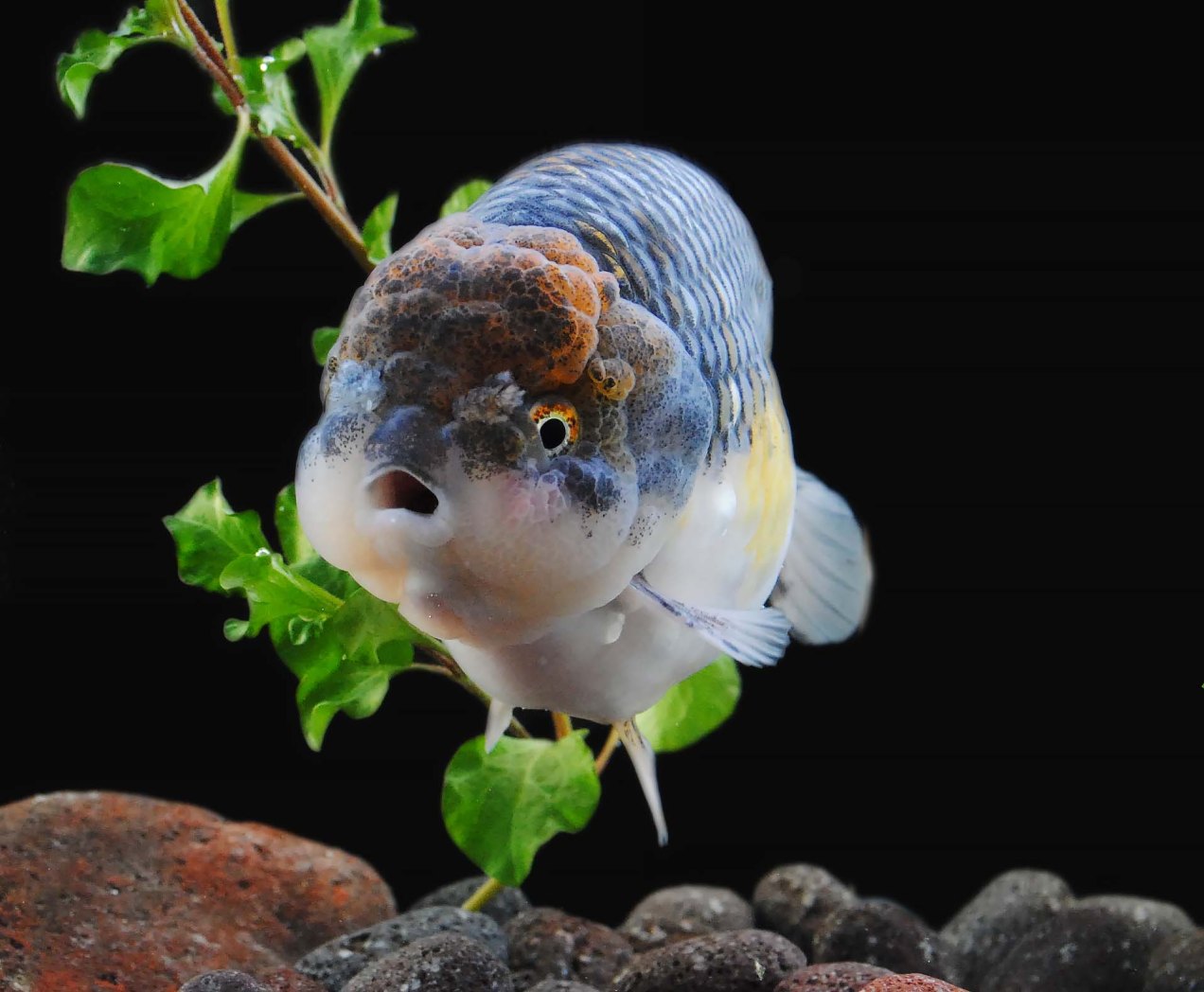
My pride so far goes to the cross between the cow ranchu and the blue ranchu. I keep only one, also. He is a male with the kirin style pattern. He looks handsome now. My plan is to mate him with a blue ranchu. I would like to see what offspring will they produce. This is the pictures of the handsome guy:

It is interesting to compare them with their childhood pictures (in the previous blog).

Well, these are the updates for now. Hopefully they bring happiness to your days.

Standard
Blue Oranda

The Blue Oranda Project: A Satisfying Result (2020)

After so many years developing the blue and panda oranda from the panda telescope specimen, I finally get this blue one with a satisfying quality. The overall quality of the project is still varied. But this one female oranda stands out. Yes, it can still be improved, especially in the headgrowth feature. The color is stained with brown pattern, which might not conform to the strict standard. Yet, I do not mind the stain. In my personal taste, it improves the beauty. In the future, I might still make some crossing which might alter the character of my blue oranda in an unpredictable way. I welcome this unpredictability.

At the same time, I have also improved my photography technic. I can now take a picture with minimal reflection by employing black fabric and a little bit of photoshop to remove the debris and sharpen the image. So, here are the results. Enjoy.

Standard
Yellow goldfish

Yellow Oranda 2020

It has been a long way to create Yellow Oranda from Yellow Comets. While the project had shown some success as reported in my last update, I was not content with the result. The main problem was the small headgrowth. Well, headgrowth was and is and will always be the main identity of an oranda. The small headgrowth did not highlight its main identity, in my point of view. So, I needed to do something about it.

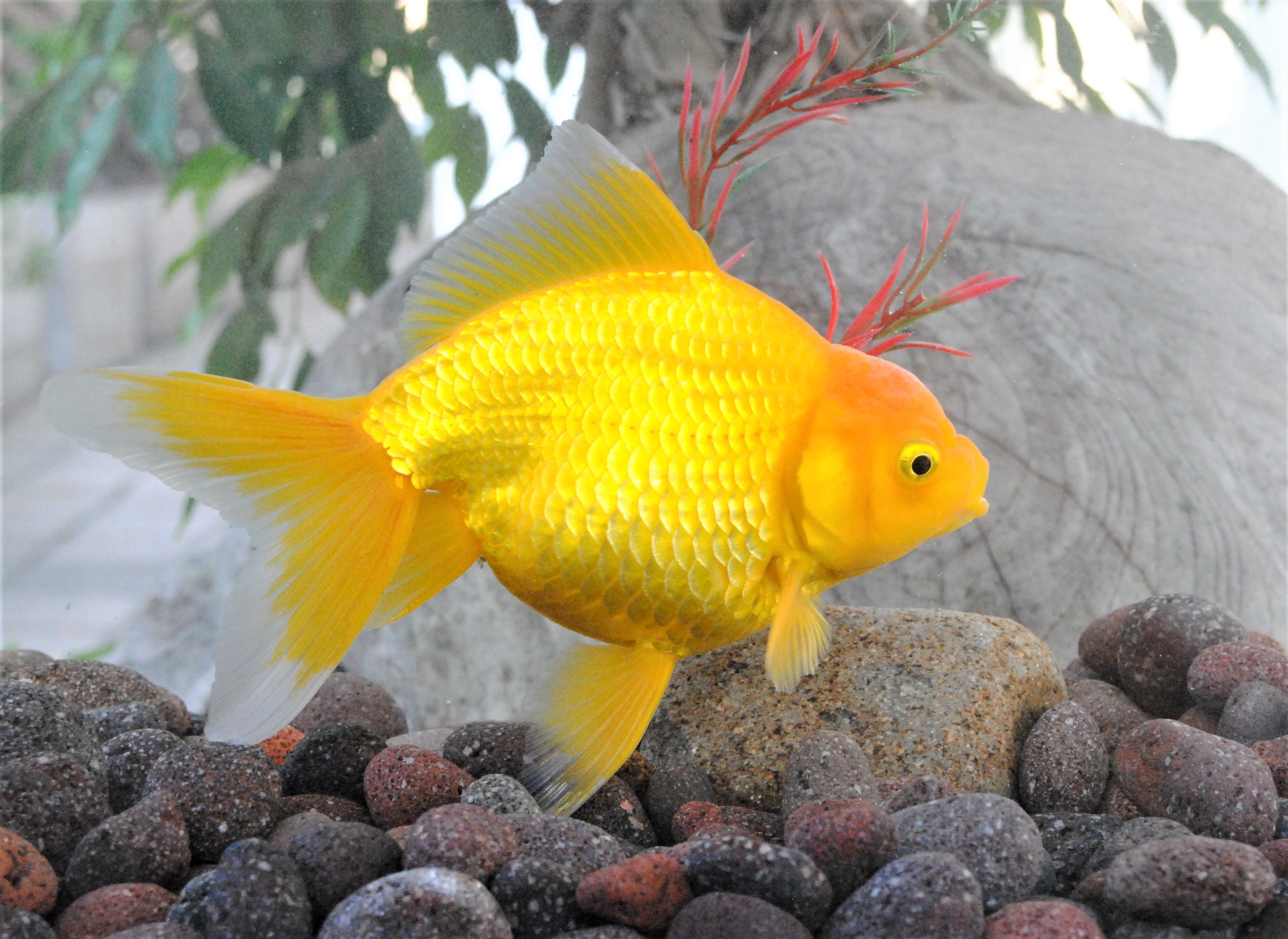
What I did was to cross my initial Yellow Oranda with an Oranda displaying a large and stable headgrowth. I chose my tricolor Oranda for this purpose, since my tricolor Oranda had large goosehead type of headgrowth. Of course, the F1 displayed no yellow color. But the F2 produced several of them. As I analyze the result, I think I am satisfied with the headgrowth of my current F2. Here are two of them:

Aren’t they beautiful? The second picture is the same fish as the one in the featured image (the Title).

The color is as intense as it can be, since they are kept outdoor full of sunshine and algae. And they are still as yellow as lemons.

I only kept four of them, since that is all I need to multiply their number. I does not take a picture of the third fish since it is almost white. Only a tiny stain of yellow is left in its body. Not good for a picture. But still good for breeding. At least I learn that it is possible to produce yellow-white goldfish, just as it is possible to produce red-white goldfish. Yes, the yellow color can coexist with the white.

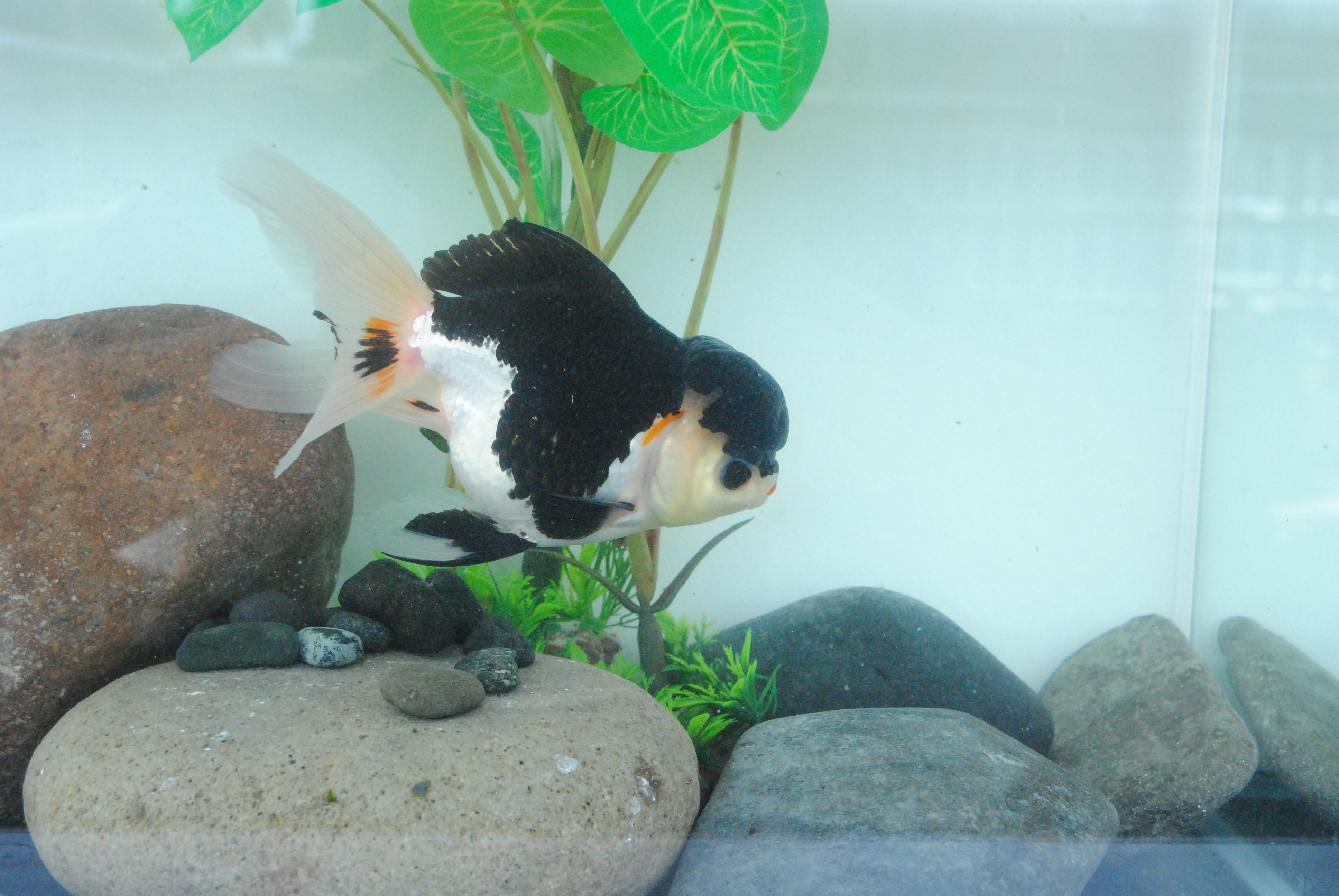
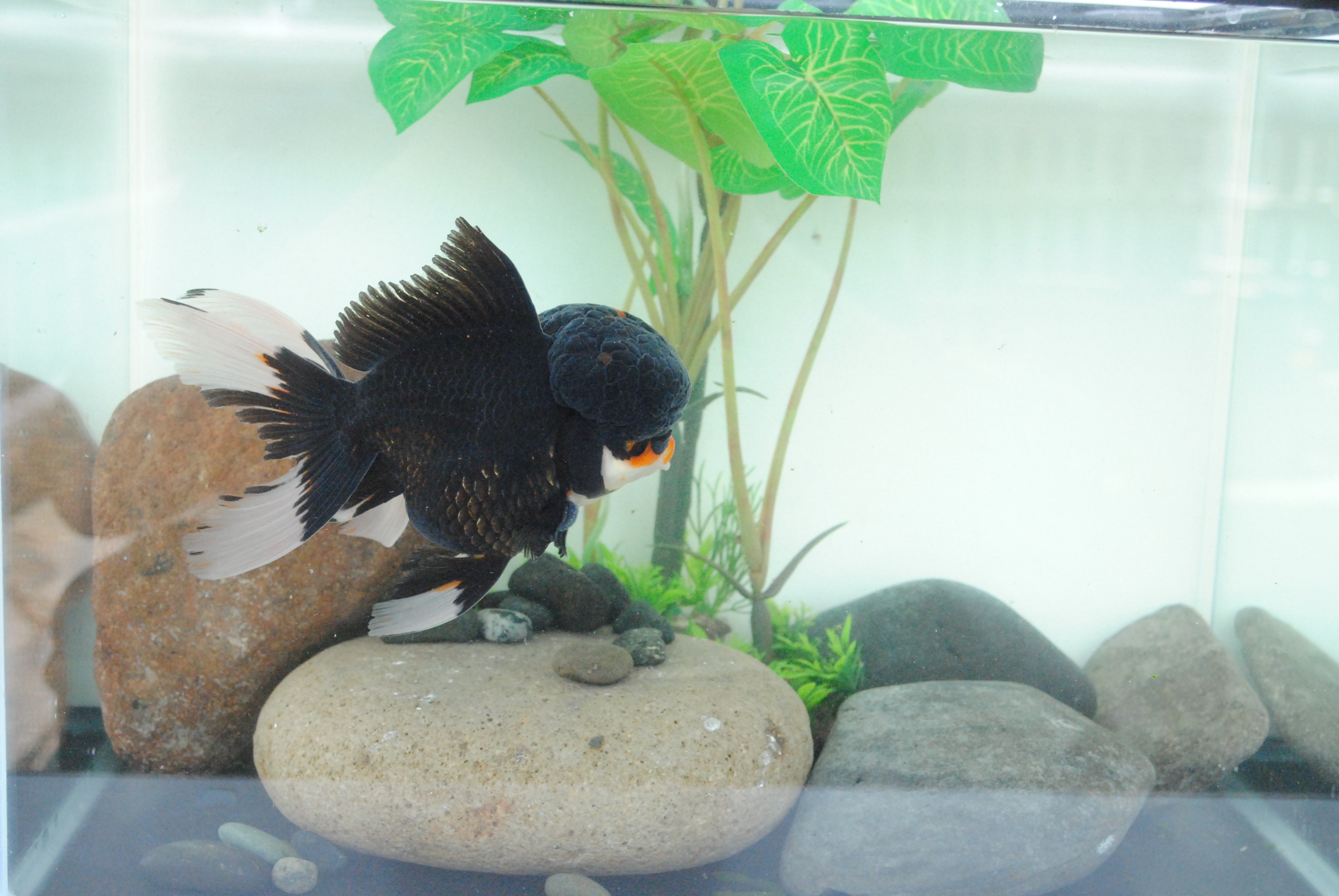
The last fish is a surprise! At first, it mutated from grey (Yes, the yellow golfsish starts from grey fry) into complete yellow. But then, it develops black color. I thought it was due to stress. It is often for a stress fish to display temporary black color on its body. But the black color persists until now (more than three months). It looks gorgeous. Remembering that one of the grandparent was a tricolor which carried strong black pigment, it is possible that this fish has turned into yellow-black variant! Of course I do hope this is true. It will take more time to confirm this. Here is the handsome fish:

Do you love him?

My next plan with the Yellow Oranda are these:

  1. Of course I will breed them just to make sure they have successor that I can use in my next breeding project.
  2. I am still not satisfied with the quality of the Oranda. So, I plan to cross this yellow oranda with a better quality Oranda in terms of the body and tail. I picture a strong and thick Yellow Oranda with beautiful tail.
  3. Concerning the yellow-black Oranda, I would like to create more of it. Right now I don’t have any pair for it. I am thinking of crossing it back with the tricolor oranda. It will ensure the presence of the black color. Of course the yellow color will not be found in the F1. But the F2 will yield several yellow-black Oranda, I hope!
Standard
kehidupan dalam air

Gairah untuk Mencipta

Kalimat yang kubaca dari buku itu terus menawan pikiranku.

“Bangun pagi setiap hari dengan gairah untuk mencipta!”

Aku menghela nafas. Bangun pagi adalah urusan yang gampang-gampang sulit. Aku ingat betapa tidak menyenangkannya ketika waktu masih anak-anak aku terbangun karena ayahku pagi-pagi sudah menyetel radio. Aku masih ingin tidur sebentar lagi. Selimut itu terasa begitu nyaman, rasanya tak ingin berpisah dengannya seumur hidup. “Ayo, sudah waktunya mandi!” Duh, di kota Malang waktu itu airnya dingin, apalagi sepagi itu. Membayangkan dinginnya air itu saja sudah  membuat badan gemetar. Tidak! Bangun pagi bukanlah sesuatu yang menggairahkan!

Baru berpuluh-puluh tahun kemudian aku bisa menemukan gairah itu. Tiap jam 5 pagi, tidak peduli alarm bunyi atau tidak, aku pasti terbangun. Dan pikiranku langsung berjalan bagai sebuah mobil yang distarter di pagi hari. “Ikan apa yang hari ini bertelur?” Aku langsung beranjak dari tempat tidurku ketika istriku masih lelap, aku pergi ke kolam-kolamku, dan dalam keremangan fajar aku mengintip diam-diam ikan di kolam mana yang sedang bertelur. Ya, aku senang mengembang biakkan ikan mas koki, dan aku memiliki banyak kolam untuk memijahkan mereka. Tiap pagi, tidak ada waktu untuk bermalas-malasan di tempat tidur. Tidak ada rasa masih ingin tidur sejenak lagi seberapa pun larut aku tidur semalam. Aku harus segera mengurusi ikan-ikan yang bertelur ini. Aku bahkan tidak berpikir tentang gairah. Tapi, itulah gairah!

Apa yang membuatmu bergairah pagi ini?

Ketika aku pulang dari kolam, aku membangunkan anak-anakku dari tidurnya. Mereka harus sekolah. Aku melihat mereka bangun dengan rasa ogah. Kukatakan pada mereka, “Hal nomor satu yang harus kalian lakukan pada waktu bangun adalah … bukan sikat gigi, bukan merapikan selimut, … tapi tersenyum!” Dan dengan ogah-ogahan mereka menyeringai. Sama sekali tidak mirip sebuah senyum. Tapi aku mengerti. Aku yang tersenyum dalam hati. Bukankah bapaknya pun dulu juga ogah-ogahan ketika dibangunkan?

Buku yang kubaca itu menceritakan bahwa manusia adalah mahluk yang diciptakan untuk meniru Penciptanya. Istilah kerennya, Imago Dei. Lantas, apa yang dapat ditiru manusia dari sang Pencipta? Hal paling awal yang dilakukan oleh sang Pencipta adalah … jelas sekali, yaitu mencipta. Jadi kalau manusia hendak meniru PenciptaNya, maka terlibatlah dalam aktivitas mencipta. Begitu bangun pagi, pikirkan, apa yang akan kuciptakan hari ini? Begitu kira-kira alur pemikiran buku itu. Di situlah manusia menemukan gairahnya, yaitu ketika ia menyelaraskan diri dengan maksud PenciptaNya.

Menurutku, ini keren.

Memang sih, ada diskusi tentang apa arti mencipta, apa bedanya mencipta dan membuat, dan lain-lain. Aku tidak ambil pusing. Aku lebih berpikir tentang bagaimana menghidupi hal keren ini. Aku mau bangun pagi setiap hari dengan gairah untuk mencipta!

Tapi, mencipta apa?

Aku bukan seorang musikus. Tidak mungkin menciptakan lagu. Aku bukan seorang ilmuwan. Tidak mungkin juga menghasilkan roket terbaru. Mungkin kalau aku seorang pengusaha parbrik, aku bisa memikirkan mencipta produk-produk baru. Sayang aku tidak punya pabrik. Apa yang bisa kucipta?

Apakah mencetak ikan koki varian baru termasuk mencipta? Aku suka menyilang-nyilangkan ikan koki untuk menghasilkan warna warni baru. Proyek eksperimenku yang sudah kuanggap selesai adalah mencetak panda ranchu, sebuah jenis yang langka, yang aku kerjakan lebih dari lima tahun. Aku juga menghasilkan ranchu berwarna coklat putih, sebuah warna yang jarang ada! Proyek paling baruku saat ini adalah mencetak oranda kuning, yang masih on progress. Aku sangat menikmati proses-proses ini, meski memakan waktu bertahun-tahun. Kalau kegiatan ini bisa dianggap sebagai bagian dari aktivitas mencipta, maka aku beruntung bisa bangun pagi tiap hari dan memikirkannya dengan bergairah, meski itu adalah hal yang sangat kecil ketimbang menemukan vaksin baru atau menghasilkan karya lukis sekelas Picasso.

Tapi bagaimana jika seseorang bahkan tidak punya benda materiil untuk dicipta seperti ikan mas koki? Apakah berarti mereka tidak bisa bangun pagi dengan gairah untuk mencipta? Apakah rekan2 karyawan yang tidak terlibat dalam bidang riset menjadi terdiskriminasi dari gairah Ilahi ini? Pikir punya pikir, saya kira tidak begitu. Masih ada hal-hal yang lebih esensial yang bisa diciptakan tanpa perlu apa-apa. Salah satunya adalah … menciptakan kebahagiaan bagi orang di sekelilingnya.

Bangun pagi setiap hari dengan gairah untuk menciptakan kebahagiaan! Ini semua orang bisa lakukan. Ini semudah bangun pagi dengan komitmen bahwa aku akan tersenyum dan menyapa setiap orang yang kujumpai hari ini. Atau bangun pagi dengan komitmen untuk membuat pasanganku senang hari ini. Tidak butuh modal besar! Cukup bondo senyum, atau tangan saja. Tangan? Ya, untuk memijat istri, atau untuk membuatkan secangkir teh hangat! Atau bangun pagi dengan gairah untuk menjadi sumber sumber solusi di kantor, atau penyebar pikiran positif di medsos! Bukankah a happy thought, with a bit of fairy dust, will make us fly?

Istriku suka berjualan. Apa saja dijualnya. Bangun pagi, yg membuatnya bergairah adalah memikirkan apa yang hendak dijualnya hari ini. Apakah menjual buah-buahan berkaitan dengan tindakan mencipta? Aku bilang iya. Menjual buah-buahan adalah bagian dari menciptakan budaya makan yang lebih sehat, yang pada akhirnya akan menciptakan masyarakat yang lebih sehat secara jasmani, dan tentunya itu ada di hati Tuhan. Keren bukan? Jadi aku katakan pada istriku, juallah apa saja yang mau kau jual hari ini, asal bukan hatiku!

Selamat bergairah untuk mencipta!

Hermanto

17 Mei 2018

Standard
cow ranchu

Cow Ranchu Crossing

Cow Ranchu is a variant of the transparent scale ranchu that has black and white color. Sometimes the black pattern can expand. The black comes in large patterns and small dots. Red color might be present in small areas of the body. If the red is too much, it cannot be called cow ranchu anymore. I do not know if it is the International standard name of not, but we Indonesian calls it Cow Ranchu since it resembles the color of black and white cow. This breed was rare before (especially in Indonesia), but it is available recently through imports from Fuzhou, China (if my information is correct). How people come up with this pattern is still a mystery for me. A breeder friend told me once that when he bred them, he got a variety of transparent color ranchu including calicos. So, in his view, the cow is just the offspring of the usual calico which then being separated purposely based on the color. So, it will not breed true. I doubt this explanation. In my understanding, the usual calico does not have the ability to expand its black pigment like this cow ranchu. And the black in calico usually comes in dots, not large patterns or blocks as in this cow ranchu. So, I decided to buy some cows at the end of 2019 with three purposes: first, to breed them to see if they breed true, second, to observe the expansion of the black pigment, and third, to cross them with other colors to see what will happen. Well, the 1st and 2nd purposes was facing hindrances. My first attempt to breed them resulted in so few offsprings. I think I need to breed more of them. And then, three out of five that I bought died, sadly. Gladly, I managed to crossbreed them with the common calico and with the blue metallic scale ranchu. This writing will mainly talk about the crossbreeding result.

These are the five I bought (I show them the left and right side for each):

The first three are the males. And the last two are the females. My favorites are number three and four. Too bad, they are gone. The remaining two are number one and five. I am trying to buy some more to replace them.

Their offspring in my first attempt to breed them was few, and they were weak in quality. Yet, my initial conclusion is that they breed true. Majority of the offsprings were cow ranchu. Few had minor red stains. No calico observed. Yet, I need to confirm this with my next breeding. I could not stand the quality of the offspring, so I culled most of them. I come out with these two left:

The first one has a yellowish stain in the area of its left pectoral fin. The rest are white with black pigment under the skin. The first one also has an outer black pigmen in its pectoral fin. I think they are good specimen to observe whether the black pigment will expand or not. These two are the reason for my initial conclusion that they can breed true.

Next, I mated the cows with these calicos:

I bought them from an importir friend who acquired the parents from China. So far, he has bred them true. I saw myself the offspring in his pond was pretty much similar in color characteristic. I asked for one female and two males. Too bad, he mistakenly sent me all females. Anyway, I could still pair them with my cows.

Here are the results of the cross between the calicos (female) and the cow (male) – after hard culling, ten of them remain:

The quality is far below my standar, so I cull them hard. Even these ten will be culled again after they serve the illustration purpose. (Mostly, my wife’s pupils will adopt them.) The offsprings resulted in different eye type, and different color variation: tiger, calico, sakura, and cow (the last one). I kept the cow one to see the progress of the black pigment.

I also use this blue metallic ranchu which comes from my own previous project to breed with the cows:

And the result of the cross between the blue metallic (female) and the cows are:

cowblue 7

The offspring consists of blue metallic scales and grey metallic scales, but I want to focus on the transparent scale offspring. After much culling due to the low quality, I keep these to represent the range of transparent color emerged from this cross: tiger, calico, and kirin-like ranchu (the last one). Kirin is another variation of transparent color where the dark color and the light color seemed to separate in half. The dark color (purple, blue, grey, black) always dominates the upper part of the body, while the light color (white, yellow, red, orange) is more in the lower part. Actually, a more accurate description I think is that the light color is all over the body in the background, while the dark color exists in the foreground and occupies only the upper part of the body. The dark color usually looks with scales, or looks like a net, while the light color is transparent. Some shiny and big metallic scales are usually seen scattered all over the body.

Comparing the two crossing, it is obvious that there are overlaps: the tiger, calico, and sakura (perhaps some of the calico will turn into sakura when they lost their black pigment, or it will never happen in this cross, I do not know and do not focus on that). But interestingly, the cross between the cow and the calico produces cow-like offspring, where the other cross does not. And the cross between the cow and the blue metallic produces the kirin-like offspring, where the other cross does not. It is a hint, I think, that kirin pattern involves the blue metallic scale in the making. I kept the kirin-like one to see or use in further project.

That’s all that I can report so far. Thank you for reading. Enjoy!

Standard
Panda Oranda

Re-melanization process

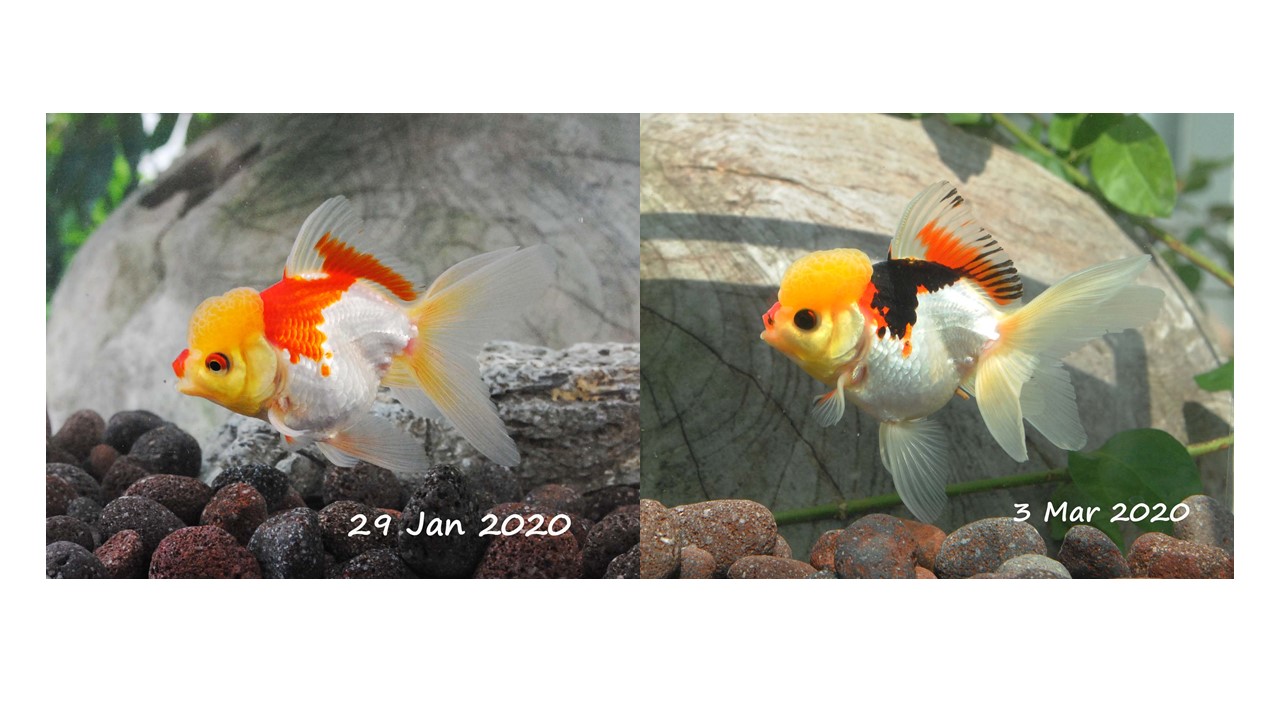
Some people complain about their black and white goldfish losing their black pigment. This is common in goldfish and the process is called de-melanization process. Well, my late experiment with breeding black and white oranda from Thailand (not from the blue metallic scale, but from the grey metallic scale as I wrote in my last post) shows quite a strong character of melanin (black pigment). The black pigment can reappear or grow. This is different from stress fish which often shows some temporary black pigment which will be gone on several weeks (or months). I am tempted to call this phenomena as re-melanization process. I notice that this changing pattern also happens in koi world in the kumonryu variety.

Well, not all black and white oranda from Thailand shows this characteristics. It just happen that the line on my hand is very strong in this unique character, and it happens in my ponds at least five times (as I noticed), which is quite often compared to my previous twenty years of experience in the goldfish world. I think I should preserve this gene and hopefully introduce it to other goldfish varieties. Below shows two fishes, one had lost all its black pigment and then regained it in just one month, and the other had a growing black pigment in the same time period.

remelanization process 2 mar 2020remelanization process mar 2020


Standard
Panda Oranda

Panda That Humbled me down

Years of my experiment brings me the conclusion that the panda coloration (or the tricolor as its side effect) is actually the blue coloration in metallic scale fish that undergoes demelanization process. That process can happen quickly in certain blue fish, turning it into a totally white fish or red and white one. But it can also happen slowly, even to the point of being halted forever, producing the beautiful panda / tricolor goldfish.

Recently, since 2018, breeders from Thailand storm the market with panda / tricolor oranda which seems to be strong in its coloration. I acquired some and breed them to see if they conformed to my understanding. And what did I find?

The offspring were not blue in color!

They were grey just like the common metallic goldfish!

I raised them to see if they will become panda like their parents. And yes, with mix results, I got several decent panda oranda. The results consist of grey (which does not seem to turn into black nor panda), black, panda, tricolor, and some who loses the melanin totally.

Here are some of the results that I raised until maturity:

DSC_9166DSC_9362DSC_9467 (2)

So, panda does not come from blue fish only. My previous conclusion was wrong. I still does not know how the grey fish can become panda, since the common grey fish (red white fish) cannot do so. Actually, I experience this once a long time ago. But I dismiss it as an exception. Perhaps next time I can find my documentation and write about it. For now, I must humbly admit that there are panda color that does not come from blue fish.

Standard
Yellow goldfish

Yellow Oranda 2019

It has been a long time I do not update on my projects. Now is the time to catch up. First, lately, I have successfully developed yellow wakin from the yellow comets I bought from Japan. However, I found out that the yellow color is most striking when seen from the side-view. So, I crossed my yellow wakin with Oranda. The yellow and red white color cross is pretty straight forward, the yellow color is recessive and the red / red white is dominant. The F1 had no yellow color. The yellow occurred as the result of F1 x F1. And after sorting hard, I kept a few as my next parent fish. This is the main female:

DSC_9571 (2)

Some of them have white marks. It is an interesting combination. This is the 2nd female which has few white color on its head and fins:

DSC_9592 (2)

Analyzing these fishes, I think it is too early to call them as Oranda. The headgrowth is there, but too small. And the tail will be more beautiful if it is more erect, as the current Asian preference dictates. So, I am not satisfied yet. I have done further projects to improve this features. I made two crosses. First is to cross these yellows with large-head Oranda (as a record, I use a Thai tricolor Oranda with goosehead type of headgrowth, with the not-so-spectacular tail shape). Second is to cross these yellows with superb body and superb tail type oranda, yet with not-so-spectacular headgrowth). As I am writing this blog, they are 3cm already. Of course, they will not be yellow. Their offspring will. So, it will take about another year to see the result. Well, let’s see ….


Standard
Brown Oranda

Brown Oranda

DSC_6510 (2)

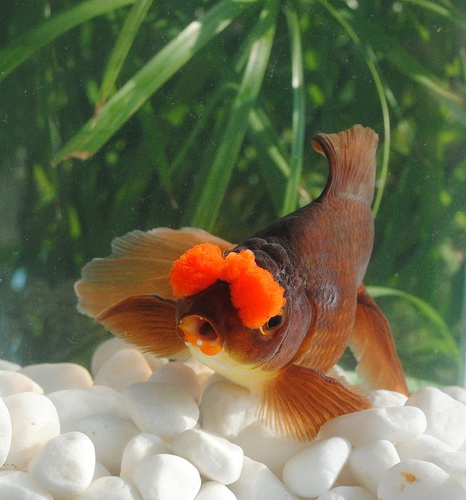
It all started with some chocolate pompom I bought from China. The brown color captivated my attention. Most of them had orange fluffy nostrils to make them adorable. To my knowledge so far, chocolate color like this was rarely found in other goldfish variety. Well, I saw a brown butterfly sometimes on the internet, but I have never seen one alive. I remembered seeing a brown oranda nicknamed chakin in an encyclopedia I had during my childhood. But I cannot find one live specimen of chakin (teh-kin, or tea-kin, the tea colored goldfish) here in Indonesia. Even the chocolate pompom had to be imported from China. I was entertaining a project to recreate brown oranda from this chocolate pompom I had.

This is one chocolate pompom I bred from the imported parents. I had many of this several years ago.

DSC_7809R

I crossed it with an oranda. I am sorry I forget about an important fact regarding this matter. I could not recall whether I used a common oranda or a redcap oranda for this cross. The result was all orange goldfish, with small head growth, and the small pompom in some. Those were my transition fish. I did not bother to take a picture of them.

Then I inbred those transition fish to get the desired result. I chose the few brown colored offspring and mated them with oranda again to improve the oranda characteristic. Once again, I got all orange color, but this time, they were decent oranda, with no or insignificant pompom. My final result should come from inbreeding them.

And yes, I got what I wanted! The brown oranda! From the start, I picked up the fry which showed light brown color right after they hatched. I grew them up. Yet, to my disappointment, only one remained brown until maturity. The rest turned into orange.

I mated this only brown with its orange sibling. The hatchlings were all brown in the beginning. And only two remained brown until now. I still keep them and now they are roughly 20 cm long with no hint of turning into brown. Unfortunately, both of them are male. All the female has turned orange. Below is one of current brown oranda I had, which I consider as my throphy.

DSC_6474 (2)

One strange phenomenon is this. Actually, there was a third male brown oranda, which slowly turned into orange. It retained less than 10 percent of its brown color. I was about to cull it out. Yet, I did not know how, it started to regain its brown color. This is one of the phenomenon I call the reverse demelanization. I managed to take the picture when it regained its brown color after being almost all orange:

DSC_6516 (2)

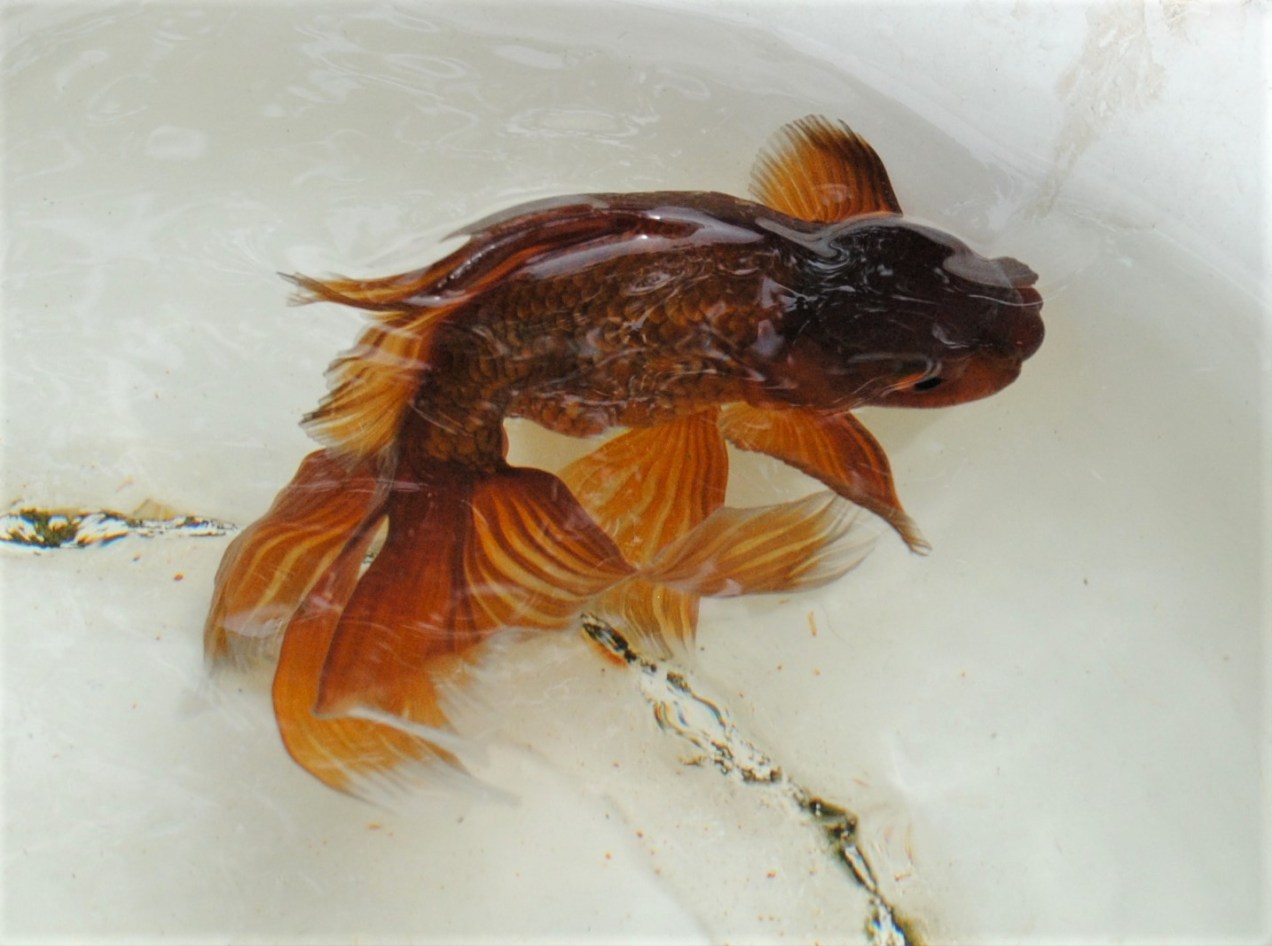
At first, I thought the increasing brown color might due to stress. If that is the case, the brown color will be temporary. But, it continued to grow to cover the whole body of the fish, leaving out only its cap. It grew into a beautiful fish: a brown red cap, if I may say! And then the reversing process stopped. Until today the fish is still alive, and has been almost a year in this state of pattern!

DSC_6633 (2)

Beautiful, isn’t it?

Any explanation?

That is my project to recreate the brown oranda. I think the project is finished. The only thing left is to multiply them, and to get the market to appreciate them.

Have a good day!

Standard