cow ranchu

Cow Ranchu Crossing

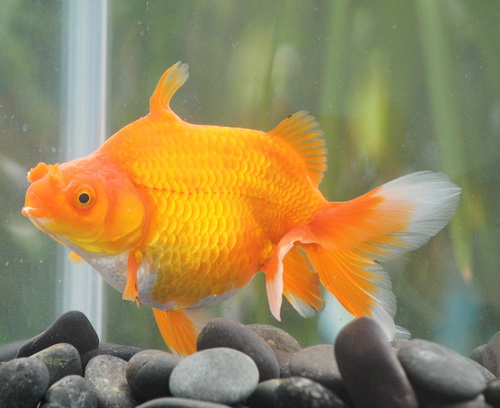
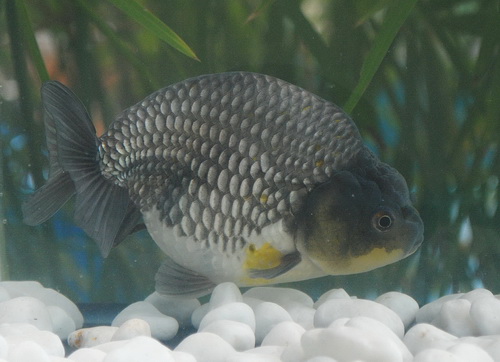
Cow Ranchu is a variant of the transparent scale ranchu that has black and white color. Sometimes the black pattern can expand. The black comes in large patterns and small dots. Red color might be present in small areas of the body. If the red is too much, it cannot be called cow ranchu anymore. I do not know if it is the International standard name of not, but we Indonesian calls it Cow Ranchu since it resembles the color of black and white cow. This breed was rare before (especially in Indonesia), but it is available recently through imports from Fuzhou, China (if my information is correct). How people come up with this pattern is still a mystery for me. A breeder friend told me once that when he bred them, he got a variety of transparent color ranchu including calicos. So, in his view, the cow is just the offspring of the usual calico which then being separated purposely based on the color. So, it will not breed true. I doubt this explanation. In my understanding, the usual calico does not have the ability to expand its black pigment like this cow ranchu. And the black in calico usually comes in dots, not large patterns or blocks as in this cow ranchu. So, I decided to buy some cows at the end of 2019 with three purposes: first, to breed them to see if they breed true, second, to observe the expansion of the black pigment, and third, to cross them with other colors to see what will happen. Well, the 1st and 2nd purposes was facing hindrances. My first attempt to breed them resulted in so few offsprings. I think I need to breed more of them. And then, three out of five that I bought died, sadly. Gladly, I managed to crossbreed them with the common calico and with the blue metallic scale ranchu. This writing will mainly talk about the crossbreeding result.

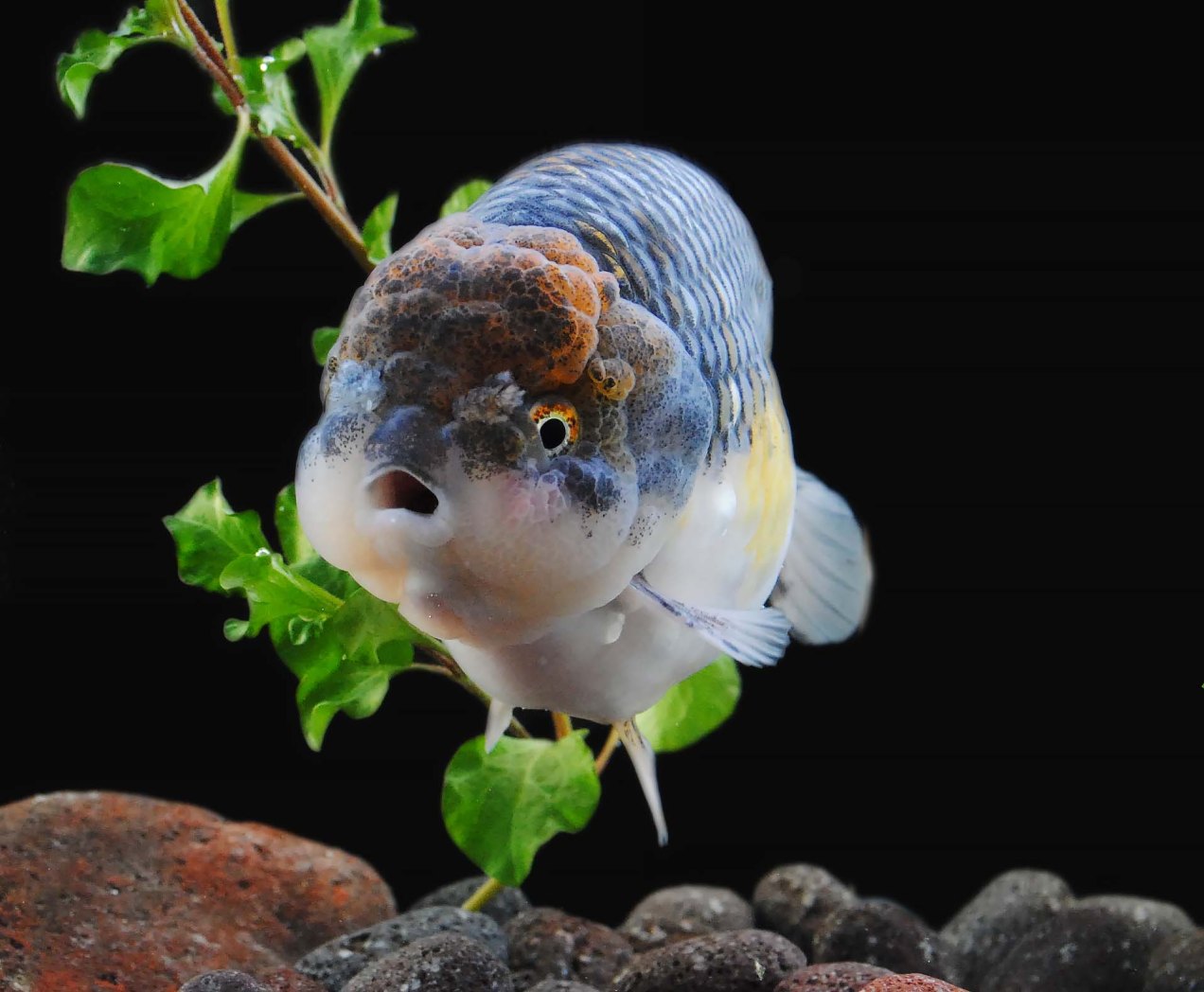
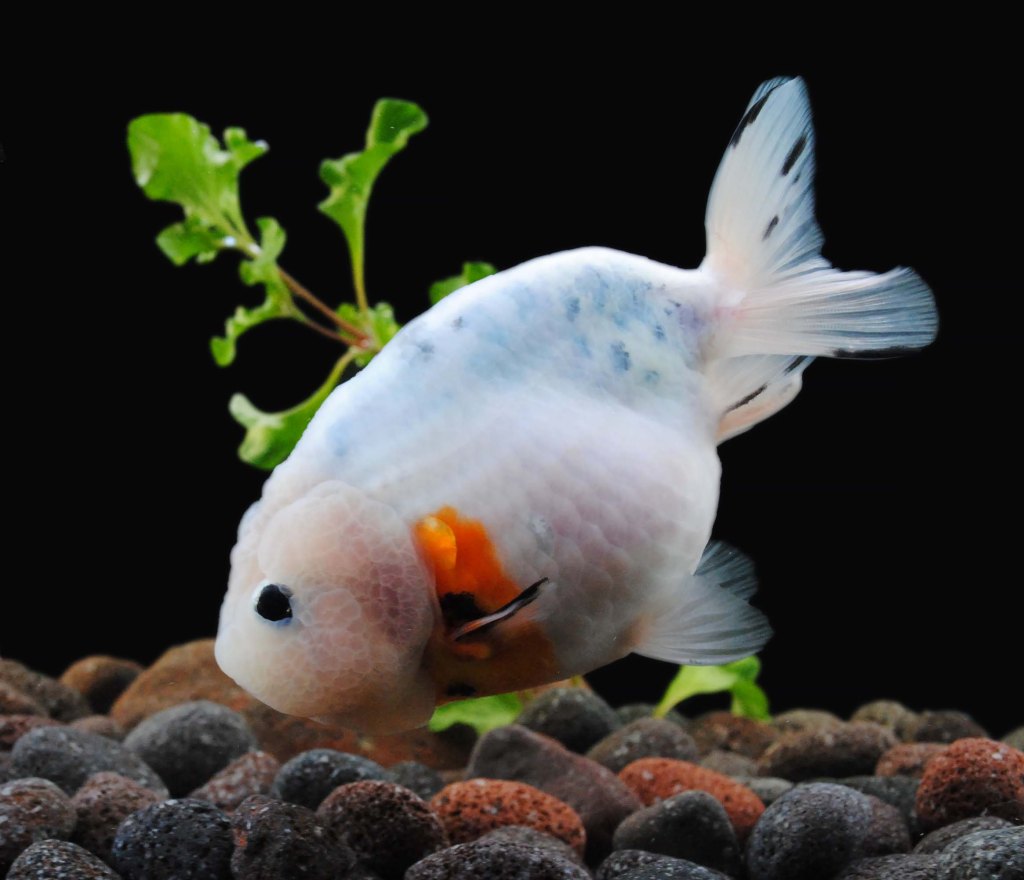
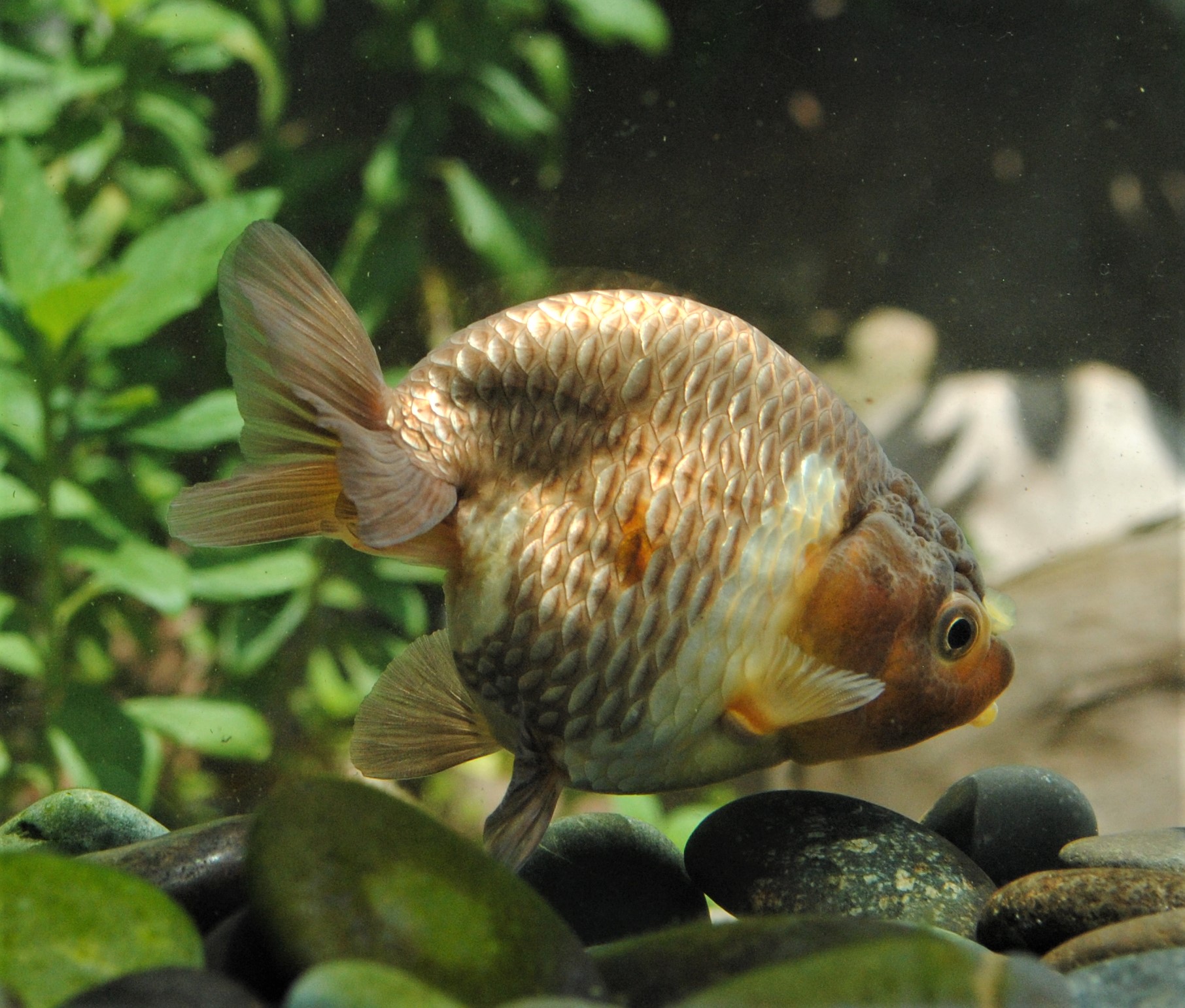
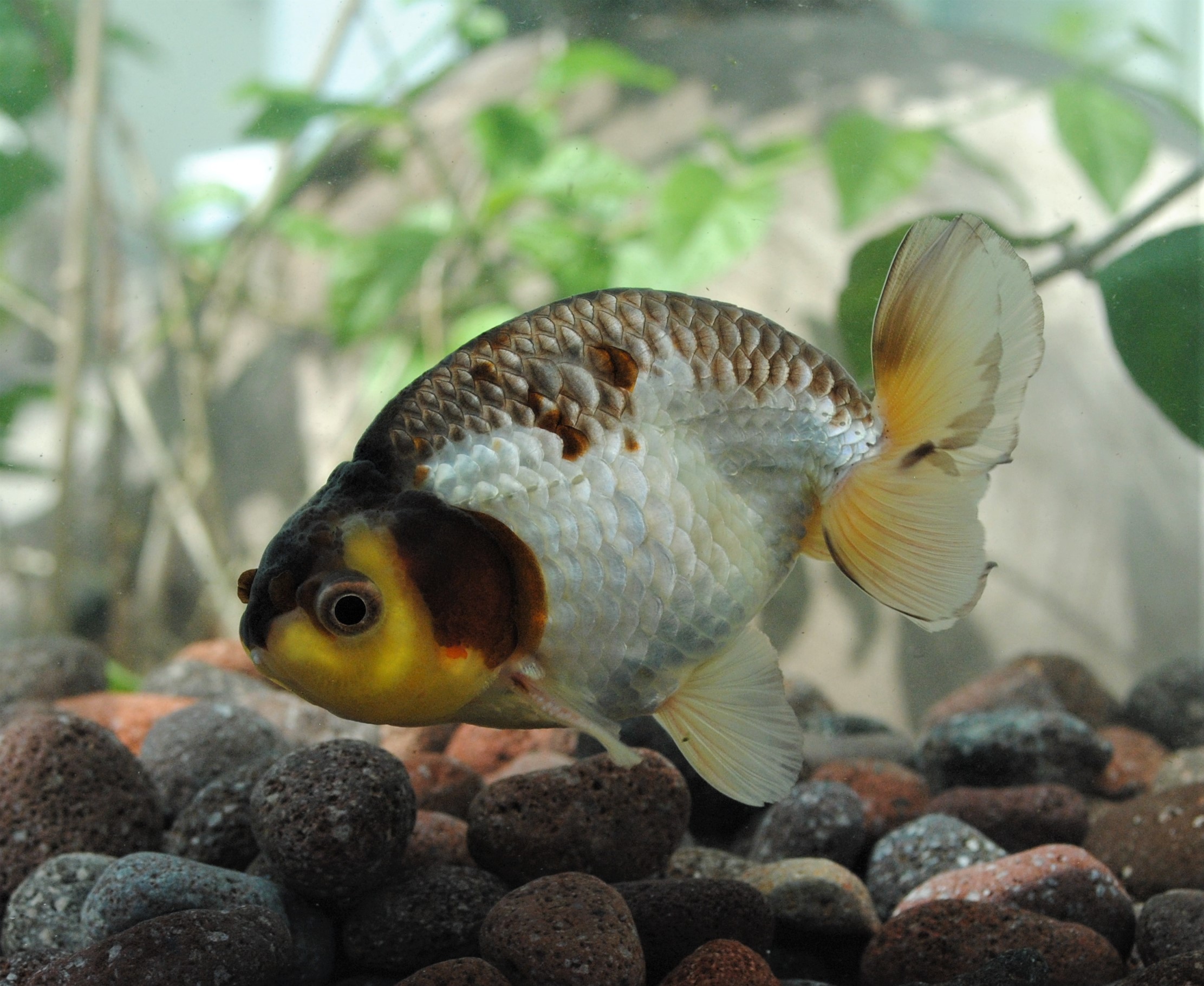
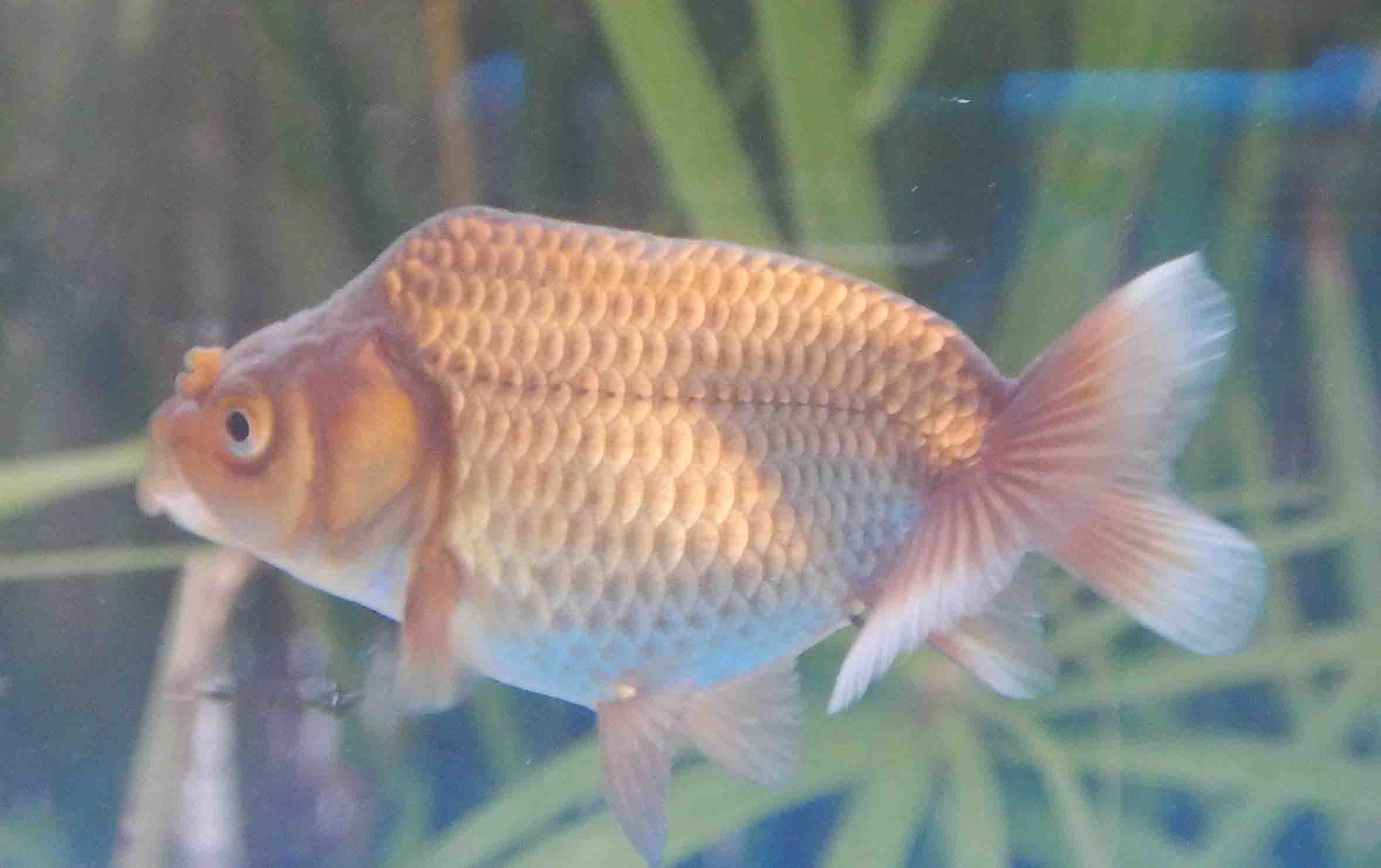
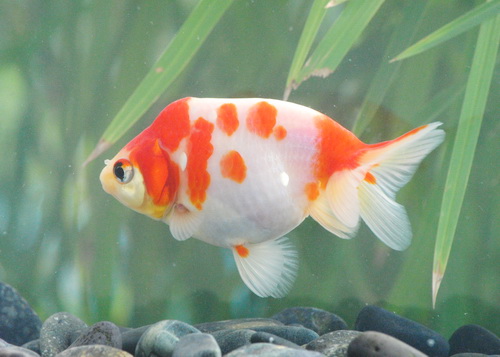
These are the five I bought (I show them the left and right side for each):

The first three are the males. And the last two are the females. My favorites are number three and four. Too bad, they are gone. The remaining two are number one and five. I am trying to buy some more to replace them.

Their offspring in my first attempt to breed them was few, and they were weak in quality. Yet, my initial conclusion is that they breed true. Majority of the offsprings were cow ranchu. Few had minor red stains. No calico observed. Yet, I need to confirm this with my next breeding. I could not stand the quality of the offspring, so I culled most of them. I come out with these two left:

The first one has a yellowish stain in the area of its left pectoral fin. The rest are white with black pigment under the skin. The first one also has an outer black pigmen in its pectoral fin. I think they are good specimen to observe whether the black pigment will expand or not. These two are the reason for my initial conclusion that they can breed true.

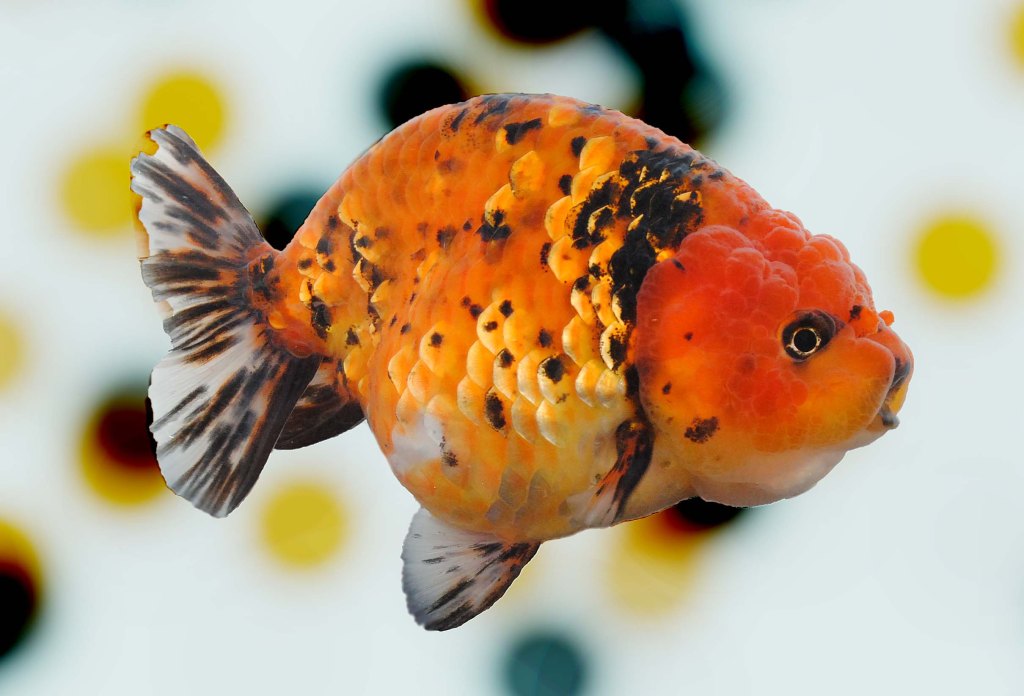
Next, I mated the cows with these calicos:

I bought them from an importir friend who acquired the parents from China. So far, he has bred them true. I saw myself the offspring in his pond was pretty much similar in color characteristic. I asked for one female and two males. Too bad, he mistakenly sent me all females. Anyway, I could still pair them with my cows.

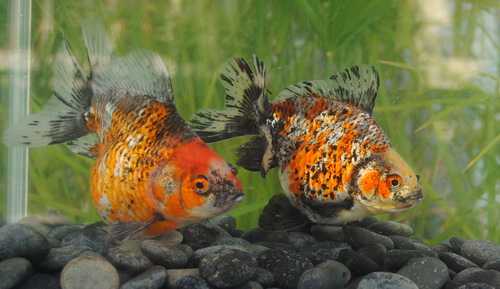
Here are the results of the cross between the calicos (female) and the cow (male) – after hard culling, ten of them remain:

The quality is far below my standar, so I cull them hard. Even these ten will be culled again after they serve the illustration purpose. (Mostly, my wife’s pupils will adopt them.) The offsprings resulted in different eye type, and different color variation: tiger, calico, sakura, and cow (the last one). I kept the cow one to see the progress of the black pigment.

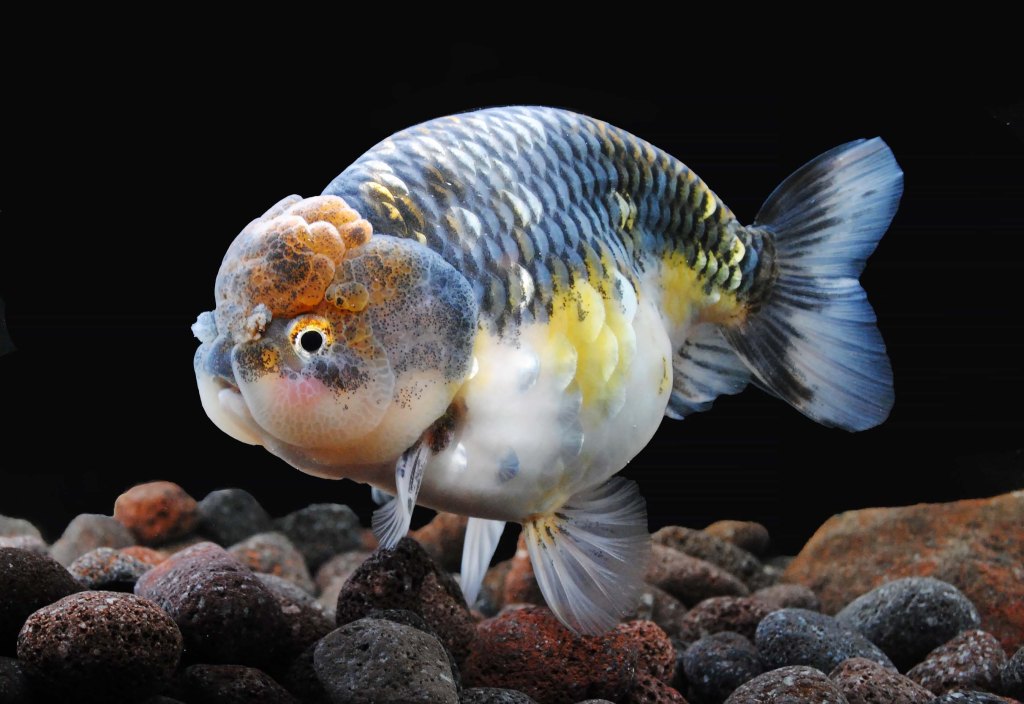
I also use this blue metallic ranchu which comes from my own previous project to breed with the cows:

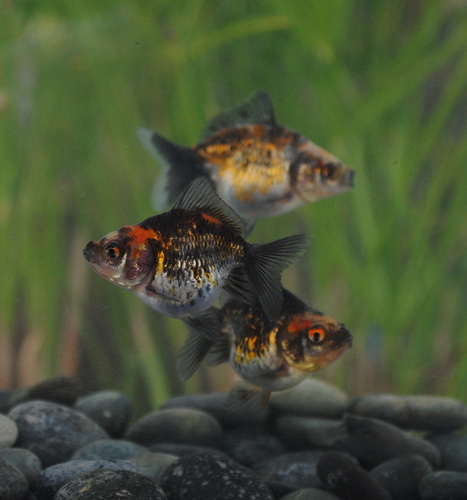
And the result of the cross between the blue metallic (female) and the cows are:

cowblue 7

The offspring consists of blue metallic scales and grey metallic scales, but I want to focus on the transparent scale offspring. After much culling due to the low quality, I keep these to represent the range of transparent color emerged from this cross: tiger, calico, and kirin-like ranchu (the last one). Kirin is another variation of transparent color where the dark color and the light color seemed to separate in half. The dark color (purple, blue, grey, black) always dominates the upper part of the body, while the light color (white, yellow, red, orange) is more in the lower part. Actually, a more accurate description I think is that the light color is all over the body in the background, while the dark color exists in the foreground and occupies only the upper part of the body. The dark color usually looks with scales, or looks like a net, while the light color is transparent. Some shiny and big metallic scales are usually seen scattered all over the body.

Comparing the two crossing, it is obvious that there are overlaps: the tiger, calico, and sakura (perhaps some of the calico will turn into sakura when they lost their black pigment, or it will never happen in this cross, I do not know and do not focus on that). But interestingly, the cross between the cow and the calico produces cow-like offspring, where the other cross does not. And the cross between the cow and the blue metallic produces the kirin-like offspring, where the other cross does not. It is a hint, I think, that kirin pattern involves the blue metallic scale in the making. I kept the kirin-like one to see or use in further project.

That’s all that I can report so far. Thank you for reading. Enjoy!

Standard
Brown Panda Ranchu, Chocolate Ranchu, Panda Ranchu, Purple goldfish

Brown Panda Ranchu

As a side result of the Purple Ranchu Project, I also get the Brown Panda Ranchu. Actually, it is the Purple Ranchu who demelanizes to produce a purple and white fish. The purple gets darker to produce the appearance of brown / light brown. This process is exactly the same as the demelanization process in the blue ranchu to become panda ranchu (Black and White Ranchu).

As this variety is still rare, I think it is better to document it here for future reference. Here are some pictures:

bp1wpbp2wpbp3wpbp4wpbp5wpbp6wp


Standard
Purple goldfish

Final Chapter on Purple Ranchu Project

I think I have come to the final stage of my project on purple goldfish. Starting with the report by Shisan C. Chen as my inspiration, I am finally able to create the purple ranchu. I called the color purple, since I heard that term being used when I was young and naive in goldfish breeding. Shisan C. Chen did not use that term. He just said that it is an intermediate color between brown and blue. I remembered my heart yearned for a more definite description or picture, “what sort of color is that? I would like so much to see it!”

In doing this project, I learned that there are two kinds of brown color in goldfish, and they are genetically different. I am sorry I cannot speak in a more scientific term since my training in genetics is very limited. But I know from my observation that when the two different brown are mated with blue, the result is totally different. I will not elaborate more on this since I have written about it several times on this blog.

So, this is the result:

Left side view:

Yes, it has brown stain, to make it a purple and brown ranchu. Some friends prefer to use the koi terminology to address this breed and call it ochiba ranchu. Yes, the head and perhaps the body could still be improved. I have focused much on the color and sort of neglecting the body conformation. But, for the color experiment, this is final.

Right side view:

Less brown stain on the right side views to make it a decent purple. I know for most people who are not familiar with this project, it is hard to differentiate this purple color with blue. So, let me give some comparison picture.

Comparison between purple and blue:

Yes, the purple has a reddish color compared to the blue.

Comparison between purple, blue and brown:

Hopefully, this project will be useful for the coming generation of goldfish breeders and hobbyist. Thank you for all the motivational support for this project. It is finished now 🙂

Standard
Chocolate Ranchu

Chocolate Ranchu updates Dec 25th

chocolate ranchu

This is the F2 of the chocolate ranchu project. I am glad to see this fish, since it is totally free from any trace of dorsal fin, and the chocolate color is present. In this F2, very few chocolate color occurs. Most of them have abominable traces of dorsal, and weak compared to the wild color ones. To find such a piece, though only one, is a joy to me.

In terms of shape, this one has a high hump, which must be tackled on though it is not so easy. Glad I have experienced this in my panda ranchu project. This hump might be the last thing to tackle.

The tail is a bit long. I do not worry about this. Crossing back to ranchu will eventually shorten the tail. But I think, as an excess, long tail chocolate ranchu with pom pom will be nice 🙂

The pompom is also something to tackle on. Actually, I am not sure to retain this pom pom or not. According to standard, a ranchu should not have the pom pom. But it might indeed look nice in this chocolate breed. Well, let it be what it will be. I might not bother to tackle it.

From this point, I think to create a decent chocolate ranchu, I will need at least four more breeding step. This will mean 2 years at least. But the result of the 1st year might yield unique breeds saleable to collectors 🙂

There are two worries. First, since there is only 1 fish, this project is in jeopardy if something happen to it. So, I have prepared the second batch for spare. Second, the chocolate color occurs so few in the batch. Fewer than the blue I create from a cross between blue and common color. Does this mean that the chocolate color behave differently genetically from the blue? If yes, then there might be some complication I have not yet understood. I hope there won’t be such complication.

Merry Christmas and Happy New Year

Standard
Uncategorized

Sakura Coloration on Ranchu-like Goldfish

As mentioned before, I am trying to create tricolor metallic scale ranchu. This project directed me into crossing a tricolor metallic scale tosa with ranchu. By tosa I mean the ryukin which has no hump. It turns out that all of the offsprings shows a combination of metallic scale and transparant scale on the body. My conclusion is that the tricolor metallic scale I used is actually a variant of calico (transparant scale) goldfish which somehow develops metallic scale all over the body. This is not a genuinely metallic scale. The piece I have here shows minimum metallic scale. The body is mostly covered with transparant scale. And it looses the black color and turns into sakura color.

Image

Don’t ask me about the body form resulting from this crossing. Horrible. This one is the best in terms of the back smoothness. The shape is not ranchu yet, that’s why I cannot call this a ranchu. The head resembles a tosa or ryukin since it has no headgrowth. And it has a hump! My first impression when I look at this piece is the image of a cow. But instead of a black and white cow, this is a red and white one.

The sakura color is impressive on this one. The red is truly red, it is not orange. And the white is milky white. Adorable. And the pattern is pleasing to the eyes. When the sakura is dominated by the red or orange color, it looks horrible to me. But this fish has the right amount of red and white combination, according to my perception. This is the sakura coloration I want to create, though not in this body form. The large red dots look like the brush strokes from an expert painter.

Image

Standard
Uncategorized

A Sea-Horse?

Image

People must think me mad to raise and post such a fish! This kind of fish will be culled out early in any farm in the world. No breeder will give it a chance to live since the defect is considered serious. It does not fit in any standard of goldfish, and so, it should not be considered as a beauty.

Actually, I do not create this fish purposely. I tolerate this because this is part of a project to create chocolate ranchu. As might be obvious from the body form of the fish, I was mating a red ranchu with a chocolate pompom. I cannot think of a better source to obtain the chocolate color than from a chocolate pompom. This fish is an F1, and is still a long way to go to become a decent chocolate ranchu. Last time I was mating a ranchu with a panda telescope in order to create a panda ranchu. It has shown some success after three and a half year. Now I am redoing the same type of project, except now with a chocolate pompom to create a chocolate ranchu. The difficulty is pretty much the same, I think.

So, yes, this fish is a monster to most of us, but to me, this is very valuable. However, as I behold this creature, I am getting an impression of beauty out of it. I immediately think of a sea-horse as I watch this fish. Perhaps it is due to the small dorsal fin in the posterior of the back. Does anybody have the same impression?

And this is a wild thought. Why not create a new goldfish category out of it? A sea-horse goldfish, maybe? I know that this will be a hard thing to accept, since it is a bit far from the normal goldfish standard. But if many people can see the beauty, why not?

Image

Standard
Panda Ranchu

Panda Ranchu Update April 2014

Image

Right now I am working on the improvement of the body, head and tail shape of my panda ranchu by crossing it with svr once again. There will be at least nine more months before we can see the result. Meanwhile, I have selected the best in the last batch, and this is the update. The picture above shows the best panda ranchu I have so far.

Few retains the panda coloration, few becomes blue ranchu, and many turn into white or white stainted with red pattern. The pictures below show the three types occurred in the batch.

Image

It is still a question whether there is a difference between black pigment behaviour in the blue and in the panda. I am not ignorant that some people conclude them to be the same. I was of the same opinion. I was thinking that when there is no white color appearing, then the color is blue. When the white appears, then the color of black pigment become darker to give the impression of black and white. But lately, I encountered some fishes that when the white appears, the black pigment does not get darker but stays blue, to make the fish into a blue white fish instead of black white fish. This makes me open once more to the possibility that there is a difference between the melanin composition and or its behaviour in the blue and in panda.

This is the blue and white ranchu from the same parents. It is true that in the picture I use the white background to highlight the blue coloration. But the keeping environment is the same.

Image

Standard
Tricolor Metallic Scale

Tricolor Metallic Scale Ranchu Project

I have crossed two female orange metallic scale ranchu to my tricolor metallic scale goldfish (as depicted in my previous posting). The aim is to create tricolor metallic scale ranchu.

First, it must be noted that the metallic scale here is not a true metallic scale, but it is a derivation of transparent scale calico fish which has acquired metallic scale appearance.

Second, after second consideration, this choice of orange metallic scale ranchu to cross might not be the best choice. The reason is that the demelanization process (the process of getting rid of black color) in orange metallic scale ranchu is working strongly. This combination of parent might result in the offsprings loosing its ability to retain its black color. Blue ranchu or black ranchu might be a better choice. Anyway, the cross has been made, so I will stick with this to see how it will turn out.

Third, the two female orange metallic scale ranchu that I use came from two different lines. The first is a thailand metallic scale ranchu, and the second is my own breed, which though the appearance is an orange metallic scale ranchu, it carries a recessive blue (or panda) color in its gene. I don’t know how will a recessive blue help, but I hope this second fish will be my luck in repressing the demelanization process. It is interesting that the offsprings of these two fishes behave differently.

This is the male parent

Image

This is the first female parent, which does not have the recessive blue genetic. The second female looks similar, so I do not post a picture of it.

Image

From the first female parent, the majority of the offspings have complete dorsal! This is out of my expectation. My rough estimate is 90% have complete dorsal. I cull them out, leaving only few with irregular dorsal. Though the observation is too early, I think I saw more scales in the offsprings, but less black color. This lack of black color is not conclusive yet, since I keep them in light-colored background due to lack of facility. The offspings which resemble transparant scale  (such as calico color) with few metallic scales are very few. A sample of the first offspings is shown below

Image

The second female parent yields roughly 50 percent of complete dorsal offspings, which I culled out early. From the irregular dorsal ones, roughly half show the characteristic of transparent scale with few metallic scales on its body. The other half show more metallic scales – more than half of their body are covered with metallic scales. This is the trait I am looking for. Concerning color, they seem to retain more purple color. This is a sample of them:

Image

When I made this cross, I did not know what to expect and what to cull out. Now I have a better idea. I will keep those with have more metallic scales – the ones that have more than half of their body covered with metallic scales. This is the first priority. Then I will choose the ones with more black / purple color among them.

Any suggestion is welcome. I will update this project in some more months.

Standard
Uncategorized

Tricolor Metallic Scale

Image

I have never paid any attention to this type. I worked on calico color for some times to understand it, then I tried to work on the kirin color (a subvariation of transparent scale goldfish) with no success. It is a fortunate event that a breeder friend introduced me to these two fishes. They caught my attention because I think they are unique. Their color looks like that that can only appear in transparent color scales, but their scales are metallic scales! It is amazing!

I know this kind of color is seen mostly in ryukin. I have never seen it in other goldfish variety. So it is possible that the specimens I have here are ryukin’s reject.  Or they might be a stable variety of its own. I do not know what to call them, other than tricolor metallic scale goldfish. The Indonesian might call it tricolor metallic scale tosa, since we use the term tosa to refer to a ryukin without hump. I also know the term “mock metallic” used by American hobbyists, but I don’t really know what they mean. Could this be the mock metallic?

I am pretty sure now that this type of color is also a subvariant of transparent scale goldfish color. But I am not sure how this color come up in the first place. Usually, when we crossed a calico with a metallic scale, we will end up with many kinds of offsprings. I usually keep only the fully transparent scale that has no or minimal trace of metallic scale. I get rid of the rest. But some breeders usually keep those with more metallic scales on the body, for this kind of fish still have selling value. Both are commonly seen. But those that the breeders rejects, such as the seemingly grey metallic scale that does not seem to mutate,  and I don’t know what else, maybe the tricolor metallic scale evolved from these rejects. I don’t know yet, this is only my guess.

The good thing is that this genetic is pretty stable. I mated these two, and this is the picture of the offsprings that I took yesterday.

Image

From these offsprings, the metallic scale types, and the black color look solid. There are few offsprings that look like transparent scales with few metallic scale. I reject them. I keep only the full metallic scales. So, the only thing I know so far is that the genetic is stable enough to pass on to its generation.

And this is the interesting thing. What I would like to do is to see whether this color can be transferred to sideview ranchu! Yes, it sounds crazy. But a tricolor metallic scale sideview ranchu will be quite nice, isn’t it? Yet it is also quite a challenge.

When I work with panda coloration, I was working with metallic scales only. Now I am going to work with metallic scale – transparent scale cross. I have no idea of how big is the problem. In my experience, when we cross a metallic scale with transparent scale, the black coloration is lost. Some show black marks when young, which will soon disappear as they grow. If this happen, I do not know how to introduce the black color again. I have tried to cross it with black fish (black ranchu) which created a different black marking from calico color. I also do not know how to create the appearance of full metallic scale like this since the cross usually creates partially metallic scale only. So, I think I should separate the color (black coloration) and the scale into two problems.

So to count the difficulties if I cross this fish with a metallic scale sideview ranchu, then it is a level 4 difficulty. First concerns the headgrowth, which is nothing to worry. Second concerns the dorsal fin, which I have the experience already and I will not worry about it. Since the fish is already a short tail one, then it does not count as a difficulty when being crossed with ranchu. Third and fourth is about the color and the scale appearance, which is a territory unknown to me. So eventhough the difficulty is only level 4, it is much more difficult than it appears, I think.

Actually, the cross has been made this morning. Now I am waiting for the eggs to hatch. I am very excited 🙂

I welcome any advice on this.

Standard
Panda Ranchu

Panda Ranchu

Image

I have many breeding projects. My current priority is to create the panda ranchu.  I started this project about 3 years ago, after strengthening the color of my panda telescope line (also known as panda moor). I began by crossing the panda telescope with an orange Thai sideview ranchu. This is a fifth level difficulty, which means that there are five contradicting features that I must tackle with. First, I must get rid of the telescope eye feature from the panda moor. Second, I must get rid of the dorsal fin in order to create a ranchu back curve. Third, I must tackle the long tail feature  in order to create a short ranchu tail. Fourth, I must develop the ranchu headgrowth in the new fish. Fifth and most important, I must inject the panda color into the new fish. In my plan, this is a 5 years project.

My first focus was to produce the panda color in the offsprings of the cross without regarding much yet about the shape. This was achieved in two generation. Following Mendellian law, I got some percentage of blue/panda fish, with all sorts of horrible shapes. I concentrated on the ones which closely resemble ranchu shape. I did some inbreeding program to stabilize the color in the third generation.

Things did not go smoothly at that time. There was an outbreak in my facility, and I was left with only two blue offsprings. One is a sterile female, and the other one is a male with weak health. The whole project was in jeopardy. The actual plan was to cross back this third generation offspring to another Thai sideview ranchu in order to strengthen the ranchu shape character. So I paired the weak blue male with a Thai sideview ranchu.

Thanks to God, I could collect the eggs the next morning. And the next day, the male died. So this project relied solely on those eggs. I could not redo it again. In fact, I was so desperate at that time that I started to cross panda moor again with a black ranchu, as a back up plan. But I felt so much relief when the eggs hatched, and they turned into healty, fast growing ranchu. All of them were grey that slowly turned into orange. There were no blue of panda among them. But that did not bother me at all. I knew that the blue or panda color was recessive, and would appear when I did an inbreeding again. The only drawbacks were the bald, small head of the ranchu and the hump that appeared right after the head. Fortunately, as I grew them, the headgrowth appeared, though very late compared to usual ranchu, and the headgrowth slowly covered the area between the head and the hump, which help to improve the appearance of the fish as a decent ranchu. The back curve was good already. My only concern was whether I would get panda or just blue.

The picture I post here is the offsprings of those orange fishes. So this is the fifth generation. Some percentage became the usual grey color which turned into orange, some turned into blue. Among the blue, some stayed blue so far, some turned early into panda, and some turned quickly into white. I tell myself, “It is ok.” I just need to repeat the first step again in order to stabilize the color. This makes me glad.

Concerning the shape, I get two kinds. First, I get ranchu, and second, I get a small percentage of deme-ranchu, or nymph, which is a ranchu with telescope eyes. Somehow the ones with telescope eyes grow darker coloration compared to their ranchu sibling. The ranchu shape carried the weaknesses of the parents from the fourth generation, namely the small head, the hump, and the late headgrowth. Other than that, the shape is perfectly ranchu. I need some more years to improve on the head shape and color.

So actually this is a premature publishing. Four more steps need to be done to create a decent ranchu shape with a stable panda color. I just get too excited to share the progress now. Two more years to go. 🙂

Standard