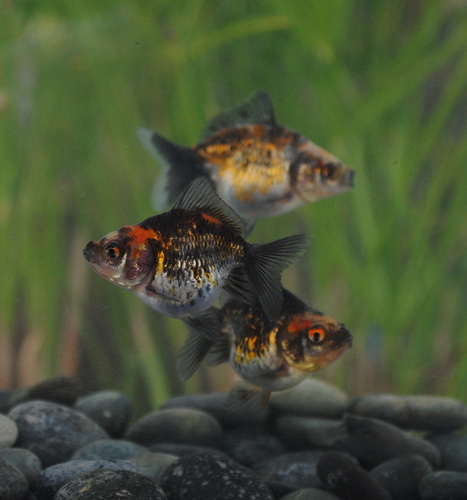
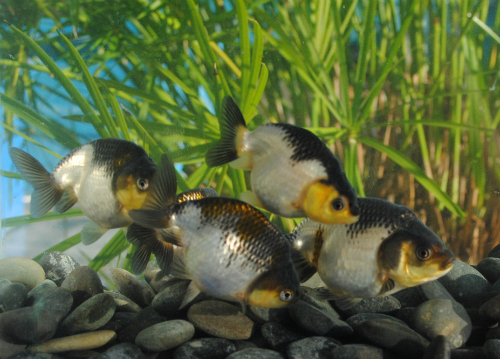
Panda Ranchu

Panda Ranchu Update April 2014

Image

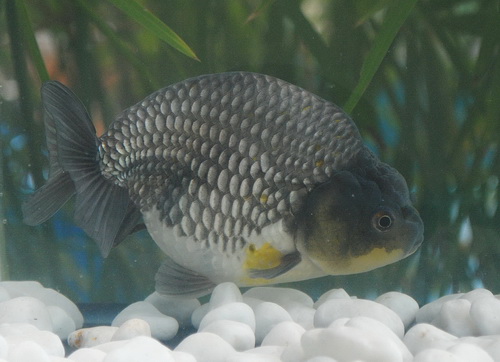
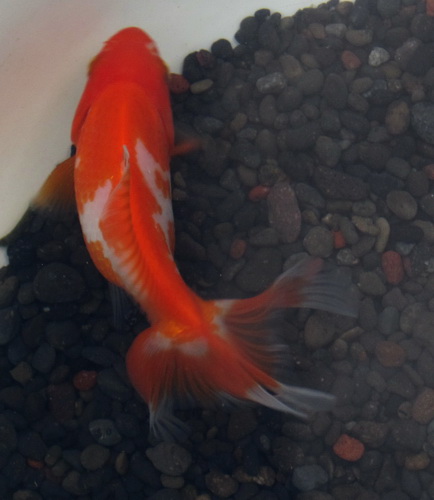
Right now I am working on the improvement of the body, head and tail shape of my panda ranchu by crossing it with svr once again. There will be at least nine more months before we can see the result. Meanwhile, I have selected the best in the last batch, and this is the update. The picture above shows the best panda ranchu I have so far.

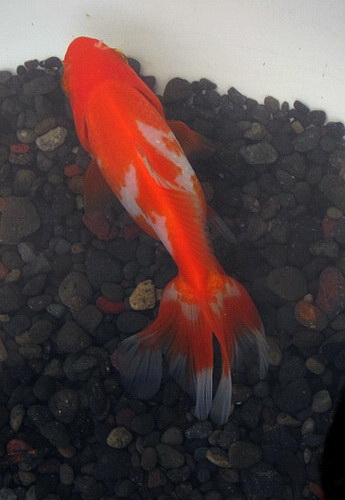
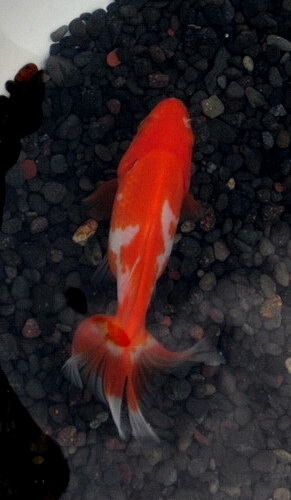
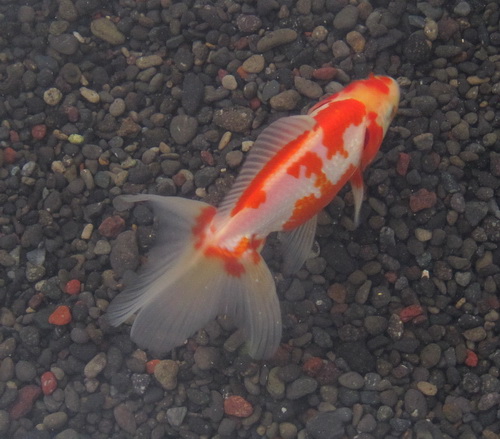
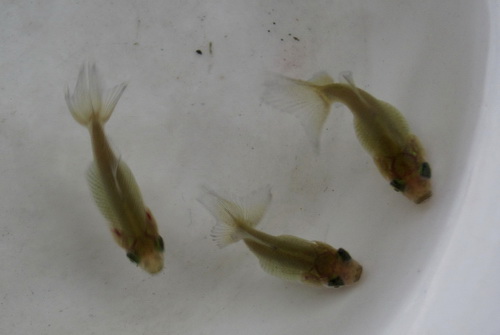
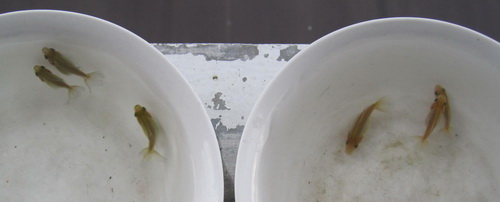
Few retains the panda coloration, few becomes blue ranchu, and many turn into white or white stainted with red pattern. The pictures below show the three types occurred in the batch.

Image

It is still a question whether there is a difference between black pigment behaviour in the blue and in the panda. I am not ignorant that some people conclude them to be the same. I was of the same opinion. I was thinking that when there is no white color appearing, then the color is blue. When the white appears, then the color of black pigment become darker to give the impression of black and white. But lately, I encountered some fishes that when the white appears, the black pigment does not get darker but stays blue, to make the fish into a blue white fish instead of black white fish. This makes me open once more to the possibility that there is a difference between the melanin composition and or its behaviour in the blue and in panda.

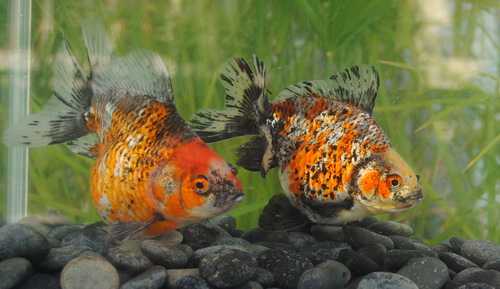
This is the blue and white ranchu from the same parents. It is true that in the picture I use the white background to highlight the blue coloration. But the keeping environment is the same.

Image

Standard
Wowkin

The idea of wowkin

It is understandable that what I am pursuing here in the creation of wowkin is not really clear. Some people might not be able to see the value of it. Actually, the idea is pretty clear for me, but the creation itself is a process. I do not know whether the fishes I have now will eventually conform to my idea or not. If not, they might just be fishes with no apparent difference from common goldfish.

I have stated early that wowkin will be a pond fish. The body, size and color will be that of wakin. The uniqueness will be on the tail. I mentioned before that the tail is a combination between wakin tail and tosakin tail. That explanation does not conform to my idea accurately. If wakin is perceived as a fish with open tail all the time, then it is not my idea for such tail to be included in wowkin. Wowkin should have the ability to open and close its tail flexibly.

Underneath this idea is the picture of a dancing tail. I once cross a ryukin with a tosakin, resulting on an unnamed variety with a very beautiful tail feature in my perception. The tail is able to dance marvelously in the water. I have never seen such a fish before, and after. However, I was in my early breeding years at that time, and had no courage to differ from the popular. I discontinued the production for good.

Now, as I have acquired more experience in breeding, that picture of the dancing tail comes up to my mind again frequently. I realized that I have forsaken a valuable feature just because I dare not differ myself. Now as I do not care too much anymore with reputation, I think it is time for me to pursue it once again. My option is to once again crossbreed ryukin and tosakin to make a side-view ryukin with new kind of tail, or to create a pond fish. Since right now I am charmed by the simplicity of wakin, I decided to pursue the second option. Someday I might come back to the first option, but for now, wowkin is my project to pursue.

So, yes, this might be an unexplored appreciation: a dancing tail. Whether it is unexplored or forgotten, I do not really know. The fish is too young right now, but some has shown a limited dancing capability. I do not know whether it will be improving as the fish mature or not, but I certainly hope it will. The issue of whether the wowkin should be a short tail, medium or long, is not decided right now. I will just see which one will be best as they mature. For now, let’s focus on the dancing capability of the tail. Below are some pictures showing one fish with the capability to have many different formations, from close tail to open tail, from plain tail to curly tail, from left side open curly tail to left side open curly tail. It is a beautiful dance.

ImageImageImageImageImageImage


Standard
Wowkin

Wowkin March 2014

Here is the updates on the wowkin project. I keep the long-bodied one: the body that resembles wakin. They can be categorized into two types: the long tail, such as these:

ImageImageImage

(too bad the last one in the picture above must be culled out since the right tail has a defect)

and the short tail, such as these:

ImageImage

In my opinion, the short tail type is closer to my original ideal. But I think I might broaden the definition by including the long tail also. I will keep both type to see how the tail become in its maturity.

And these are the rejects:

Image

I reject them not because of their tail, but because of their body, which looks like the more fancy goldfish type such as oranda. I will limit the definition of wowkin to the long body type since wowkin is meant to be a pond fish.

Now the remaining time is to wait them grow and to see the result.

Standard
Purple goldfish

Chocolate and Blue

Image

I have some chocolate pompoms. Their bodies are dark brown, and their pompoms are bright orange. This brown color is unique. In my observation, the brown color can get so tense as if there is an additional chocolate blanket covering the scales. This covering is similar to the deep black covering in the Thai black ranchu. When the color is not intense, they look like a lighter brown color with metallic shine.

The offspring of the pompoms show light brown color from the day they hatched, which is a different characteristic from the common red or red-white metallic scale offspring.  So, there are three types of color in the metallic scale offspring, namely the grey (as produced by the red or red-white fish), the blue (as produced by the metallic blue fish), and the brown (as produced by the brown or chocolate fish).

This is the offspring of the brown or chocolate pompoms.

Image

It must be noted that the brown color in chocolate pompoms is different from the brown color that usually appear in blue metallic fish. So, in goldfish, we have two types of brown. The reason of my saying them to be different comes from the observation of their offspring. The blue brown goldfish comes from blue fries, while the brown or brown-orange pompom comes from light brown fries. The difference of color in their juvenile stage is enough to conclude that they have different color genetics.

To produce chocolate pompoms from chocolate pompom parents is easy. I do not see much challenge on it. But there is still one area I would like to understand about this chocolate color. So far, the body is totally brown. There are few instances where the bodies become orange. The tails are sometimes orange, but most of the times are brown. The pompom balls are most of the time orange, but few remain brown. I have not seen the white color appear in the body. So I would like to know if it is possible to produce a brown and white color from this breeding project.

We know that the color of black ranchu cannot exist with white color. That’s why we can never create a black and white ranchu by crossing a black ranchu with a white ranchu. It seems that the black color expels the appearance of the white. But the black color does not expel the orange / red color. That’s why we can sometimes see a black gold / black-orange goldfish. There should be a name for this behaviour, unfortunately I do not know it. Maybe it can be called the white-repelling behavior. In the chocolate breeding project, I would like to know if the chocolate color also has a white-repelling behavior, or is it possible to create a brown and white fish.

Another area to understand is what will happen if the chocolate is crossed with the common red metallic fish. I think I can answer this without even do the experiment. I will say that the red color is dominant to the chocolate, so the offspring will show the grey color only, and will eventually turn into red or red-white goldfish in F1. Then if we mate F1 x F1, the result will be some red or red-white fish and some chocolate. This is exactly what happens if we cross the blue or panda color with the red or red-white color. I expect the same thing to happen when we cross the chocolate with the red or red-white. (Just for a note, the cross between black color with red or red and white goldfish does not behave this way. The black color can sometimes, not always, occur as early as in F1, with varying degree of color density).

A more interesting understanding is to know what will happen if we cross the chocolate with the blue! Will they be blue-chocolate goldfish? Or will they be blue-chocolate-white and orange goldfish? What will the color of their fries be? Which is more dominant, brown or blue?

This is the blue goldfish. It has a brown coloration also.

Image

To my surprise, I do not get blue nor brown fries. I get grey fries! This is out of my expectation. But it is an interesting fact. Too bad I am weak at my biology, so I do not know how to interpret this. But I am excited to see what they will be as they grow. Will they be just common red or red-white? And if so, what will the F2 be if I inbreed the F1? I will continue the experiment just to see what will happen.

Image

Image

As a note, I remember there was already such an experiment done by Shishan C. Chen before the 2nd world war. As I consulted to the paper, I am amazed to know that I am repeating some of what he has done. In the experiment, Chen used wild goldfish to cross with blue. The result confirms my conclusion. I have done the same. But for the cross between the wild goldfish with the chocolate, which I have not done, my assumption of the result confirms partially the conclusion of Chen’s experiment.

Concerning the cross between the blue and chocolate, Chen confirms my result. And he gave me a better understanding of what to expect. If I inbreed the F1, he said that I will get grey, black, blue, brown, and some intermediate color between blue and brown which can be distinguished clearly from blue or brown. I wonder what that intermediate color will be! He also mentioned the blue-brown color. I am not sure if this is the same as the intermediate color or a different one. I guess my project will let me know about it.

Chen did not talk about the white-repelling behavior since it was not his concern. I think I must do it myself to know the answer then. Hopefully I can produce a brown-white goldfish, which will be interesting J

Standard
Panda Ryukin

Panda Ryukin

Image

Sometimes we get an unexpected gift. It is the case with the fish in the picture. When I crossed my panda moor (telescope eyes) with panda oranda, I got this piece! It has a plain head, without headgrowth nor telescope eyes. And it has a little hump! So this piece is best categorized as panda ryukin, though it has no ryukin bloodline so far. Yes, the head is still too big for a ryukin and the hump is too small. It is not yet a decent ryukin.

Its sibling is varied. The dominant outcome is the telescope eyes. This is understandable, since my panda oranda actually already had the genetics of panda moor. Very few have both telescope eyes and headgrowth. The rest of the offspring do not have telescope eyes nor headgrowth, some without hump, some with a small hump. I guess the hump characteristics comes from the moor, which we know is closely related to demekin.

At first, I did not know what to do with this piece, except to sell it. I was concentrating on panda side view ranchu and panda oranda. I did not think I have the appetite to create panda ryukin. However, this piece has a strong color. It has been three months and the pattern stays. While some other have a fading black color, this one does not. I continually marvel at its pattern, and am unwilling to sell it. The notion of creating panda ryukin keeps on coming to my mind. It should be an easy project to create panda ryukin from this piece. This is a gift from heaven. Why don’t I take the chance? I continually feel the urge whenever I see her mating in the morning. Yes, this one is a very productive female. So, I am glad that at last I have a free capacity to allocate to this project.

I crossed this piece with a long tail ryukin that I bought from China. The offspring are two cm long right now. Based on my experience with panda coloration, I know that this batch will be a transition fish. There will not be a single panda color exists in F1. The aim is to create a decent ryukin shape in this F1. The panda ryukin will show up in the F2, as a result of F1 x F1. So I do not need to make the cross between this mother with ryukin anymore. One time cross is enough. And I do not need many offspring. Just a male and a female will be enough. So I cull out this batch strictly every day to reduce the quantity of the fish. I even cull out the flat tail and those who take longer to show the split tail. I keep 24 of them right now, and am still thinking of a way to reduce them again. I might consider to sell this mother since I have no use of her anymore. Who knows someone else will want to do the same project.

The next update will be in a few months, to see whether this project yields a decent ryukin body or not. We must wait for six to nine months to see the real panda ryukin from this project. Hopefully things will work as planned.

Standard
Tricolor Metallic Scale

Tricolor Metallic Scale Ranchu Project

I have crossed two female orange metallic scale ranchu to my tricolor metallic scale goldfish (as depicted in my previous posting). The aim is to create tricolor metallic scale ranchu.

First, it must be noted that the metallic scale here is not a true metallic scale, but it is a derivation of transparent scale calico fish which has acquired metallic scale appearance.

Second, after second consideration, this choice of orange metallic scale ranchu to cross might not be the best choice. The reason is that the demelanization process (the process of getting rid of black color) in orange metallic scale ranchu is working strongly. This combination of parent might result in the offsprings loosing its ability to retain its black color. Blue ranchu or black ranchu might be a better choice. Anyway, the cross has been made, so I will stick with this to see how it will turn out.

Third, the two female orange metallic scale ranchu that I use came from two different lines. The first is a thailand metallic scale ranchu, and the second is my own breed, which though the appearance is an orange metallic scale ranchu, it carries a recessive blue (or panda) color in its gene. I don’t know how will a recessive blue help, but I hope this second fish will be my luck in repressing the demelanization process. It is interesting that the offsprings of these two fishes behave differently.

This is the male parent

Image

This is the first female parent, which does not have the recessive blue genetic. The second female looks similar, so I do not post a picture of it.

Image

From the first female parent, the majority of the offspings have complete dorsal! This is out of my expectation. My rough estimate is 90% have complete dorsal. I cull them out, leaving only few with irregular dorsal. Though the observation is too early, I think I saw more scales in the offsprings, but less black color. This lack of black color is not conclusive yet, since I keep them in light-colored background due to lack of facility. The offspings which resemble transparant scale  (such as calico color) with few metallic scales are very few. A sample of the first offspings is shown below

Image

The second female parent yields roughly 50 percent of complete dorsal offspings, which I culled out early. From the irregular dorsal ones, roughly half show the characteristic of transparent scale with few metallic scales on its body. The other half show more metallic scales – more than half of their body are covered with metallic scales. This is the trait I am looking for. Concerning color, they seem to retain more purple color. This is a sample of them:

Image

When I made this cross, I did not know what to expect and what to cull out. Now I have a better idea. I will keep those with have more metallic scales – the ones that have more than half of their body covered with metallic scales. This is the first priority. Then I will choose the ones with more black / purple color among them.

Any suggestion is welcome. I will update this project in some more months.

Standard
Daphnia

Culturing Daphnia

It is said that before one goes to war, one must make sure the logistic is secure. It is the same when one wants to breed goldfish, one need to secure the supply of food for the fries. The continual availability of the food is very important to the fries. Later development of the fish depends heavily on the development in this early stage. The two best choices food for the fries are daphnia and artemia.

Different place might prefer different choice. In the place where I live (Indonesia), artemia is expensive and the preparation process is tedious. Daphnia – or is known as “kutu air (water flea)” here – is the best choice. If one can find a place near one’s farm that yields plenty of daphnia daily, it is the ideal scenario. I once had this kind of place. It was a river with shallow banks 10 minutes of motorcycle ride from my house. I scooped enough daphnia for my breeding activity everyday for free. It was a time of prosperity.

However, the supply did not continue for long. As flood came in the wet season, the daphnia was gone. I must wait till the next dry season to come when the daphnia became plentiful again. However, as the daphnia hunter became more numerous, the supply began to diminish. People harvested the daphnia without consideration, and soon the daphnia were gone forever from that place. I had to depend on buying from a seller to supply my daphnia need. However, buying daphnia everyday can be very expensive. I begin to look for a way to cultivate the daphnia myself.

I consulted many books and articles in the internet, and experimented a lot for years, constantly finding a better, cheaper and easier way to culture daphnia. It is not easy to culture it. At least, it is not as easy as the book said and the articles wrote. However, the books and articles help a lot in understanding the way it reproduce and what it consumes. I will just give a very short summary on this since many have written about this in length. At the end of the day, one will need to experiment alone to find the most suitable way for oneself to culture daphnia. What is easy and what works for me might not be so for others.

Concerning daphnia’s reproduction, I will say that this is an amazing creature. When the environment is conducive, it will reproduce by cloning itself. So there is no need to mate with opposite sex. We can start our culture using just one single daphnia! When the environment gets harsh, if there is time, the daphnia will produce male offspring. The male and the female will then mate to produce eggs. The eggs will survive the harsh environment for a long period of time, and when the environment is conducive once more, the eggs will hatch and will start cloning itself again. So, this is a creature that can reproduce in two different ways. It is so amazing. So, the first task is to maintain an environment which will be conducive for the daphnia to clone itself. We do not want the daphnia to lay eggs, or worst – to perish.

Concerning the food, basically it eats all organic particles in the water, including bacteria. So the second task is to find the best available food that will boost the production of daphnia.

There are many types of dahpnia. The one needed for goldfish breeding is the more common and small one, such as the Daphnia Pulex. The freshly hatching goldfish fries will eat the babies of the daphnia, which is usually hard to see with bare eyes. People often think that the freshly hatching fries can eat adult daphnia already, which is not the case. It will need a few more days before the fries can eat adult daphnia. Another famous type of daphnia is the giant daphnia (Daphnia Magna). Due to its size, it is not useful for fries less than 3cm in length, which is roughly equivalent to one-month-old fries.

The more useful one, which is the small daphnia, is harder to cultivate compared to the giant one. Yet, this small daphnia is the subject of this article. The difficulty can be described in this way: when lack of food, the daphnia will perish, but when the food is over, the water will become foul and the culture will crash. So, it is hard to determine the balance. This is not the case for daphnia magna. When lacking of food, the daphnia magna can still survive.

The method I use to maintain the water quality for the daphnia culture is to have a routine partial water change, and to have two cultures of daphnia. The routine partial water change is to prolong the time before the culture crashes. The culture crash must be accepted as a fact, and it will sooner or later happen. So, the partial water change will help the culture not to crash too soon. When the production of daphnia reaches its peak, that is, when we can harvest plenty of it satisfactorily, it is time to start the second culture. When the first culture’s yield is decreasing, and the water is getting bad, then it is time to start it all over again. By this time, hopefully the second culture has reached its peak. The partial water change is done only when the culture is in its peak. There is no use to change the water when the culture has not reached its peak or close to it. The partial water change must be done routinely. How routine is it? It will depend on the situation. If the feeding is very intensive, using food that can easily foul the water, then the water change might need to be done daily, or even twice a day. But if the water does not easily become foul, then the schedule can be lessen into once every three days or so. This is the method I use to maintain the peak performance of daphnia’s yield.

Concerning the food, I have experimented with many things such as milk powder, fish pellet powder, vegetables, green water, rice soaking water, etc. People say activated yeast is good, but I have not tried it. I have never tried animal’s excrement, either, for it is unthinkable to use in a city house. Lately, the most satisfactory ingredient I use is the organic household garbage. It is easy, and cheap, and it yields almost instant and abundant result. I ask my maid to gather the leftover from the kitchen, such as chicken and meat leftover, bones, vegetable and fruits leftover, egg shells, rice leftover, unused seasoning, tofu, etc. This is a superb food for daphnia as long as it is free from chemicals such as pesticide. The drawback is when the garbage is too plenty, there is a bad odor, which is not desirable. But when the garbage is not over, and is fully soaked in the water, then the smell is tolerable. So, it is good to plan ahead where the culture will be held. An open area where there is plenty of fresh air which is not close to household activity is better. I encourage you to try how much garbage is needed to start your own culture. Start from just tiny amount of garbage, because even a bit too much for the start will foul the water and crash the culture quickly. You can increase the amount later if you think it is not enough.

Since I have many breeding activity, my need of daphnia is a lot. So I culture my daphnia currently in two ponds 3m x 1m each. Each pond only needs a plastic bag full of garbage for several days. So the garbage needed is just tiny compared to the pond size. I have not done this in aquarium or small tub setting, but I think this can be done easily using the same method. Hope this help. Good luck.

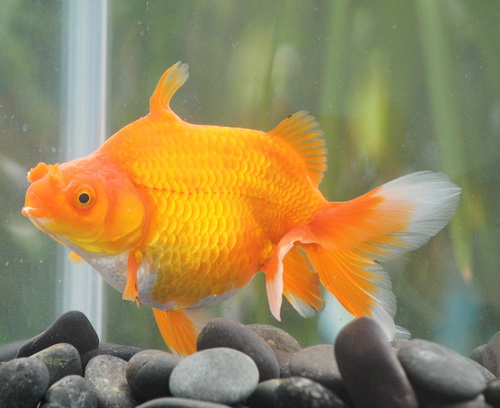
Standard
Uncategorized

Tricolor Metallic Scale

Image

I have never paid any attention to this type. I worked on calico color for some times to understand it, then I tried to work on the kirin color (a subvariation of transparent scale goldfish) with no success. It is a fortunate event that a breeder friend introduced me to these two fishes. They caught my attention because I think they are unique. Their color looks like that that can only appear in transparent color scales, but their scales are metallic scales! It is amazing!

I know this kind of color is seen mostly in ryukin. I have never seen it in other goldfish variety. So it is possible that the specimens I have here are ryukin’s reject.  Or they might be a stable variety of its own. I do not know what to call them, other than tricolor metallic scale goldfish. The Indonesian might call it tricolor metallic scale tosa, since we use the term tosa to refer to a ryukin without hump. I also know the term “mock metallic” used by American hobbyists, but I don’t really know what they mean. Could this be the mock metallic?

I am pretty sure now that this type of color is also a subvariant of transparent scale goldfish color. But I am not sure how this color come up in the first place. Usually, when we crossed a calico with a metallic scale, we will end up with many kinds of offsprings. I usually keep only the fully transparent scale that has no or minimal trace of metallic scale. I get rid of the rest. But some breeders usually keep those with more metallic scales on the body, for this kind of fish still have selling value. Both are commonly seen. But those that the breeders rejects, such as the seemingly grey metallic scale that does not seem to mutate,  and I don’t know what else, maybe the tricolor metallic scale evolved from these rejects. I don’t know yet, this is only my guess.

The good thing is that this genetic is pretty stable. I mated these two, and this is the picture of the offsprings that I took yesterday.

Image

From these offsprings, the metallic scale types, and the black color look solid. There are few offsprings that look like transparent scales with few metallic scale. I reject them. I keep only the full metallic scales. So, the only thing I know so far is that the genetic is stable enough to pass on to its generation.

And this is the interesting thing. What I would like to do is to see whether this color can be transferred to sideview ranchu! Yes, it sounds crazy. But a tricolor metallic scale sideview ranchu will be quite nice, isn’t it? Yet it is also quite a challenge.

When I work with panda coloration, I was working with metallic scales only. Now I am going to work with metallic scale – transparent scale cross. I have no idea of how big is the problem. In my experience, when we cross a metallic scale with transparent scale, the black coloration is lost. Some show black marks when young, which will soon disappear as they grow. If this happen, I do not know how to introduce the black color again. I have tried to cross it with black fish (black ranchu) which created a different black marking from calico color. I also do not know how to create the appearance of full metallic scale like this since the cross usually creates partially metallic scale only. So, I think I should separate the color (black coloration) and the scale into two problems.

So to count the difficulties if I cross this fish with a metallic scale sideview ranchu, then it is a level 4 difficulty. First concerns the headgrowth, which is nothing to worry. Second concerns the dorsal fin, which I have the experience already and I will not worry about it. Since the fish is already a short tail one, then it does not count as a difficulty when being crossed with ranchu. Third and fourth is about the color and the scale appearance, which is a territory unknown to me. So eventhough the difficulty is only level 4, it is much more difficult than it appears, I think.

Actually, the cross has been made this morning. Now I am waiting for the eggs to hatch. I am very excited 🙂

I welcome any advice on this.

Standard
Panda Ranchu

Panda Ranchu

Image

I have many breeding projects. My current priority is to create the panda ranchu.  I started this project about 3 years ago, after strengthening the color of my panda telescope line (also known as panda moor). I began by crossing the panda telescope with an orange Thai sideview ranchu. This is a fifth level difficulty, which means that there are five contradicting features that I must tackle with. First, I must get rid of the telescope eye feature from the panda moor. Second, I must get rid of the dorsal fin in order to create a ranchu back curve. Third, I must tackle the long tail feature  in order to create a short ranchu tail. Fourth, I must develop the ranchu headgrowth in the new fish. Fifth and most important, I must inject the panda color into the new fish. In my plan, this is a 5 years project.

My first focus was to produce the panda color in the offsprings of the cross without regarding much yet about the shape. This was achieved in two generation. Following Mendellian law, I got some percentage of blue/panda fish, with all sorts of horrible shapes. I concentrated on the ones which closely resemble ranchu shape. I did some inbreeding program to stabilize the color in the third generation.

Things did not go smoothly at that time. There was an outbreak in my facility, and I was left with only two blue offsprings. One is a sterile female, and the other one is a male with weak health. The whole project was in jeopardy. The actual plan was to cross back this third generation offspring to another Thai sideview ranchu in order to strengthen the ranchu shape character. So I paired the weak blue male with a Thai sideview ranchu.

Thanks to God, I could collect the eggs the next morning. And the next day, the male died. So this project relied solely on those eggs. I could not redo it again. In fact, I was so desperate at that time that I started to cross panda moor again with a black ranchu, as a back up plan. But I felt so much relief when the eggs hatched, and they turned into healty, fast growing ranchu. All of them were grey that slowly turned into orange. There were no blue of panda among them. But that did not bother me at all. I knew that the blue or panda color was recessive, and would appear when I did an inbreeding again. The only drawbacks were the bald, small head of the ranchu and the hump that appeared right after the head. Fortunately, as I grew them, the headgrowth appeared, though very late compared to usual ranchu, and the headgrowth slowly covered the area between the head and the hump, which help to improve the appearance of the fish as a decent ranchu. The back curve was good already. My only concern was whether I would get panda or just blue.

The picture I post here is the offsprings of those orange fishes. So this is the fifth generation. Some percentage became the usual grey color which turned into orange, some turned into blue. Among the blue, some stayed blue so far, some turned early into panda, and some turned quickly into white. I tell myself, “It is ok.” I just need to repeat the first step again in order to stabilize the color. This makes me glad.

Concerning the shape, I get two kinds. First, I get ranchu, and second, I get a small percentage of deme-ranchu, or nymph, which is a ranchu with telescope eyes. Somehow the ones with telescope eyes grow darker coloration compared to their ranchu sibling. The ranchu shape carried the weaknesses of the parents from the fourth generation, namely the small head, the hump, and the late headgrowth. Other than that, the shape is perfectly ranchu. I need some more years to improve on the head shape and color.

So actually this is a premature publishing. Four more steps need to be done to create a decent ranchu shape with a stable panda color. I just get too excited to share the progress now. Two more years to go. 🙂

Standard
Ryukin

Ryukin

My relationship with ryukin is not always good. I remember my first encounter was when I was 10 years old. There were two ryukin imports in the local fish shop. I was amazed by the hump of the fish, and it got carried away into my dreams for weeks. The price was rp 25.000 (the equivalent of usd 2.5), but it was too expensive already for a school boy at that time. As I grow up, my esteem of ryukin gets lower and lower. I was into sideview ranchu at that time and was thinking that sideview ranchu was everything. My first breeding project was ryukin, since I think it was easy. And indeed, the breeding confirmed me that ryukin breeding was too easy. After that, I abandoned ryukin altogether and focused on sideview ranchu.

Now, as I am preparing to write a book on goldfish appreciation as a joint effort with a friend, I begin to relearn about ryukin and is breeding it again to collect sufficient amount of illustration. So, after 13 years, I come back to ryukin! My friend teaches me humility by showing me so much that I don’t know about ryukin. Now I begin to appreciate ryukin again.

Maybe I want to be like Tom Bombadil in the goldfish world. I care less about the trend, the market, etc. I like to work on my own terms. The trend on ryukin today is the short tail ryukin. I do not have an interest on it. My interest is to create a sideview broadtail ryukin since the older tradition consider it to be the most valued in the ryukin category and it is not easy to find anymore.

I bought a pair of sideview broadtail ryukin from China. If they breed true, then this would be an easy project. To my surprise, the genetic of those two were not stable. The genetic of topview broadtail was thick on them. So, to my dislike, I ended up with topview broadtail offsprings. Please don’t get me wrong. Topview broadtail has its own beauty. Just that it is not my goal right now. The second weakness was in the hump. Very few have decent humps. So I suspected that American veiltail bloodline might be thick on them. To produce true sideview broadtail ryukin turned out to be not easy.

My solution was to cross the broadtail I had with long tail ryukin, as I am convinced the genetic of long tail ryukin should be stable already. So I bought some long tail ryukin from China. The purpose is to strengthened the genetic of sideview tail, but retaining the broadtail (fan-like) characteristic.

To my surprise, I found out that there was a genetic of short tail in my long tail ryukin parent! I was puzzled to the reason why should the Chinese cross the short tail and long tail ryukin in the first place. So, from this cross I get short broadtail, normal short tail, normal long tail, medium broadtail, and long broadtail! I am suddenly rich! But I will stick to my first priority, which is the medium brroadtail. So I will sell all the other types.

I am glad that so far the sideview appearance has been incorporated into the broadtail with success to some extent. In another month I will harvest them and be able to show some pictures.

Standard