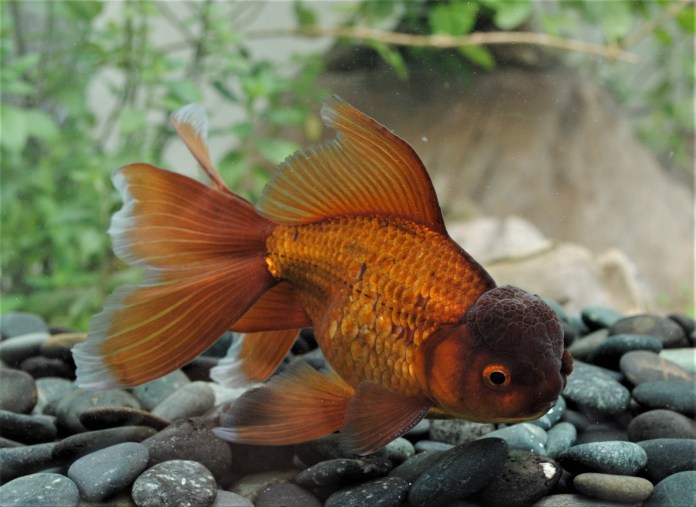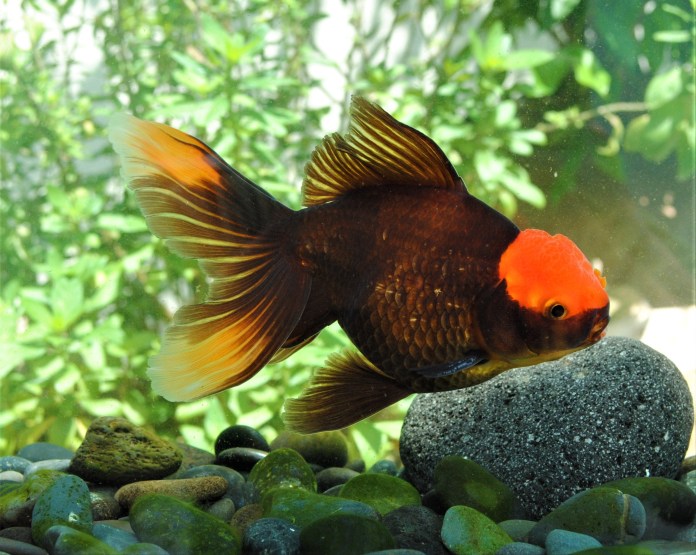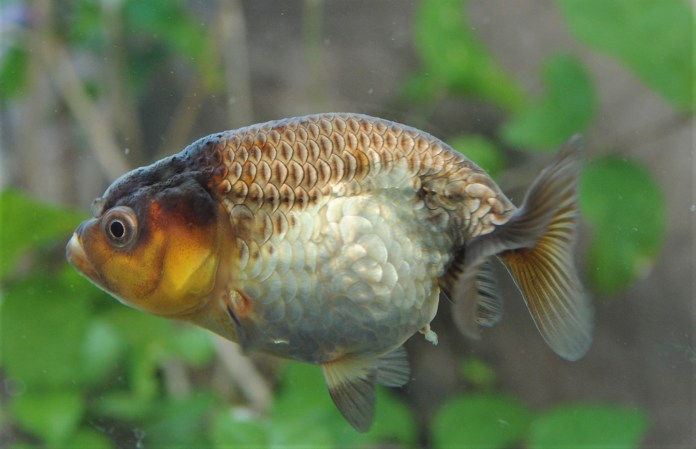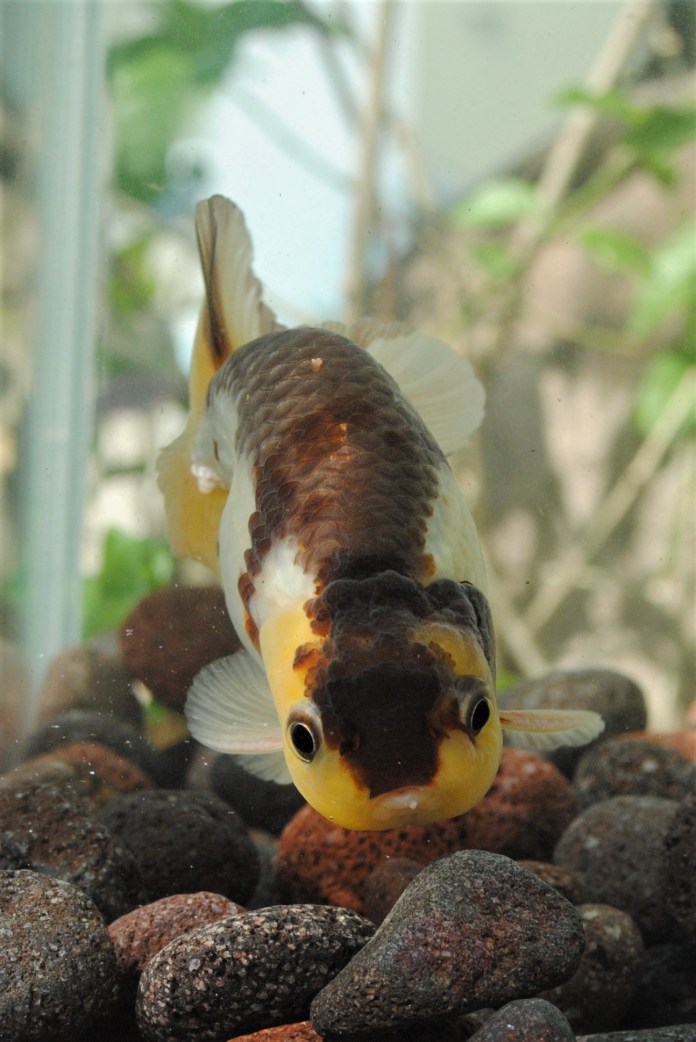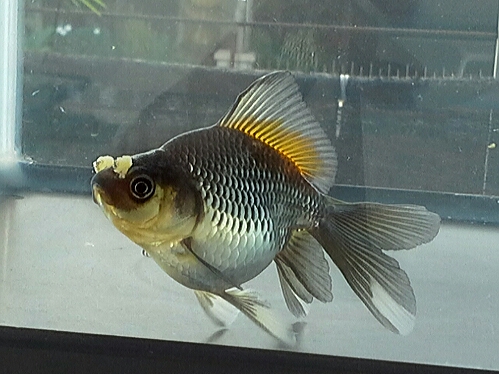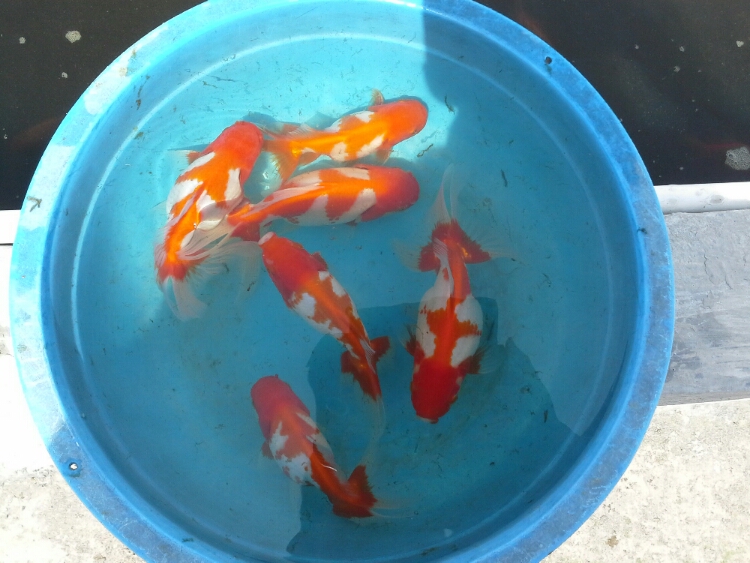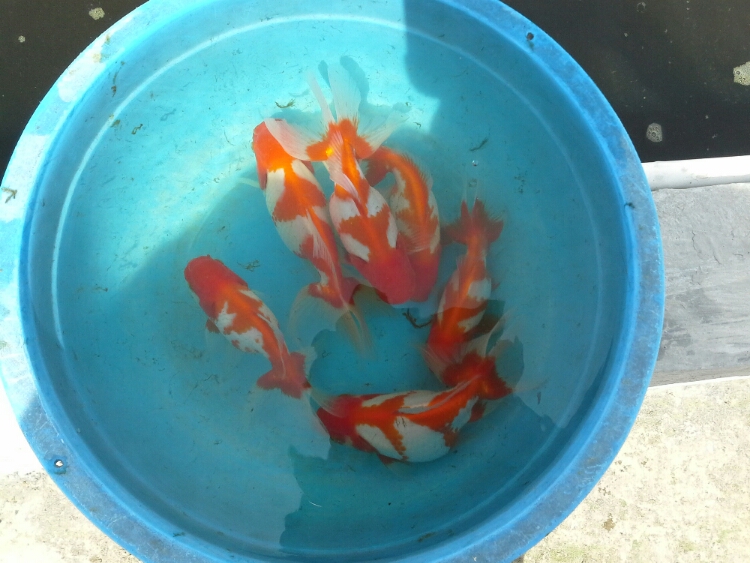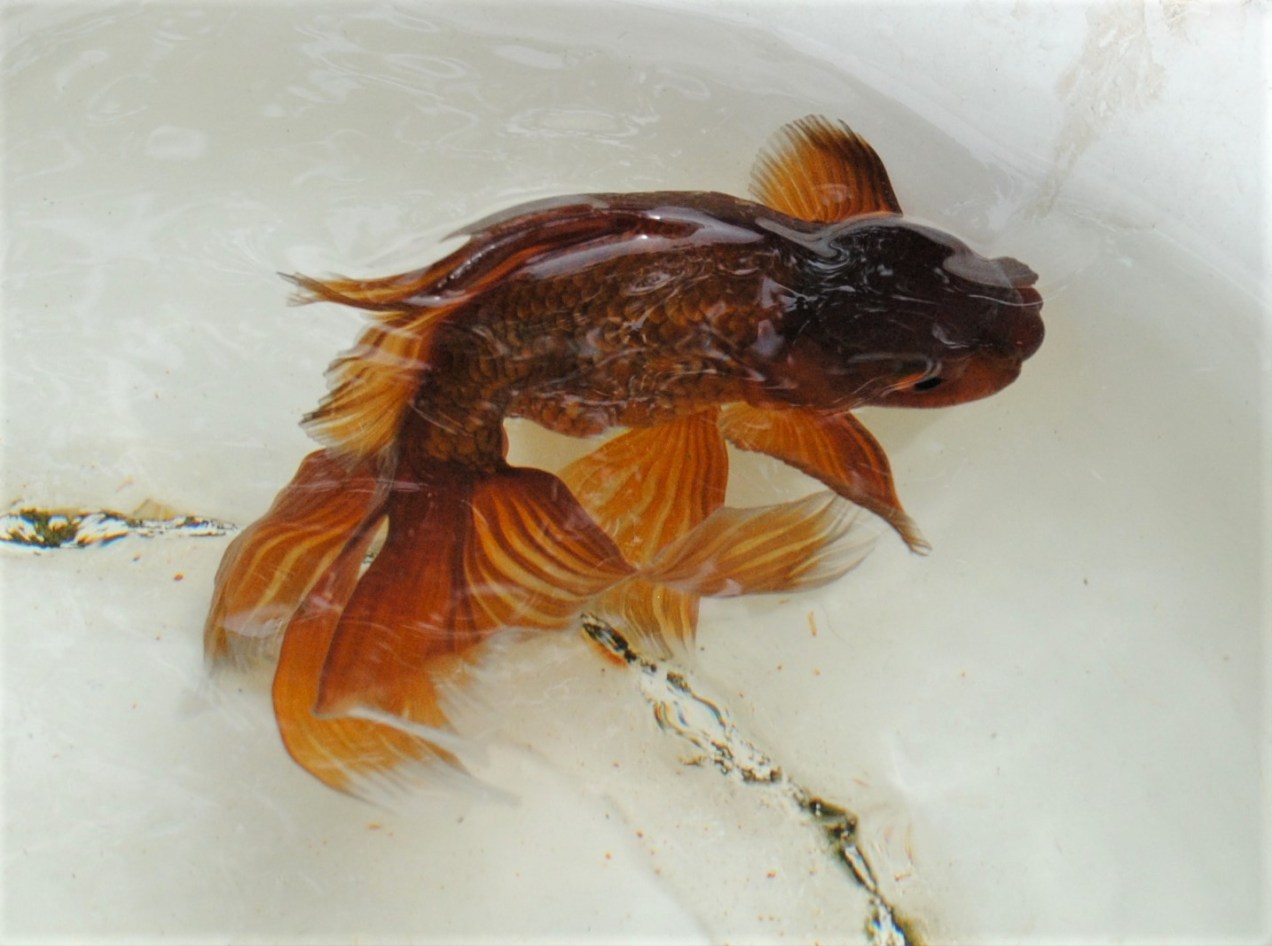
Brown Panda Ranchu, Chocolate Ranchu, Panda Ranchu, Purple goldfish

Brown Panda Ranchu

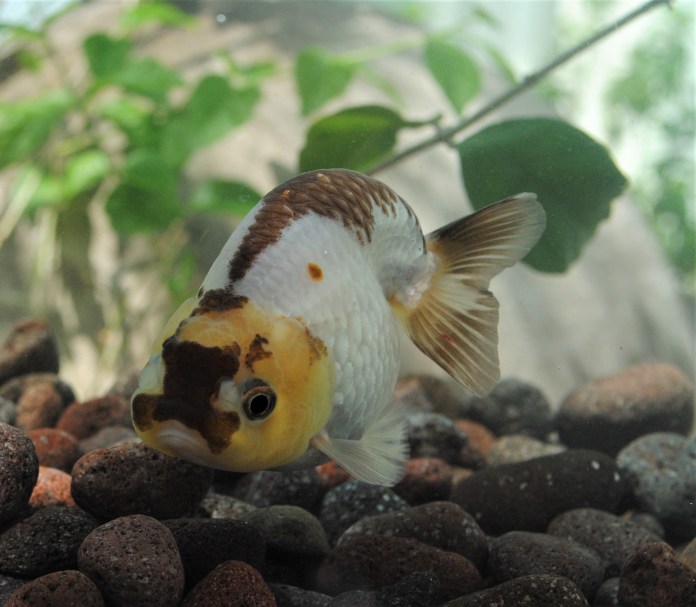
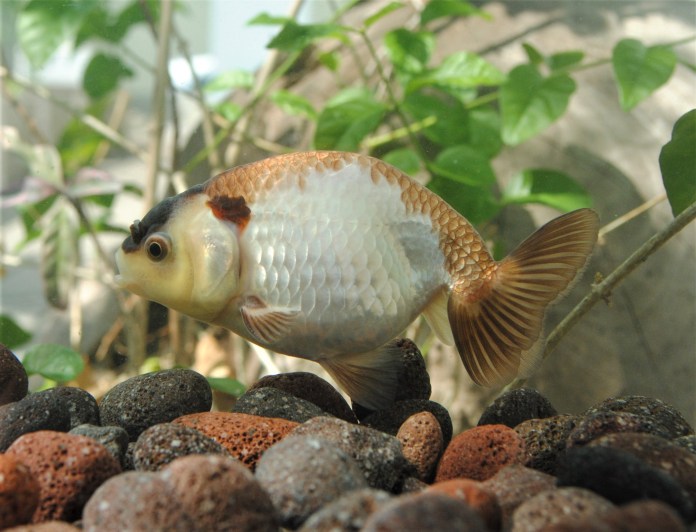
As a side result of the Purple Ranchu Project, I also get the Brown Panda Ranchu. Actually, it is the Purple Ranchu who demelanizes to produce a purple and white fish. The purple gets darker to produce the appearance of brown / light brown. This process is exactly the same as the demelanization process in the blue ranchu to become panda ranchu (Black and White Ranchu).

As this variety is still rare, I think it is better to document it here for future reference. Here are some pictures:

bp1wpbp2wpbp3wpbp4wpbp5wpbp6wp


Standard
Purple goldfish

Final Chapter on Purple Ranchu Project

I think I have come to the final stage of my project on purple goldfish. Starting with the report by Shisan C. Chen as my inspiration, I am finally able to create the purple ranchu. I called the color purple, since I heard that term being used when I was young and naive in goldfish breeding. Shisan C. Chen did not use that term. He just said that it is an intermediate color between brown and blue. I remembered my heart yearned for a more definite description or picture, “what sort of color is that? I would like so much to see it!”

In doing this project, I learned that there are two kinds of brown color in goldfish, and they are genetically different. I am sorry I cannot speak in a more scientific term since my training in genetics is very limited. But I know from my observation that when the two different brown are mated with blue, the result is totally different. I will not elaborate more on this since I have written about it several times on this blog.

So, this is the result:

Left side view:

Yes, it has brown stain, to make it a purple and brown ranchu. Some friends prefer to use the koi terminology to address this breed and call it ochiba ranchu. Yes, the head and perhaps the body could still be improved. I have focused much on the color and sort of neglecting the body conformation. But, for the color experiment, this is final.

Right side view:

Less brown stain on the right side views to make it a decent purple. I know for most people who are not familiar with this project, it is hard to differentiate this purple color with blue. So, let me give some comparison picture.

Comparison between purple and blue:

Yes, the purple has a reddish color compared to the blue.

Comparison between purple, blue and brown:

Hopefully, this project will be useful for the coming generation of goldfish breeders and hobbyist. Thank you for all the motivational support for this project. It is finished now 🙂

Standard
Yellow goldfish

Yellow Goldfish 2017

It has been a year since my last update. Just to review the project, I have bought some yellow commets. I crossed them with my double tail goldfish. I thought the double tail was of yellow color. Later on, the fish turned into mandarin orange color, and the eyes turned into strange color (perhaps albino). I did not documented it well, so I cannot provide any picture. Anyway, it came from the red white double tail goldfish. So, I will consider the gene as plain red / red white goldfish.

The result of the cross was 100 percent orange (red / red white), and 100 percent single tail. No yellow appeared. And no double tail at all. Some of the tail are long, some are short. Here they are:

c

As they matured, I did F1 x F1. The results are varied. I collect 2 batches of them. Here are the stats:

Batch 1:

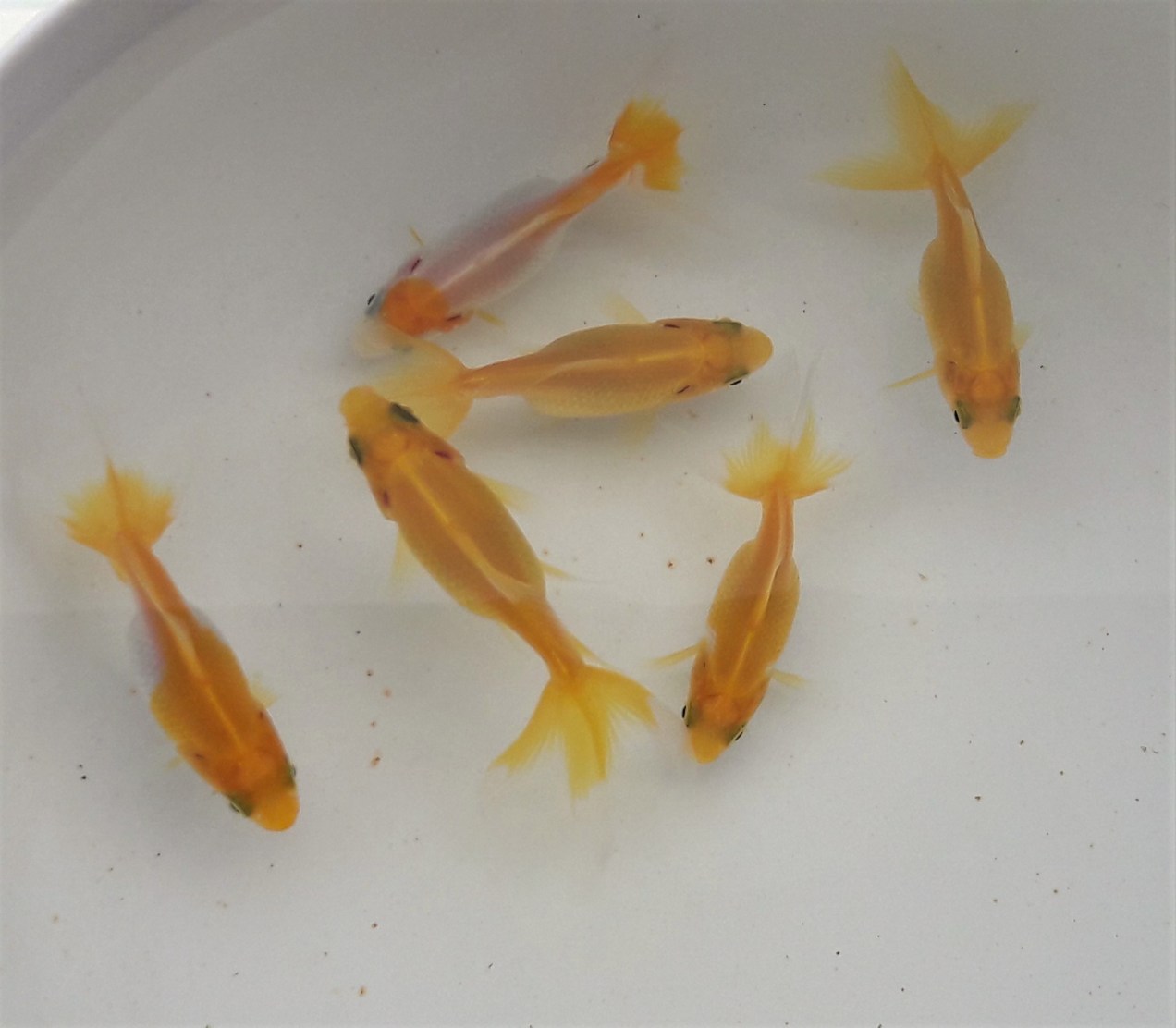
Total 77 offspring. Single tail are 61 (79.2%). Double tail are 16 (20.8%). I can easily separate the single from the double early without the need to wait for the mutation process. However, some of them did not survive along the way. The survivor are 73. The desired yellow double tail are only 3 (4.1%). Orange double tail are 11 (15.1%). Yellow single tail are 14 (19.2%). Orange single tail are 45 (61.6%). So, the desired yellow double tail are only 3 pieces. Two of them are defect. That means, I keep only 1 from this batch.

Batch 2:

Total 541 offspring. Single tail are 432 (79.8%). Double tail  are 109 (20.2%). The stats can be said as the same as that of batch 1. The survivor are only 287. Most of them are stunted and did not survive. From the survivor, the desired yellow double tail are 21 (7.3%). Orange double tail are 55 (19.2%). Yellow single tail are 57 (19.9%). Orange single tail are 154 (53.6%).  From the  21 desired yellow double tail, 12 are defect. So I keep 9 desired results.

Here are some pictures to compare the yellow double tail and orange double tail. Pardon me for the bad pictures.

What type of goldfish are these yellow ones? They do not belong to the popular category such as ryukin, oranda or ranchu. They looks like wakin, perhaps with smaller body and longer tail. Actually, this is my regret. I think I should use a more popular type to cross with the yellow commet from the start. Anyway, it already happens. I need to decide what to do next. Shall I breed them just to get more uncategorized yellow goldfish? Or shall I cross them with more popular type? Perhaps I can produce yellow oranda, yellow ryukin, yellow pompom, or just yellow wakin. I will decide later.


Standard
Yellow goldfish

Big Progress on Yellow

It has been sometimes I dream of yellow goldfish. It all started when I accidentally acquired a yellow tosakin. I was unaware at that time if the color was yellow. I thought it was just a pale fish due to the lack of sunlight.

I did make a cross between that yellow tosakin and a wakin, as part of my another project. Most of the offspring were red – really deep red – in color. But few show different color. It took a while for me to realize that they were yellow and mandarin orange color. I was inspired to create more of them. But unfortunately, there were too few of them. Usually from the same batch, all of the yellow were of the same sex. And most of the female were infertile. What to do?

This is my yellow female infertile goldfish

semi lemon 2

my semi lemon

I remembered from my last trip to Japan, I saw that Japan has yellow commets. I also heard that they are common in America, Israel, and some more parts of the world. But Indonesia has none. So I planned to import some yellow commets from Japan. Thanks to Limas who made it possible. I did not have any yellow male. I only had some mandarin orange male fish. So I planned to breed my male mandarin orange goldfish with female commets from Japan.

These are what I call the mandarin orange:

mandarin orange

Upon the arrival of the yellow commets, I noticed that the yellow color was a bit different from my yellow goldfish. The commets were more like lemon color. My yellow goldfish had a bit of orange flavor in it, though I will still consider it yellow.

This is the comparison:

lemon cross

Alas, the yellow commets did not lay any eggs yet, though it has been months since I bought them. But the BIG SURPRISE is that, yesterday, my infertile yellow female suddenly laid eggs! And lots of them. I was tempted several times to let go the fish. Glad I did not do it. It has been a year or more without any eggs, but suddenly it laid the eggs yesterday. I matched her with the male lemons from Japan. And I am very enthusiastic to see the result.

If the yellow goldfish project was in jeopardy from the start, now I begin to see a big hope. And from this, there is a possibility to create yellow oranda, and even yellow ranchu in the future. Certainly this will enrich the goldfish diversity. Yellow goldfish will not be limited to yellow commets anymore 🙂

Wish me the best!

Standard
Purple goldfish

What color is this?

This is the most unique color I find in this purple goldfish project. It started as purple fish. But then it develops white coloration. The purple color becomes darker, to make it look like light brown. I do not know what to call this combination. Purple and white? Chocolate and white? It surely looks like brown magpie bird to me.

20150723_072508(2)

20150723_072449(1)

Many of the purple develop the white color, but most turn into totally white. So, I guess the behavior of this pattern is basically similar to the panda. That means there is a room for stabilizing the pattern through selective breeding.

unfortunately, there is only one with this kind of pattern. I hope the pattern will stay, though it is very probable that it will fade. And the purple goldfish is always the smaller compared to the blue and brown in the same batch.

My plan is to strengthen this pattern and multiply them in the form of pompom goldfish. Next, I would like to develop ranchu in this pattern. Wish me the best 🙂

Standard
Panda pompom

Panda pompom

From my experiment to create purple goldfish, I accidentally create panda pompom. This is predictable, since I use chocolate pompom and metallic blue fish as the grandparent. Some blue fishes appear in the offspring. Some have pompom, some do not. But most of the pompom feature are blue also. This one is extraordinary since the pompom feature is white, giving it a good contrast. If today we usually find pompom goldfish with chocolate body and orange pompom features, hopefully we will see more of blue or panda body and white pompom features. I can’t wait to see this piece mature. Enjoy.

20150723_072638(1)

Standard
Playing with patterns

Playing with pattern

Pattern is not one of the judging criteria in competition nowadays. However, pattern always has its own way to fascinate hobbyist all the time, from beginners to experts. History shows that some breeders had focused on pattern appreciation all along. Red cap oranda is one famous pattern that still exists until today. Jikin breeders are masters of pattern creation with their 12 red goldfishes. I am sure pattern will always find its way in the heart of goldfish hobbyist.

There is a science to the pattern manipulation. Unfortunately, this science is mostly unkown. I believe much of the knowledge is lost. Some who know tend to keep it secret. Most hobbyist are not aware that this can be an area to pursue. The undermining of pattern criteria in competition might contribute to this ignorance. The ethical assault faced by those who practice this art also contribute to the secrecy of this knowledge.

For me, I tend to think that this is interesting. My own experiment has led me to conclude that water parameter, food content, and background color can be used to manipulate the pattern. Other things such as whether it is outdoor or indoor, whether to use biological filtration or routine water change, the density of fishes, the PH parameter, and so on, seem to contribute to the pattern building. Tricks employed by Jikin breeders also seem to work but not to all goldfish. Some goldfish are easier to manipulate while some seem to resist manipulation. This need to be explained genetically.

Wakin and jikin are among the easiest to manipulate. Some oranda react well to manipulation tricks, while some like orange oranda are harder to manipulate. In my experience, ranchu is more difficult to manipulate.

Below is the results of my experiment on pattern building. I am not in the position yet to tell readera what I have been doing. I am still learning. Perhaps later on as I understand more, I will tell. The fishes I used are the oranda that have wakin genetics. They are my F3 from my oranda – wakin cross, which have been crossed back to oranda. I find that most of them are easy to manipulate, but not as easy as wakin. Some from the same batch cannot be manipulated, no matter what I do. Seems that the fish that mutate earlier from its wild color state into red and white is easier to manipulate. The one that takes longer to mutate is harder.

Enjoy.

20150609_103254(1) 20150609_103246(1) 20150609_103244(1)

Standard
Uncategorized

Ogon goldfish – is it possible?

Guanine is the substance responsible to produce the shiny metallic look in the scale of goldfish. When the guanine is absent, we will have the transparent colored goldfish such as sakura and calico. In goldfish world, as far as we know the guanine is found in the scale. It is sometimes found in the gill also. But I have never heard anyone mention about the presence of guanine in the fins. The fins of goldfish is commonly found in its transparent state. Lately, as I was observing my fishes, I noticed a certain yellow fish that have unusual deposit of guanine in its pelvic fins. This is the picture I take this morning:

DSCN1573(1)

It is quite shiny compared to others such as this:

DSCN1583(1)

I begin to recall that koi has a variety called ogon, which has shiny fins. I begin to suspect that what makes ogon koi have shiny fins is the abundance of guanine level in its fin. And my mind keep thinking whether it is possible to create ogon like goldfish, that is the goldfish with shiny metallic fins. An ogon goldfish might look like this photoshop image below. Notice the unusual shine in the fins. It will be very eye-catching in the tank. (Sorry for the low quality image).

ogon koi

The yellow fish I have makes me think that this is possible. It is just that nobody has tried this. It will be a tedious project though. Maybe we will need to select fishes that have more than usual guanine deposit in its fins and use them as parent fishes. Maybe this need to be done for many generation through selective breeding until a truly ogon goldfish is created. It will be a long journey. But this will create a new kind of goldfish! Does anybody want to take this challenge?

Standard
Purple goldfish

Purple, really?

My last attempt in Nov 2014 to cross bluegoldfish and chocolate one resulted on one purplish goldfish in the second generation. I was so excited to see it grow. Unfortunately it died early, taking away all my hope with it. Then there was also a problem with my facilities which required a couple of months to repair. My breeding activity was halted.

But now, things are settled, and I can resume my breeding activity. I try to cross parents again. Just for reminder, the parents are the F1 of blue x chocolate. It must be admitted that the purple is always a minority in the offspring. But this time, instead of one, I get about 10 purple! What a joy!
DSCN1562(2)

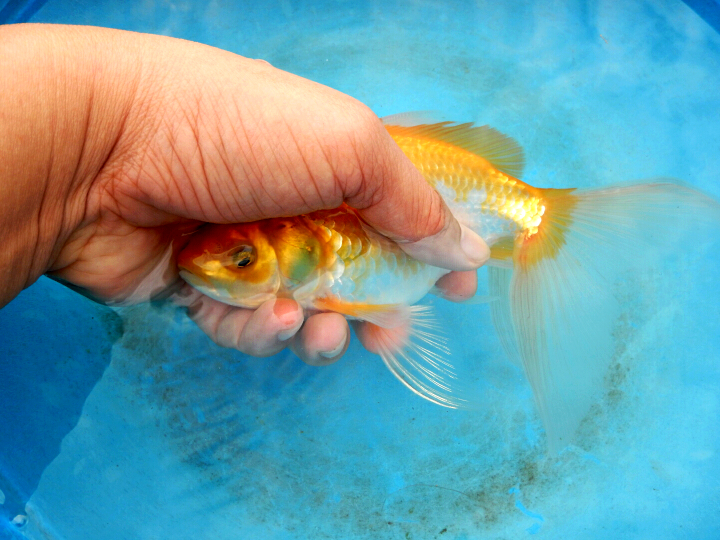
To see the variation of color, I take this picture this morning. The fish in the top position is the blue. Three fishes in the middle are the purple. E one in the bottom left is the grey/green/wild color. The bottom right one is the chocolate. Hopefully you can see their color differentiation.

the purple is what Shishan Chen in his writing reported as the intermediate color between blue and chocolate yet distinguishable from the two. Some other ancient books labeled it as purple, and I will use that name for this particular color.

Three of the purple fishes have turned into white, perhaps due to the warm temperature of my tub. Hopefully not all of them turn white. But this shows that the purple have the capacity to become purple and white, which might be interesting. I do not know yet how it looks like.

Well, hopefully everything is allright, and we can see the mature result of the purple goldfish. After that, I think I will aim at creating purple ranchu.

Standard
Wowkin

wowkin update Jan 17th, 2015

My wowkins have passed its one year life span now. Some show the desired tail shape. The size is satisfying. They can grow large enough. The red coloration is also good. The body shape deviates a bit from the plan, though. I was thinking of a body exactly like the wakin. But my best wowkin (in terms of the tail shape) has a body in between wakin and tosakin. This can be seen clearly in the picture

DSCN0773(1) DSCN0772(1)

My attempt to inbreed the wowkins results in body types just like the current wowkin and also shorter type, but the tails are long. I think I cannot get the desired wakin body from inbreeding. So, right now I am crossing  my current wowkin back to wakin. The pair is shown in the picture above. The wakin is the male.

What to expect from this cross? I think I will get the body right. The tail might have a drawback, though. But I am hoping a small percentage of the ideal wowkin to occur from this cross. If this happens, then the rest is just selective breeding.

Standard