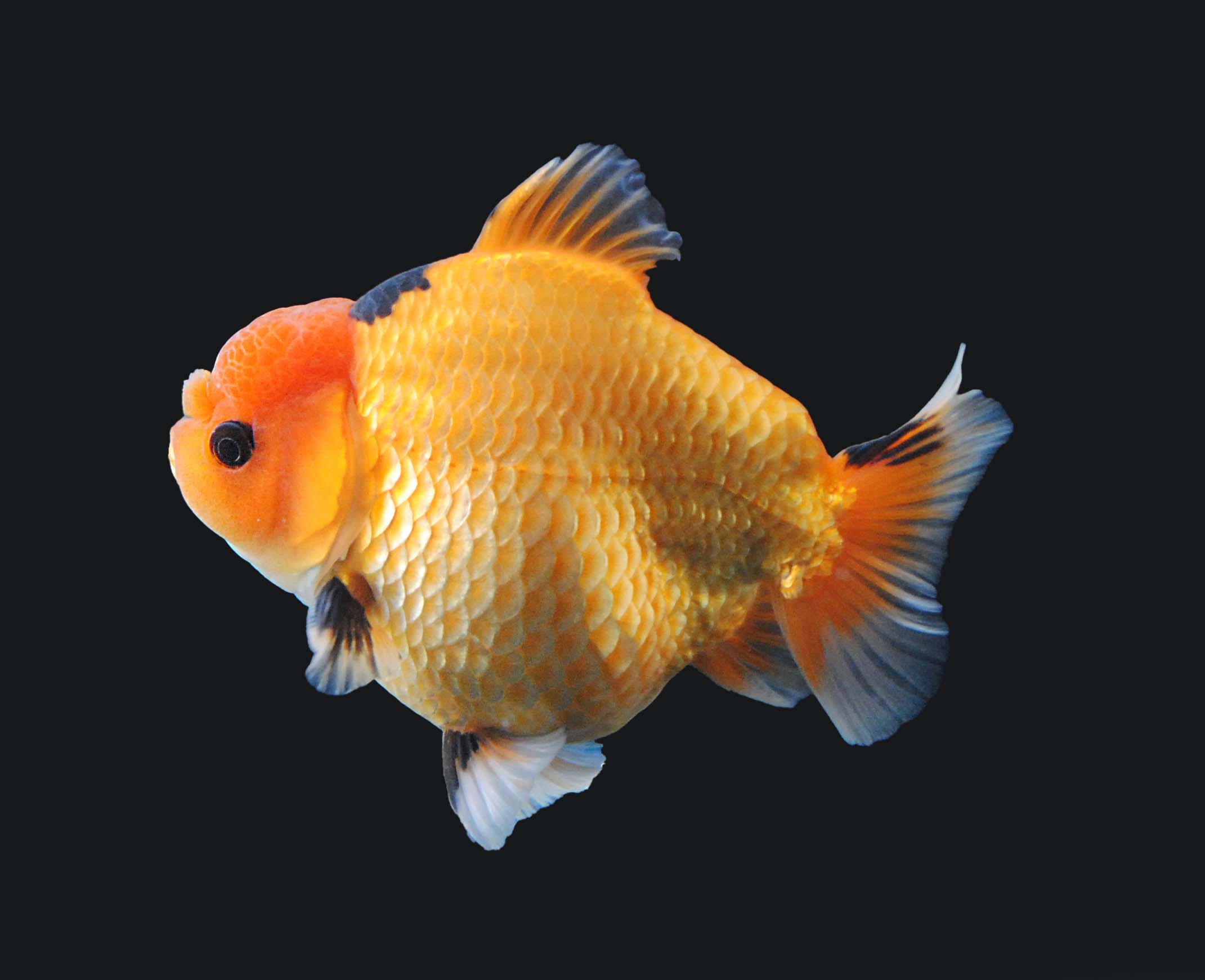
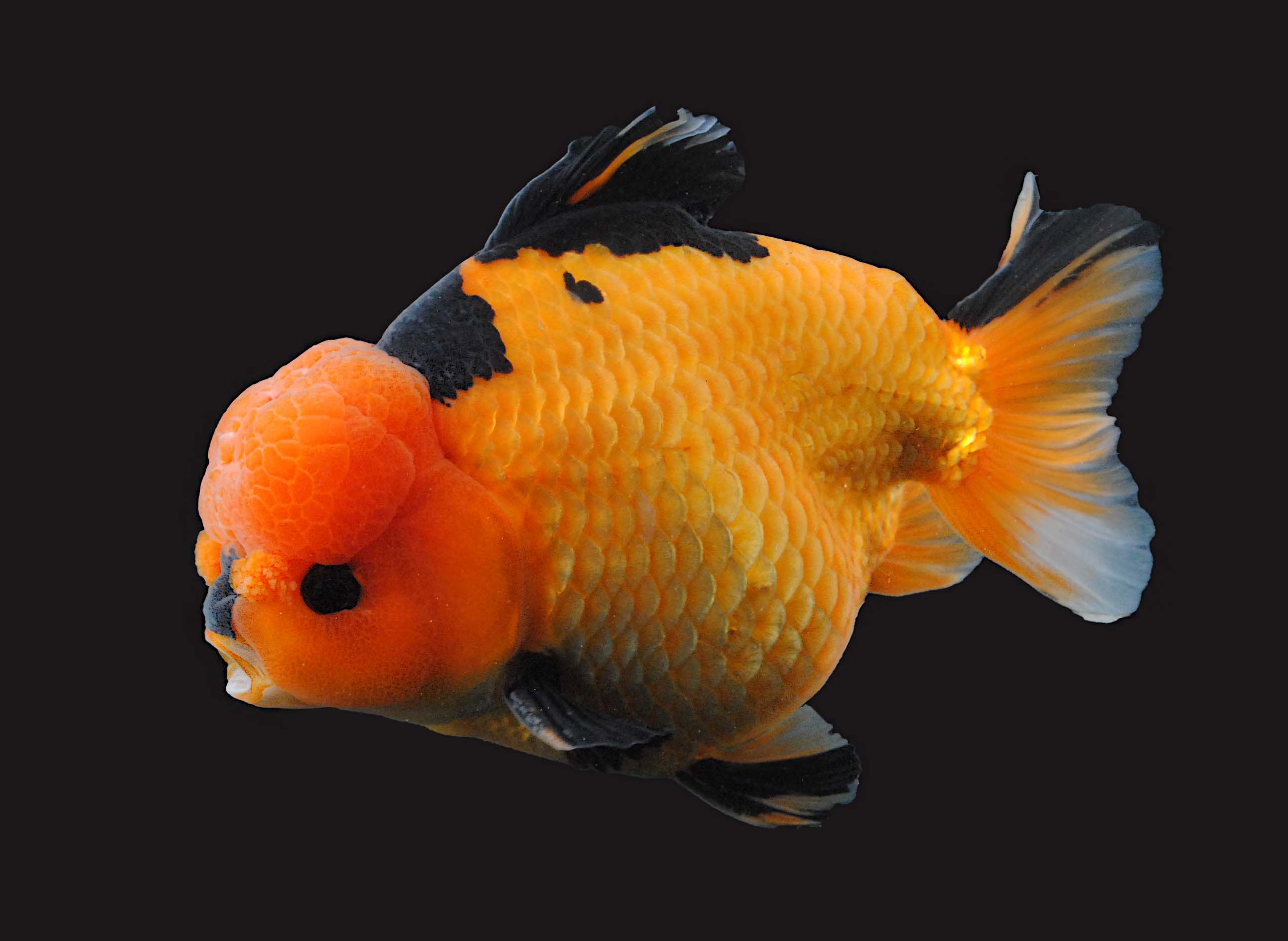
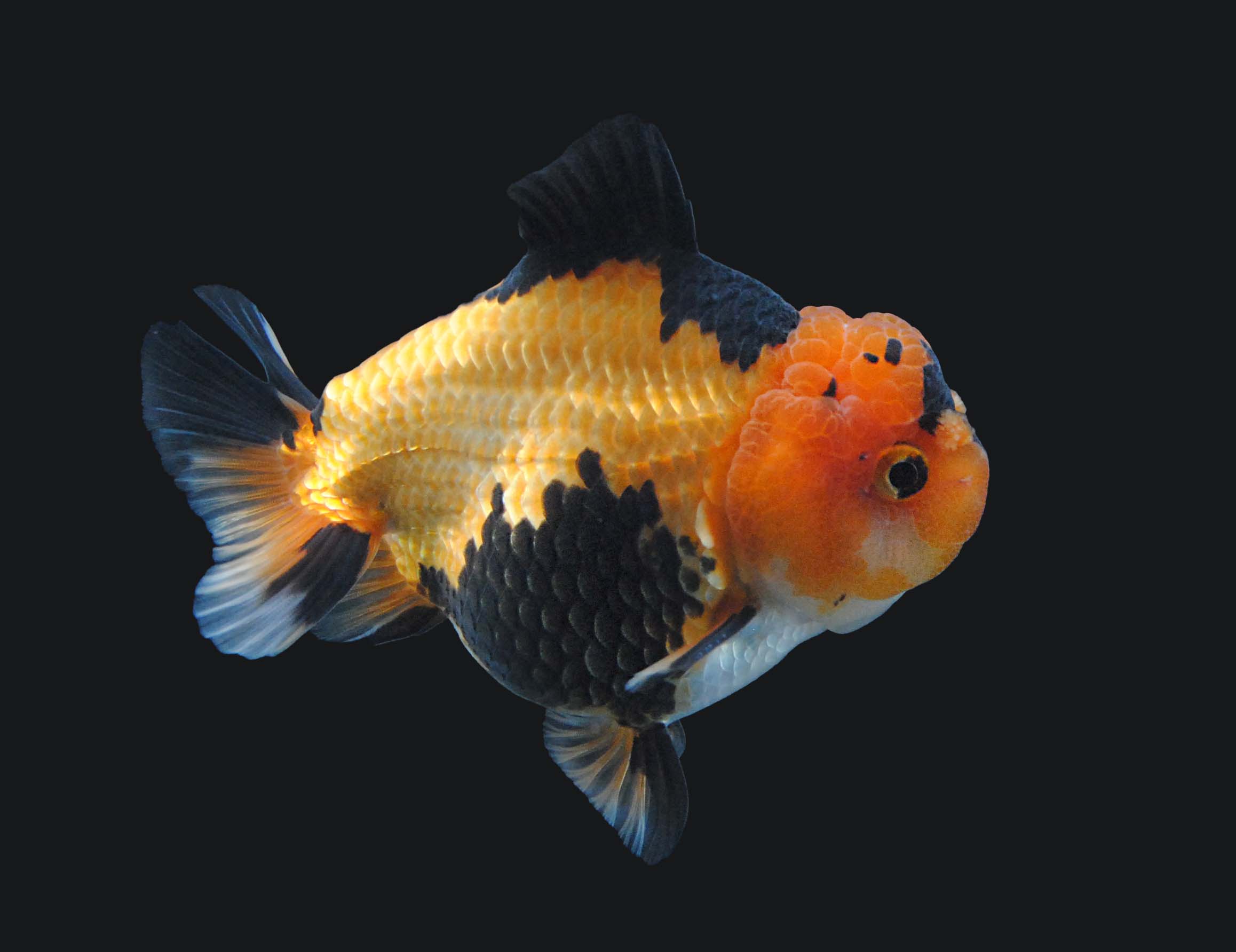
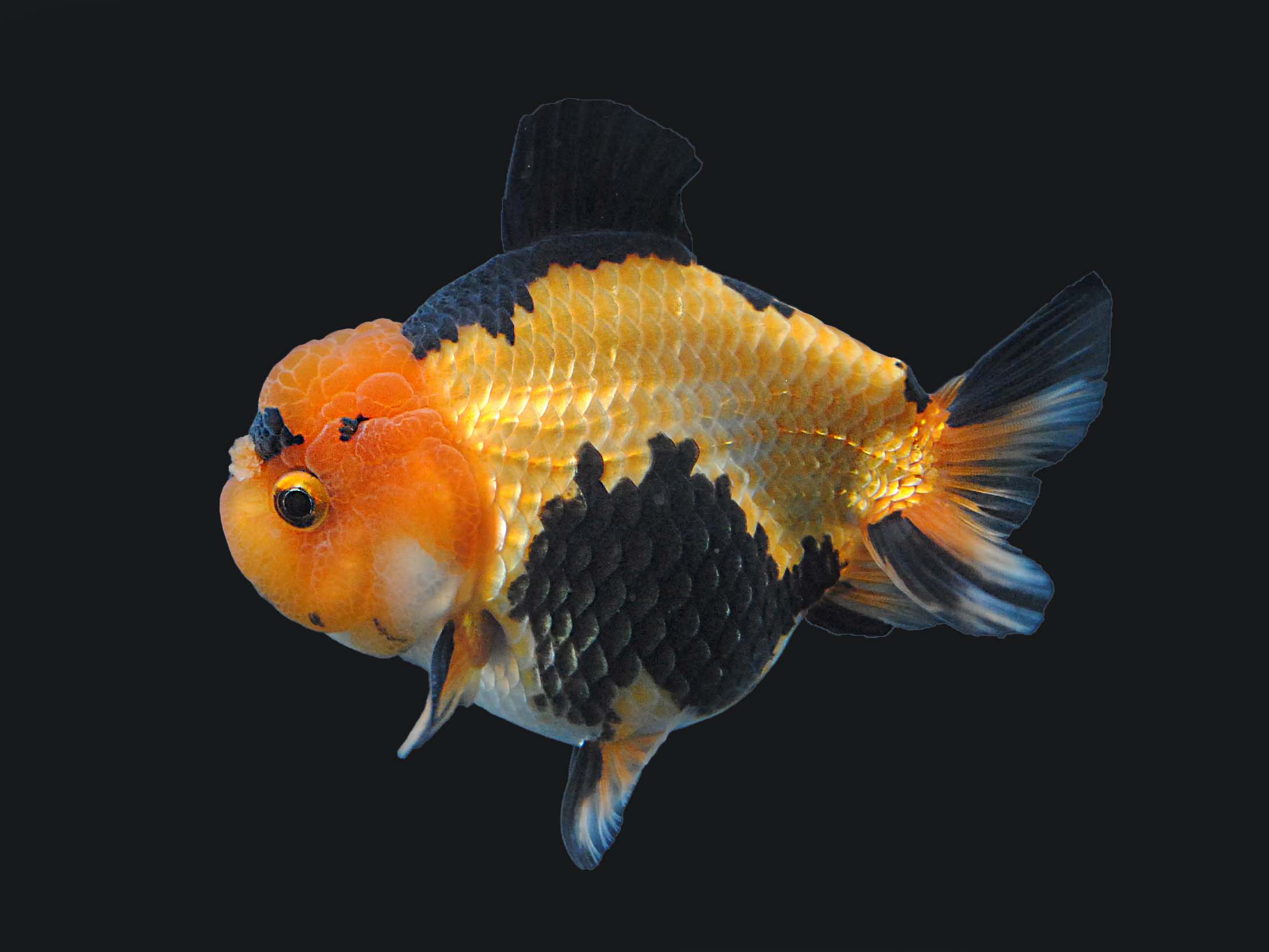
In my plan, I am supposed to concentrate on my ranchu projects this year. But I must confess that I am too occupied with tosakin instead of focusing on ranchu. It is already October. The year will end soon. I have not made any significant progress on my brown, purple, and blue ranchu projects. But I think I still need to report my progress here.
To follow up the diary #6, most of the offspring are not satisfying in terms of the quality. I took a big risk by sorting out almost all of them. I kept only one female from each type. And I am not proud with the quality.
Yes, there is a bump near the tail area. The color is good, though.
This purple ranchu has a rough back curve.
This tricolor is actually a blue ranchu that lost some of its melanin. She has been in this stable color for months. I hope she will continue to be like this. However, the back curve is very bumpy.
I mated these three with my two male semi-purple ranchu:
The results are few. They are 7 cm right now. And I think I see some interesting quality. Thank God!
I will take their pictures when they are older and provide the update later on.
After many years of failure, I finally acquired a productive female. She was of an ambiguous background. I got it from a local breeder, which was not the logical place to get a cow ranchu. So far, cow ranchu in Indonesia was imported. Its appearance in a local farm was considered impossible. Some friends even said that it came directly from a calico parents. Anyway, she was productive. She laid thousands of eggs, which was way too much for my small capacity.
I managed to mate her once with my own cow offspring – the only one. (When I say my cow breeding project so far was a failure, it does not mean I fail 100%. It just mean I do not get the result I want. Well, getting only one beautiful offspring certainly is far from my expectation.)
Somehow, I had great confidence in this pair. But they choose a bad timing to mate. My facility was starting a major renovation for the next two months, and I was going abroad after that. Obviously I could not raise all of them. I could not even breed the second batch. My hands were tied.
So, I made a move which some considered weird. I kept only 20% of the eggs which I thought I could still manage, and I gave away freely the rest to a goldfish farmer friend in the village. I believed these hatchlings would have better care in the village. I only asked him to spare some for the purpose of Contest Keeping in my city and ten fishes for myself.
In turned out that it was the last time I could mate them. I had a chance to mate the female with a yellow sakura oranda for my yellow cow ranchu project. Then the female died. You can imagine my sadness of losing her. After that, my male cow ranchu’s health deteriorated. For two months his life was only being in and out from the quarantine tank several times. At last he was gone forever.
Now my only hope was in the offspring. But it was a faint hope. A disease wiped all of the offspring in my place except one. Yes. I was left with one cow ranchu – and I was not proud of its quality.
Frankly, this project was playing tricks on my expectation. Not long ago I was so glad to the prospect of success, but then, I was left with almost nothing.
I was glad that my friend from the village gave me ten offspring though they were still small and we could not judge the quality accurately at that time. I lost five of them. But I am glad I successfully raise five of them. And now they are in the breeding season!
The quality I had was a bit below expectation, but I am very grateful to have them. At least I have something to work on. Wish me the best!
The most productive female:
The not so productive female one but very active to eat the eggs in the media:
This female is not productive at all, never lays any eggs. She loves to eat the eggs on the floor, but never disturb the eggs in the media during the mating:
I finally kept only two male fish from this project. They are semi-ranchu (ranchu with a defect dorsal) but with good intense black color. The black pigment has grown since, defying the demelanization process! Here are their development from six months ago.
First fish previously:
Now:
Second fish (previously):
Now:
If I do not follow their development closely, I might not be able to recognize them. The black color is expanding, and also the orange color! Both fish lost some of the white color in their tails to become orange! The second fish lost its white color on the cheeks. That is an amazing phenomenon. We can still recognize them from their awkward back bone shapes.
Interesting to note that the first fish has a goosehead type of headgrowth while the second one has a lionhead type.
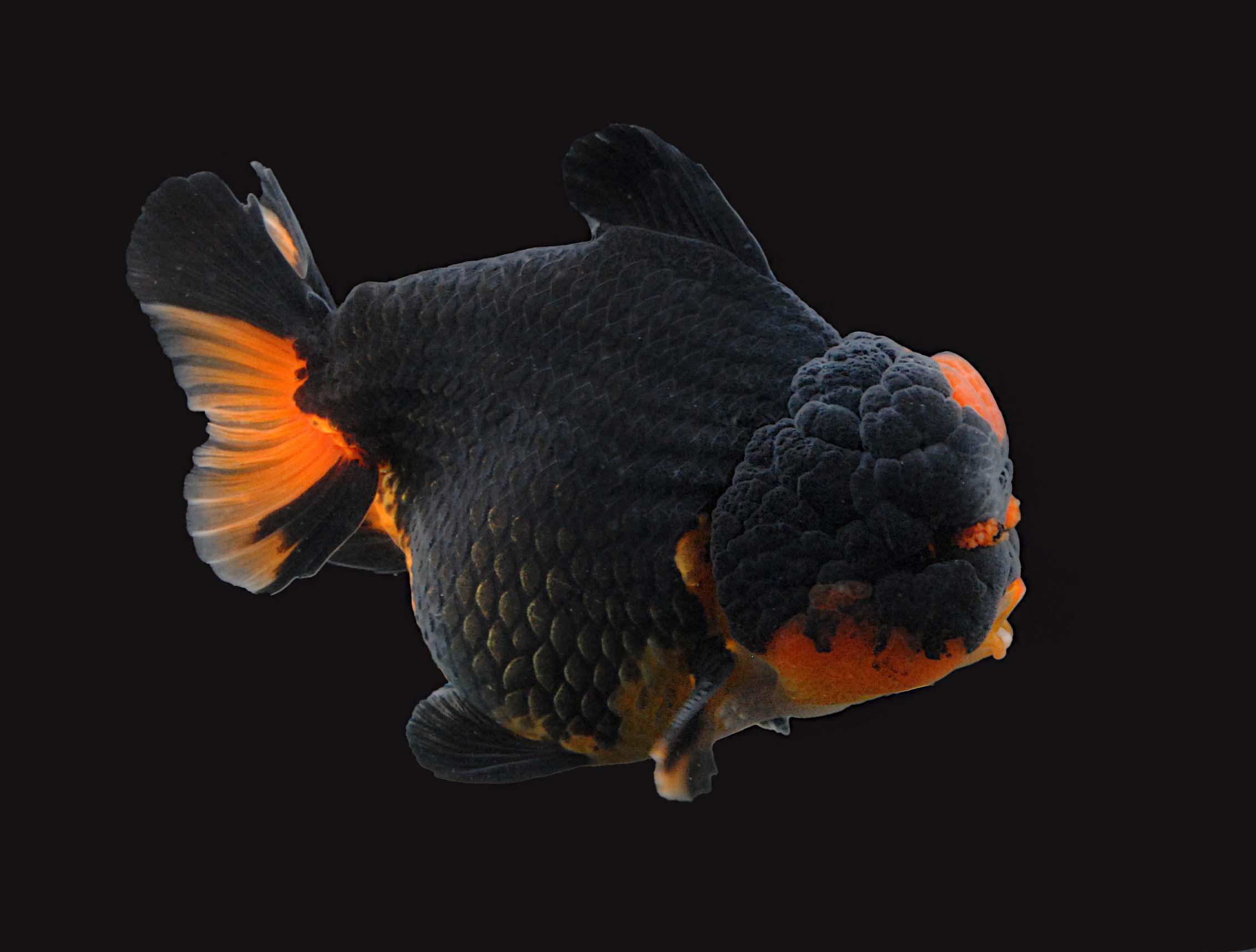
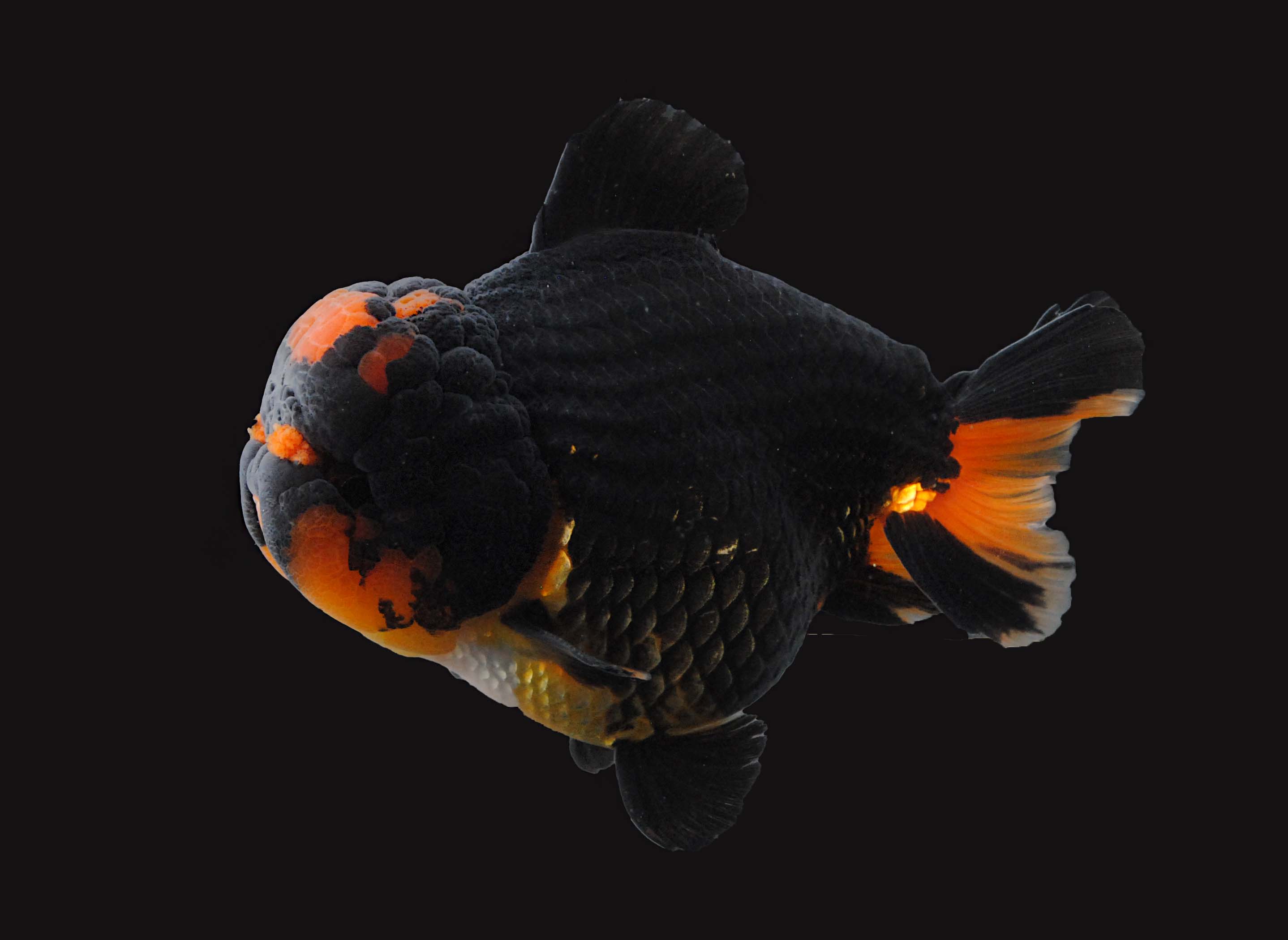
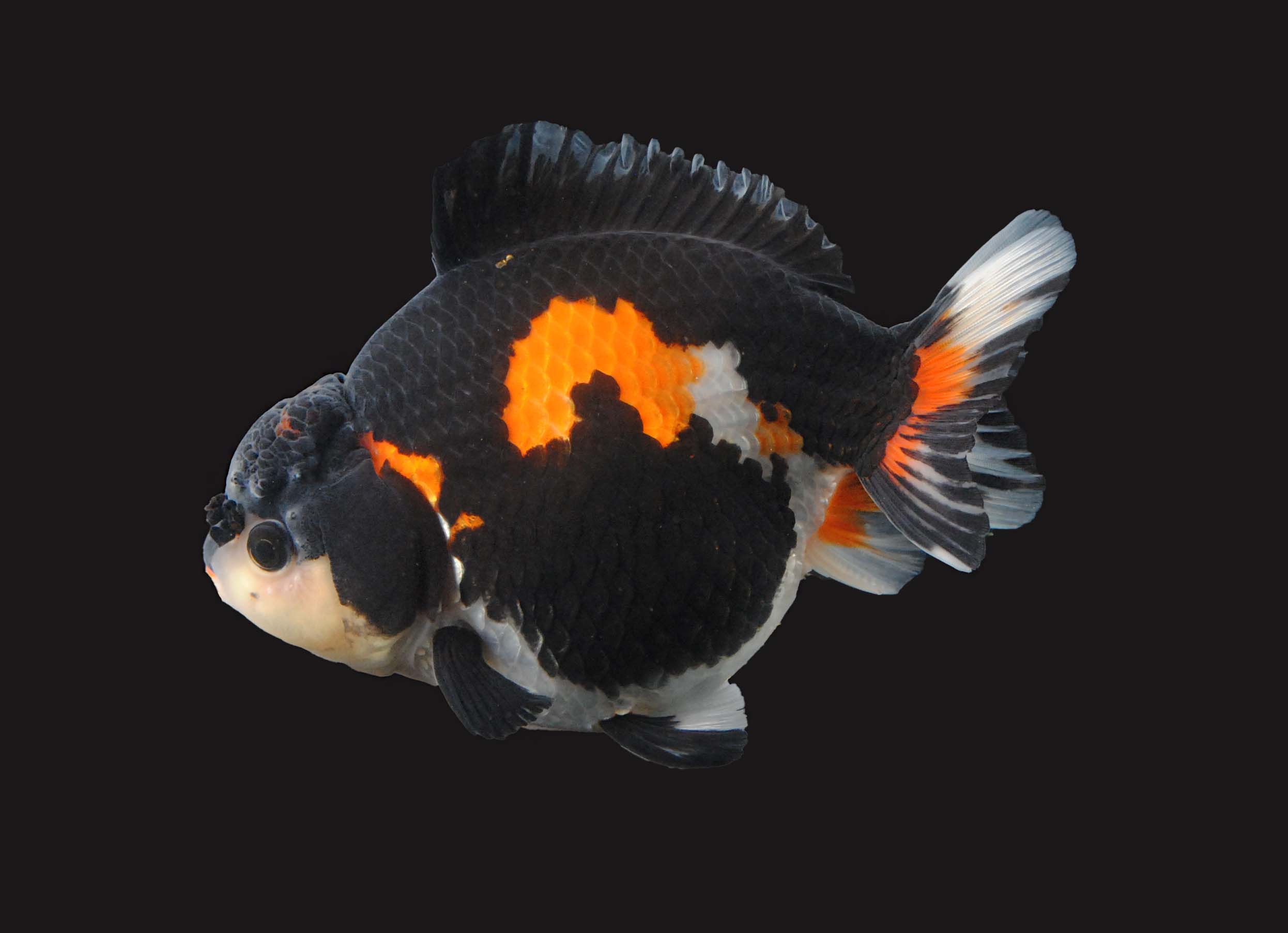
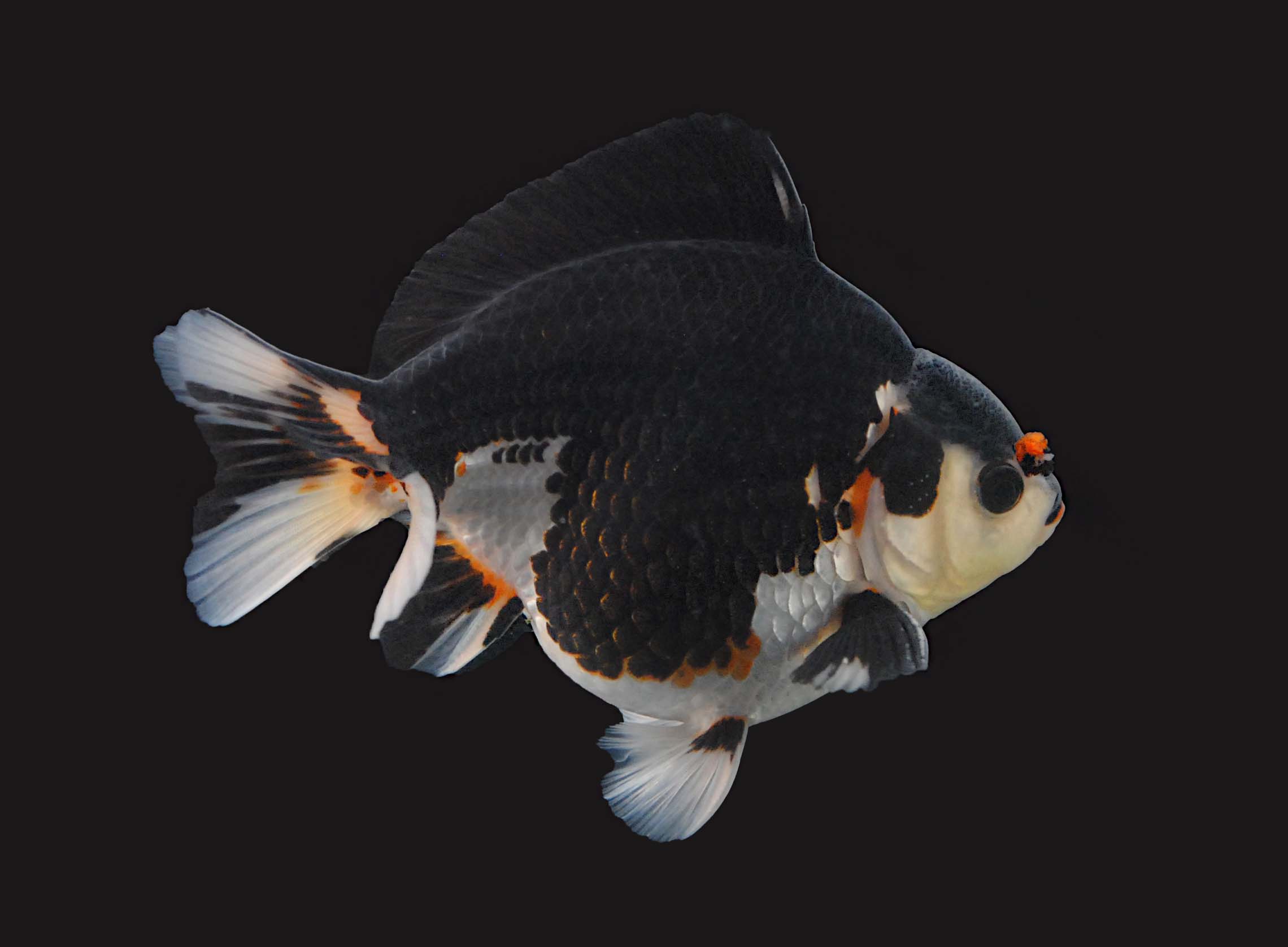
I mated them with their female sibling, which died after that. I mated them back with a tricolor oranda (no picture). The result is great in terms of color. But the dorsal appears fully again. These are two of the results from the tricolor oranda cross:
They have superb colors, don’t they?
The first offspring is my favorite. She is the female I crossed back to the two father four days ago. I do not hope for a decent ranchu shape at this stage. I will settle for a defect dorsal but with good tricolor quality.
The second offspring is a male. There is no point in mating him with the sibling. I mated her with a grey ranchu from my previous failed tricolor project. The backcurve is decent enough, but the tail is weak. It has tricolor gene in its grandparent.
Want to see the results? Must wait for several months to come. Hopefully it will look like this (I clear out the dorsal using Photoshop):
First let me update the offspring of Mr. DBS line in my place. Since it has become the basic ingredient for my tosakin project, I see the need to preserve it. Here are two very different siblings from this line:
My purpose in this tosakin project is to create tosakin with deep red color. I have posted this in the diary #11 this year. From my crossing to get a deep red color, I get two surprises which I have not posted before.
The first one is a red-white fish with a better red color (though not so intense yet) which has a tail shape closer to a decent tosakin (with a shorter tail). But I do think this fish is the key that will bring me one step closer to my goal. That is why I named her the Key. She looks like this:
In the pond, the red color is a bit more intense than this picture. Somehow, I cannot get the color right during my photo session. But the color difference is visible when she is paired with the DBS line as shown below:
I do think that the cross between the DBS line (male) and the Key (female) will produce a decent tosakin with better coloration. So, I mated the Key with several male from DBS line. These are the male fishes:
The one on the right is not the DBS line. He is the deep red semi tosakin fish. I mated him with the Key to preserve the intense red color to be used for the next step of the project. I cannot wait to see the result!
The second surprise is the appearance of a different kind of tosakin. The characterstics are a softer tail, but longer. And a better red color than the DBS line. I do not recall what crossing that produces them. I suspect the butterfly is responsible for this. There are two of them, both are male:
The first fish:
The second fish:
Aren’t they beautiful?
Well, can we call them tosakin? Perhaps not. Not in the standard sense. But, can we create a different strain of tosakin? A softer and longer type of tail. Or is it a sin? Frankly, my mind runs wild imagining a possibility to put my signature on a new strain of tosakin!
But I do not have female fish with their characteristics.
What I will do for sure is to cross them with the female tosakin from the DBS line above:
And what will the result be? I can only imagine something good and beautiful! 😊
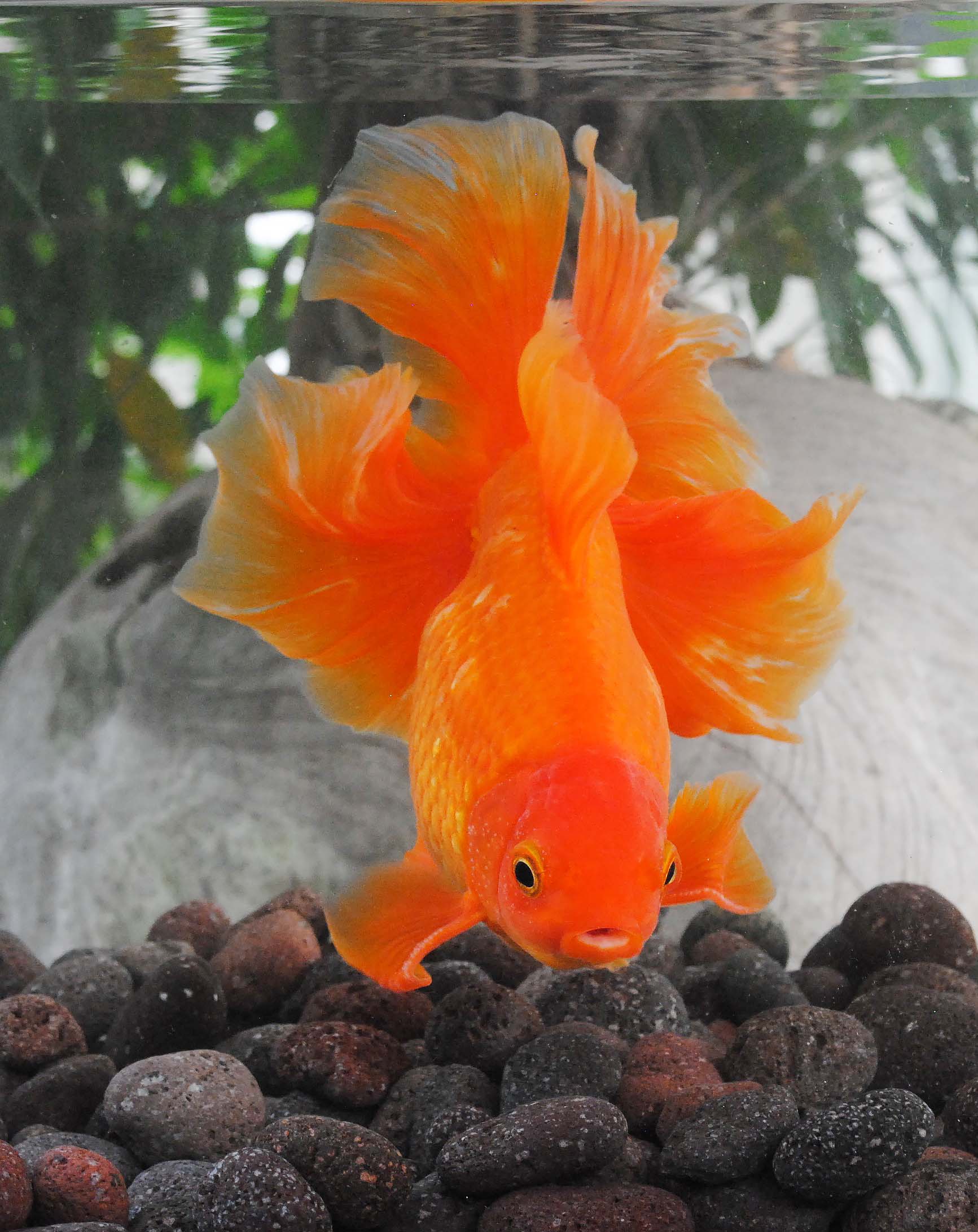
This is a comparison between three shapes of Oranda.
Three of my Oranda have grown mature into Jumbo size. I think they have reached their peaks, or almost. So, it is the right time to compare them with the purpose of learning and adjusting my idealism of Oranda.
The first one is Helen the 2nd, as my main blueprint. She carries the recessive gene of purple color, so she is what I call a semi purple oranda. Let’s see her development over time:
Previous (6 months ago):
Now:
I am not really happy with the development. The headgrowth is growing, so there is no problem with it. But the body which was stout before seems to lose its thickness. I do not know why. Can it be because of the headgrowth? As the head grows, the previously high curve of the back bone looks a bit flat now. Or can it be due to the excessive breeding? Perhaps lots of nutrients in the body are directed to producing eggs to let the body lose its muscles, just like a human mother facing calcium deficiency after giving birth. I do not know. The size of the fish is amazing, but she looks like a young fish with mediocre quality. The color does not seem to change much. The orange color cannot become red. And yes, few flecks of black pigment appear on her body. It is not a sign of stress. It is common for a semi purple fish to develop such color over time. The first ray of the dorsal fin becomes untidy. The tail is in good shape.
These are the video of Helen from the side and top, showing her size:
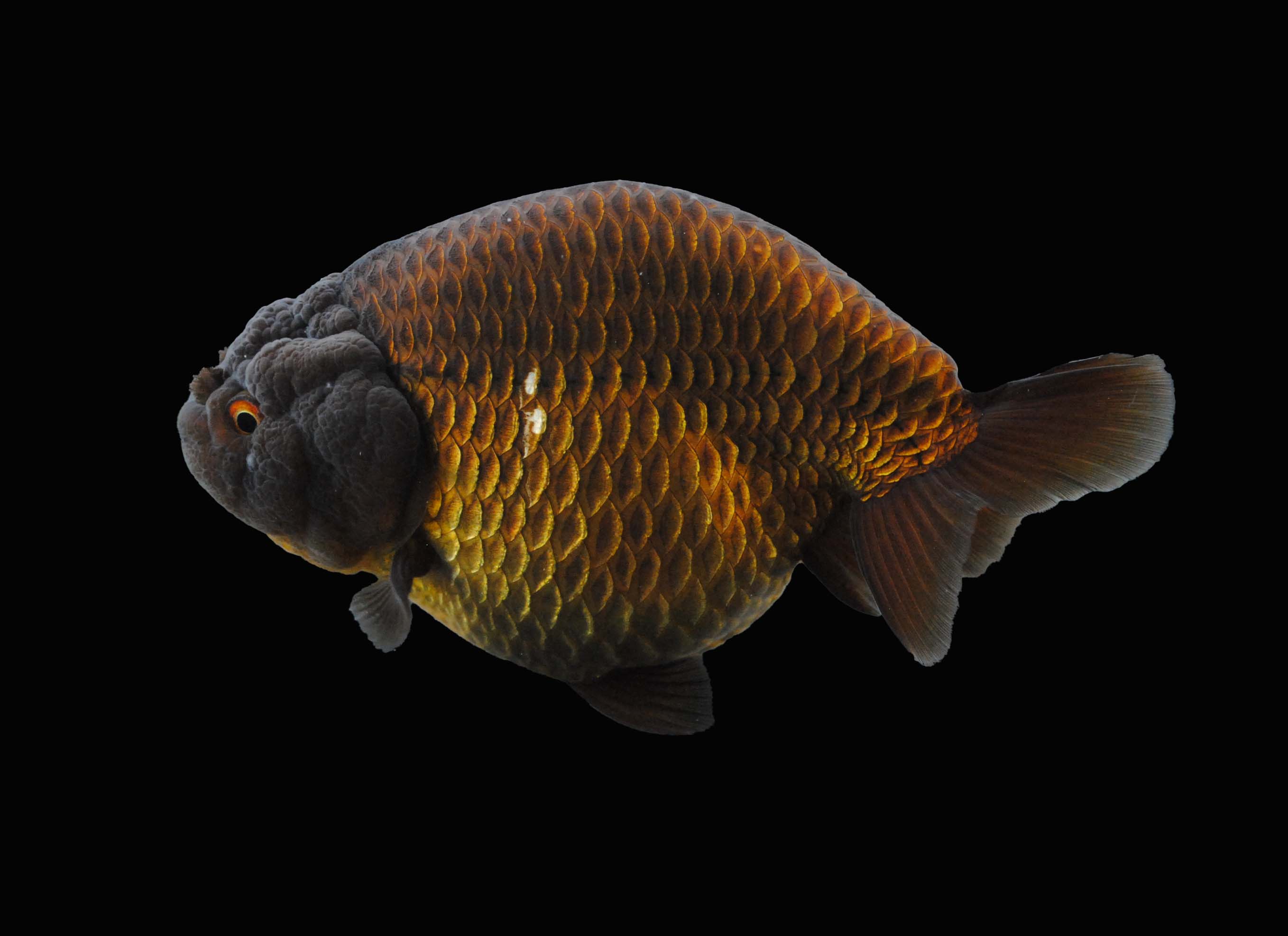
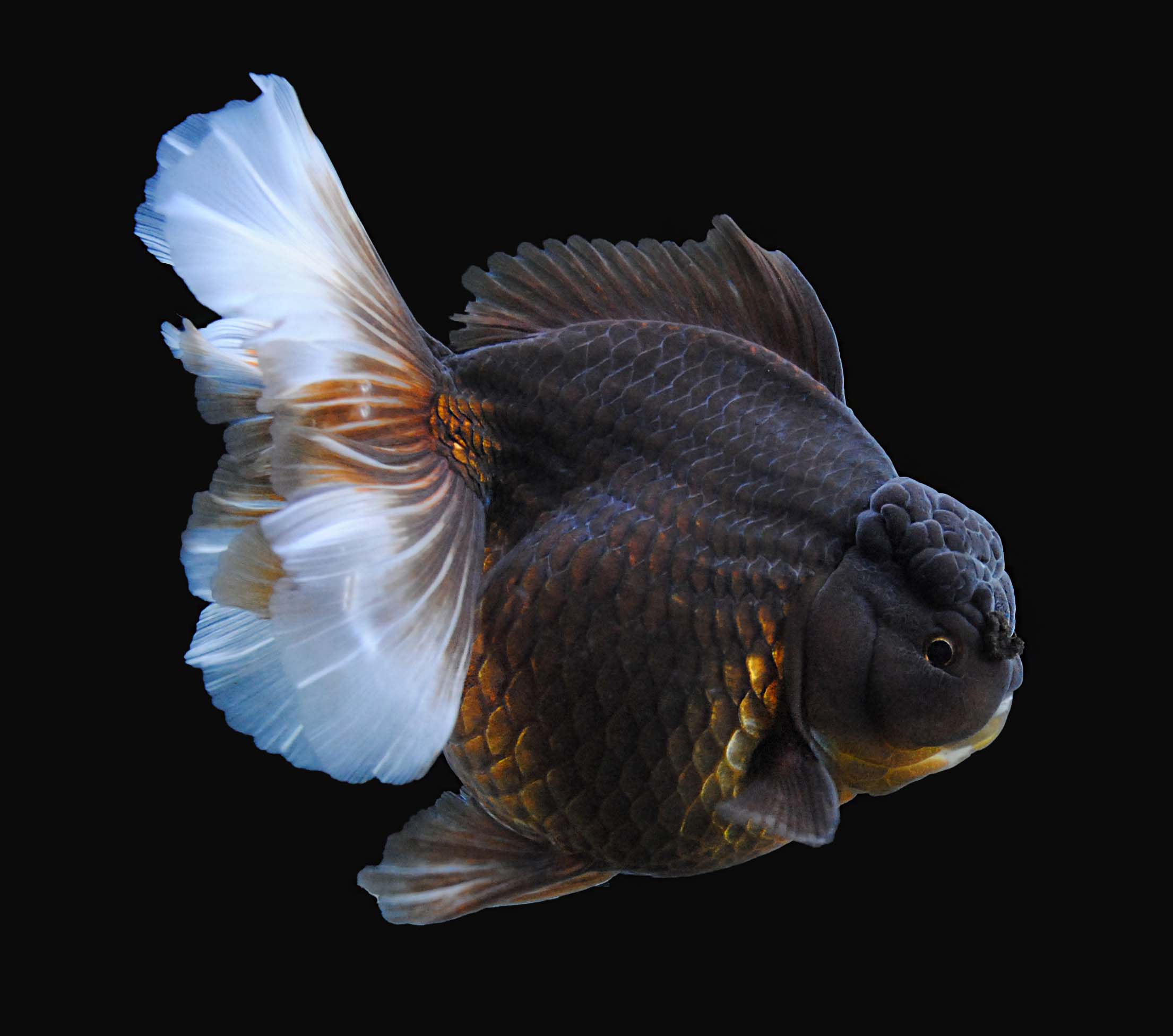
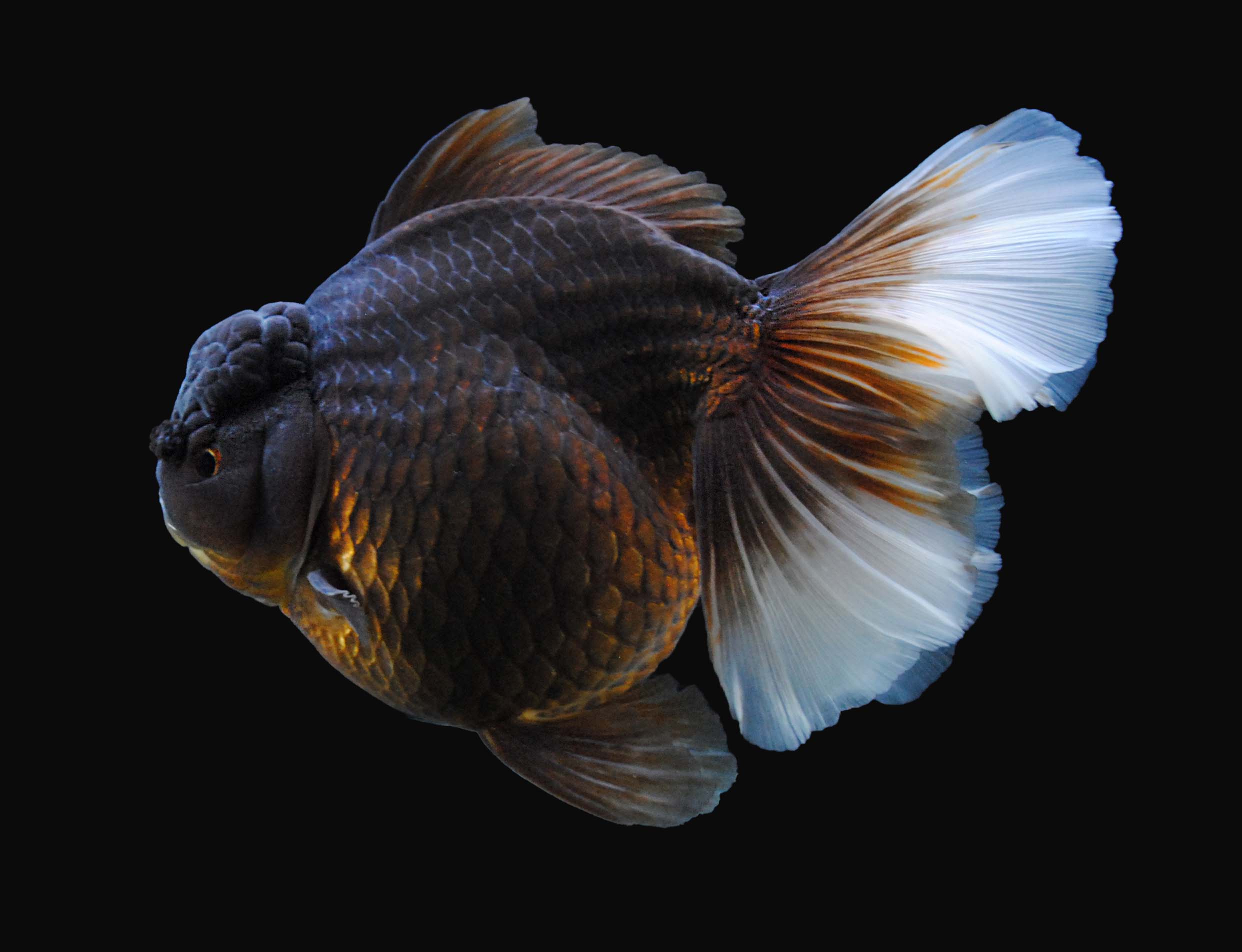
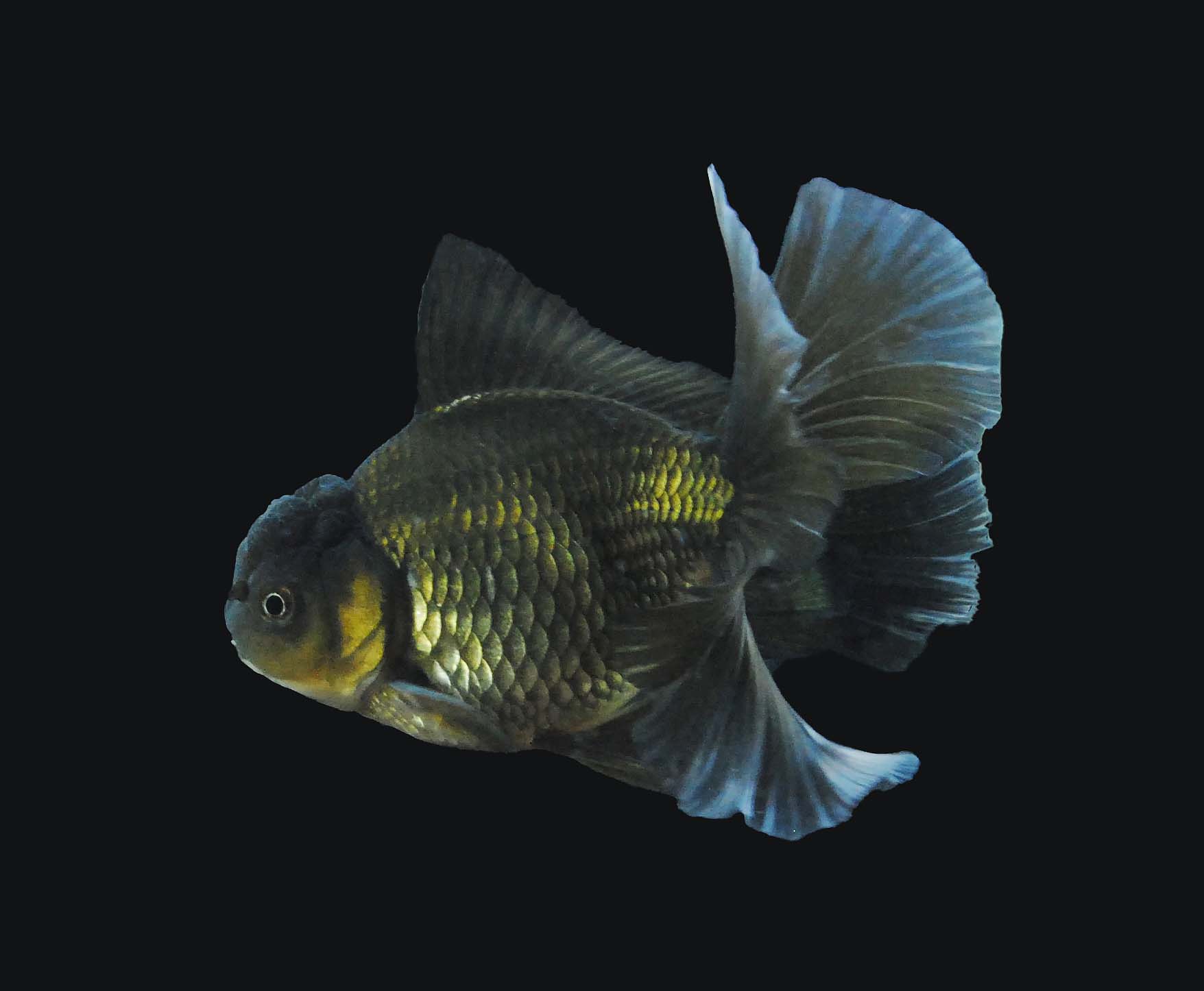
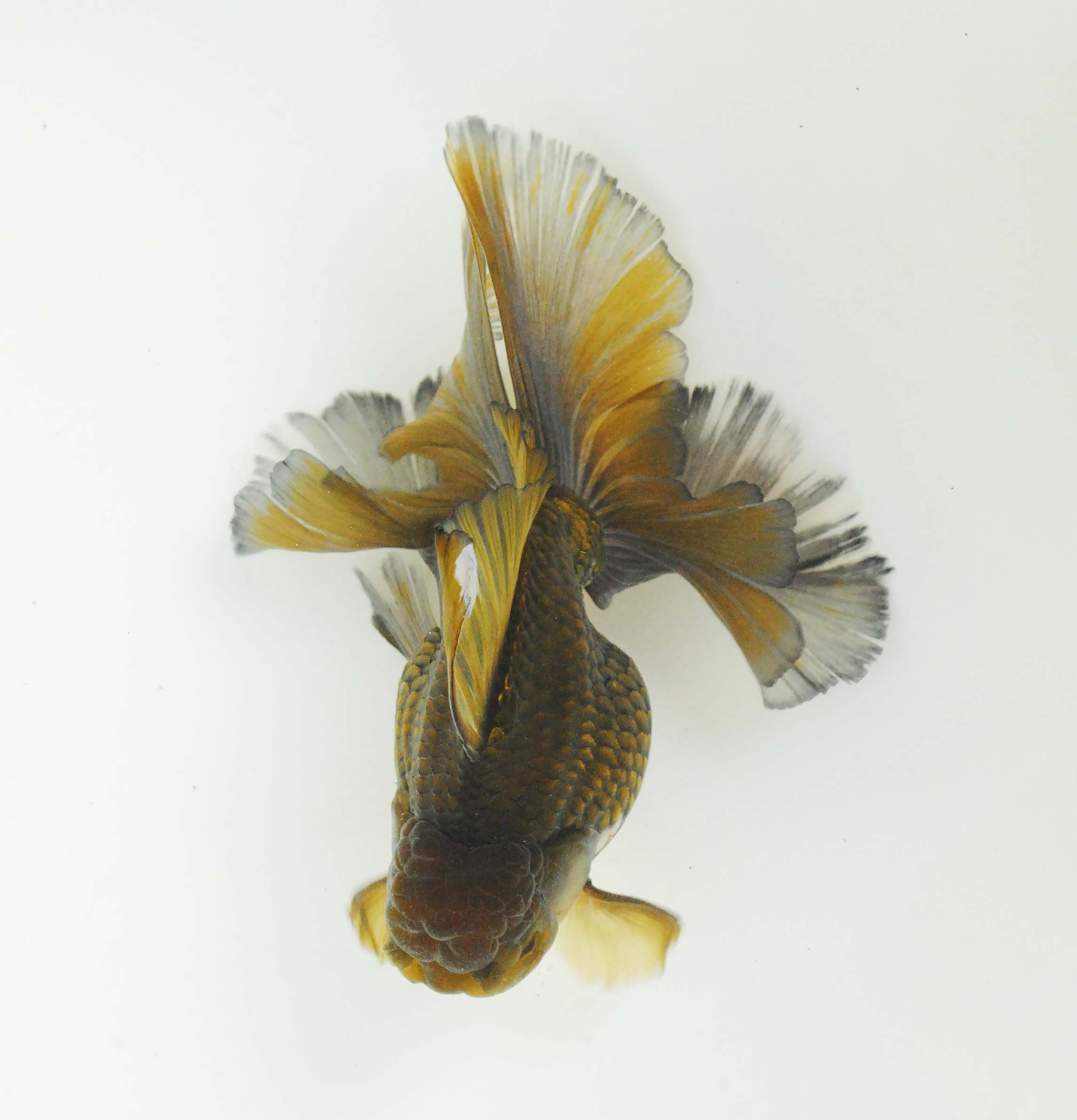
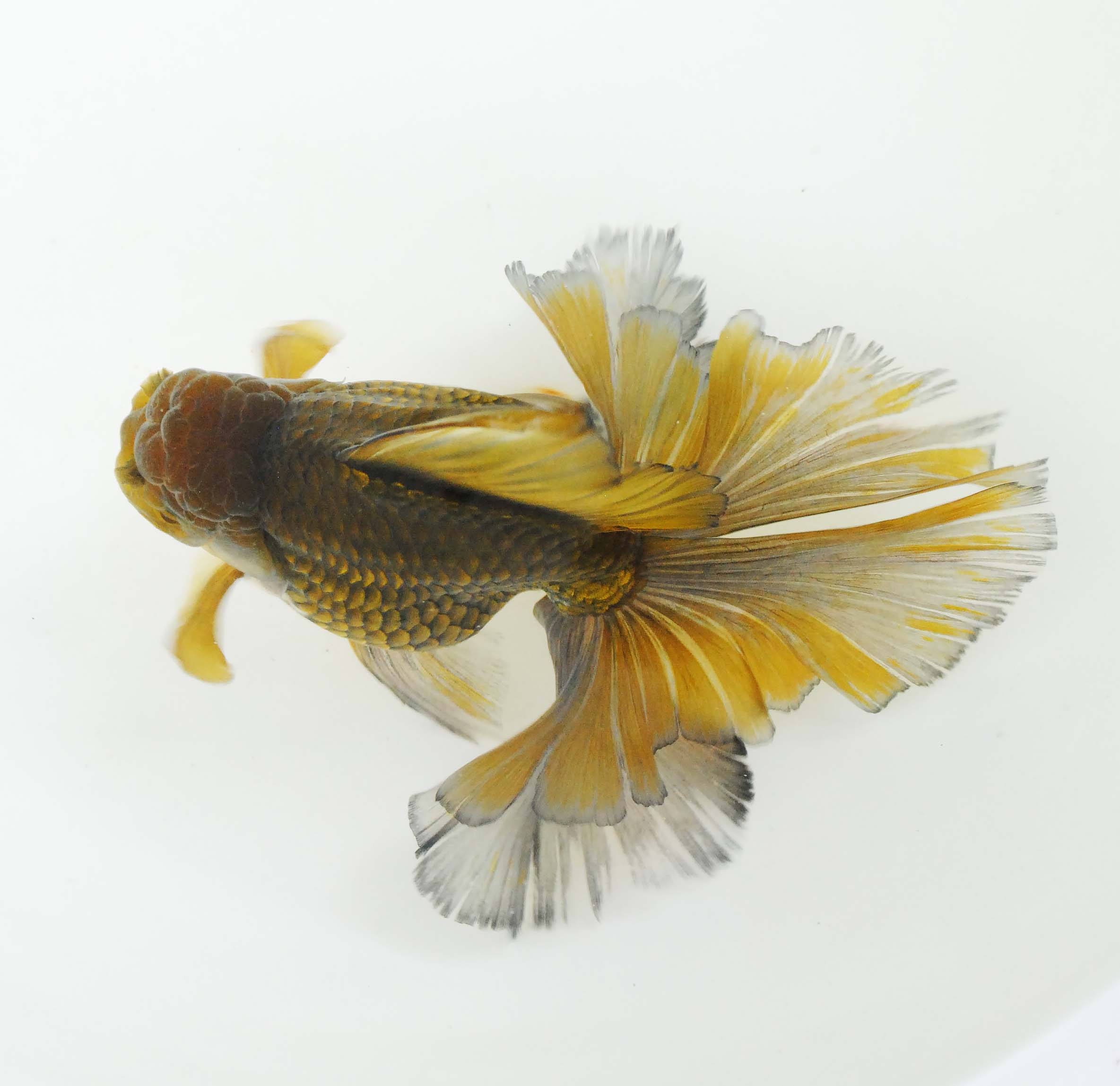
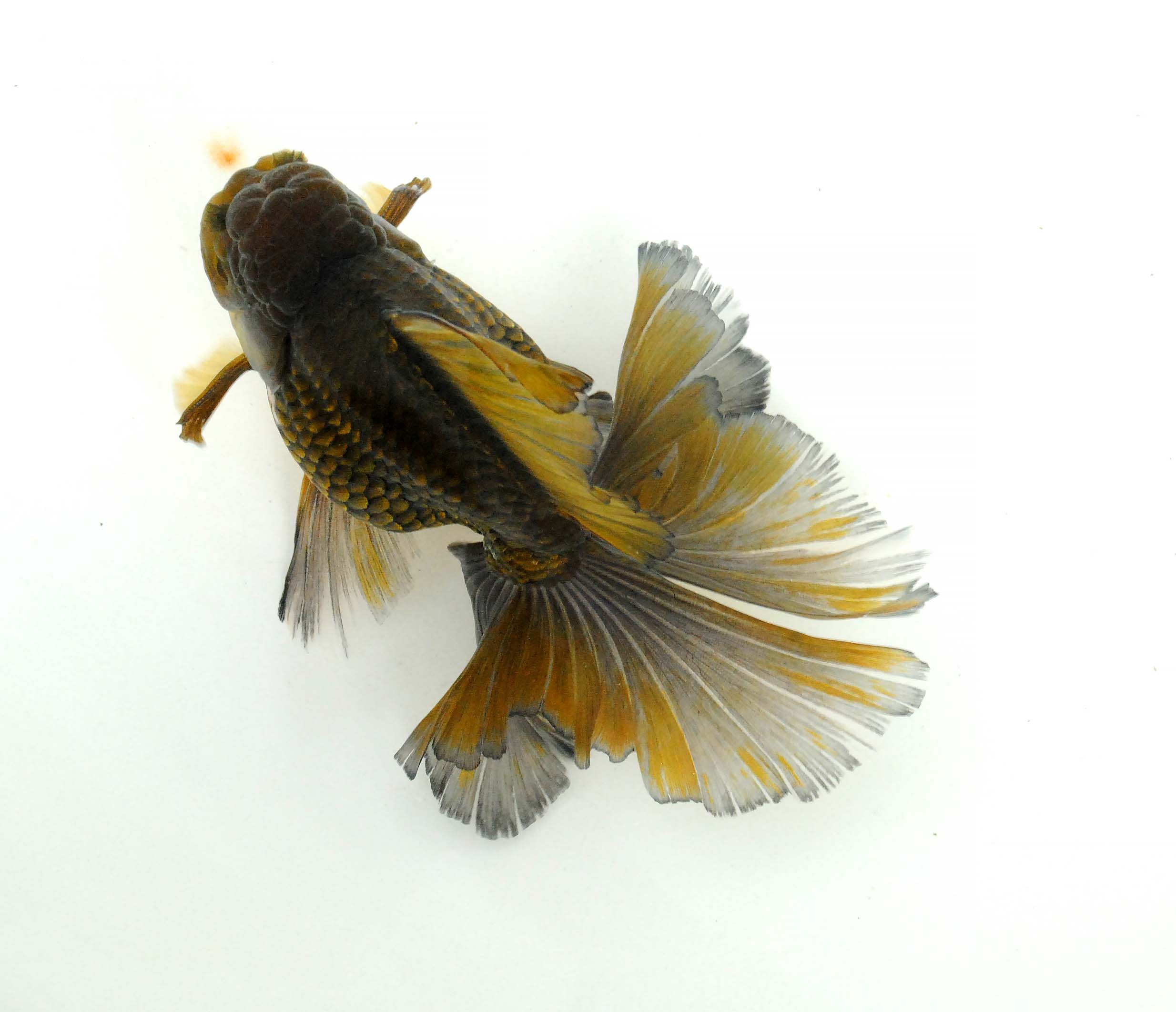
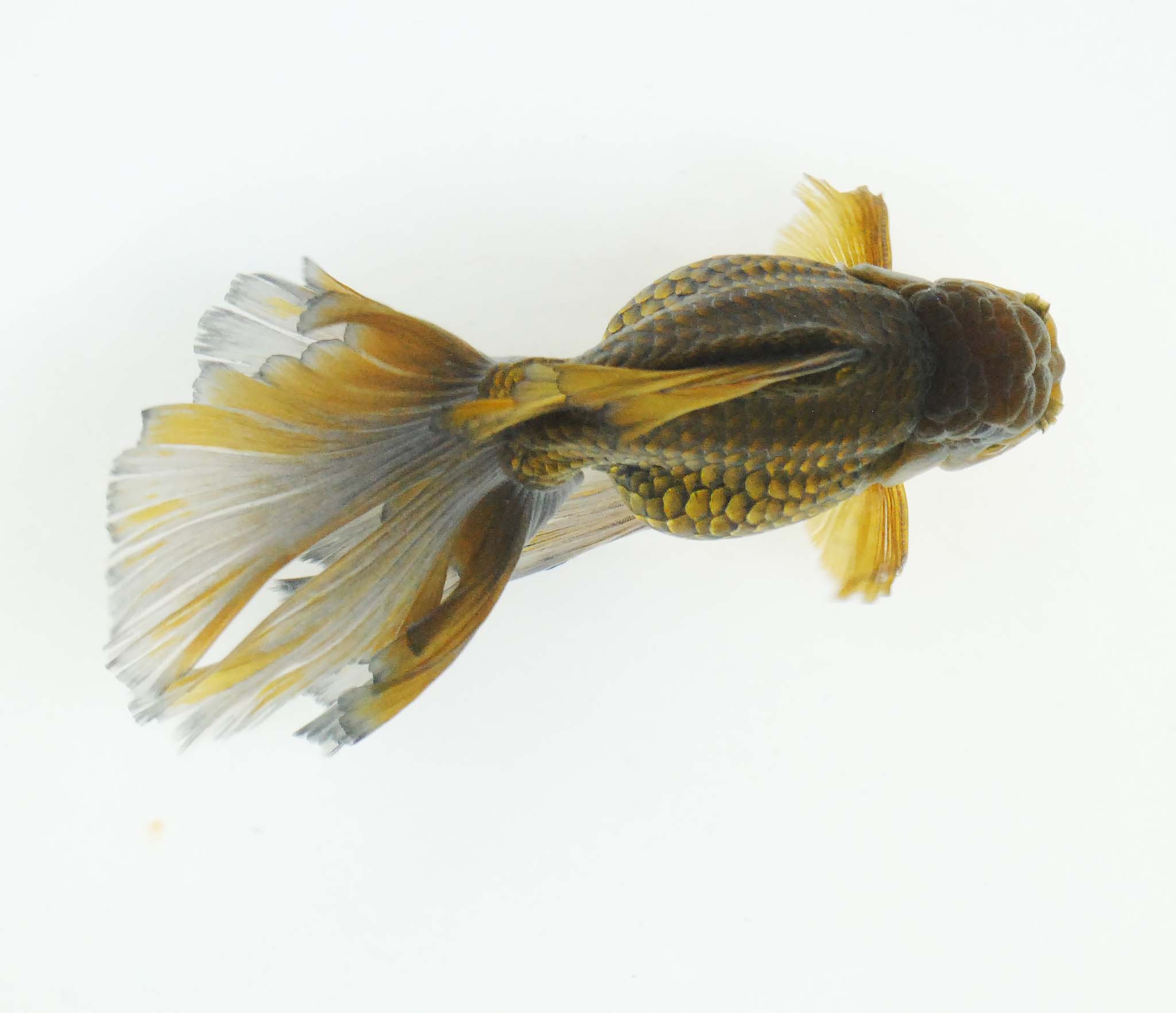
The second oranda to compare is my Dark Choco Oranda. Amazingly, with such a round body she can grow into jumbo size also! Let’s see how she develops:
Previous (6 months ago):
Now:
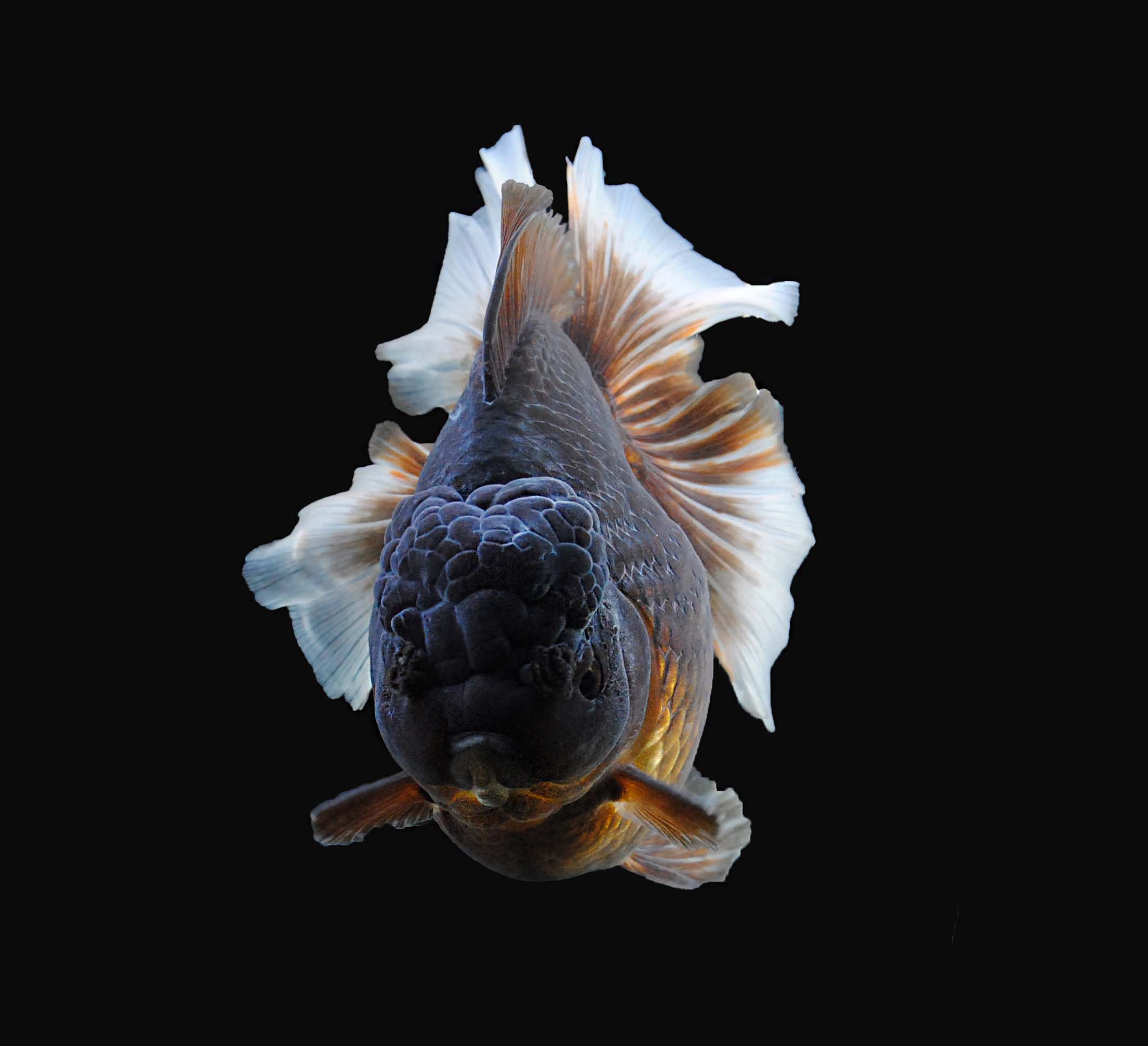
She was not in my blue print at all. I never think about such a ryukin-like body shape. I do not even have a ryukin currently. So, this shape comes to me out of the blue. And the dark chocolate color is another blessing. I do not even know that such color exists. I only knew the tea-colored brown goldfish so far. So, to have this fish is like to hit a double jackpot for me. Since this fish has caught my attention, I think it is suitable for me to give her a name. But I cannot make up my mind whether to name her Kong or Godzila. I think Godzila sounds better, though she is a female.
The headgrowth grows but not so much. It grows in the same pace with the body growth, so she can maintain her bulky ryukin-like shape with the small headgrowth. But the color seems to grown more solid, and it spreads to the fins! The dorsal fin is getting slightly bent.
Seeing this color, I remember that we have various spectrum of black color in goldfish. But usually, we divide them into just two: solid black, and not so solid one. The tea-colored brown resembles the not so solid type of black pigment, while the dark choco resembles the solid black color. There seems to be another layer or coat of brown color on top of the scale, which might be the cause of darker appearance. Let’s review the differences in a picture:
I felt the urge to preserve this dark brown color. So far, I see it nowhere else. It will be a pity if we lose such a beautiful color. I have a male sibling of her with the same dark color, thank God! But the sibling has a very different shape of body and fin! If I mate them, there is a possibility to be able to preserve the dark brown color, but I might not be able to maintain the bulky shape of Godzila. Well, life seldom gives all we want.
But there was a bigger problem than that. Godzila is now about 1.5 years of age and no sign of breeding till last month. Fish usually lays eggs at the age of four months in my place. Godzila definitely falls under the category of unproductive / sterile. I already gave up on her. Fortunately, suddenly she laid eggs for the first time at the beginning of this month. I was not prepared at that time. But I was able to keep the eggs the second time she mated. I could not wait to see the result!
These are her video, from side, from top (to show the size) and the comparison between the dark and the light brown:
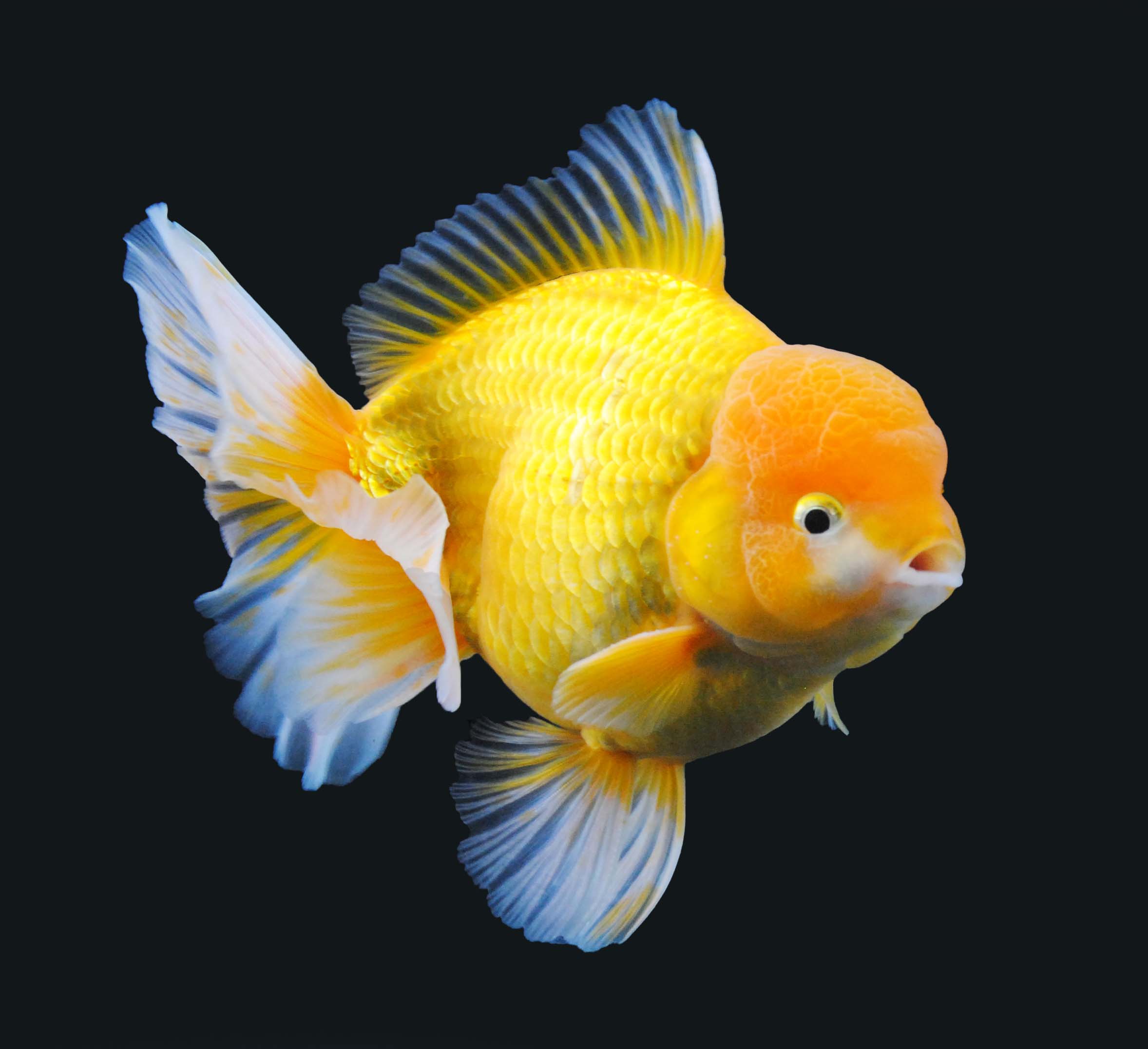
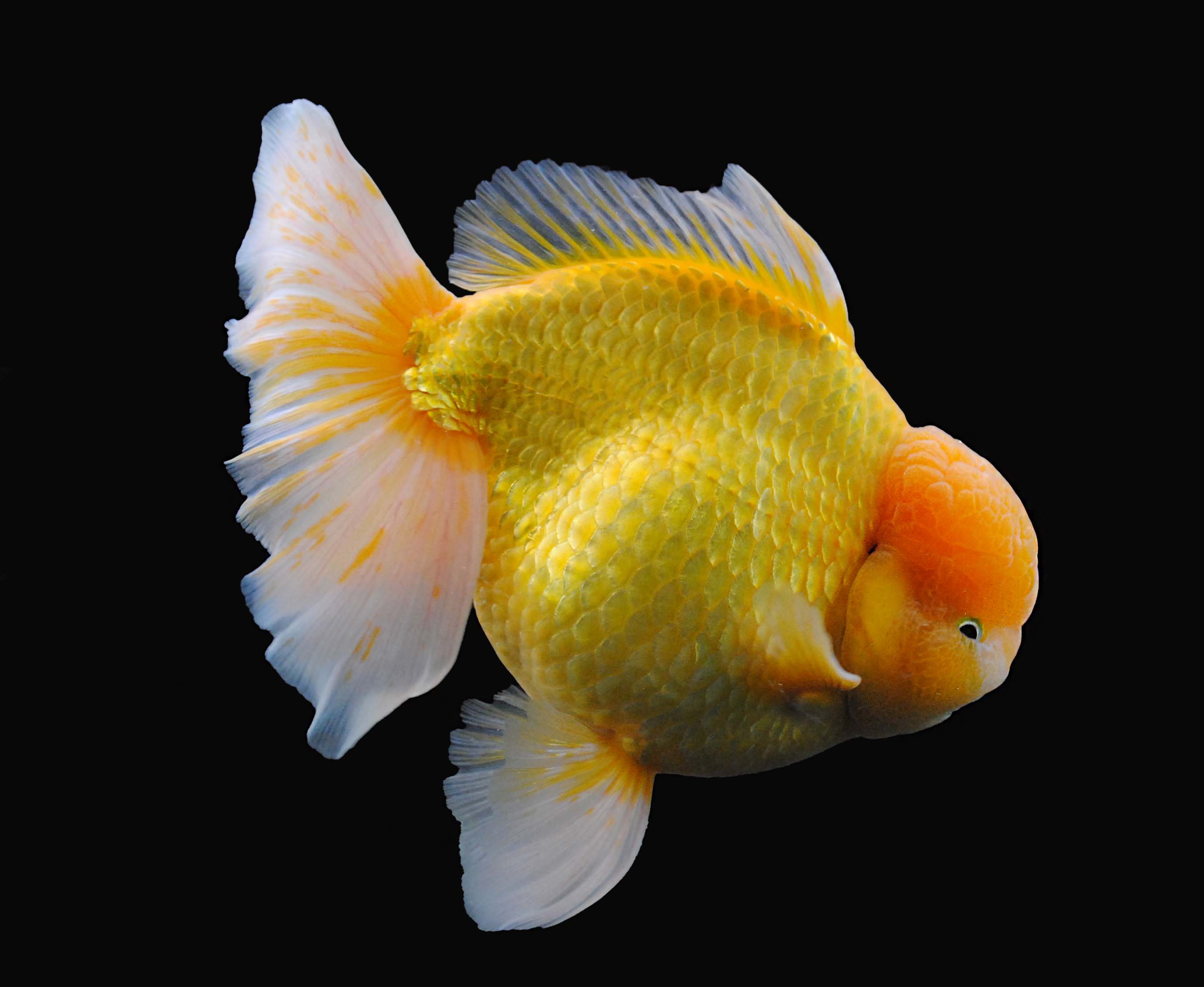
The third fish is a male yellow goldfish. He is a jumbo fish right now and the last of yellow oranda I keep at this moment. Of course, I have his offspring but in a crossing appearance. I mean, I cross her with a goosehead and comes up with a red and white fish as the F1. They are semi yellow oranda. This yellow has a stout longer body with a beautiful headgrowth. Let’s see the development of this handsome guy:
Previous (6 months ago):
Now:
The headgrowth has developed very well. The goosehead type of head is visible, along with the slight development on its cheeks. The fish does not lose its stoutness nor its body length, which I think is good. The only weaknesses are the fold in its lower right tail and the dorsal fin losing a bit of its ability to stay erect.
To refresh a little bit, I had bred Tosakin for many years alone with not much success. Then a friend of mine, mr Dibyo, offered his support in acquiring some good quality tosakin babies from the Izumi Line, Japan. We bought 40 in total. Sadly, they were hard to breed. Mostly the eggs did not hatch, or hatched in a weak condition and died immediately. There were rare occasion when the eggs hatched properly, but when it was time to cull, it became apparent that most of the offspring had defected dorsal fins. The defect could amount to more than 90%. It was a hopeless case.
But by that time, I had a male grey tosakin from Thailand which I acquired before. Since it was the only male I had, I crossed it with butterfly goldfish, and did backcrossing to the father for several generations. I tried to acquire decent tosakin by doing so, but it never happened to my satisfaction. Finally, I gave up the grey old fellow. He was very old and unable to swim. Mr Dibyo asked for the fish, gave him extraordinary care which I could not give, and he even succeeded to mate him with the Izumi line! And the result was fantastic! We called it the DBS line, under mr Dibyo’s name.
Mr Dibyo gave me lots of the F2 of that line, which he let me pick by myself. Mr Dibyo and I had different preferences concerning the tail. He would like to breed those with beautiful large middle tail, while I would like to focus on the fish with strong flips. I picked up those with flips always open even when swimming, with less regard on the beauty of the middle tail. Well, it was hard to get both features at that moment. But surely, it was our dream.
These are the four I kept for my parent fish: one male and three female.
The male:
The three female:
The mating is still hard for me. The fertile eggs are few. But anyway, I manage to have my own Tosakin babies! But I do not update on the babies for now. What I would like to update was my project to create better red color in the Tosakin. As you see, they are all orange in color.
As I mentioned before in another post, I had a very strong red color in a red and white male butterfly goldfish. I called him Beni. He died already. But I managed to cross him with tosakin. Of course I do not get tosakin tail-shape right away. The tail is between tosakin and butterfly. I saved only the fish with the best red color. And this guy is the champion:
He has split tail. Sometimes he shows small flips, but mostly he doesn’t. I am very eager to mate him with those female tosakins as soon as possible.
I have several different color in red spectrum in his siblings. But he is the most red. The picture below highlight how red he is compared to the tosakin. And this is the end of my diary today. Wish me success in creating a decent deep-red tosakin in the near future!
This update covers the evolution of my Dancing Queen (DQ) Project.
To refresh a little bit, my original DQ project was meant to create sideview tosakin. This was the best result from the year 2020 after several years of effort:
But I guess it was a lonely journey. I decided to terminate the project for good. I was struggling at that time. It was hard for me to let go my lovely babies. Just before I let go all my DQ, I made an unthoughtful move by mating my last DQ with a grey Rosetail Oranda. Perhaps in my subconscious awareness I was hoping that Oranda with DQ tail might receive better acceptance. As a result, I ended up with few beautiful grey Oranda like this:
But I quickly realized they could not display their beautiful tail in deep water pond. So, once again, I was thinking of terminating them. But, as before, I managed to unthoughtfully breed them before I sold them. And I think I hit a jackpot. Some of the offspring have flatter tail, making them more suitable for shallow water and top-viewing. So I kept three of them in my large shallow pond along with my tosakin. As the fishes grew mature, I was amazed with the development. One of them grew into a very beautiful fish. Every time I showed him to my friends, they cannot help marvel at its tail. It is visibly different from tosakin tail. And I cannot stop taking his pictures:
And this is the tail position when he swims forward:
The tail is way longer and larger than my Tosakin, and softer. There is a flavor of the rosetail effect which is absent in Tosakin. Yes, it is very similar to the Orchid Tail developed by friends in Thailand. Since it has no legal name yet, my friends and I call it Oranda Dancing Queen (Oranda DQ). And I think I would like to develop it further to be one of my signature.
Too bad, the female are not as good as this male. This is one productive female which I breed with him:
I hope there will be some decent offspring resembling the father.
But I think I need to improve its color and enhance the tail feature. So, I decided to cross the handsome male with Tosakin. I know, this might impact negatively to the headgrowth. But I think I can work it out later on. The tail might look closer to tosakin, but I think I can select some closer to the father. And these are some of the current results:
With this piece as the best, I think:
I can still see the softness characteristic of the tail.
So, my DQ has evolved into Oranda DQ.
Well, let’s wait how these babies will develop in the future. Will they grow their headgrowth? Will the tail become as handsome as their father’s? Let’s hope so!
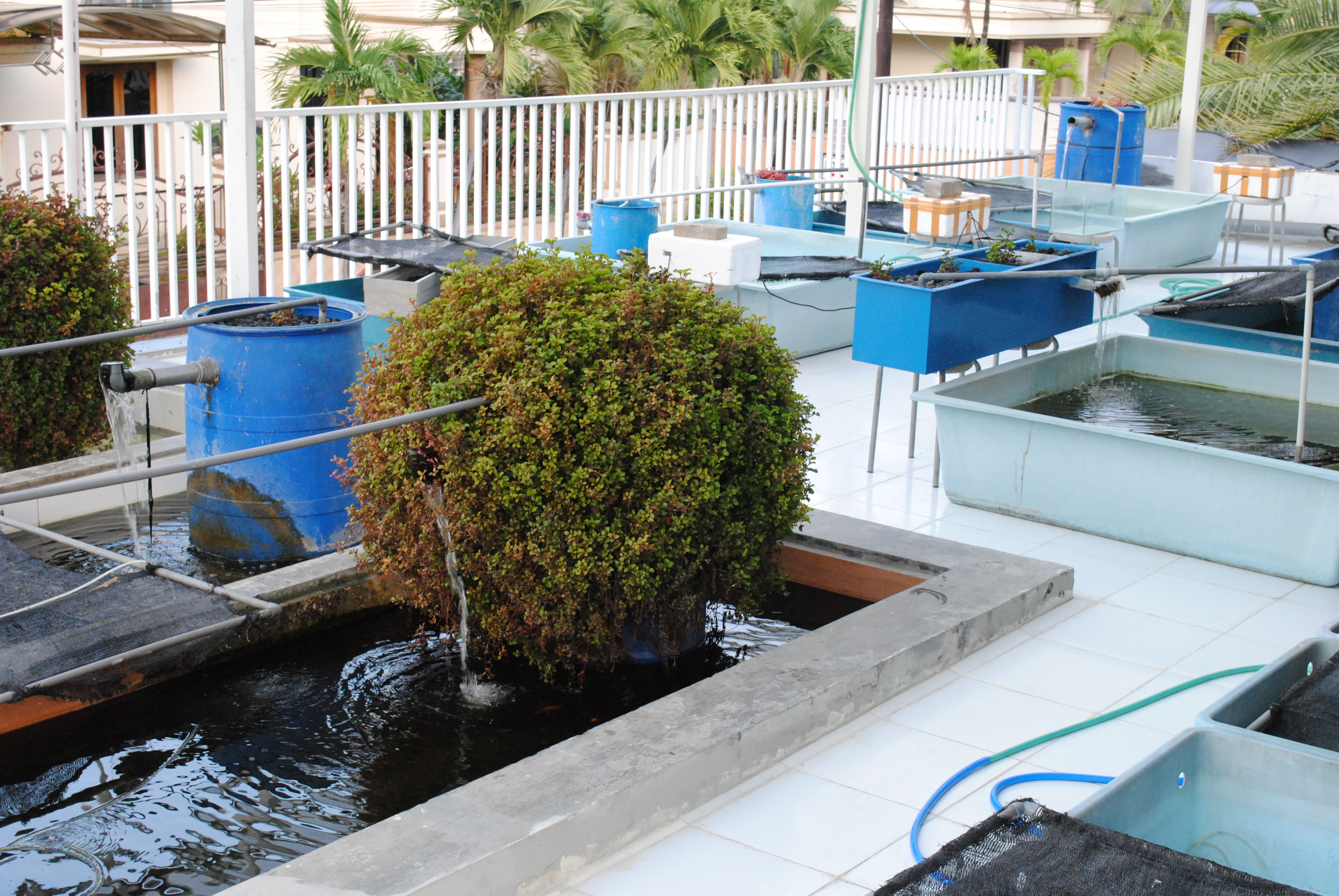
Just a quick apology. I am sorry for being absent for the last several months. It was mainly because my facility need repair. As seen in my profile picture, my place was dirty and in need of maintenance.
The problem became urgent since the waters constantly leaking from several of my tubs and make the metal beam supporting my facility corrosive. My ponds are on the second floor. I think the condition was dangerous. That was the reason I decided to call for the reparation immediately.
It needed a months to prepare the place for repair. I must move several tubs indoor and wait for the workers to get ready.
The reparation work itself took two months. Then the Moslem Holiday of Idul Fitri came, the country was in holiday for almost two weeks. I could not go anywhere since my helper went back to the village to celebrate the Holiday. I took care of my fishes by myself for two weeks. After that, I went on vacation to Australia for three weeks. I was infected by covid 19 after that, which forced me to stay unproductive for another ten days. So, I must halt my breeding projects for almost 5 months.
Glad that now my facility has resume 80% of its operation.
A little bit better with the new tiles and stronger foundation 😊
This fish is a cross between celestial goldfish and butterfly (dragon eyes / telescope eyes). There is nothing unusual from the side view of the fish. It resembles the common telescope eyes. But, there is something strange when seen from above.
Beneath the thin tissues covering the eye-tubes, when observed carefully, we will see other eyes glaring upwards! At a first glance, we might miss them. I was not aware of this phenomenon until I send the fish to my friend’s house. He helped me sell the fish. I just realized this uniqueness when I saw my friend’s video of the fish.
So, the fish has four eyes. Two of them protrudes to the side while the other two look upward. The eyes are the combination of telescope eyes and celestial eyes. The celestial eyes of the fish are not so sharp since they are covered by thin tissues.
Actually, I encountered this phenomenon several times before, but none of the upward eyes are so well-developed as in this specimen. While some might think this case unique, some might think it bizarre. I myself do not think I will continue to develop such feature. Nevertheless, this phenomenon makes me marvel at the mutation capacity of goldfish.
Browsing through old books on Goldfish, I saw specimens I cannot find nowadays. In this writing, I want to mention three that capture my attention.
First, a celestial eye with headgrowth. This is rare. I have met two kinds of celestial goldfish: the popular celestial eye without dorsal (usually with slim body and long tail) and the celestial eye with pompoms (usually comes with short tail and thick body). From my experiment, I have created celestial eye with dorsal fin (Nicknamed Celestial Dragon according to Mr Lei in his youtube channel Goldfish Corner).
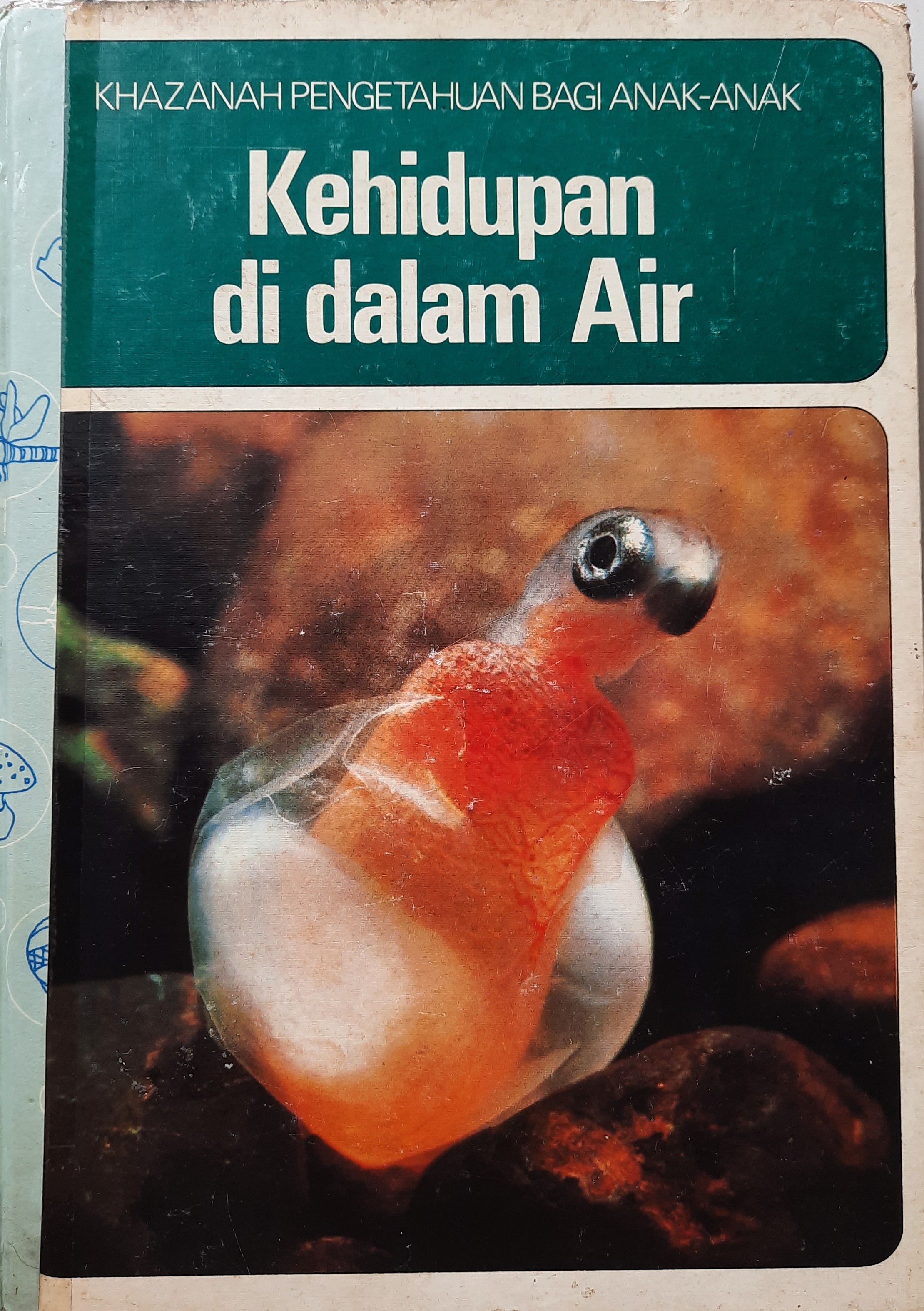
But there is another type of celestial I have never seen alive nor mentioned by anyone else. I find the fish in my old encyclopedia. In fact, it is the first book I read in my childhood that mentions goldfish.
The Indonesia edition has 1979 copyright. Very old! And it has only 1 page about goldfish, which I observed to my heart lots of time.
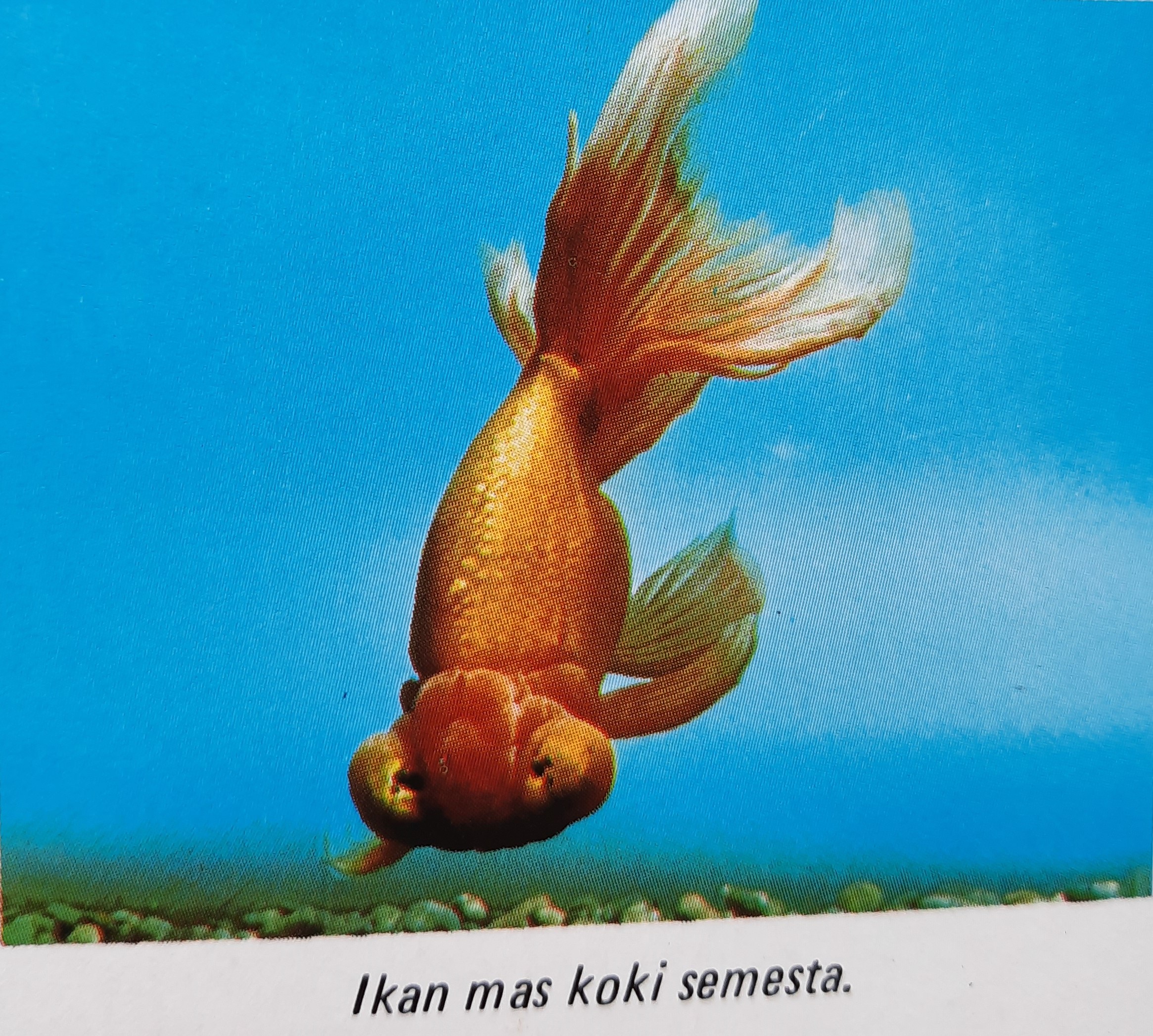
Beautiful goldfish for a child like me! I adopted the terms Hanabus, Seibungyo, Chakin, and more without knowing what they meant. At the heart of this picture is a weird kind of celestial:
This celestial has a headgrowth!
Well, nothing else I can say about it. No other information. It remains an out-of-this-world goldfish for me. Yes, there is a temptation to recreate it. But as I think again, I do not know if I want to do that. The fact that this specimen existed once but no more might be a hint that something might be wrong with it. Perhaps there was not enough market. Perhaps the fish lost a certain function which make it unable to survive. I do not know. I think a headgrowth like that (seems to be like a goosehead type) might intervere with the eyes, in terms of both the functionality and the appreciation – a conflict between two features). Yet, it remains a mysterious fish for me.
Second, a rare ranchu color from Joseph Smartt and James H. Bundell’s “Goldfish Breeding and Genetics” (1996):
On top of page 67 I see a beautiful but rare color:
There is no description about the color. I try to observe this picture many times to figure out if this belongs to metallic or transparent scalation category, but I just cannot be sure about it. And I have no idea of how to create such color! It occurs to me if this was a real fish or just a redwhite fish painted with black marker. But knowing the reputation of the author, I believe it was a real fish. This specimen reminds a mystery to me. Do tell me if you can throw some light on how to create this coloration.
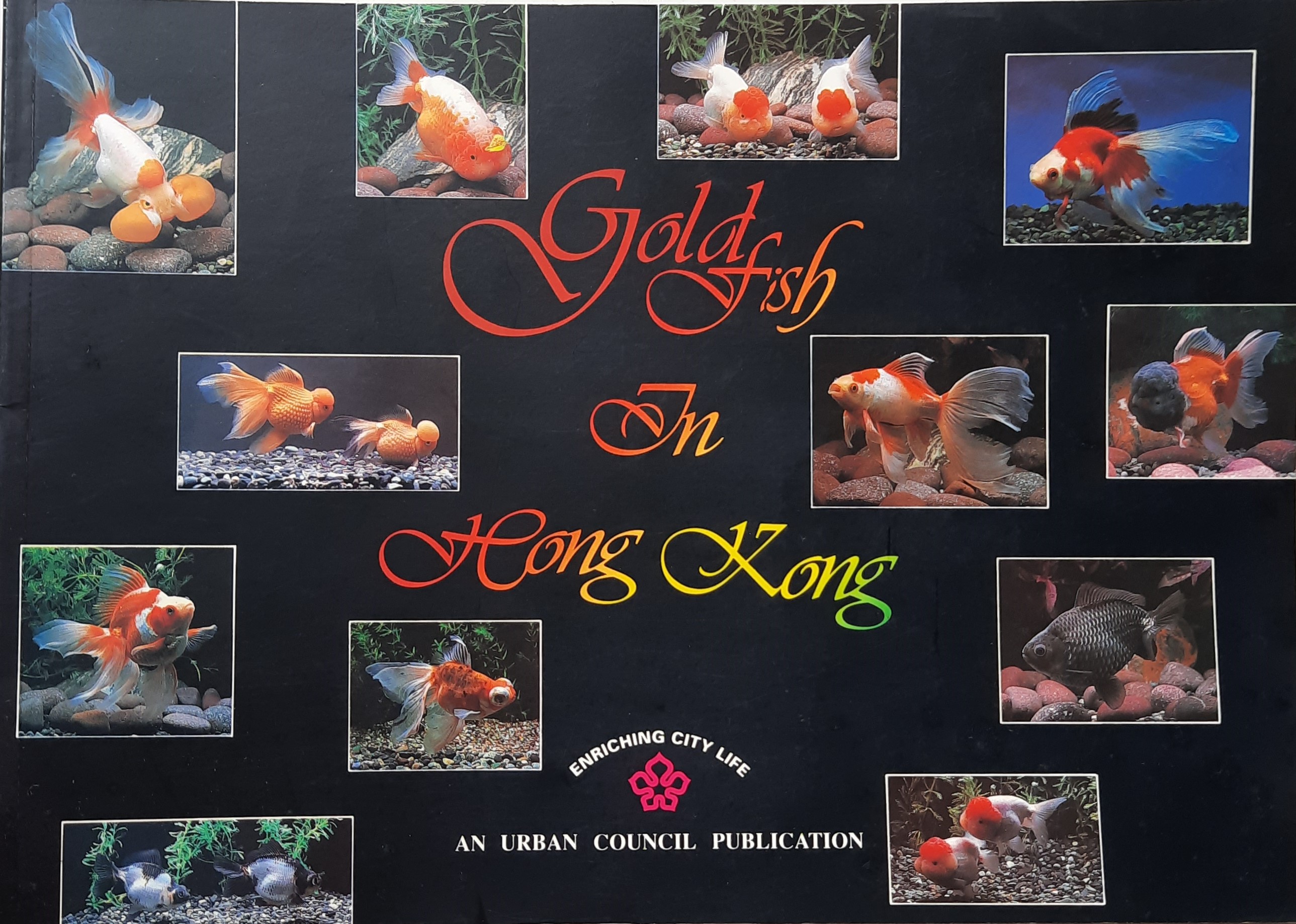
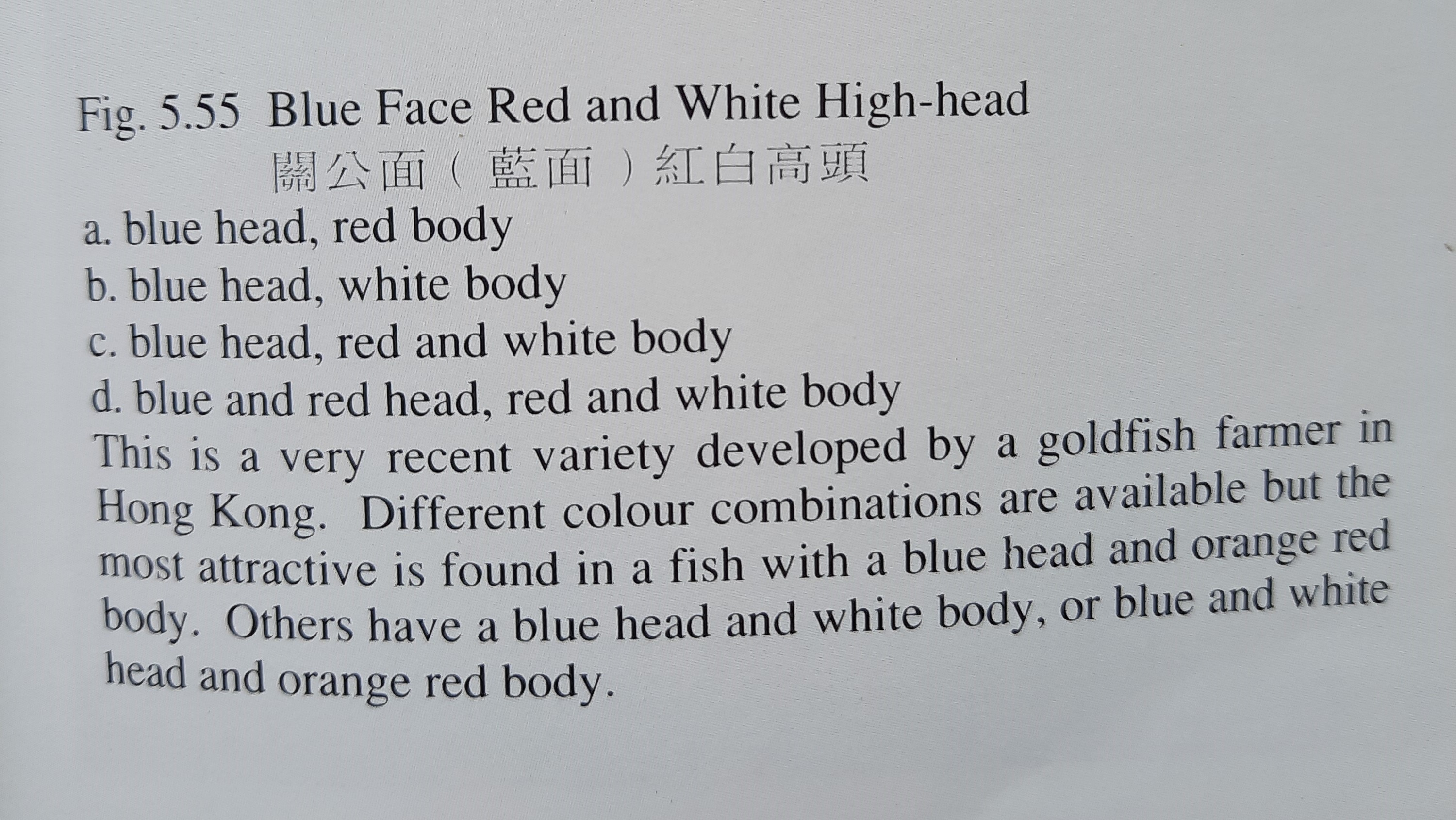
Third, a rare oranda color from “Goldfish in Hongkong” by An Urban Council Publication (1993):
On page 43 there are pictures like these:
And this is the description:
Strange color, right?
For sure I have never seen such a color on the internet nowadays. I also do not know how to create such a fish. The description gives a hint that it has something to do with blue fish (blue metallic scale, I think). But how come the blue color only appear in the face of the fish in a uniform way?
Those three specimens are in the top category of the most mysterious goldfish for me. It will be a delight if one day someone will revive them.









































 hermantogoldfish