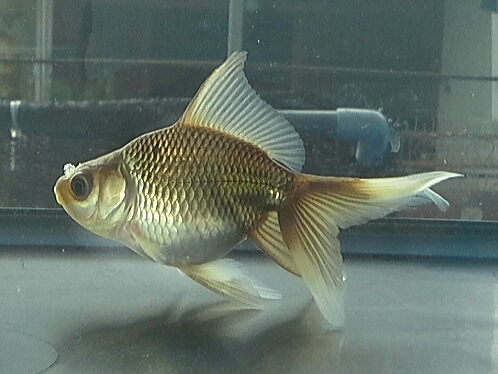
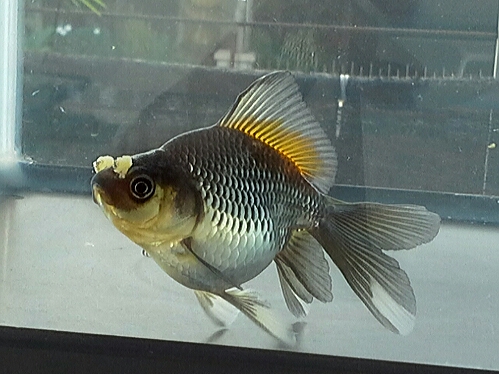
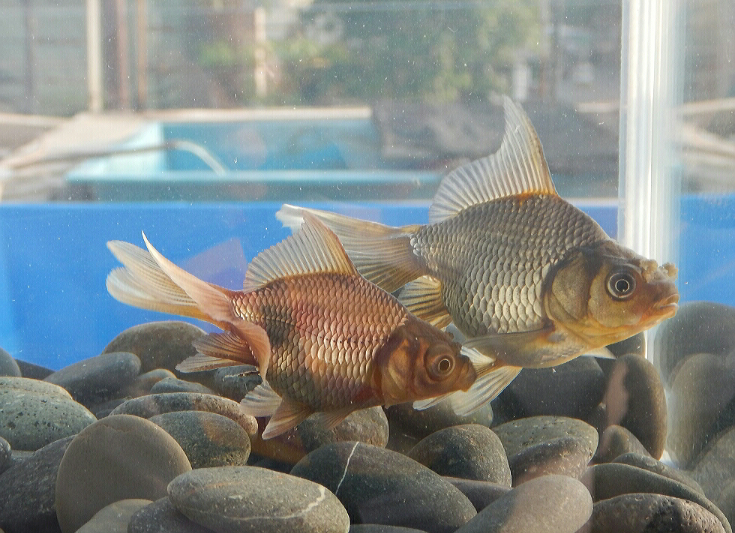
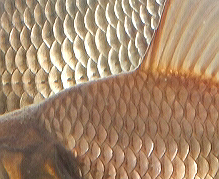
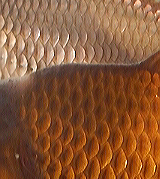
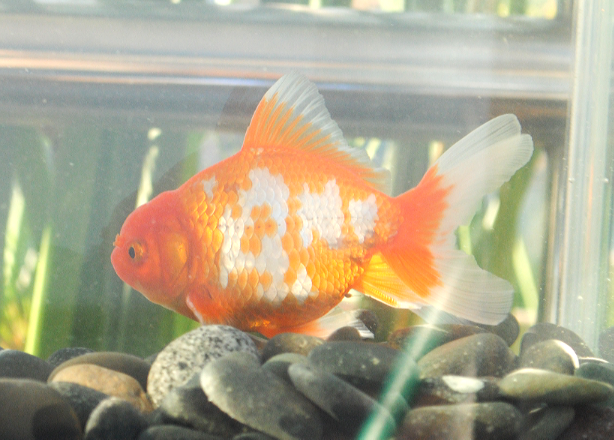
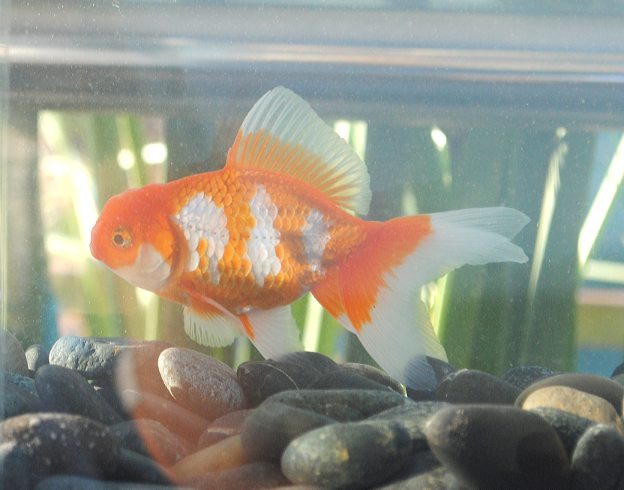
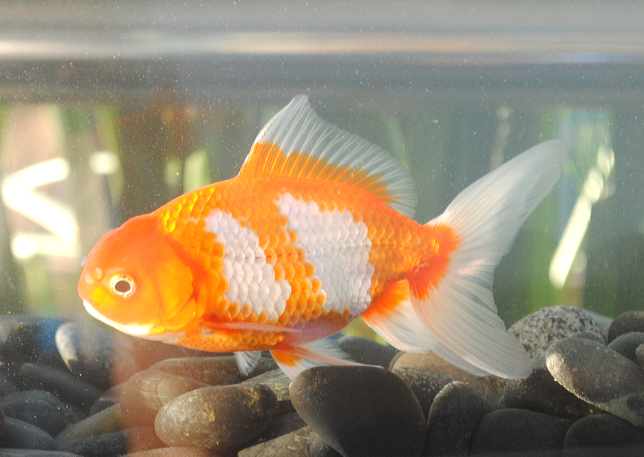
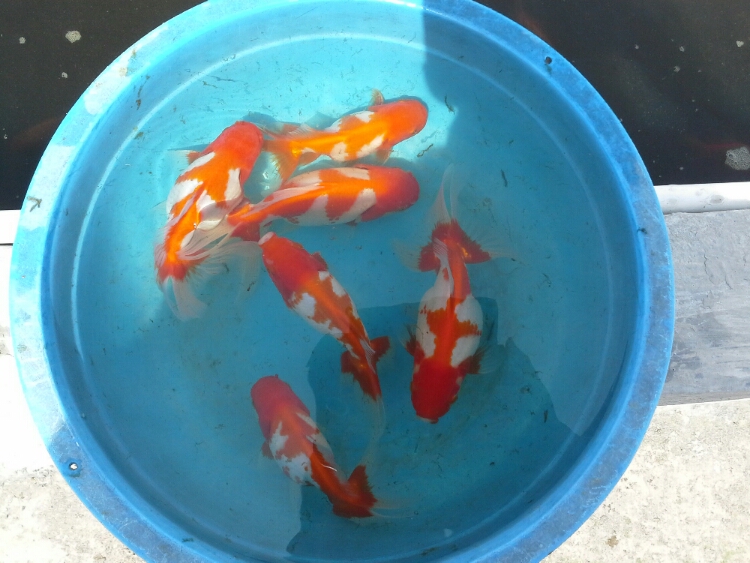
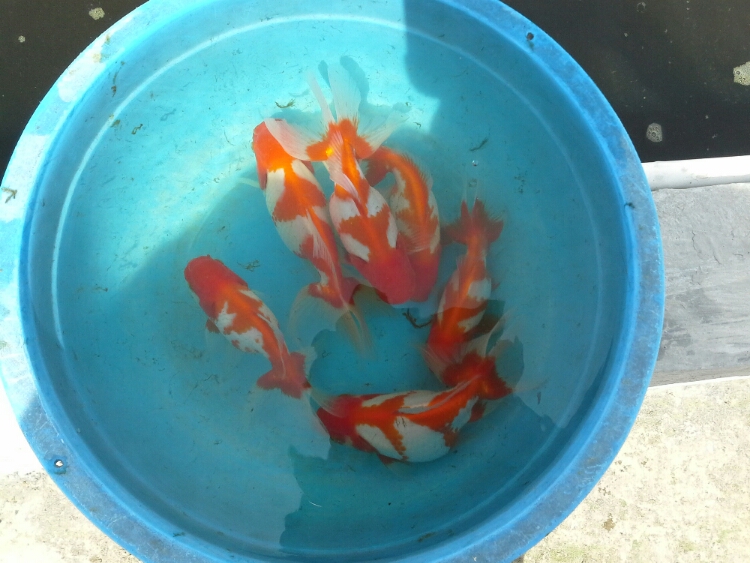
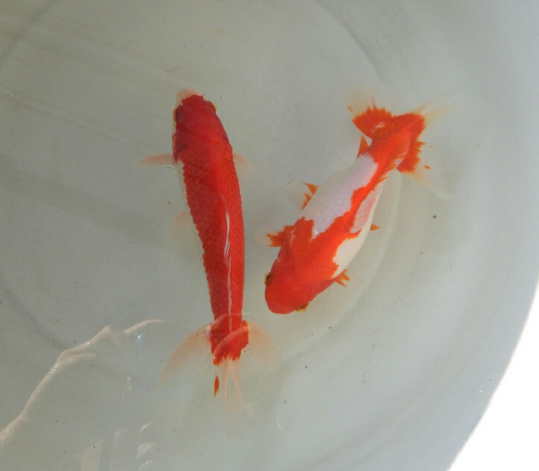
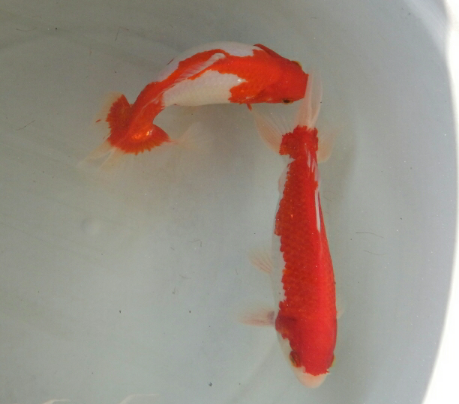
From my experiment to create purple goldfish, I accidentally create panda pompom. This is predictable, since I use chocolate pompom and metallic blue fish as the grandparent. Some blue fishes appear in the offspring. Some have pompom, some do not. But most of the pompom feature are blue also. This one is extraordinary since the pompom feature is white, giving it a good contrast. If today we usually find pompom goldfish with chocolate body and orange pompom features, hopefully we will see more of blue or panda body and white pompom features. I can’t wait to see this piece mature. Enjoy.
Purple goldfish update on July, 2015
The above picture is the same purple goldfish in a lighter and darker background. This color is distinguishable from the blue and chocolate below:
The pictures below show the differences between purple and blue
and this shows the difference between purple and chocolate
The picture below shows the fishes with respective colors from left: purple, green, blue and brown
Below are the highlights
So far I think I have succeeded in producing purple goldfish, or purplish one, or any other name differentiable from blue and brown (chocolate). At this point, I think I can wrap up this project and consider it done. What remains is to try the same project again but with different type of fish. What I have in mind is ranchu. I would like to create purple ranchu. But first, I need to create the chocolate ranchu, which is still my ongoing project. It will be a challenging project!
There is another observation coming from this purple goldfish which I am not ready to share yet. Let see for another year or more if this observation really yields something interesting.
Have a good day!
Beautiful patterns
These are some results of my playing with patterns. The quality of the fishes is not the focus in this experiment. I just focus on the pattern. Enjoy.
Dropsy Treatment
I have experienced dropsy in my fishes probably close to a hundred times. I have tried to find articles about it with no satisfying answers. The best conclusion I draw from my reading is that there is no cure yet for dropsy. Once I even brought a fish with dropsy to a lab. It was a topview ranchu I bought from Thailand. It was a lovely fish. I have treated the fish with all medication I was familiar with, but of no result. When I brought it to the lab, the result confused me. The lab said that they found nothing wrong in the fish. It was healthy. So the lab officer speculated on a mutation as a result of something that happen to the fish that trigger the dropsy. I don’t really understand about it. The fish continued to live for several months in the lab until I finally let it go.
I also experienced rare cases where the dropsy is cured. A friend named Mr Andy Hernianto and I were together in pondering these cases. Our observation led us to believe that there is a way to treat the dropsy with a higher chance of success. This is our conclusion.
First, it must be understood that dropsy usually appears together with or after a certain illness. So, while the dropsy itself is not contagious, the illness accompanying it can be contagious. While the dropsy itself does not lead to death, the illness can lead to death. When the illness is cured, dropsy persists, and the fish lives on. When the illness is not cured and dropsy appears, then the fish is in danger. So, first thing in the dropsy treatment is to make sure that the illness is cured.
I do not know what illnesses cause dropsy. I do not know whether it is a special illness or common illness. I do not know how dropsy develops. It is beyond the scope of this article.
Second, after the illness is gone, high aeration can be used to treat dropsy. In this case, there is no medication needed. Medication can be used if we suspect the illness is still present. The key is high aeration. Later on, we will make this more sophisticated by saying that the key is high oxygen level.
This treatment is so simple. I usually put the fish with dropsy in a shade, and start to give high aeration. This treatment is particularly effective if the dropsy is still in its beginning state. The dropsy can be cured in several days up to a month. I usually put a fish in a clean container by itself, and no filtration. Water change can be done routinely if there is no medication used. If the dropsy has been there for a relatively long period, this treatment seems useless. The dropsy might be permanent already. At least I have tried this for a month, and I gave up. I do not know if the treatment was done for a longer period. This is one experiment I did in 2012.
The treatment took approximately ten days. And the fish was cured as before. Below is the picture of the fish being cured from dropsy.
Later on, I share this finding with another friend Mr Jemmy Wijaya. He reasoned that this must have something to do with the oxygen intake ability of the fish. If that is the case, then cold water temperature will help to cure the disease. Then he did the treatment with a chiller and reported success. I myself do not have a chiller and have never done the experiment. But I think it makes sense.
So, this is how to treat dropsy. I know I do not do statistics, but I sort of thinking that the success rate for a beginning period of dropsy is very high, probably 80 percent or more. Thanks to Mr Andy Hernianto and Mr Jemmy Wijaya. I hope there are scientists among the readers of this blog that will do more experiments to perfect this work.
Playing with pattern
Pattern is not one of the judging criteria in competition nowadays. However, pattern always has its own way to fascinate hobbyist all the time, from beginners to experts. History shows that some breeders had focused on pattern appreciation all along. Red cap oranda is one famous pattern that still exists until today. Jikin breeders are masters of pattern creation with their 12 red goldfishes. I am sure pattern will always find its way in the heart of goldfish hobbyist.
There is a science to the pattern manipulation. Unfortunately, this science is mostly unkown. I believe much of the knowledge is lost. Some who know tend to keep it secret. Most hobbyist are not aware that this can be an area to pursue. The undermining of pattern criteria in competition might contribute to this ignorance. The ethical assault faced by those who practice this art also contribute to the secrecy of this knowledge.
For me, I tend to think that this is interesting. My own experiment has led me to conclude that water parameter, food content, and background color can be used to manipulate the pattern. Other things such as whether it is outdoor or indoor, whether to use biological filtration or routine water change, the density of fishes, the PH parameter, and so on, seem to contribute to the pattern building. Tricks employed by Jikin breeders also seem to work but not to all goldfish. Some goldfish are easier to manipulate while some seem to resist manipulation. This need to be explained genetically.
Wakin and jikin are among the easiest to manipulate. Some oranda react well to manipulation tricks, while some like orange oranda are harder to manipulate. In my experience, ranchu is more difficult to manipulate.
Below is the results of my experiment on pattern building. I am not in the position yet to tell readera what I have been doing. I am still learning. Perhaps later on as I understand more, I will tell. The fishes I used are the oranda that have wakin genetics. They are my F3 from my oranda – wakin cross, which have been crossed back to oranda. I find that most of them are easy to manipulate, but not as easy as wakin. Some from the same batch cannot be manipulated, no matter what I do. Seems that the fish that mutate earlier from its wild color state into red and white is easier to manipulate. The one that takes longer to mutate is harder.
Enjoy.
Ogon goldfish – is it possible?
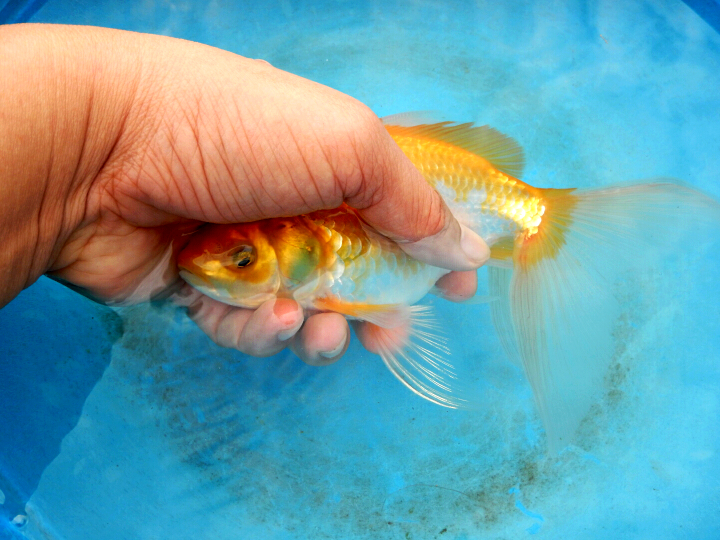
Guanine is the substance responsible to produce the shiny metallic look in the scale of goldfish. When the guanine is absent, we will have the transparent colored goldfish such as sakura and calico. In goldfish world, as far as we know the guanine is found in the scale. It is sometimes found in the gill also. But I have never heard anyone mention about the presence of guanine in the fins. The fins of goldfish is commonly found in its transparent state. Lately, as I was observing my fishes, I noticed a certain yellow fish that have unusual deposit of guanine in its pelvic fins. This is the picture I take this morning:
It is quite shiny compared to others such as this:
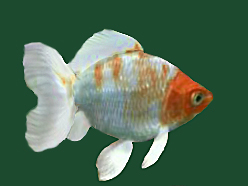
I begin to recall that koi has a variety called ogon, which has shiny fins. I begin to suspect that what makes ogon koi have shiny fins is the abundance of guanine level in its fin. And my mind keep thinking whether it is possible to create ogon like goldfish, that is the goldfish with shiny metallic fins. An ogon goldfish might look like this photoshop image below. Notice the unusual shine in the fins. It will be very eye-catching in the tank. (Sorry for the low quality image).
The yellow fish I have makes me think that this is possible. It is just that nobody has tried this. It will be a tedious project though. Maybe we will need to select fishes that have more than usual guanine deposit in its fins and use them as parent fishes. Maybe this need to be done for many generation through selective breeding until a truly ogon goldfish is created. It will be a long journey. But this will create a new kind of goldfish! Does anybody want to take this challenge?
Purple, really?
My last attempt in Nov 2014 to cross bluegoldfish and chocolate one resulted on one purplish goldfish in the second generation. I was so excited to see it grow. Unfortunately it died early, taking away all my hope with it. Then there was also a problem with my facilities which required a couple of months to repair. My breeding activity was halted.
But now, things are settled, and I can resume my breeding activity. I try to cross parents again. Just for reminder, the parents are the F1 of blue x chocolate. It must be admitted that the purple is always a minority in the offspring. But this time, instead of one, I get about 10 purple! What a joy!
To see the variation of color, I take this picture this morning. The fish in the top position is the blue. Three fishes in the middle are the purple. E one in the bottom left is the grey/green/wild color. The bottom right one is the chocolate. Hopefully you can see their color differentiation.
the purple is what Shishan Chen in his writing reported as the intermediate color between blue and chocolate yet distinguishable from the two. Some other ancient books labeled it as purple, and I will use that name for this particular color.
Three of the purple fishes have turned into white, perhaps due to the warm temperature of my tub. Hopefully not all of them turn white. But this shows that the purple have the capacity to become purple and white, which might be interesting. I do not know yet how it looks like.
Well, hopefully everything is allright, and we can see the mature result of the purple goldfish. After that, I think I will aim at creating purple ranchu.
wowkin update Jan 17th, 2015
My wowkins have passed its one year life span now. Some show the desired tail shape. The size is satisfying. They can grow large enough. The red coloration is also good. The body shape deviates a bit from the plan, though. I was thinking of a body exactly like the wakin. But my best wowkin (in terms of the tail shape) has a body in between wakin and tosakin. This can be seen clearly in the picture
My attempt to inbreed the wowkins results in body types just like the current wowkin and also shorter type, but the tails are long. I think I cannot get the desired wakin body from inbreeding. So, right now I am crossing my current wowkin back to wakin. The pair is shown in the picture above. The wakin is the male.
What to expect from this cross? I think I will get the body right. The tail might have a drawback, though. But I am hoping a small percentage of the ideal wowkin to occur from this cross. If this happens, then the rest is just selective breeding.
updates Jan 16th, 2015
The whole project is frustrated. The prototype chocolate ranchu in the previous posting, the only one, is dead. When I came back from the holiday a week ago, I found the fish died.
Must start it over again.
2014 in review
The WordPress.com stats helper monkeys prepared a 2014 annual report for this blog.
Here’s an excerpt:
A San Francisco cable car holds 60 people. This blog was viewed about 3,400 times in 2014. If it were a cable car, it would take about 57 trips to carry that many people.