Uncategorized

The Diary of a Goldfish Breeder 2025 (#3)

Update on: Ogon goldfish project

In June 2015 I wrote about the prospect of doing a unique project, that is to create ogon goldfish. To refresh the memory, please read the following post:

Now, it has been 10 years since I wrote about it. Nothing has been done so far. Until at the beginning of this year (2025) I met a koi breeder and judge, mr Kevin from Surabaya. He specializes in breeding ogon koi. And he is kind enough to give me two baby male ogon koi from his breed.

I kept the ogon koi in a small tub, in the hope that they will not grow too large. I want to make a cross between the ogon koi and goldfish. The purpose is still the same, to create goldfish with shiny metallic fins and tail like the ogon koi. Well, if it can be achieved, I believe it will be a new unique and beautiful specimen of goldfish. Last time I try to make an illustration of such fish using photoshop, which might not be eye-catching due to my limited skill. Now, I ask chatgpt to generate the fish I envision. And see the difference between my normal tosakin and the envisioned ogon tosakin below!

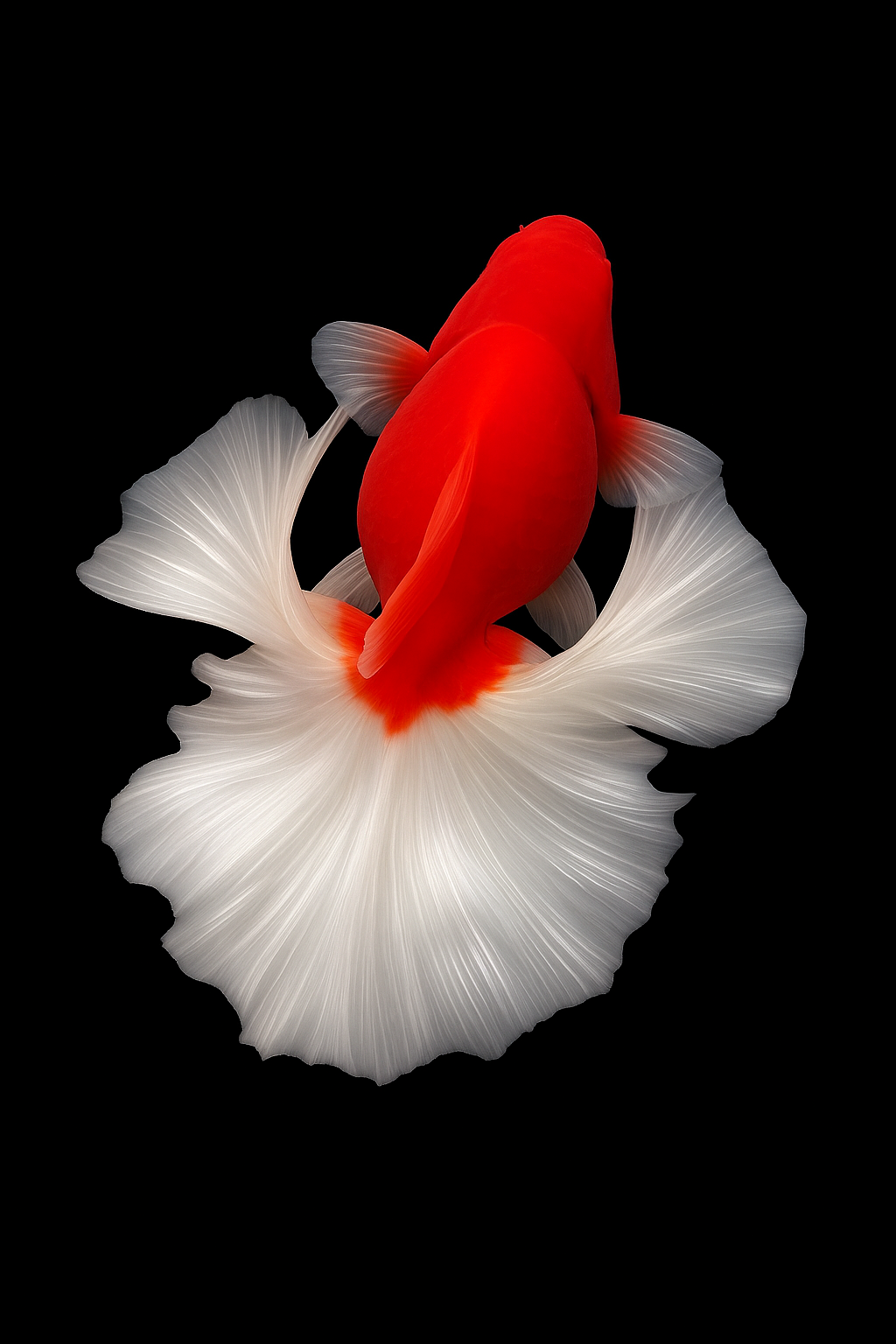
The two ogon oranda below are also generated by chatgpt:

Marvelous, aren’t they?

So, instead of employing the purely selective breeding strategy, I will use the crossbreeding strategy between koi and goldfish. The ultimate question is: is it possible to cross between two different species?

Well, I am not uninformed about this. Since high school I was taught that such cross is possible but the offspring will be infertile. The case being mentioned was the cross between horse and donkey. I believed that theory until lately.

It happens that I enjoy following the scientific new discovery on prehistoric human. We now know that we as homo sapiens were not alone hundred of years ago. There were homo neanderthals, homo denisovans, and some more. They were considered extinct right now. But the DNA research shows that they leave a trace in our DNA. This information shows that it is possible to create fertile offsprings from species crossing. One of the podcast (I forget which one) raised up a question of how this is possible. The speaker explained that species categorization and the conclusional theory about infertility in the species crossing are man-made, and nature does not follow human’s categorization nor theory. Well, it was an enlightening explanation for me.

Then I went back to the case of crossing between horse and donkey. I ask chatgpt to find information about such crossing and whether there was a case that does not conform to the theory of infertility. And guess what? There were several documented experiment on such case! the record showed slight chance that the female F1 of such crossing were fertile. When they mate with male donkey, the offspring (F2) are donkeys. The AI does not find the case of crossing back to horse. And no account of fertile male F1. Well, I do not dig deeper. I think this information is enough for me to conclude that koi and goldfish can mate, and there is very slight chance that the offspring are fertile and I can cross them back to goldfish, provided the specimen carries the metallic fins genetics as in ogon color. Yes, I know it highly depends on luck. So, I need lots of best wishes from all the hobbyist who read this diary.

In the goldfish world, I have with me a paper from 2008 titled “The formation of a diploid gynogenetic hybrid clonal line of red crucian carp x common carp, and its application” by Shaojun Liu, Jing Wang, Wei Duan, Min Tao, Jifang Liu, Chun Zhang, Kaikun Luo & Yun Liu. It seems that they were doing the same experiment with koi and goldfish. unfortunately, the paper is too technical for me to read. I do not have enough background to understand what it says.

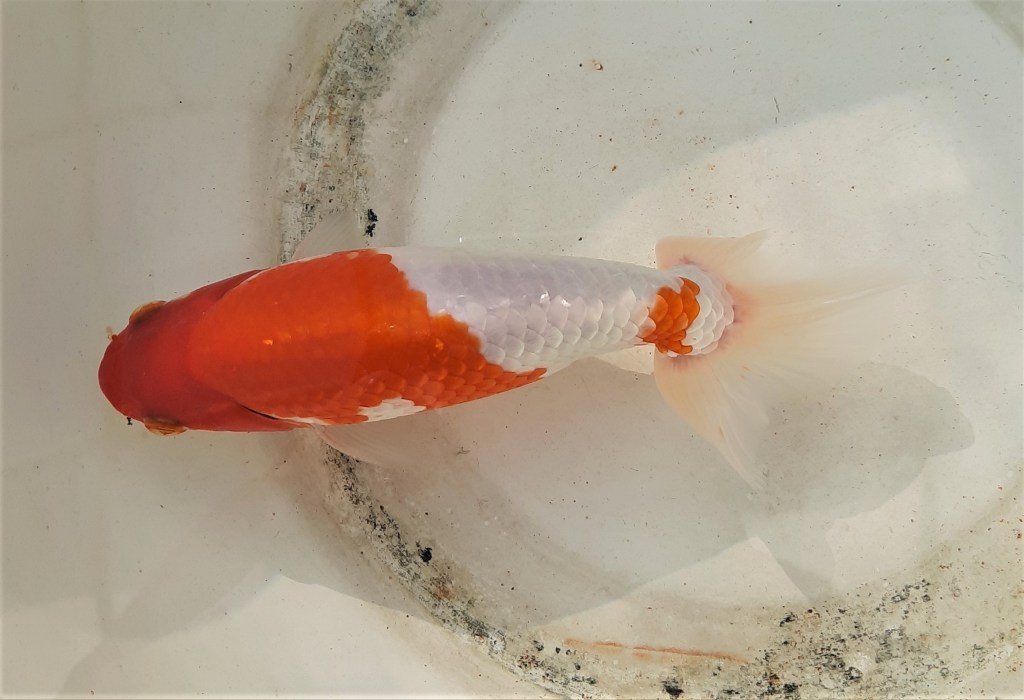
So, back to my project. I am glad to report that I have done the first attempt of crossing. My two ogon koi has come to maturation, and I mated them with a tricolor oranda. Why such pair? Frankly, no reason at all. Everytime I put a productive female goldfish in the tub with the koi, the goldfish stop laying eggs. The koi has never chased the goldfish. This was frustrating. So, when a goldfish was laying eggs in another pond, I strip the eggs and strip the sperms of the koi on top of the eggs. Yes, hand spawning. It happens that the tricolor oranda was laying eggs in another pond close to the koi tub in my facility, so I just grabbed the oranda and mate her with the kois.

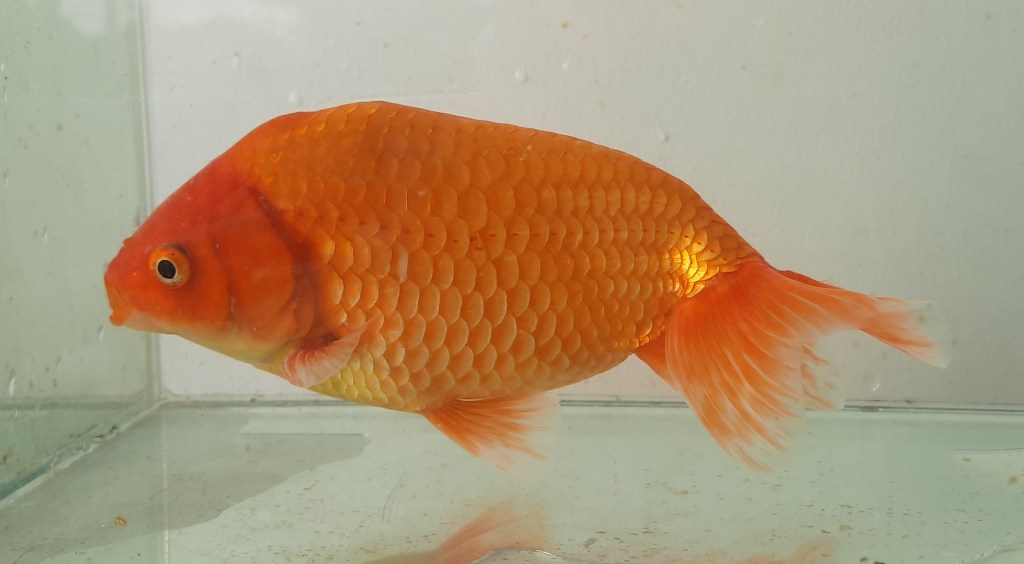
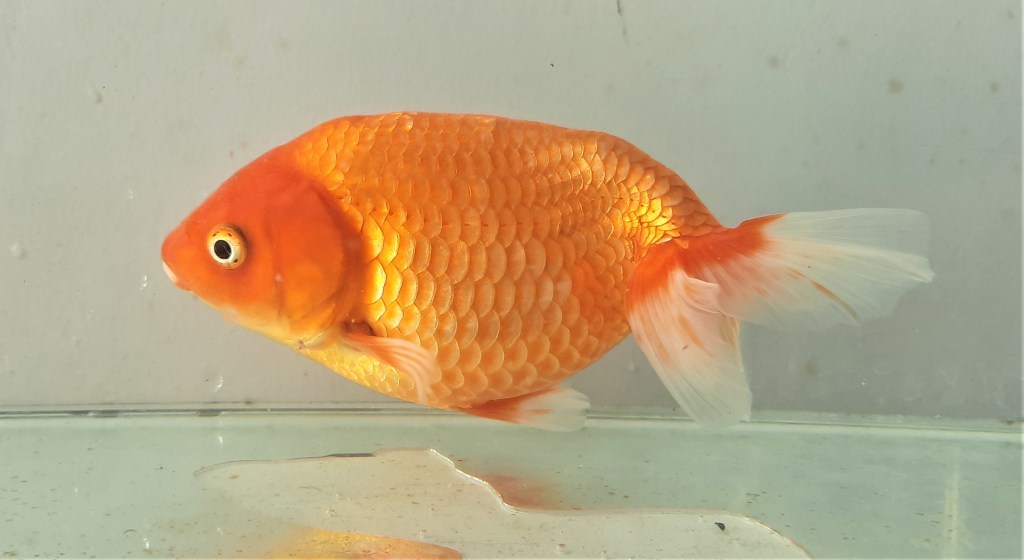
These are the pair:

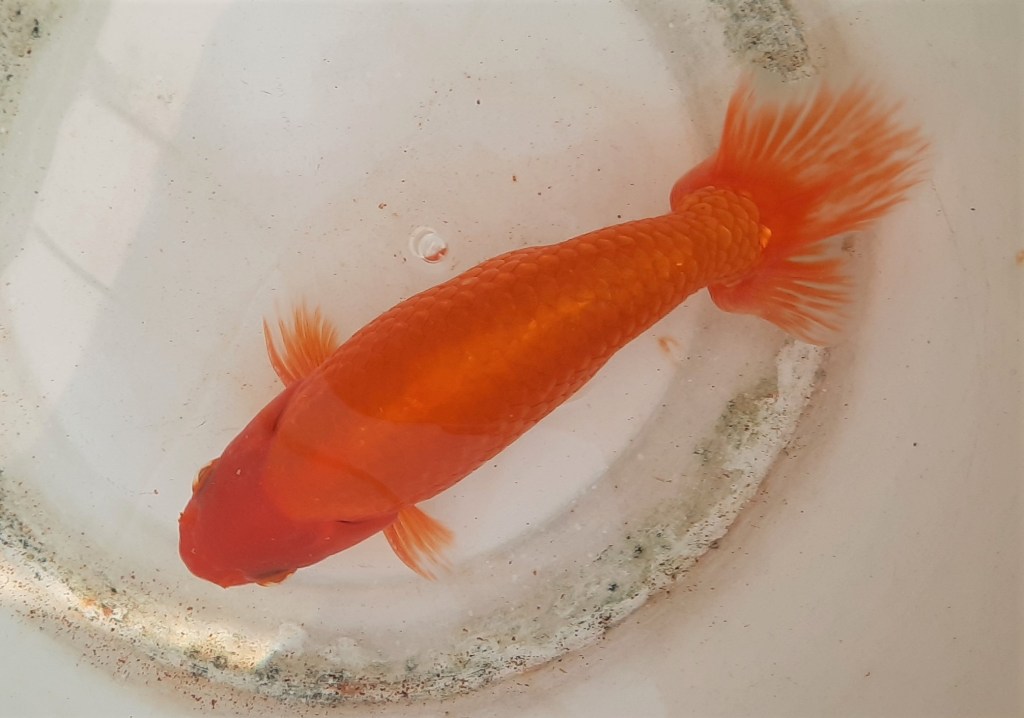
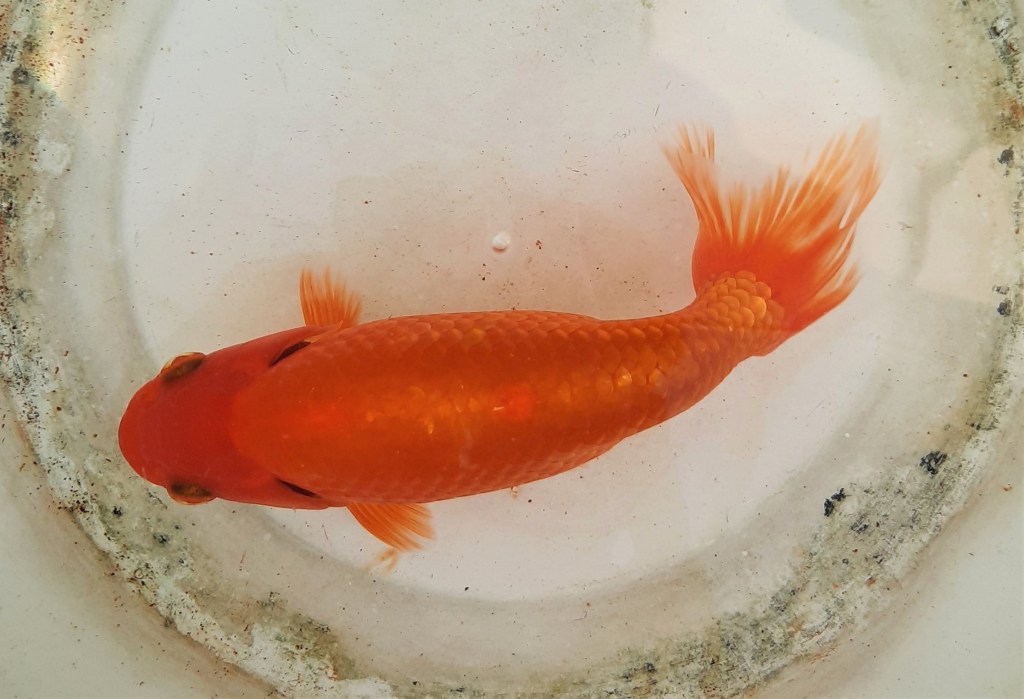
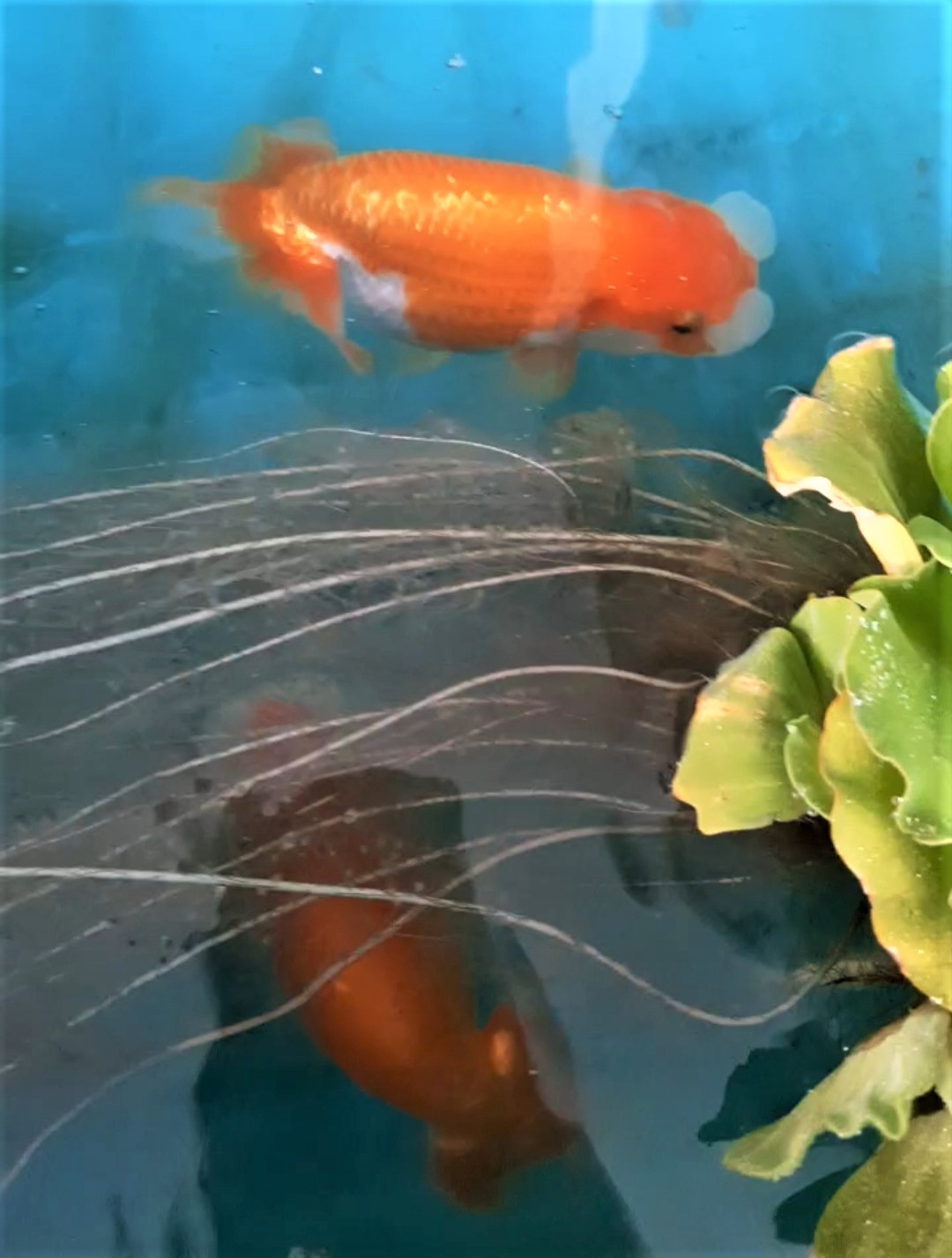
From the forced mating, only three eggs hatched! So few! But the successful hatching gets me excited! The ofspring is already two months or so, I think. And here they are:

At this stage, the metallic in the fins and tails is below my expectation. But the metallic color in the head (mouth and gill) is a trait I was not expecting, though that trait comes in varied degree in the. I cannot see clearly if they have moustache like the koi or not at this time. Well, I guess I can only wait for them to grow up and observe their progress for now.

I mated the koi with the tosakin with the same strategy twice. Nothing hatched at all! I do not know why. I also mated the koi with orange oranda (a cross between purple oranda and black oranda) and got a lot of healthy fry – more than a hundred of them. They are 2 cm in size right now. I will update on them later.

That’s all my report for now. If you are excited about this project, wish me the best!
Standard
Uncategorized

How to Induce Spawning

First, it is useful to categorize female fishes into four categories: very productive, normal productive, and less productive, and infertile. In the case of a very productive fish, we do not need to do anything and the fish will lay eggs by its own everywhere and anywhere. Even when there is no male partner, it will lay its eggs. But most fishes fall under the category of normal productive, which will usually lay eggs in a comfortable environment with the presence of male partner. The problem arises when we have the less productive fishes. We need tricks to induce the spawning. In the case of the infertile fishes, nothing can be done. The infertility can be of two kinds: the fish cannot lay eggs, or the fish can lay eggs but the eggs cannot hatch. So, our focus is how to induce spawning in the less productive fishes, which of course the tricks will also applicable to the normal productive fishes.

Basically, I use two ways to induce spawning: to make the fish comfortable or to make the fish uncomfortable (or introduce changes). I will try the first method before considering the second one.

I live in the tropical area, so my methods might not work for other areas. Each breeder need to find his / her own ways in the two frameworks.

If we use biological filtration pond or tank, then the fish will be comfortable in a mature filtration. If we use water change method, then it is better to have a routine schedule. Male partners should be present. Outdoor or semi outdoor environment will be good since it is in accordance with the fishes’ internal clock. Enough sunlight. Introduce plants. Do not feed with growth pellets or tubifex worms. Feed with wheatgerm-based meal. Use live food such as frozen bloodworm and daphnia. Mosquito larvae is a superb food for this purpose. Normally, these actions will suffice to induce breeding. The fishes will mate at around 5 am. It is an advantage to be in the tropical area that I do not need to take into account the winter season or the water temperature.

For the less productive fishes, to make it comfortable, we can introduce a productive female one in the tank. After the productive one lay eggs, we can remove her. We can hope that the less productive one will follow to lay eggs.

Another way to make her comfortable to spawn is to put bricks or clay pots in the pond. Somehow it is believed that the smell of the soil can induce the fish to breed. I do not know how true it is, but I sometimes use this method combined with other ways.

If the comforting methods do not work, we might consider to make the fish uncomfortable by introducing change / surprise. Why uncomfortable methods might induce breeding? I read it somewhere that in the presence of death the fish might naturally think she need to lay eggs to preserve her descendants. So, the change might make the fish think she is going to die (smile). The mild measure in introducing change includes moving the fish from indoor to outdoor. Or if the fish is kept in outdoor, put her for several weeks indoor before moving her to outdoor again. We can also play with the water temperature. Try to keep the fish in a colder temperature for several weeks, then move to a warmer environment. Total water change can also be a surprise to the fish. Drastic water parameter change might be introduced also, mimicking the rain fall. Fasting (deprived of food) and then pumping the fish with good food can also be tried.

A more risky way that I sometimes use it to lay the fish in insufficient water level. This is the way I do it. As I make a total water change, when I fill the tub again, I put the fish in when the water level is still insufficient to submerse her. So the fish will be a bit stressful for a minute or two for lacking water, but will not be hurt / damaged. It is enough to make her think she is going to die for a while. This is the most extreme measure I take. But I seldom use it and I only use it for a hard case.

The breeding can also be induced by injecting substances such as Ovaprim to the fish. But I do not use this method.

These are the methods I use to induce spawning. My methods are simple. I am sure there are many more advanced and creative ways. I will encourage the readers to explore and to share their ways.

Standard
Uncategorized

On Feeding Goldfish

Basically, how we feed our goldfish is determined by our purpose of keeping. Some people might just want to keep goldfish for relaxation. What they want is their fishes to enjoy a healthy and long life. They do not bother much about pumping up the size of their fishes. For such people, feeding the fishes with staple /maintenance pellets once or twice a day will be sufficient. The fishes might not grow or might grow slowly, but the fishes will enjoy many years of happy life.

Some want to be the best groomer of their fishes. They wanted their fishes to grow in size (and shape) in no time. For these people, their purpose might be achieved by a heavy feeding such as six times a day, or even ten times a day, with growth pellets which contain high fat and high protein contents. Live foods such as tubifex worms, silk worms, might sometimes be used also.

Fish pellets can usually be categorized into three types: maintenance pellets, growth pellets and color enhancer pellets. The maintenance type is used as daily food with sufficient nutrients for the fishes. The growth type is used to foster the fast growth of the fishes. The color enhancer one is used to improve the red color and the shiny scale of the fishes.

As for me, since I am an experimenting with breeding, so my main purpose is to feed the fishes with foods that will induce them to breed. My feeding consists of pellets and live food. I use the wheatgerm-based pellets to induce spawning. The wheatgerm-based pellets can be categorized as maintenance diet type since they do not contain high fat and high protein, but sometimes can be categorized also as growth pellets since they help the fish to grow by optimizing the digestive systems. This quality of improving the digestive systems will improve the productivity of the female fishes. I also use live foods such as frozen bloodworm and live / frozen daphnia since they will induce breeding. Another excellent live food that can induce breeding is the mosquito larvae, but I do not usually use them. Tubifex worm and growth pellets are absolute no for the female parents.

My breeding activity dictates that I must grow the fries also. All good quality goldfish should grow thick backbone early as a foundation for life. Without it, they will have trouble swimming as their age matures. So, when they are young, I give them live daphnia and growth pellets grinded as fine as flour. As they are growing, I introduce frozen bloodworm and growth pellets. I used to use tubifex worms, but for the sake of convenient, I do not use it at present. I continue to give this diet to fishes that need to grow headgrowths such as oranda and ranchu. I employed heavy feeding for them. But for fishes that does not need to grow headgrowth like tosakin or butterfly, I switch to wheatgerm-based pellets only and do not employ heavy feeding to induce the growth of their tail with less feeding. My young fishes eat this diets until the age of roughly four months, where they started to breed. It is too early to breed them at that age, but I do not want to damage their productivity, so I mixed their diets with mainly wheat-germ based pellets. When they are ready to breed, at the age of six months and above, their diets consist of wheatgerm-based pellets and frozen bloodworms. The growth pellets and daphnia are provided once in a while. Only for fishes that I want to grow into big sizes I pump them up with growth pellets and frozen bloodworm.

This is how I feed my foldfishes.

Standard
Uncategorized

Kinranshi?

These are the results of wakin and topview ranchu crossing. Surprisingly, most of them are dorsalless even in the F1. That fact says something of wakin, which need further exploration and confirmation.

And their sideview respectively:

The smoothness of the back is remarkable, considering they are a cross between fish with dorsal and a dorsal-less fish. And they are surely good swimmers.

Standard
Uncategorized

Dropsy Treatment

I have experienced dropsy in my fishes probably close to a hundred times. I have tried to find articles about it with no satisfying answers. The best conclusion I draw from my reading is that there is no cure yet for dropsy. Once I even brought a fish with dropsy to a lab. It was a topview ranchu I bought from Thailand. It was a lovely fish. I have treated the fish with all medication I was familiar with, but of no result. When I brought it to the lab, the result confused me. The lab said that they found nothing wrong in the fish. It was healthy. So the lab officer speculated on a mutation as a result of something that happen to the fish that trigger the dropsy. I don’t really understand about it. The fish continued to live for several months in the lab until I finally let it go.

I also experienced rare cases where the dropsy is cured. A friend named Mr Andy Hernianto and I were together in pondering these cases. Our observation led us to believe that there is a way to treat the dropsy with a higher chance of success. This is our conclusion.

First, it must be understood that dropsy usually appears together with or after a certain illness. So, while the dropsy itself is not contagious, the illness accompanying it can be contagious. While the dropsy itself does not lead to death, the illness can lead to death. When the illness is cured, dropsy persists, and the fish lives on. When the illness is not cured and dropsy appears, then the fish is in danger. So, first thing in the dropsy treatment is to make sure that the illness is cured.

I do not know what illnesses cause dropsy. I do not know whether it is a special illness or common illness.  I do not know how dropsy develops. It is beyond the scope of this article.

Second, after the illness is gone, high aeration can be used to treat dropsy. In this case, there is no medication needed. Medication can be used if we suspect the illness is still present. The key is high aeration. Later on, we will make this more sophisticated by saying that the key is high oxygen level.

This treatment is so simple. I usually put the fish with dropsy in a shade, and start to give high aeration. This treatment is particularly effective if the dropsy is still in its beginning state. The dropsy can be cured in several days up to a month. I usually put a fish in a clean container by itself, and no filtration. Water change can be done routinely if there is no medication used. If the dropsy has been there for a relatively long period, this treatment seems useless. The dropsy might be permanent already. At least I have tried this for a month, and I gave up. I do not know if the treatment was done for a longer period. This is one experiment I did in 2012.

DSC_6908

The treatment took approximately ten days. And the fish was cured as before. Below is the picture of the fish being cured from dropsy.

DSC_6974

Later on, I share this finding with another friend Mr Jemmy Wijaya. He reasoned that this must have something to do with the oxygen intake ability of the fish. If that is the case, then cold water temperature will help to cure the disease. Then he did the treatment with a chiller and reported success. I myself do not have a chiller and have never done the experiment. But I think it makes sense.

So, this is how to treat dropsy. I know I do not do statistics, but I sort of thinking that the success rate for a beginning period of dropsy is very high, probably 80 percent or more. Thanks to Mr Andy Hernianto and Mr Jemmy Wijaya. I hope there are scientists among the readers of this blog that will do more experiments to perfect this work.

Standard
Uncategorized

Ogon goldfish – is it possible?

Guanine is the substance responsible to produce the shiny metallic look in the scale of goldfish. When the guanine is absent, we will have the transparent colored goldfish such as sakura and calico. In goldfish world, as far as we know the guanine is found in the scale. It is sometimes found in the gill also. But I have never heard anyone mention about the presence of guanine in the fins. The fins of goldfish is commonly found in its transparent state. Lately, as I was observing my fishes, I noticed a certain yellow fish that have unusual deposit of guanine in its pelvic fins. This is the picture I take this morning:

DSCN1573(1)

It is quite shiny compared to others such as this:

DSCN1583(1)

I begin to recall that koi has a variety called ogon, which has shiny fins. I begin to suspect that what makes ogon koi have shiny fins is the abundance of guanine level in its fin. And my mind keep thinking whether it is possible to create ogon like goldfish, that is the goldfish with shiny metallic fins. An ogon goldfish might look like this photoshop image below. Notice the unusual shine in the fins. It will be very eye-catching in the tank. (Sorry for the low quality image).

ogon koi

The yellow fish I have makes me think that this is possible. It is just that nobody has tried this. It will be a tedious project though. Maybe we will need to select fishes that have more than usual guanine deposit in its fins and use them as parent fishes. Maybe this need to be done for many generation through selective breeding until a truly ogon goldfish is created. It will be a long journey. But this will create a new kind of goldfish! Does anybody want to take this challenge?

Standard
Uncategorized

If your comments does not show up here …

I do not usually check my blog unless I am writing new post. Today, when I open this blog, to my surprise, I get a message saying that “Akismet” has saved me from 420 spams! Now there is one spam left in the spam folder. And when I checked that one spam, it is not a spam at all. It is a comment from one of you, my friend! So I un-spam that comment. Now I wonder if all the 420 spams being cleaned automatically by the Akismet were actually comments and letters from the people who read my blog!

If this happens, I can only say sorry for that. I do not get a chance to see your comments. But if you are willing, do write again. I will check the blog regularly every week. Or if there is a suggestion how to turn off the Akismet, I will be glad to learn.

Thank you.

Standard
Uncategorized

Sakura Coloration on Ranchu-like Goldfish

As mentioned before, I am trying to create tricolor metallic scale ranchu. This project directed me into crossing a tricolor metallic scale tosa with ranchu. By tosa I mean the ryukin which has no hump. It turns out that all of the offsprings shows a combination of metallic scale and transparant scale on the body. My conclusion is that the tricolor metallic scale I used is actually a variant of calico (transparant scale) goldfish which somehow develops metallic scale all over the body. This is not a genuinely metallic scale. The piece I have here shows minimum metallic scale. The body is mostly covered with transparant scale. And it looses the black color and turns into sakura color.

Image

Don’t ask me about the body form resulting from this crossing. Horrible. This one is the best in terms of the back smoothness. The shape is not ranchu yet, that’s why I cannot call this a ranchu. The head resembles a tosa or ryukin since it has no headgrowth. And it has a hump! My first impression when I look at this piece is the image of a cow. But instead of a black and white cow, this is a red and white one.

The sakura color is impressive on this one. The red is truly red, it is not orange. And the white is milky white. Adorable. And the pattern is pleasing to the eyes. When the sakura is dominated by the red or orange color, it looks horrible to me. But this fish has the right amount of red and white combination, according to my perception. This is the sakura coloration I want to create, though not in this body form. The large red dots look like the brush strokes from an expert painter.

Image

Standard
Uncategorized

Illegitimate Modification of Pompom

I used to put together many parent fishes from different goldfish types in one pond. It is not my intention that they will breed in the pond. When I want to breed them, I will move the pair I want into the breeding tub. So, eventhough the fishes mate in the pond, I will just let them eat the eggs. Usually, there is no survivor from the eggs. But this time, there is one survivor, and I notice it when it is close to 12 cm already. There is something nice in this illegitimate offspring, and I decide to keep it.

Image

Judging from the body form, this must be the offspring of my chocolate pompom with my broadtail ryukin. The pompom is visible here, though not as big as the original parent. The tail shows the trace of a broadtail. And the body is somewhat in the middle form between the long pompom body and the high ryukin body. I take this as a desired modification from the tail shape of the pompom which is too flat for the Asian taste nowadays (and folded), and from the pompom body which is too long according to the popular trend.

This is the original chocolate pompom. Notice how the body and tail has differed substantially.

Image

The chocolate color is affected. Here it becomes grey. This is understandable, since the chocolate color is recessive. But this is of no concern. Another backcrossing will bring the chocolate back to the fish. So also the size of the pompom tissue.

I think the only possible route from here is to cross it back to chocolate pompom. This breeding might bring the desired body and tail modification back to zero. But I do hope that few will carry the modification gene. The ideal result is to have the body and tail shape like the one I have currently, but with chocolate color and bigger pompom.

Standard