Purple goldfish

The difference between blue and purple

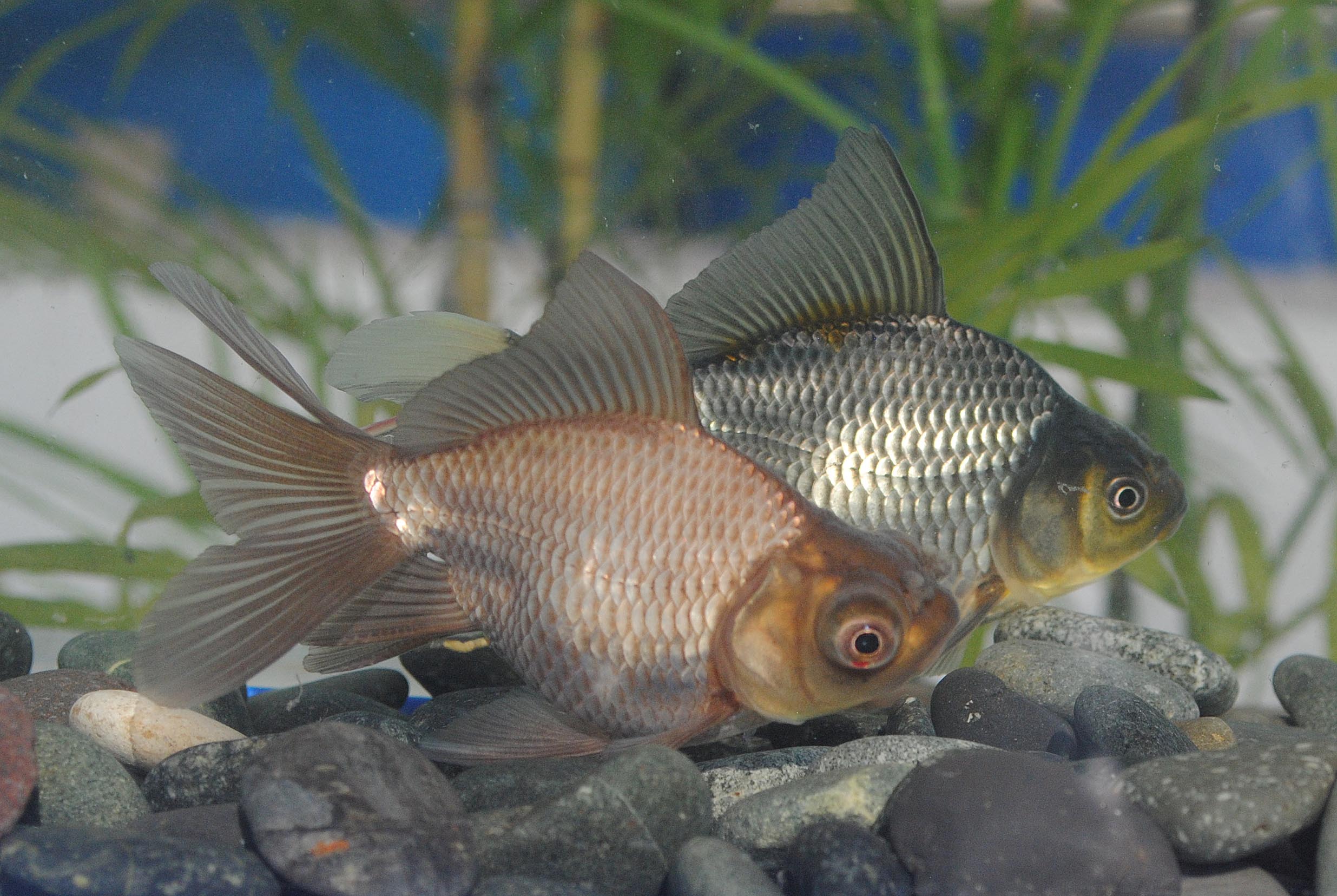
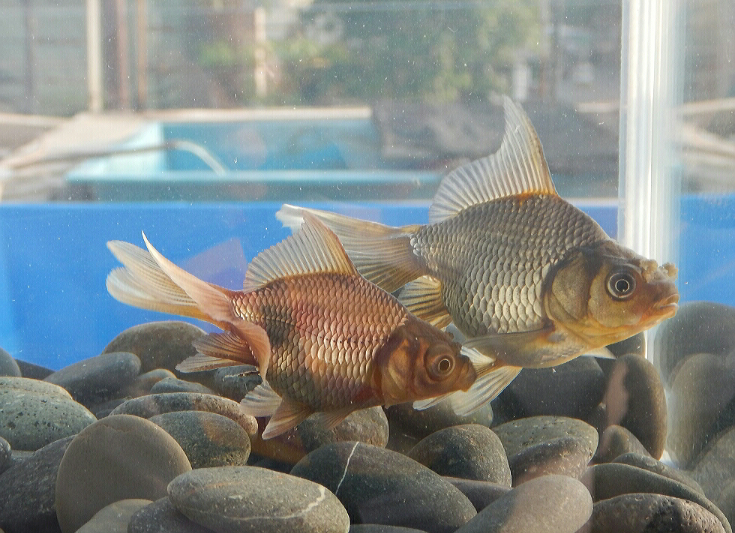
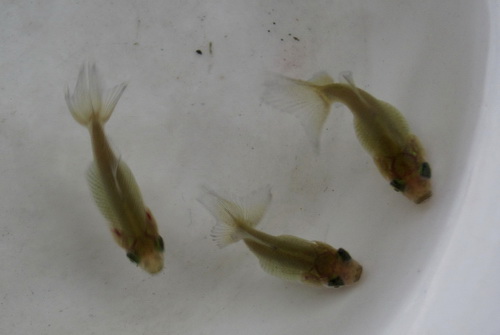
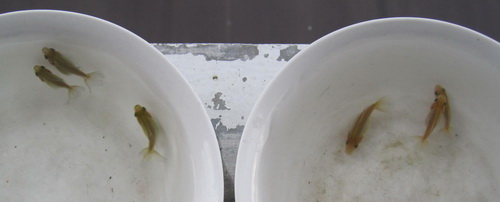
One of my concern is that the purple color is hard to differentiate from the blue color. My aim of posting these pictures is to show that those two colors are indeed differentiable. When being put side by side with chocolate / brown, the purple will look like blue. But when being put side by side with blue, the purple look like brown. So, purple is indeed a color spectrum between the blue and the brown, and differentiable from the two. The pictures below show the difference between blue and purple. I hope it is clear which one is which 🙂 Have a good day.

purple and blue 2

purple and blue 1

Standard
Purple goldfish

Update on purple goldfish, September 16th, 2015

Telescope eyes occur in my breed once and a while, though I have never intended to breed them. These three telescope eyes are from one batch, from the same parent, yet they differ widely in their color. The left one is a panda. The middle one is the purple goldfish – I think it is still rare, and perhaps the only one in Indonesia currently. Hopefully this pose highlights the purple color from the rest. The right one is the chocolate with some beautiful stain of orange, also a rarity, I think. Enjoy,

colorful telescopes

Standard
Purple goldfish

What color is this?

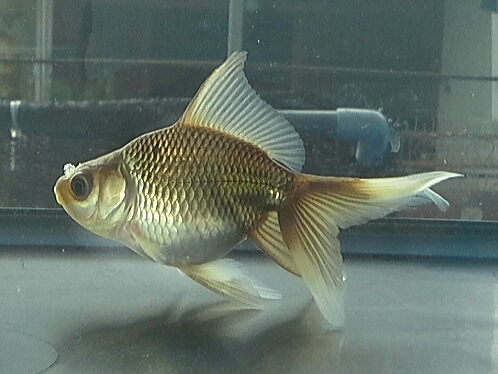
This is the most unique color I find in this purple goldfish project. It started as purple fish. But then it develops white coloration. The purple color becomes darker, to make it look like light brown. I do not know what to call this combination. Purple and white? Chocolate and white? It surely looks like brown magpie bird to me.

20150723_072508(2)

20150723_072449(1)

Many of the purple develop the white color, but most turn into totally white. So, I guess the behavior of this pattern is basically similar to the panda. That means there is a room for stabilizing the pattern through selective breeding.

unfortunately, there is only one with this kind of pattern. I hope the pattern will stay, though it is very probable that it will fade. And the purple goldfish is always the smaller compared to the blue and brown in the same batch.

My plan is to strengthen this pattern and multiply them in the form of pompom goldfish. Next, I would like to develop ranchu in this pattern. Wish me the best 🙂

Standard
Purple goldfish

Purple goldfish update on July, 2015

DSCN2583(1)

DSCN2601(1)

The above picture is the same purple goldfish in a lighter and darker background. This color is distinguishable from the blue and chocolate below:

Blue goldfish

Blue goldfish

Chocolate goldfish

Chocolate goldfish

The pictures below show the differences between purple and blue

DSCN2607(1)DSCN2619(1)

and this shows the difference between purple and chocolate

DSCN2635(1)

The picture below shows the fishes with respective colors from left: purple, green, blue and brown

DSCN2652(2)

Below are the highlights

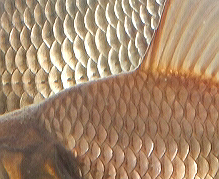
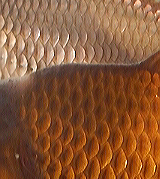
Blue scale on top, purple scale below

Blue scale on top, purple scale below

Purple scale on top, chocolate scale below

Purple scale on top, chocolate scale below

So far I think I have succeeded in producing purple goldfish, or purplish one, or any other name differentiable from blue and brown (chocolate). At this point, I think I can wrap up this project and consider it done. What remains is to try the same project again but with different type of fish. What I have in mind is ranchu. I would like to create purple ranchu. But first, I need to create the chocolate ranchu, which is still my ongoing project. It will be a challenging project!

There is another observation coming from this purple goldfish which I am not ready to share yet. Let see for another year or more if this observation really yields something interesting.

Have a good day!

Standard
Purple goldfish

Purple, really?

My last attempt in Nov 2014 to cross bluegoldfish and chocolate one resulted on one purplish goldfish in the second generation. I was so excited to see it grow. Unfortunately it died early, taking away all my hope with it. Then there was also a problem with my facilities which required a couple of months to repair. My breeding activity was halted.

But now, things are settled, and I can resume my breeding activity. I try to cross parents again. Just for reminder, the parents are the F1 of blue x chocolate. It must be admitted that the purple is always a minority in the offspring. But this time, instead of one, I get about 10 purple! What a joy!

DSCN1562(2)

To see the variation of color, I take this picture this morning. The fish in the top position is the blue. Three fishes in the middle are the purple. E one in the bottom left is the grey/green/wild color. The bottom right one is the chocolate. Hopefully you can see their color differentiation.

the purple is what Shishan Chen in his writing reported as the intermediate color between blue and chocolate yet distinguishable from the two. Some other ancient books labeled it as purple, and I will use that name for this particular color.

Three of the purple fishes have turned into white, perhaps due to the warm temperature of my tub. Hopefully not all of them turn white. But this shows that the purple have the capacity to become purple and white, which might be interesting. I do not know yet how it looks like.

Well, hopefully everything is allright, and we can see the mature result of the purple goldfish. After that, I think I will aim at creating purple ranchu.

Standard
Purple goldfish

Update On Blue X Brown

I wrote before that I am redoing the work of Shisan C. Chen in crossing brown and blue goldfish. The offspring are all grey. As they mature, some become orange, and orange black, and some remain grey. I have mated the F1 with F1 and would like to share the interesting result.

But first, I would like to mention that there are two kinds of brown or chocolate in goldfish. One is the brown stain we usually find in blue fish. In this kind, the brown can coexist with blue. In fact, it is a blue fish that has the red pigmen in parts of its body. The red looks brown.  If the black pigmen disappears, the brown becomes red. Even when the fish is totally brown, it is still identical with the blue genetics. When this kind of brown is mated with blue fish, the result is blue, or blue with brown stain, and all brown. This is because they are of the same type. Basically, this kind of mating is a mating of the same color genetics.

The second type of brown is the one we find in chocolate pompom. This has nothing to do with blue, and cannot coexist together. They are unrelated. When the black pigmen disappear, the brown will turn into orange. It is this second type of brown that Shisan C. Chen use. I know this after comparing his result with mine. And this mating is what I am interested in. I have shown before that the result is perplexing. The cross between this type of brown and blue does not result in any blue or brown fish at all. The result is uniformly wild color! Some like to call it green or grey. When mature, some of them become orange, or orange and black, or wild.

More amazing is the result of F1 x F1. Just as Shisan C. Chen reported, we have blue, and brown (which should be the second type of brown), and grey (which Chen did not report), and  … something intermediate between brown and black which can be clearly distinguished from both. This is the mysterious color I want to know. What color is that?

Now let us look at the picture of my offspring that represent the four color.

DSC_1699 (2)

The one in the ten o’clock position is obviously the blue. The one in the four o’clock is the wild / green. Below that in the five o’clock is the brown. And the mysterious color is the one remaining. What color is it?

Yes, it is clearly differentiable from the rest. In my observation, the fish looks like pinkish, or purplish. I do not know what it will be in its maturity. Truly, I want to know. Unfortunately, this color is the rarest in the batch. There are only one or two when I search them in a glance. I will know the details when it is time for the next culling.

I have heard before that there are claims of purple colored goldfish. But some people think that the one who call it purple was too imaginative. But if this one in my offspring turns into pinkish or purplish goldfish, then I will know that the purple goldfish is real, and it is truly different from blue or brown, and when in early stage, the color is reasonably pink / purple. Still need time to observe the result.

meanwhile, I will try to cross the F1 with F1 again. This time I will concentrate on that mysterious color. I will increase their numbers.

Enjoy.

Standard
Purple goldfish

Chocolate and Blue

Image

I have some chocolate pompoms. Their bodies are dark brown, and their pompoms are bright orange. This brown color is unique. In my observation, the brown color can get so tense as if there is an additional chocolate blanket covering the scales. This covering is similar to the deep black covering in the Thai black ranchu. When the color is not intense, they look like a lighter brown color with metallic shine.

The offspring of the pompoms show light brown color from the day they hatched, which is a different characteristic from the common red or red-white metallic scale offspring.  So, there are three types of color in the metallic scale offspring, namely the grey (as produced by the red or red-white fish), the blue (as produced by the metallic blue fish), and the brown (as produced by the brown or chocolate fish).

This is the offspring of the brown or chocolate pompoms.

Image

It must be noted that the brown color in chocolate pompoms is different from the brown color that usually appear in blue metallic fish. So, in goldfish, we have two types of brown. The reason of my saying them to be different comes from the observation of their offspring. The blue brown goldfish comes from blue fries, while the brown or brown-orange pompom comes from light brown fries. The difference of color in their juvenile stage is enough to conclude that they have different color genetics.

To produce chocolate pompoms from chocolate pompom parents is easy. I do not see much challenge on it. But there is still one area I would like to understand about this chocolate color. So far, the body is totally brown. There are few instances where the bodies become orange. The tails are sometimes orange, but most of the times are brown. The pompom balls are most of the time orange, but few remain brown. I have not seen the white color appear in the body. So I would like to know if it is possible to produce a brown and white color from this breeding project.

We know that the color of black ranchu cannot exist with white color. That’s why we can never create a black and white ranchu by crossing a black ranchu with a white ranchu. It seems that the black color expels the appearance of the white. But the black color does not expel the orange / red color. That’s why we can sometimes see a black gold / black-orange goldfish. There should be a name for this behaviour, unfortunately I do not know it. Maybe it can be called the white-repelling behavior. In the chocolate breeding project, I would like to know if the chocolate color also has a white-repelling behavior, or is it possible to create a brown and white fish.

Another area to understand is what will happen if the chocolate is crossed with the common red metallic fish. I think I can answer this without even do the experiment. I will say that the red color is dominant to the chocolate, so the offspring will show the grey color only, and will eventually turn into red or red-white goldfish in F1. Then if we mate F1 x F1, the result will be some red or red-white fish and some chocolate. This is exactly what happens if we cross the blue or panda color with the red or red-white color. I expect the same thing to happen when we cross the chocolate with the red or red-white. (Just for a note, the cross between black color with red or red and white goldfish does not behave this way. The black color can sometimes, not always, occur as early as in F1, with varying degree of color density).

A more interesting understanding is to know what will happen if we cross the chocolate with the blue! Will they be blue-chocolate goldfish? Or will they be blue-chocolate-white and orange goldfish? What will the color of their fries be? Which is more dominant, brown or blue?

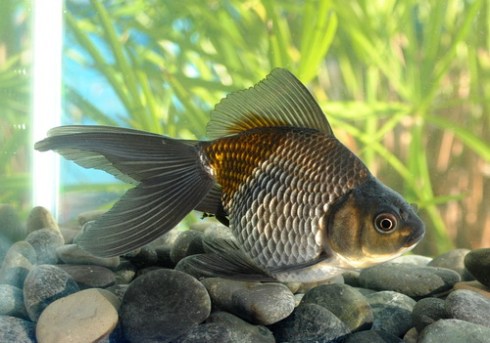
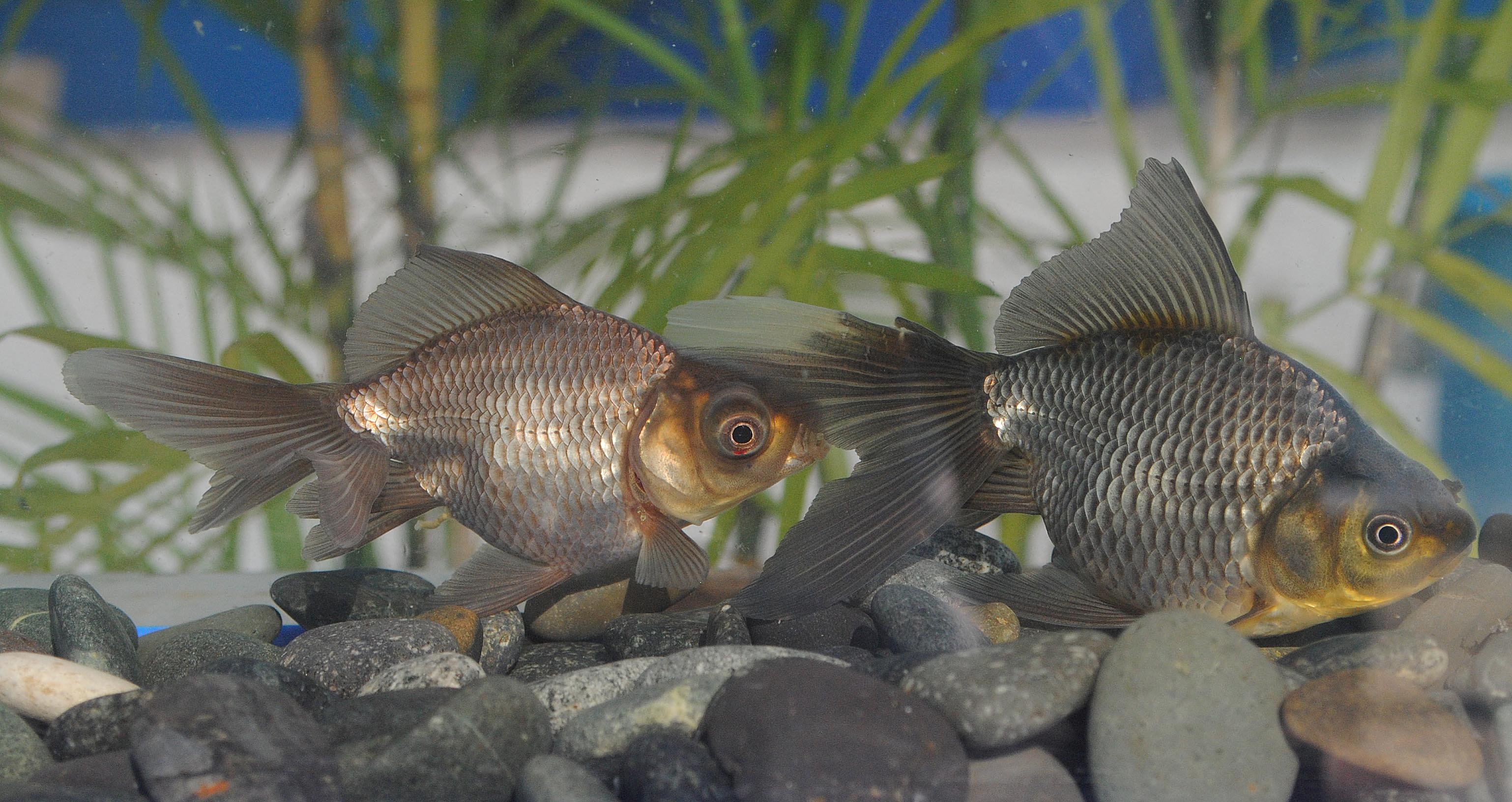
This is the blue goldfish. It has a brown coloration also.
Image

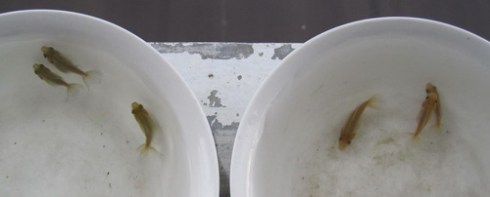
To my surprise, I do not get blue nor brown fries. I get grey fries! This is out of my expectation. But it is an interesting fact. Too bad I am weak at my biology, so I do not know how to interpret this. But I am excited to see what they will be as they grow. Will they be just common red or red-white? And if so, what will the F2 be if I inbreed the F1? I will continue the experiment just to see what will happen.

Image

Image

As a note, I remember there was already such an experiment done by Shishan C. Chen before the 2nd world war. As I consulted to the paper, I am amazed to know that I am repeating some of what he has done. In the experiment, Chen used wild goldfish to cross with blue. The result confirms my conclusion. I have done the same. But for the cross between the wild goldfish with the chocolate, which I have not done, my assumption of the result confirms partially the conclusion of Chen’s experiment.

Concerning the cross between the blue and chocolate, Chen confirms my result. And he gave me a better understanding of what to expect. If I inbreed the F1, he said that I will get grey, black, blue, brown, and some intermediate color between blue and brown which can be distinguished clearly from blue or brown. I wonder what that intermediate color will be! He also mentioned the blue-brown color. I am not sure if this is the same as the intermediate color or a different one. I guess my project will let me know about it.

Chen did not talk about the white-repelling behavior since it was not his concern. I think I must do it myself to know the answer then. Hopefully I can produce a brown-white goldfish, which will be interesting J

Standard