Uncategorized

Sakura Coloration on Ranchu-like Goldfish

As mentioned before, I am trying to create tricolor metallic scale ranchu. This project directed me into crossing a tricolor metallic scale tosa with ranchu. By tosa I mean the ryukin which has no hump. It turns out that all of the offsprings shows a combination of metallic scale and transparant scale on the body. My conclusion is that the tricolor metallic scale I used is actually a variant of calico (transparant scale) goldfish which somehow develops metallic scale all over the body. This is not a genuinely metallic scale. The piece I have here shows minimum metallic scale. The body is mostly covered with transparant scale. And it looses the black color and turns into sakura color.
Image

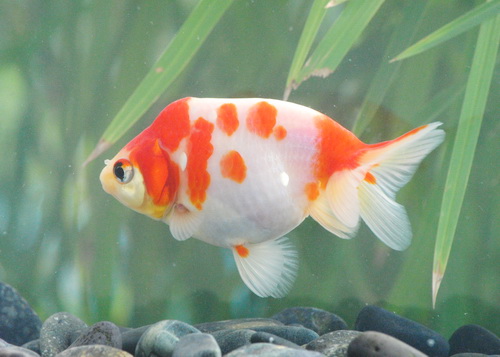
Don’t ask me about the body form resulting from this crossing. Horrible. This one is the best in terms of the back smoothness. The shape is not ranchu yet, that’s why I cannot call this a ranchu. The head resembles a tosa or ryukin since it has no headgrowth. And it has a hump! My first impression when I look at this piece is the image of a cow. But instead of a black and white cow, this is a red and white one.

The sakura color is impressive on this one. The red is truly red, it is not orange. And the white is milky white. Adorable. And the pattern is pleasing to the eyes. When the sakura is dominated by the red or orange color, it looks horrible to me. But this fish has the right amount of red and white combination, according to my perception. This is the sakura coloration I want to create, though not in this body form. The large red dots look like the brush strokes from an expert painter.

Image

Standard
Uncategorized

Illegitimate Modification of Pompom

I used to put together many parent fishes from different goldfish types in one pond. It is not my intention that they will breed in the pond. When I want to breed them, I will move the pair I want into the breeding tub. So, eventhough the fishes mate in the pond, I will just let them eat the eggs. Usually, there is no survivor from the eggs. But this time, there is one survivor, and I notice it when it is close to 12 cm already. There is something nice in this illegitimate offspring, and I decide to keep it.

Image

Judging from the body form, this must be the offspring of my chocolate pompom with my broadtail ryukin. The pompom is visible here, though not as big as the original parent. The tail shows the trace of a broadtail. And the body is somewhat in the middle form between the long pompom body and the high ryukin body. I take this as a desired modification from the tail shape of the pompom which is too flat for the Asian taste nowadays (and folded), and from the pompom body which is too long according to the popular trend.

This is the original chocolate pompom. Notice how the body and tail has differed substantially.

Image

The chocolate color is affected. Here it becomes grey. This is understandable, since the chocolate color is recessive. But this is of no concern. Another backcrossing will bring the chocolate back to the fish. So also the size of the pompom tissue.

I think the only possible route from here is to cross it back to chocolate pompom. This breeding might bring the desired body and tail modification back to zero. But I do hope that few will carry the modification gene. The ideal result is to have the body and tail shape like the one I have currently, but with chocolate color and bigger pompom.

Standard
Uncategorized

A Sea-Horse?

Image

People must think me mad to raise and post such a fish! This kind of fish will be culled out early in any farm in the world. No breeder will give it a chance to live since the defect is considered serious. It does not fit in any standard of goldfish, and so, it should not be considered as a beauty.

Actually, I do not create this fish purposely. I tolerate this because this is part of a project to create chocolate ranchu. As might be obvious from the body form of the fish, I was mating a red ranchu with a chocolate pompom. I cannot think of a better source to obtain the chocolate color than from a chocolate pompom. This fish is an F1, and is still a long way to go to become a decent chocolate ranchu. Last time I was mating a ranchu with a panda telescope in order to create a panda ranchu. It has shown some success after three and a half year. Now I am redoing the same type of project, except now with a chocolate pompom to create a chocolate ranchu. The difficulty is pretty much the same, I think.

So, yes, this fish is a monster to most of us, but to me, this is very valuable. However, as I behold this creature, I am getting an impression of beauty out of it. I immediately think of a sea-horse as I watch this fish. Perhaps it is due to the small dorsal fin in the posterior of the back. Does anybody have the same impression?

And this is a wild thought. Why not create a new goldfish category out of it? A sea-horse goldfish, maybe? I know that this will be a hard thing to accept, since it is a bit far from the normal goldfish standard. But if many people can see the beauty, why not?

Image

Standard