calico ranchu, cow ranchu

The Diary of a Goldfish Breeder 2024 (5)

In this Diary I will report the results of the cross between Cow Ranchu and Black Ranchu in this video:

The black is actually an offspring of my previous Cow Ranchu (Milk Cow Variant). Let me show the results and I will compare them with the offspring of Cow x Sakura reported in the previous diary (#4).

Here are the offspring:

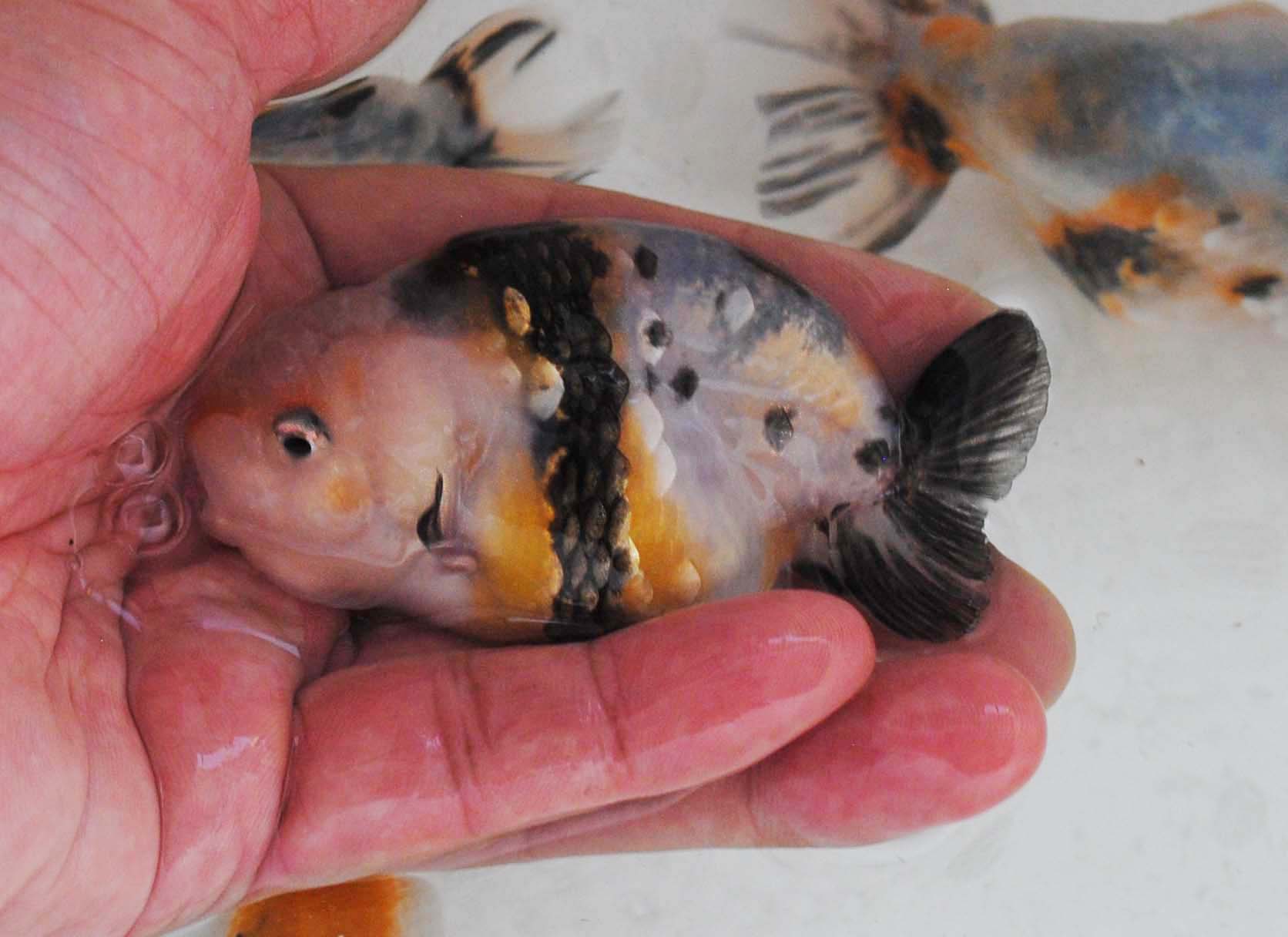
The first category are fishes with large black markings in the shape of large blocks / islands. In these results they have red color. If they are free from the red color, they will come close to true Cow Ranchu, I think. At least when being watched from the top. Interestingly, from the side viewing, the black markings extend to one side of the body (sadly, only one side) to appear like large belts.
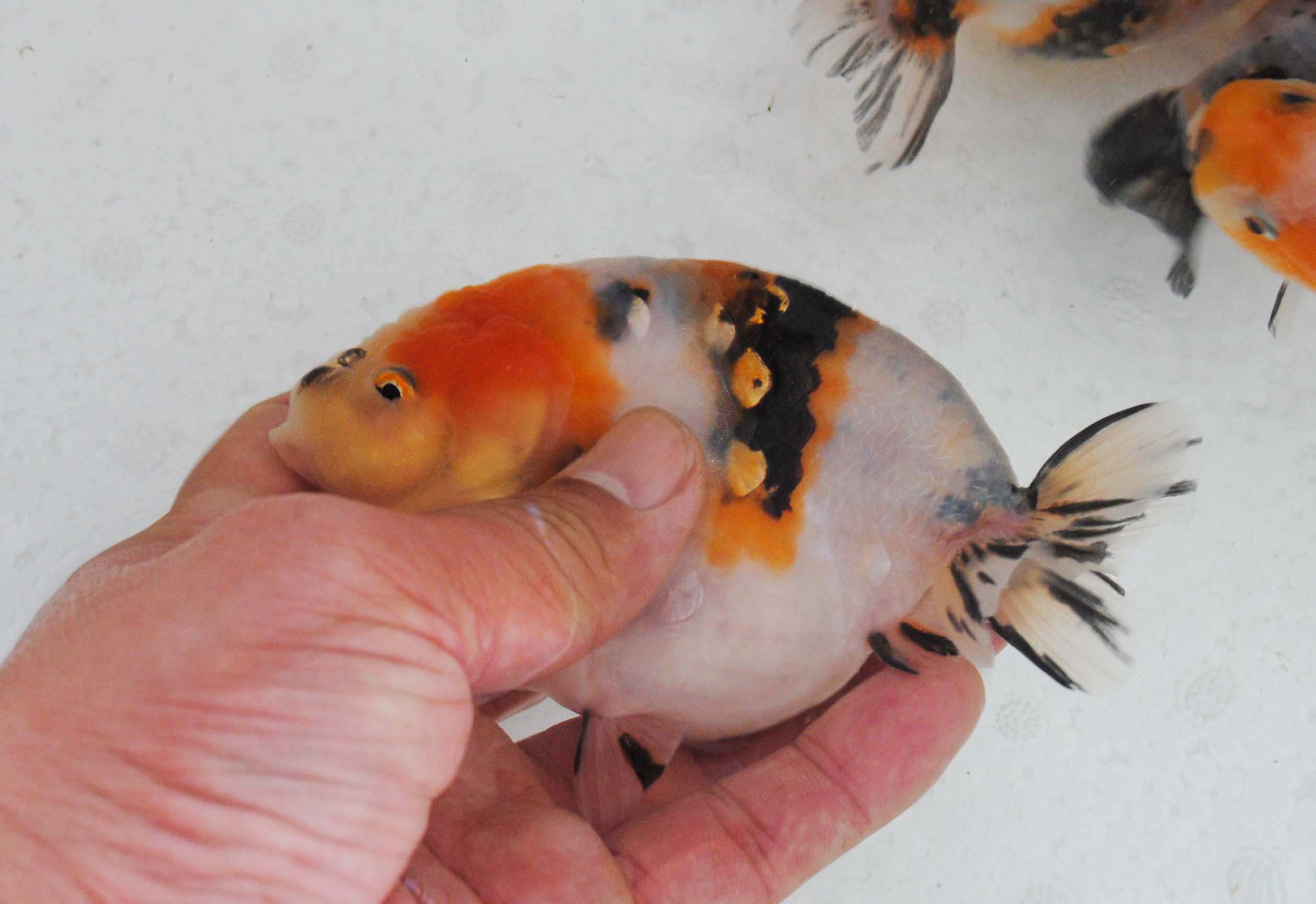
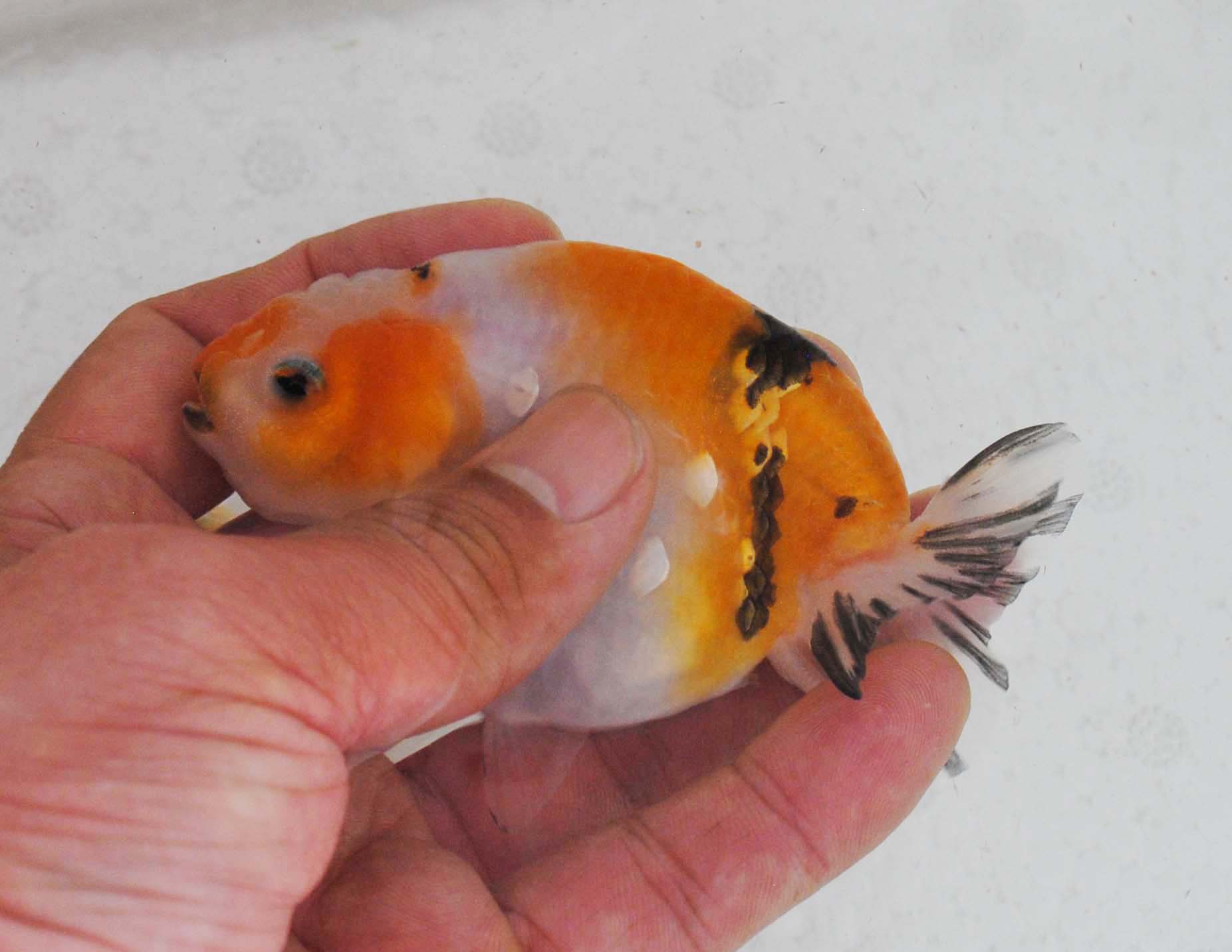
I think this is an interesting phenomenon. The project can be directed to create Cow Ranchu and Ranchu with Belts.

This one also has a belt in one side of the body, but the black marking does not extend to the top of the body. I will put this in the same class as category one, I think.

All these four will be in my breeding plan.

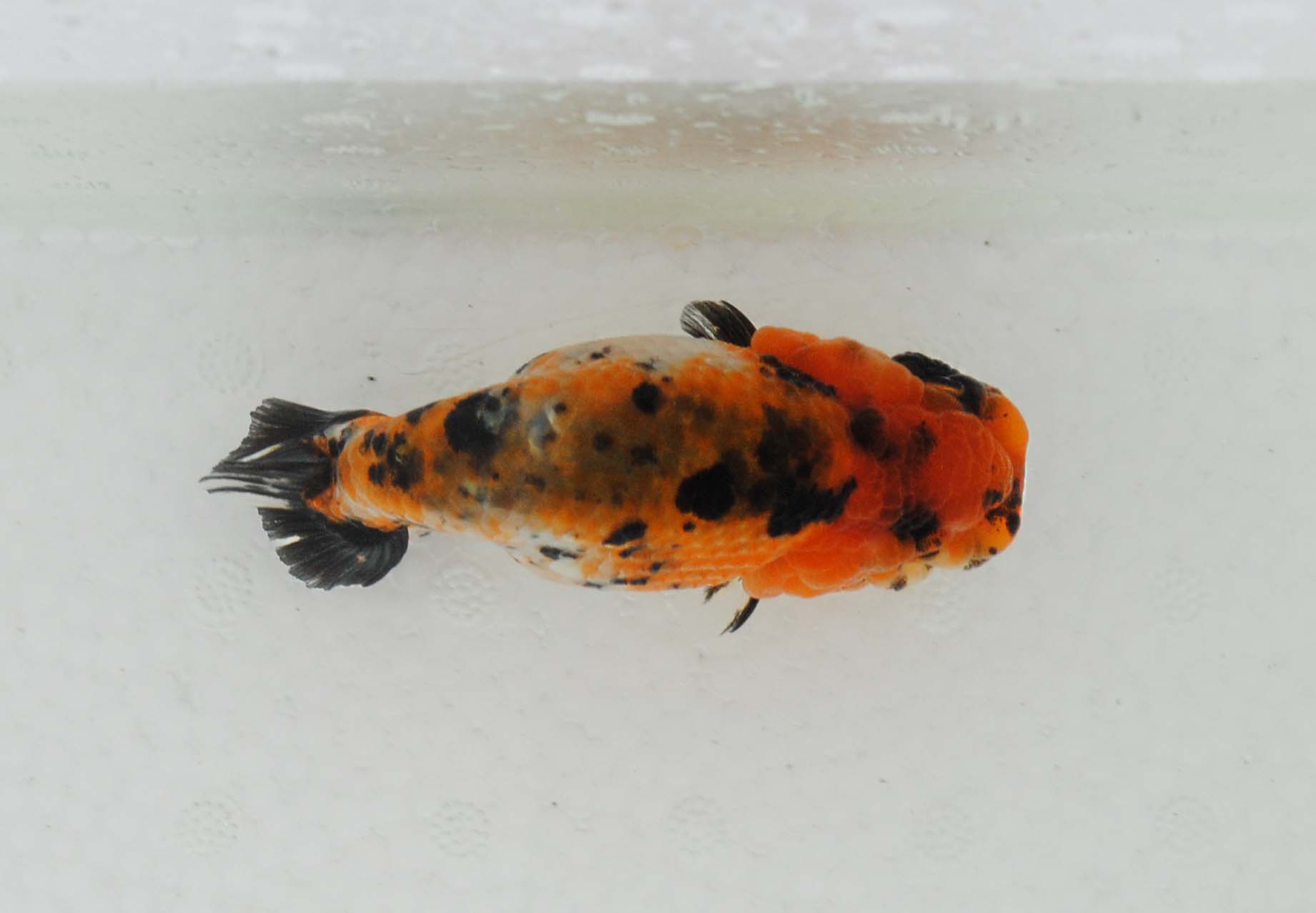
This is the 2nd category. It has lots of black marking, in the shapes of large blocks and dots. But the black marking does not produce a belt appearance. It is more towards irregular pattern. It can be considered as calico with lots of orange color. I am still undecided whether to use this in the project or not.
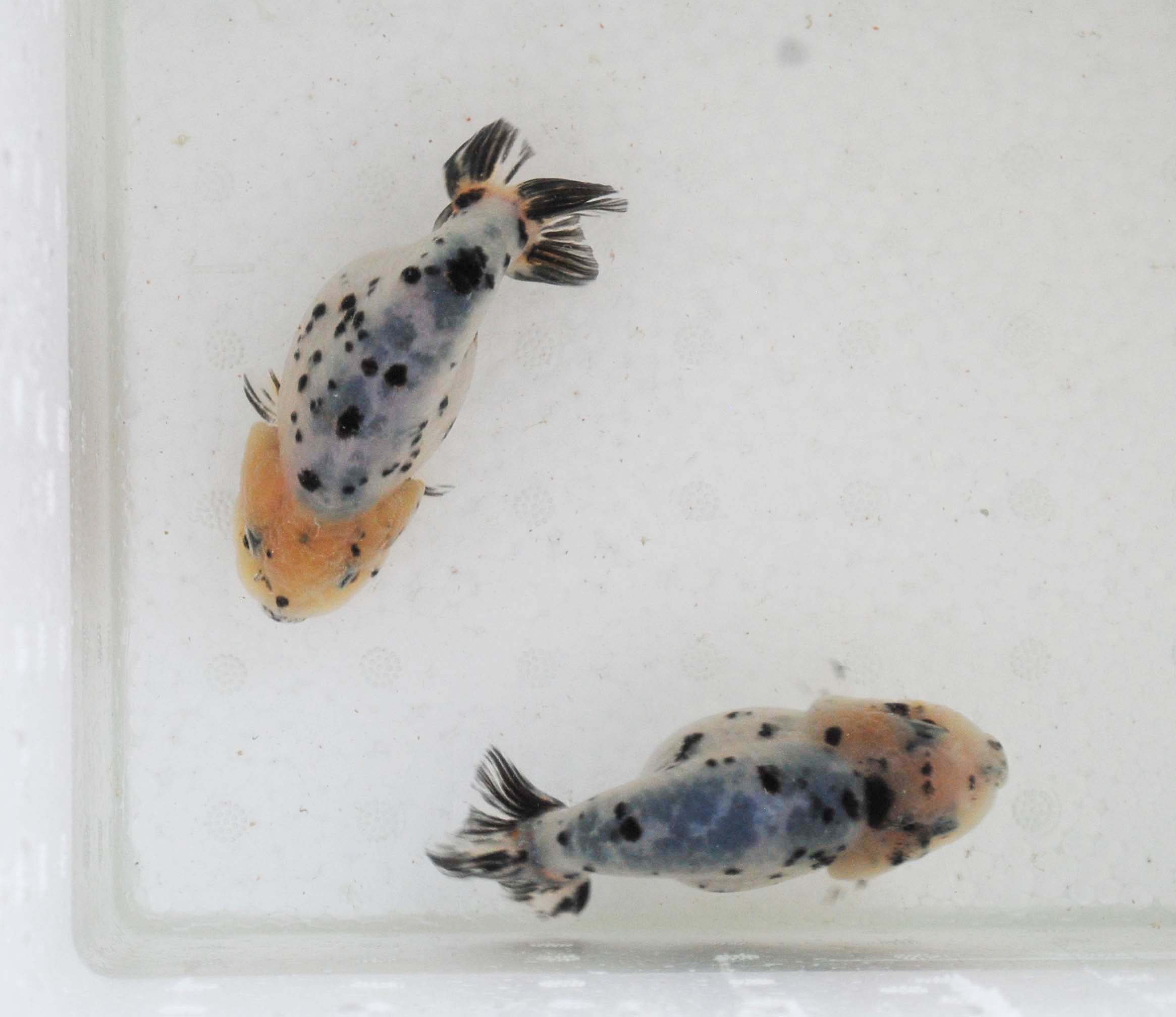
This third category is also interesting. They are close to the pattern of snow leopard, except that the snow leopard does not have blue and the black dots are smaller and many.
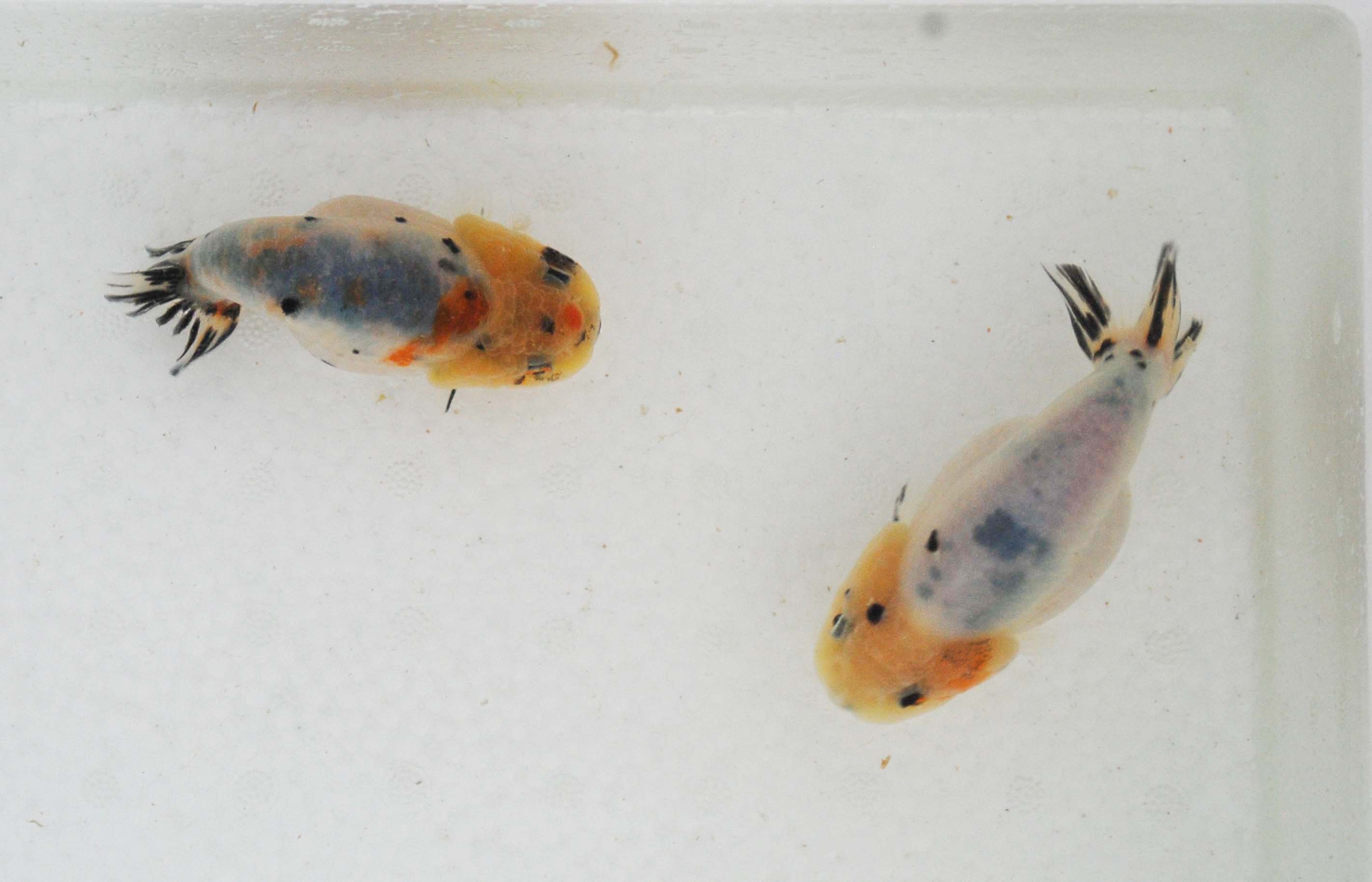
The fourth category resembles calico but a weak one. The blue and white are dominant while all the other three color are minimal. I do not think I can use them to propel this project.
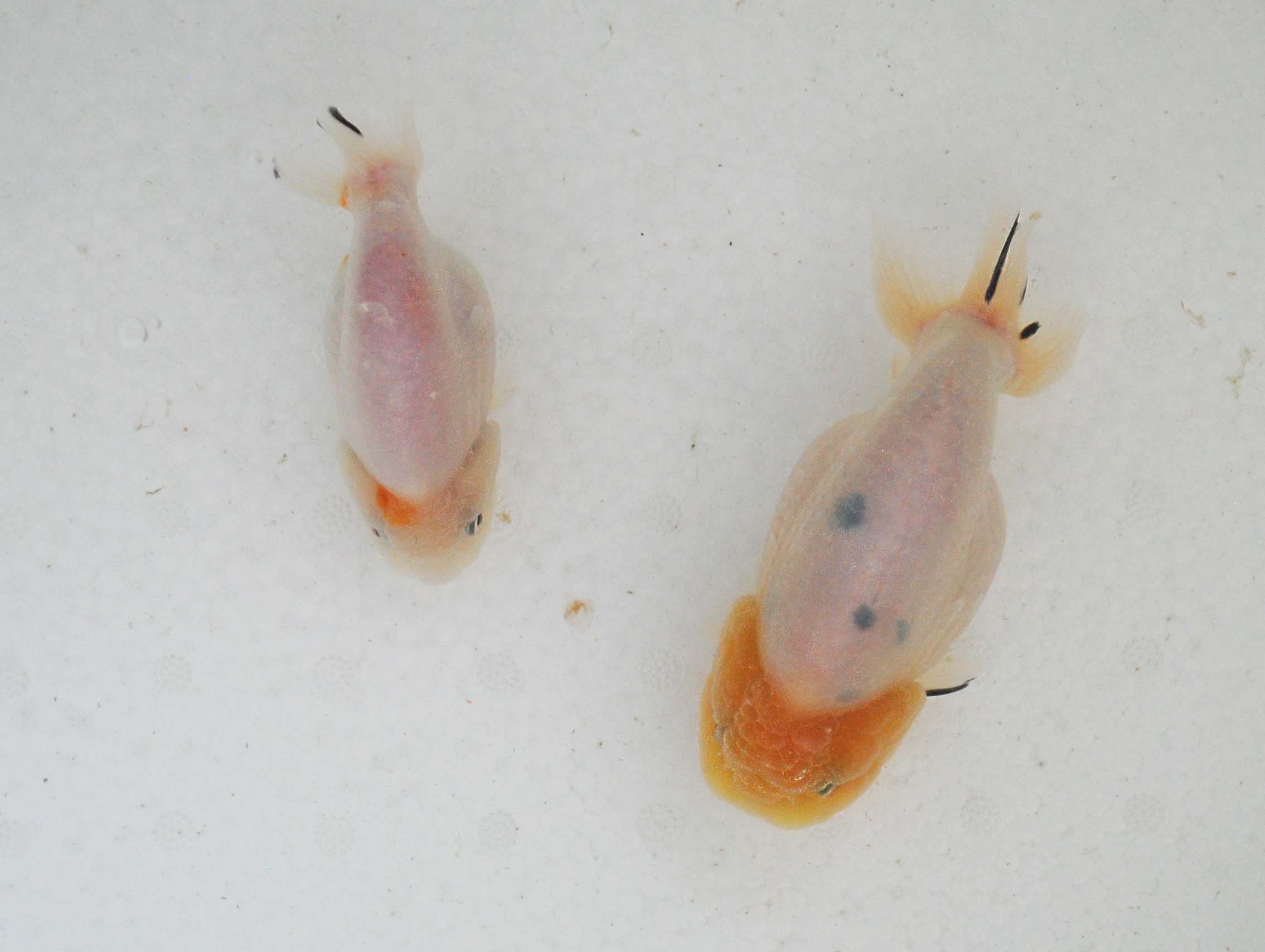
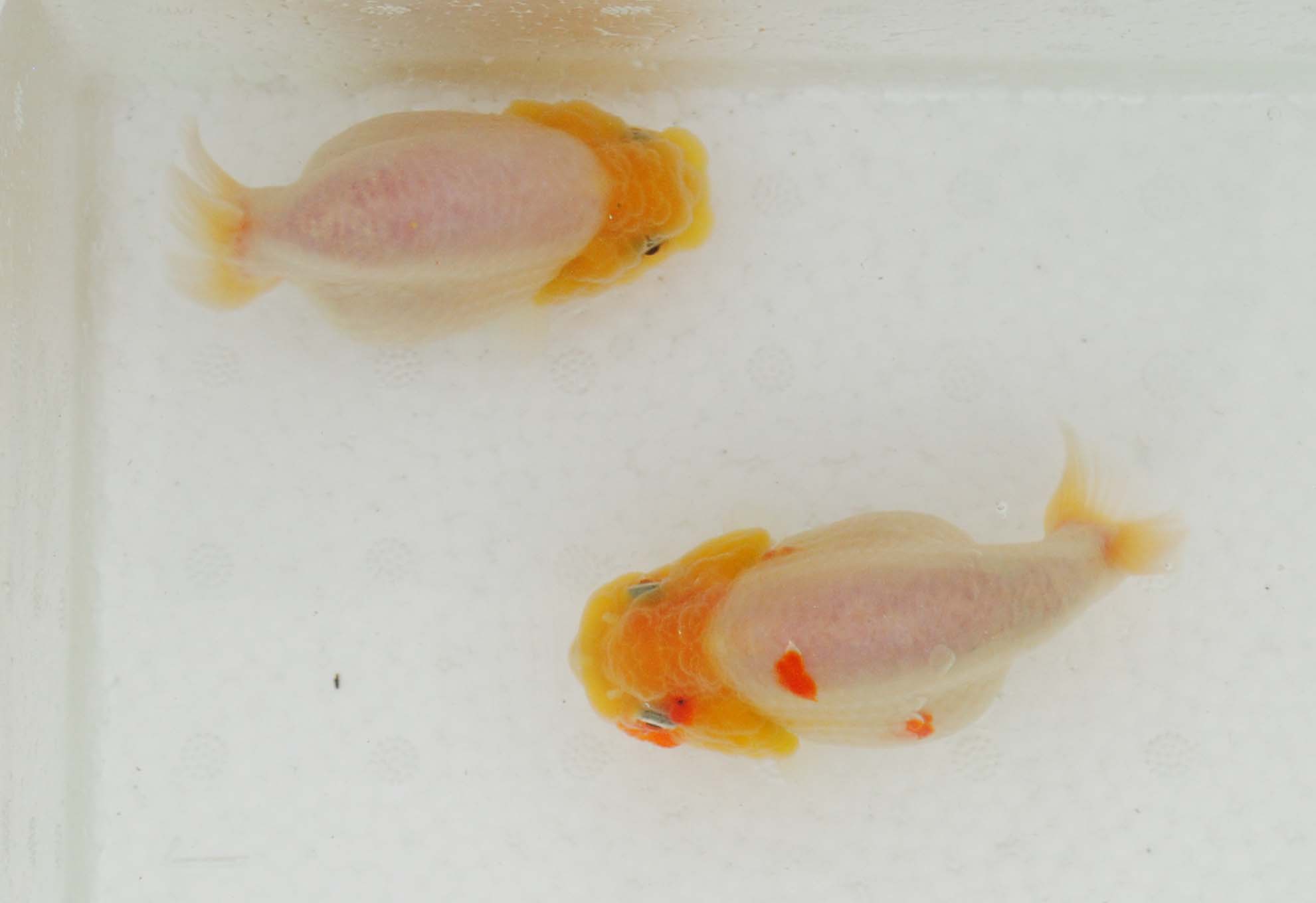
The fifth category is the almost white fish. I notice that the black color is stubborn, though minimal.

This sixth category is the Sakura. Once again, the black color still appears in a minimal proportion.
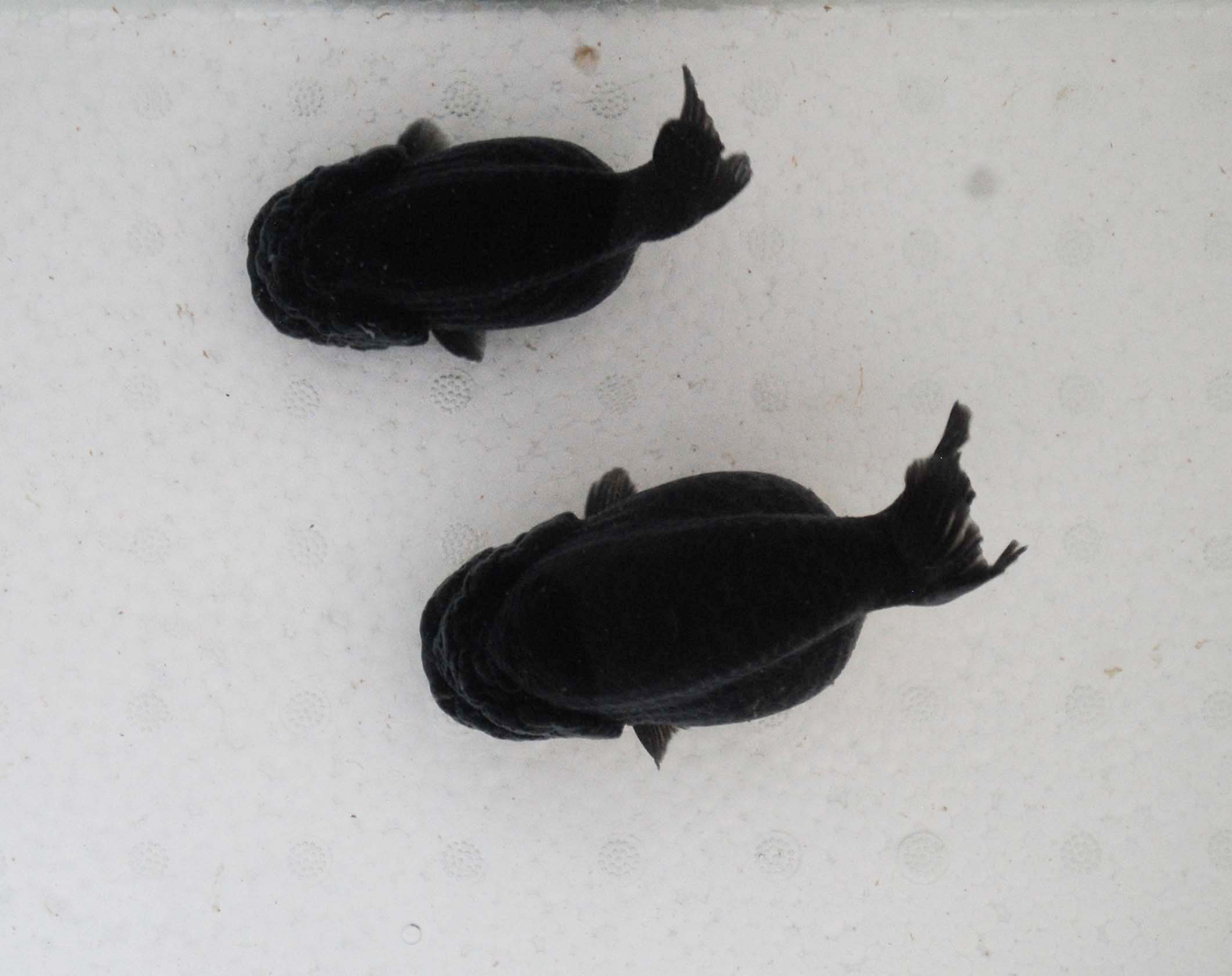
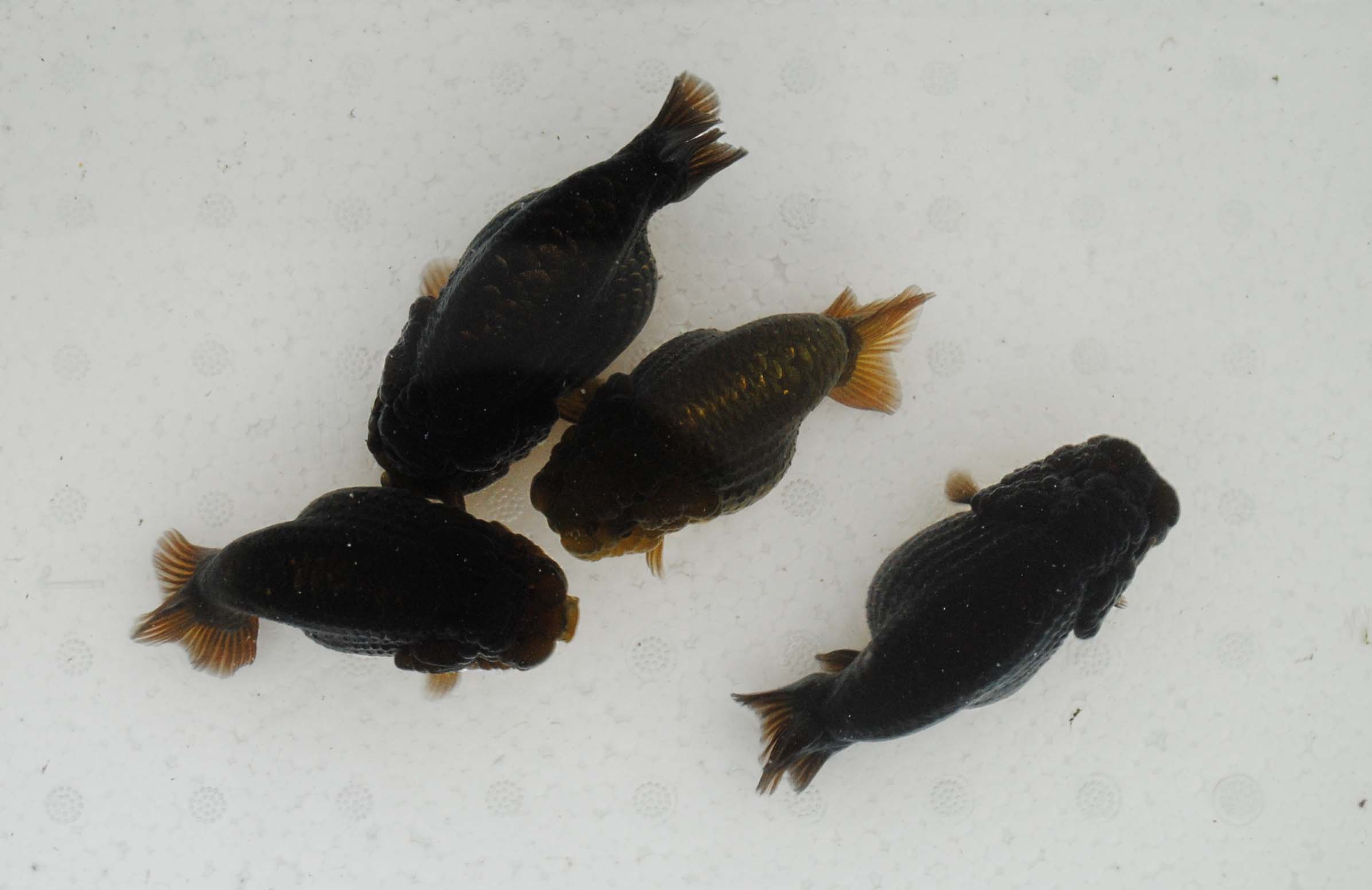
And the last category is the black color. They always come out from the Milk Cow crossing. Of course, I will use them as my main ingredient in this project.

So, to compare with the Cow x Sakura, let us examine this table:
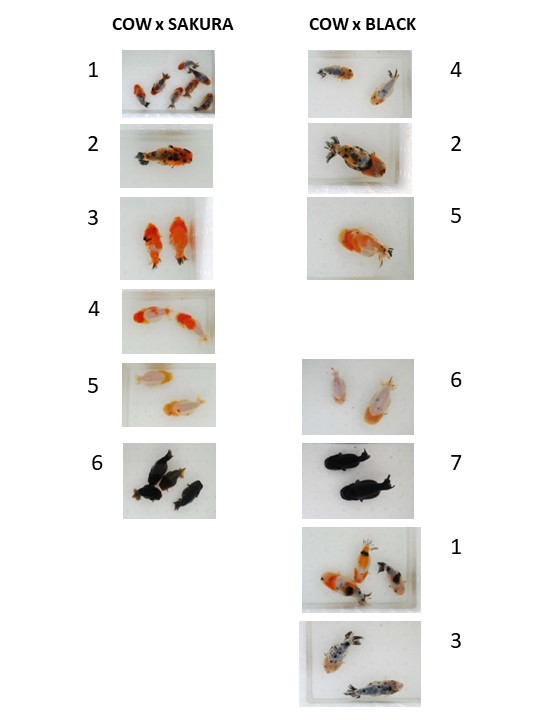
In the cross with Sakura, we do have offspring #4 (left) which has beautiful proportion between the red and white color (roughly 30% – 70% or 40% – 60%). This is different from #3 (left) which is dominated by red color. And #4 has no trace of black pigment. We do not see this variant in the Cow x Black offspring.

The offspring that comes up only from the Cow x Black are the #1 (right) and #3 (right). Yes, the cow / belt variant and the (somewhat) snow leopard variant only appears in the cross with black. I find this finding interesting.

The beautiful calico variant only appears in the cross between milk Cow and Sakura. This is also a thing to ponder.

The black appears on all of the crossing.

I think there is a lot to think about from this observation. I will make my next breeding plan based on this information. Tell me if you find any interesting interpretation to this information.

Standard
cow ranchu

The Diary of a Goldfish Breeder 2024 (4)

My experiment with Cow Ranchu is still ongoing. After so many attempts, I still have no clue of how to produce the color pattern. I had bought Cow Ranchu many times with limited success in breeding them. I grew suspicious concerning whether the fish (both male and female) had been treated in a certain way to prevent successful breeding. I had few offsprings, though. But at this point, none can be categorized as cow. The suspicion makes me reluctant to buy more import of Cow.

Yet, when an seller imported them once again, I was tempted to try this project once more. But I did not want to buy many. This time, I bought just one male. In my mind, this will be my last attempt to buy Cow Ranchu. If this also fails, I will stop buying them. To my surprise, this male is very vigorous! I bred him twice, with different female, and they gave me lots of offspring. He died afterwards. I have not taken a decent picture of these parents, but I have short videos of them.

In this diary, I will show the offspring from the first cross. It is between this male Cow Ranchu with a Sakura Ranchu. Well, it is not really Sakura since it has several black dots. But the dots are minimal, so it is closer to Sakura pattern. This Sakura is the result of my previous experiment with previously imported Cow Ranchu.

The Male
The Female

I am interested in knowing what color patterns are produced. And it is interesting to compare with the next diary where I cross the same male Cow with another fish.

I just take the pictures from top view for quick reference and classify them based on the color pattern. Here are they:

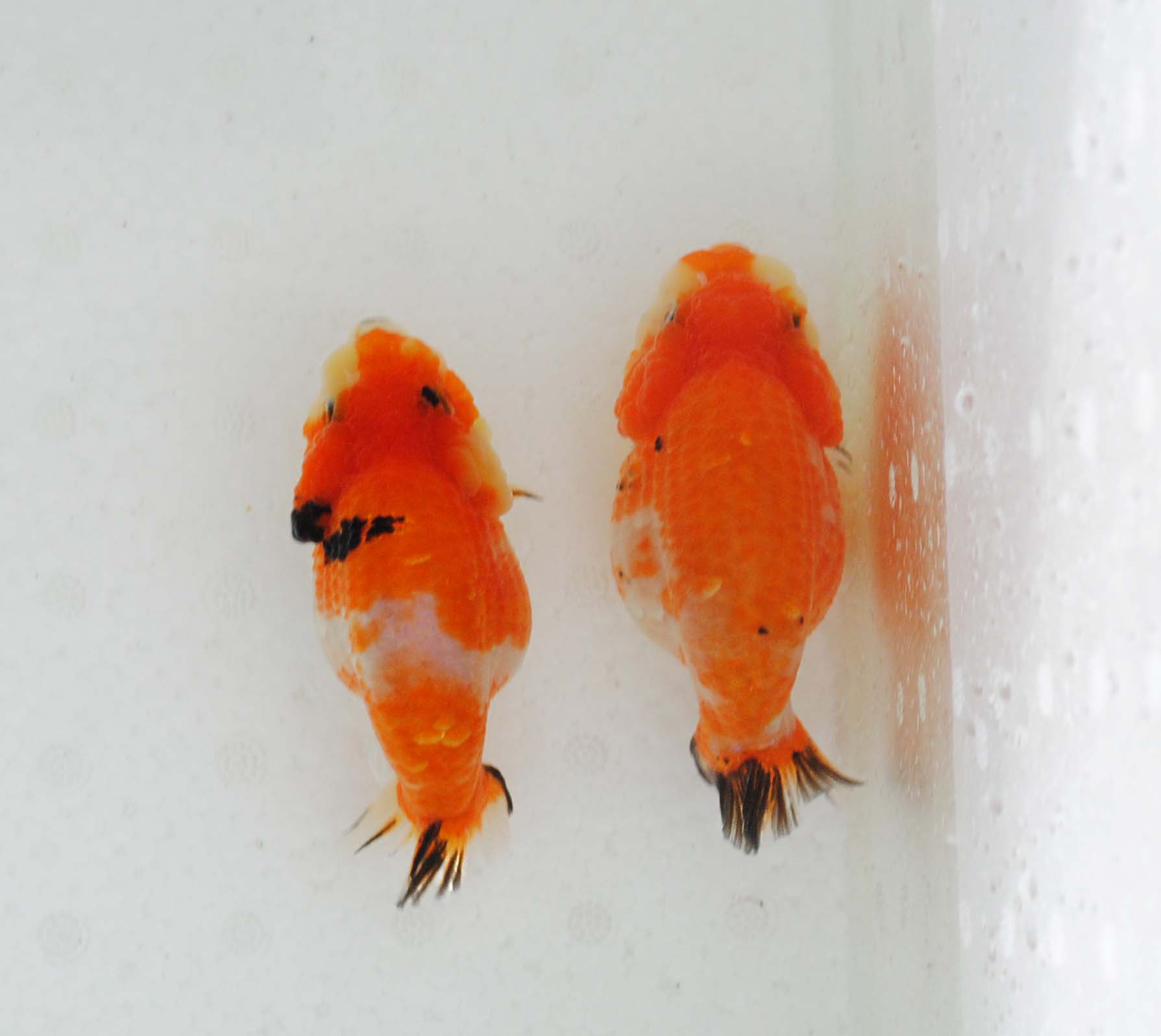
Many become Calico with good pattern quality. By definition, calico should have five colors visible. These offspring have blue, white, red, black, and orange / brown color. The blue color is strong. All the color is in good proportion. Actually, I like these offspring. But for my purpose (in understanding cow), I will not use them to further my project. So, I will sell all of them.

The second category is with lots of orange color and with no blue, so I put this in a different category from the calico. Perhaps, this fish can be said to have four color: orange, black, white, and the black pigment under the orange color (I do not know what to call it, it is definitely not blue). I will not use this one for my project, either.

This third category can be called three colors since it has red, white, and black color. But the black pigment is so minimal that this category can also be called Sakura. I am interested in this category. There is a story to it. I once bought a strikingly beautiful three colors transparent Ranchu from a farmer. This is the fish:

Such a marvelous color, isn’t it? Too bad, the breeder only had one. I asked him to find similar pattern in the batch and he could not find any. Upon questioning him how he came up with this color, he said he crossed the Cow Ranchu (from my lineage) with a Sakura Ranchu! He described the Sakura to have lots of red color with minimal black markings and several metallic scales in the body. This description matches the third category of the offspring I am talking above! That’s why, I will use this third category to further my experiment. If my experiment with Cow Ranchu takes a different turn to result on this kind of three colors, I do not mind at all! (Note: the three colors is female. It grew large in my facility and died without ever producing any egg).

The fourth category is the true Sakura. Actually, I do not think I will need them for the Cow Ranchu project. But one has an excellent body quality, which whets my appetite to breed it. I am sorry I have not taken the pictures right now. Hopefully, I will have the pictures next time.

The fifth category is the totally white / almost white fish. I am still considering their usage on this project. So I am undecided right now and will keep one. Perhaps the totally white one.

The last category are the black metallic fish. This is what I learn from the presence of this category. The fact that Cow Offspring (the milk cow variety) always produces decent number of black offspring means that black fish are involved in the making of milk Cow variety. Well, it is my conclusion. I can be wrong. But unless proven otherwise, I will keep this category and use it in my cow project.

And this is the end of my report today.

Enjoy!

Standard
The Diary of a Goldfish Breeder 2021, yellow sakura oranda

The Diary of a Goldfish Breeder 2021 (26)

The new project I take this year is the Yellow Sakura Oranda.

It just occurred to me last year that it might be interesting to cross Sakura Oranda with my Yellow Goldfish. I pictured a goldfish with soft color skin as Sakura Oranda but the color is yellow white instead of red white. But I was not so sure about the upcoming result. Would the cross yield the color I imagined? Or would it be just orangish color which could not be clearly differentiated from the sakura color? Some transparent color goldfish have yellowish color, would my cross yield something differentiable from that?

I did this project out of curiosity. I just want to know.

After I separated the transparent from the metallic scale in the F1, I got all sakura color (red white). This is as expected, since yellow is recessive to red. I got the yellow color in the F1. Strangely, some of them had black marking. Perhaps the sakura oranda I used in the crossing was carrying the calico genetics. They were not perfect.

This one was not neat. The fins looked weak. Yet, I could confirm the color as yellow instead of red. I was very glad with this first result in terms of color. When I write this blog, the fish is no more.

The second yellow sakura had some improvements. The fins looked good, the body shape was more stout. The yellow color was a bit too little, but it was ok. I really liked this one. I managed to cross this with my metallic yellow oranda once, and this guy died.

I was left with several yellow sakura offspring.

One thing about sakura coloration is that the pattern counts. When the red color is too dominant, or when the red and white pattern was too plain (such as half the body is red and half is white), the fish becoming uninteresting for me. I consider a combination of red and white in proportional amount with some red islands as good pattern. I applied the same appreciation standard to my yellow sakura. So, I culled out a lot with dull pattern, and kept just one precious gem. This one piece is the one I currently have. The body quality is good enough, although there is a slight defect in the lower tail lobe and the dorsal which disqualify him from the contest. But, I found the pattern very beautiful. I think I can see two cartoon eyes in the pattern. And the soft yellow color combined with the milky white is more than I can expect. I also succeed in getting rid of the black pigment from the fish.

I take several pictures of him. Please enjoy. Merry Christmas.

Standard
The Diary of a Goldfish Breeder 2021

The Diary of a Goldfish Breeder 2021 (9)

Yellow Color in goldfish is a fascinating project for me due to its rarity. My main project is to create Yellow Oranda (or better, Yellow and White Oranda), which I have succeeded. This variant falls in the category of Metallic Scale. Now my task is to improve the quality of the fish in terms of its headgrowth, body shape, and tail.

A side project in this Yellow Adventure is to create Yellow and White Transparent Scale Oranda. I nickname the variant as the Yellow Sakura Oranda. I did this out of curiosity to satisfy my imagination. In fact, I have a doubt about its market acceptance. Can the fish be clearly differentiated from the common Calico Oranda and its variations?

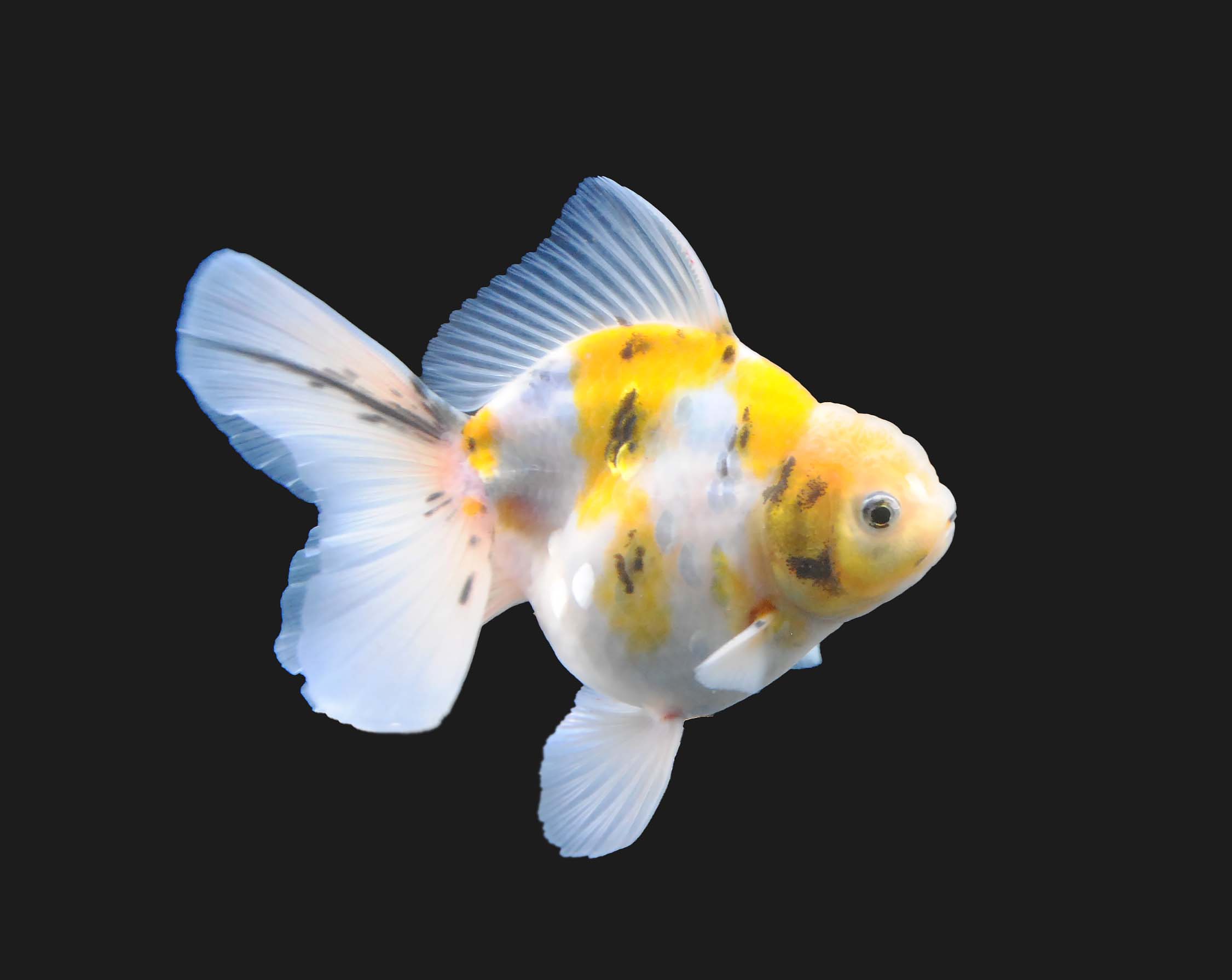
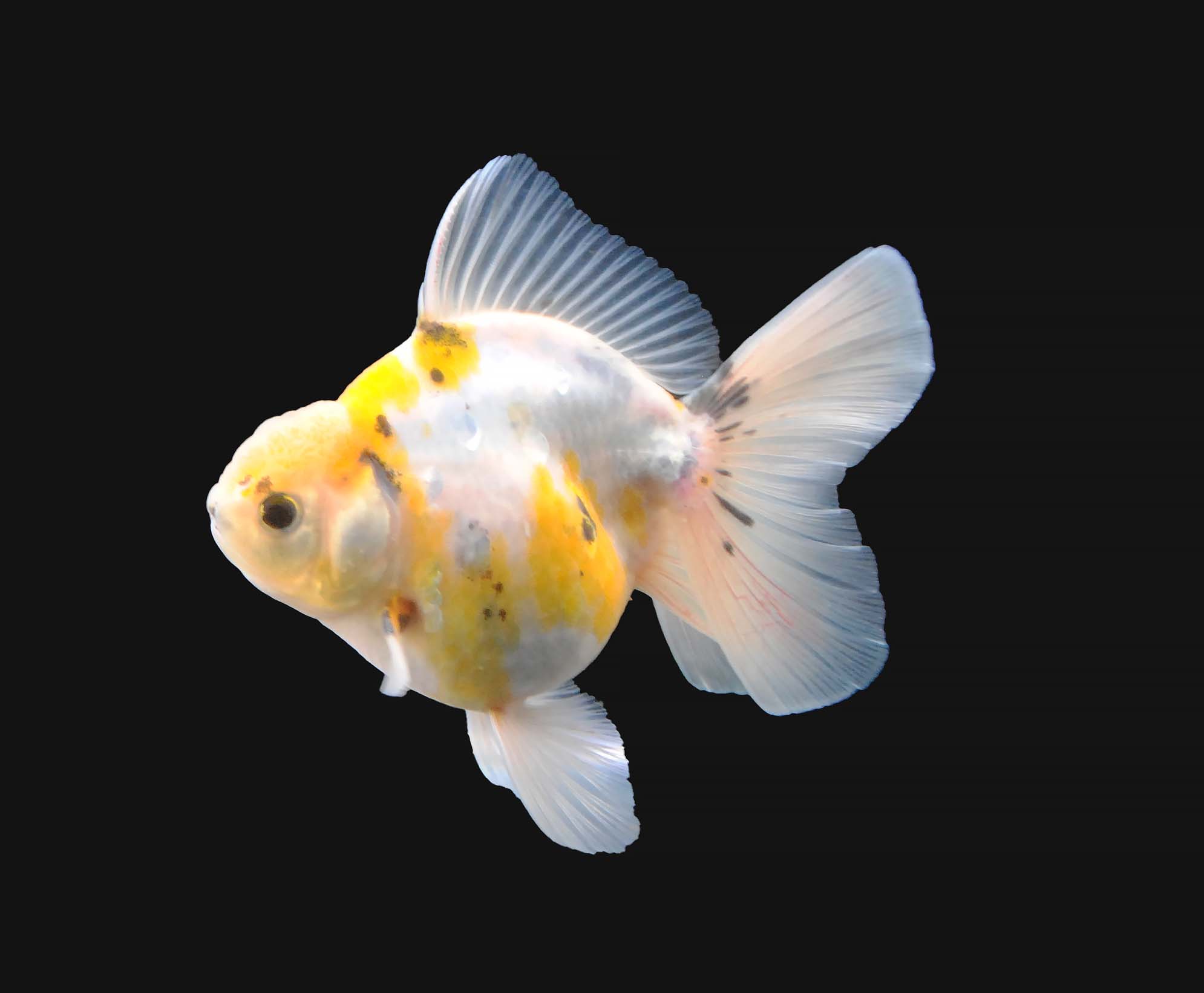
I started this project last year. I mated my Yellow Oranda (metallic scale) with a Calico Oranda. The F1 were Sakura in its Phenotype. I had a chance to inbreed the F1 this January. Too bac, most of the offspring have single tail and I must cull them out. I was left with only four fishes, which grow into different colors. One become Sakura with strong red color, one is a black and white fish, another one is a color between yellow and orange, and the best one is clearly yellow with white and black / blue spots! This last one is what I am interested in.

The yellow color is pale, but it is clearly yellow. However, it is a bit hard to capture in camera. I must do some editing to try to bring out the real color. I cannot say it is nice, but surely it is an interesting combination when combined with the white color. My surprise comes from the melanin showing up in the combination in the form of blue and black spots. I thought the melanin pigment will go away when the fish grows up. But it stays.

Well, the fish is not a perfect one. The middle tail does not split (but invisible from the side viewing). Yet the body and tail shape are not bad. Concerning the color, let the reader be the judge.

Standard
cow ranchu

Cow Ranchu Crossing

Cow Ranchu is a variant of the transparent scale ranchu that has black and white color. Sometimes the black pattern can expand. The black comes in large patterns and small dots. Red color might be present in small areas of the body. If the red is too much, it cannot be called cow ranchu anymore. I do not know if it is the International standard name of not, but we Indonesian calls it Cow Ranchu since it resembles the color of black and white cow. This breed was rare before (especially in Indonesia), but it is available recently through imports from Fuzhou, China (if my information is correct). How people come up with this pattern is still a mystery for me. A breeder friend told me once that when he bred them, he got a variety of transparent color ranchu including calicos. So, in his view, the cow is just the offspring of the usual calico which then being separated purposely based on the color. So, it will not breed true. I doubt this explanation. In my understanding, the usual calico does not have the ability to expand its black pigment like this cow ranchu. And the black in calico usually comes in dots, not large patterns or blocks as in this cow ranchu. So, I decided to buy some cows at the end of 2019 with three purposes: first, to breed them to see if they breed true, second, to observe the expansion of the black pigment, and third, to cross them with other colors to see what will happen. Well, the 1st and 2nd purposes was facing hindrances. My first attempt to breed them resulted in so few offsprings. I think I need to breed more of them. And then, three out of five that I bought died, sadly. Gladly, I managed to crossbreed them with the common calico and with the blue metallic scale ranchu. This writing will mainly talk about the crossbreeding result.

These are the five I bought (I show them the left and right side for each):

The first three are the males. And the last two are the females. My favorites are number three and four. Too bad, they are gone. The remaining two are number one and five. I am trying to buy some more to replace them.

Their offspring in my first attempt to breed them was few, and they were weak in quality. Yet, my initial conclusion is that they breed true. Majority of the offsprings were cow ranchu. Few had minor red stains. No calico observed. Yet, I need to confirm this with my next breeding. I could not stand the quality of the offspring, so I culled most of them. I come out with these two left:

The first one has a yellowish stain in the area of its left pectoral fin. The rest are white with black pigment under the skin. The first one also has an outer black pigmen in its pectoral fin. I think they are good specimen to observe whether the black pigment will expand or not. These two are the reason for my initial conclusion that they can breed true.

Next, I mated the cows with these calicos:

I bought them from an importir friend who acquired the parents from China. So far, he has bred them true. I saw myself the offspring in his pond was pretty much similar in color characteristic. I asked for one female and two males. Too bad, he mistakenly sent me all females. Anyway, I could still pair them with my cows.

Here are the results of the cross between the calicos (female) and the cow (male) – after hard culling, ten of them remain:

The quality is far below my standar, so I cull them hard. Even these ten will be culled again after they serve the illustration purpose. (Mostly, my wife’s pupils will adopt them.) The offsprings resulted in different eye type, and different color variation: tiger, calico, sakura, and cow (the last one). I kept the cow one to see the progress of the black pigment.

I also use this blue metallic ranchu which comes from my own previous project to breed with the cows:

And the result of the cross between the blue metallic (female) and the cows are:

cowblue 7

The offspring consists of blue metallic scales and grey metallic scales, but I want to focus on the transparent scale offspring. After much culling due to the low quality, I keep these to represent the range of transparent color emerged from this cross: tiger, calico, and kirin-like ranchu (the last one). Kirin is another variation of transparent color where the dark color and the light color seemed to separate in half. The dark color (purple, blue, grey, black) always dominates the upper part of the body, while the light color (white, yellow, red, orange) is more in the lower part. Actually, a more accurate description I think is that the light color is all over the body in the background, while the dark color exists in the foreground and occupies only the upper part of the body. The dark color usually looks with scales, or looks like a net, while the light color is transparent. Some shiny and big metallic scales are usually seen scattered all over the body.

Comparing the two crossing, it is obvious that there are overlaps: the tiger, calico, and sakura (perhaps some of the calico will turn into sakura when they lost their black pigment, or it will never happen in this cross, I do not know and do not focus on that). But interestingly, the cross between the cow and the calico produces cow-like offspring, where the other cross does not. And the cross between the cow and the blue metallic produces the kirin-like offspring, where the other cross does not. It is a hint, I think, that kirin pattern involves the blue metallic scale in the making. I kept the kirin-like one to see or use in further project.

That’s all that I can report so far. Thank you for reading. Enjoy!

Standard
Uncategorized

Sakura Coloration on Ranchu-like Goldfish

As mentioned before, I am trying to create tricolor metallic scale ranchu. This project directed me into crossing a tricolor metallic scale tosa with ranchu. By tosa I mean the ryukin which has no hump. It turns out that all of the offsprings shows a combination of metallic scale and transparant scale on the body. My conclusion is that the tricolor metallic scale I used is actually a variant of calico (transparant scale) goldfish which somehow develops metallic scale all over the body. This is not a genuinely metallic scale. The piece I have here shows minimum metallic scale. The body is mostly covered with transparant scale. And it looses the black color and turns into sakura color.

Image

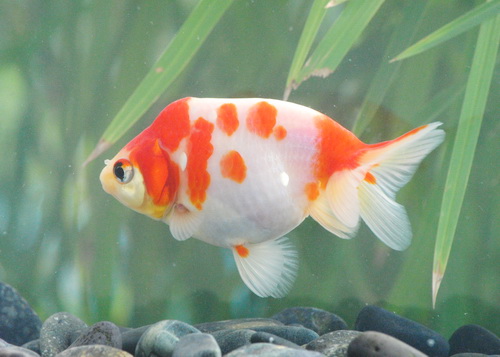
Don’t ask me about the body form resulting from this crossing. Horrible. This one is the best in terms of the back smoothness. The shape is not ranchu yet, that’s why I cannot call this a ranchu. The head resembles a tosa or ryukin since it has no headgrowth. And it has a hump! My first impression when I look at this piece is the image of a cow. But instead of a black and white cow, this is a red and white one.

The sakura color is impressive on this one. The red is truly red, it is not orange. And the white is milky white. Adorable. And the pattern is pleasing to the eyes. When the sakura is dominated by the red or orange color, it looks horrible to me. But this fish has the right amount of red and white combination, according to my perception. This is the sakura coloration I want to create, though not in this body form. The large red dots look like the brush strokes from an expert painter.

Image

Standard