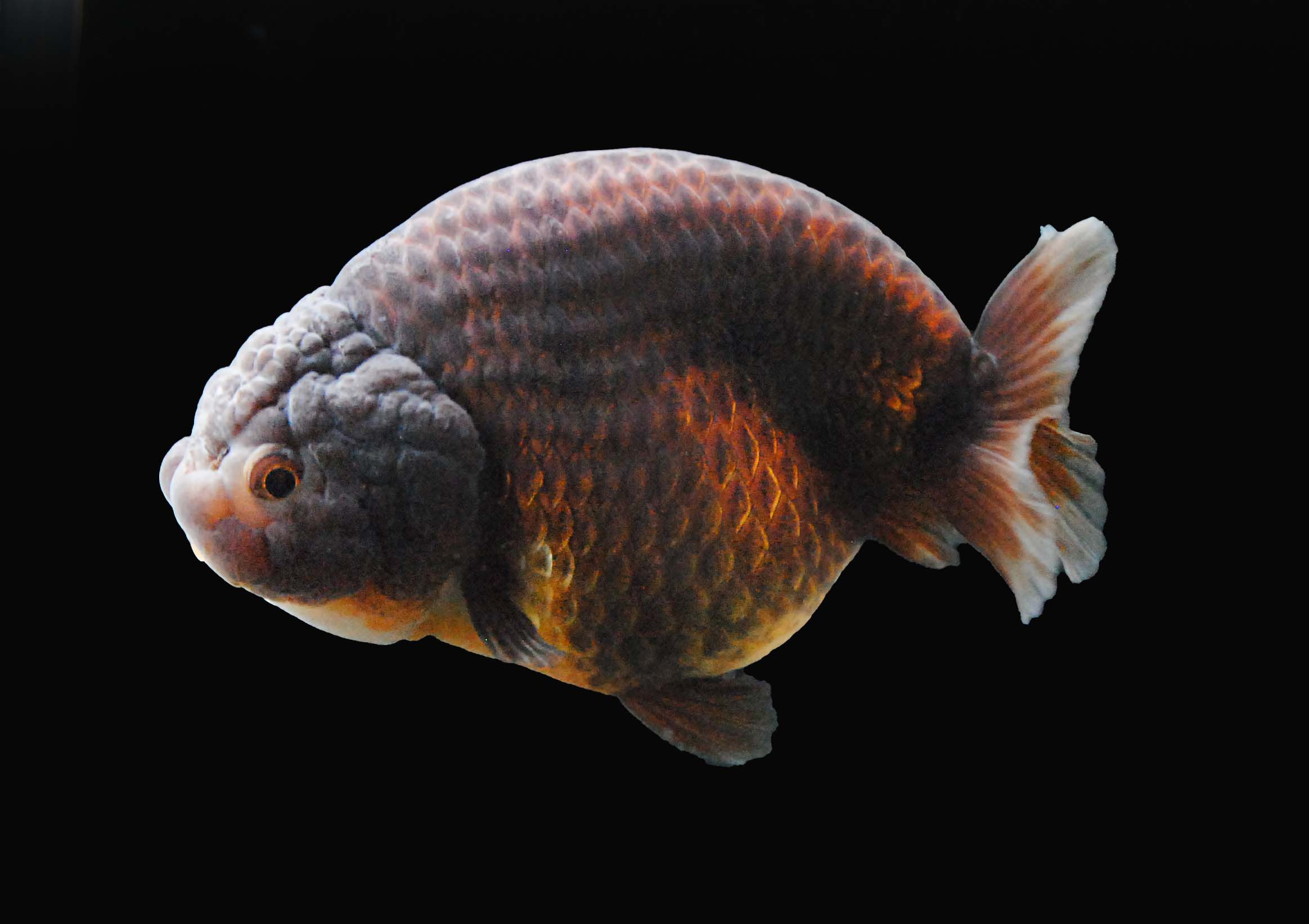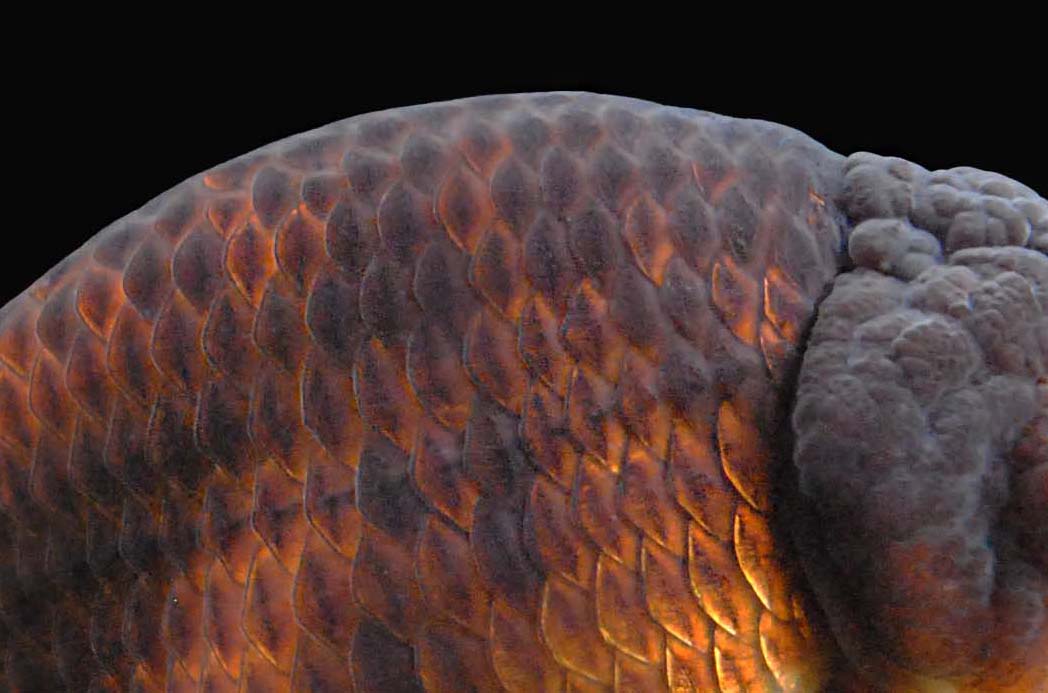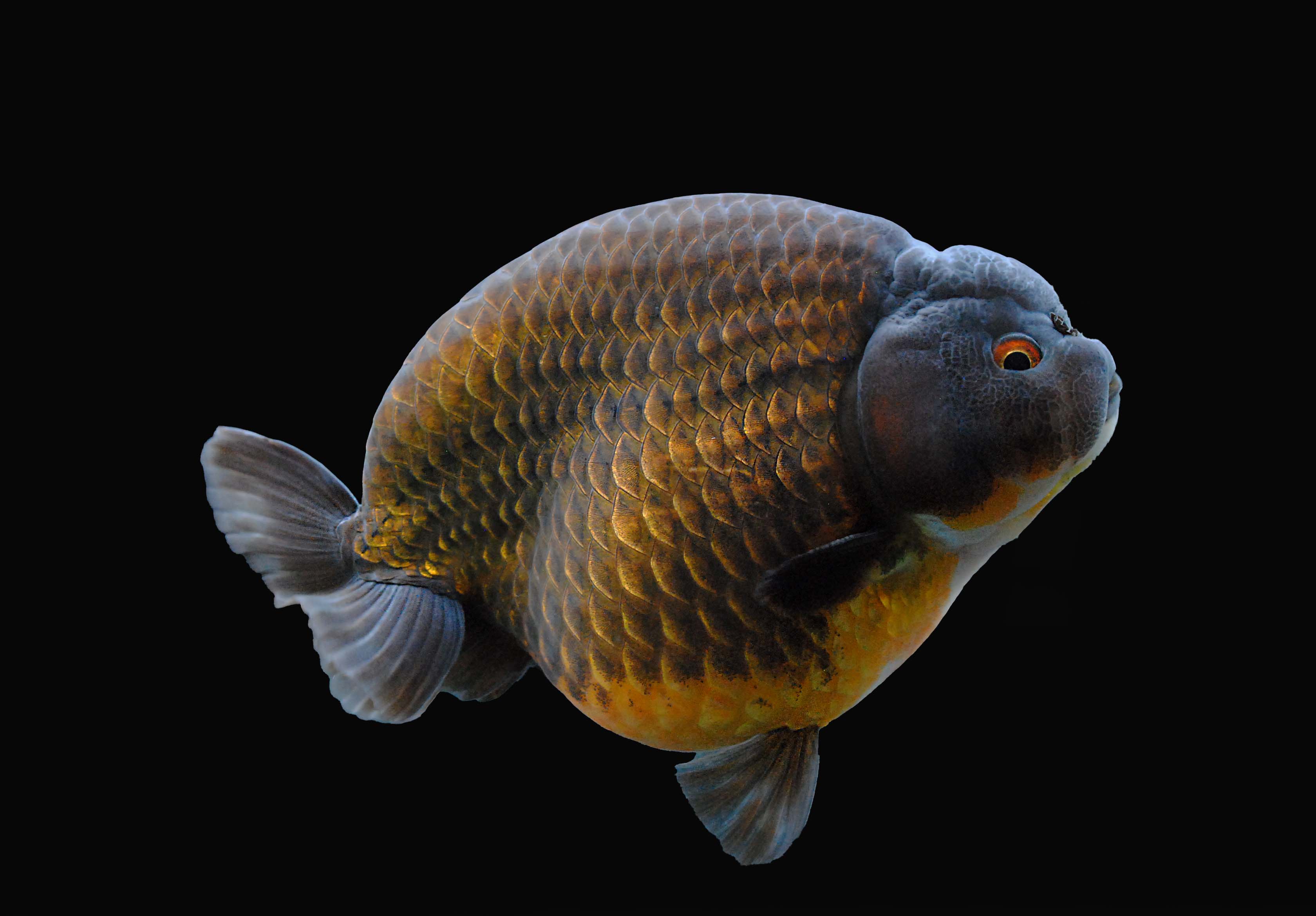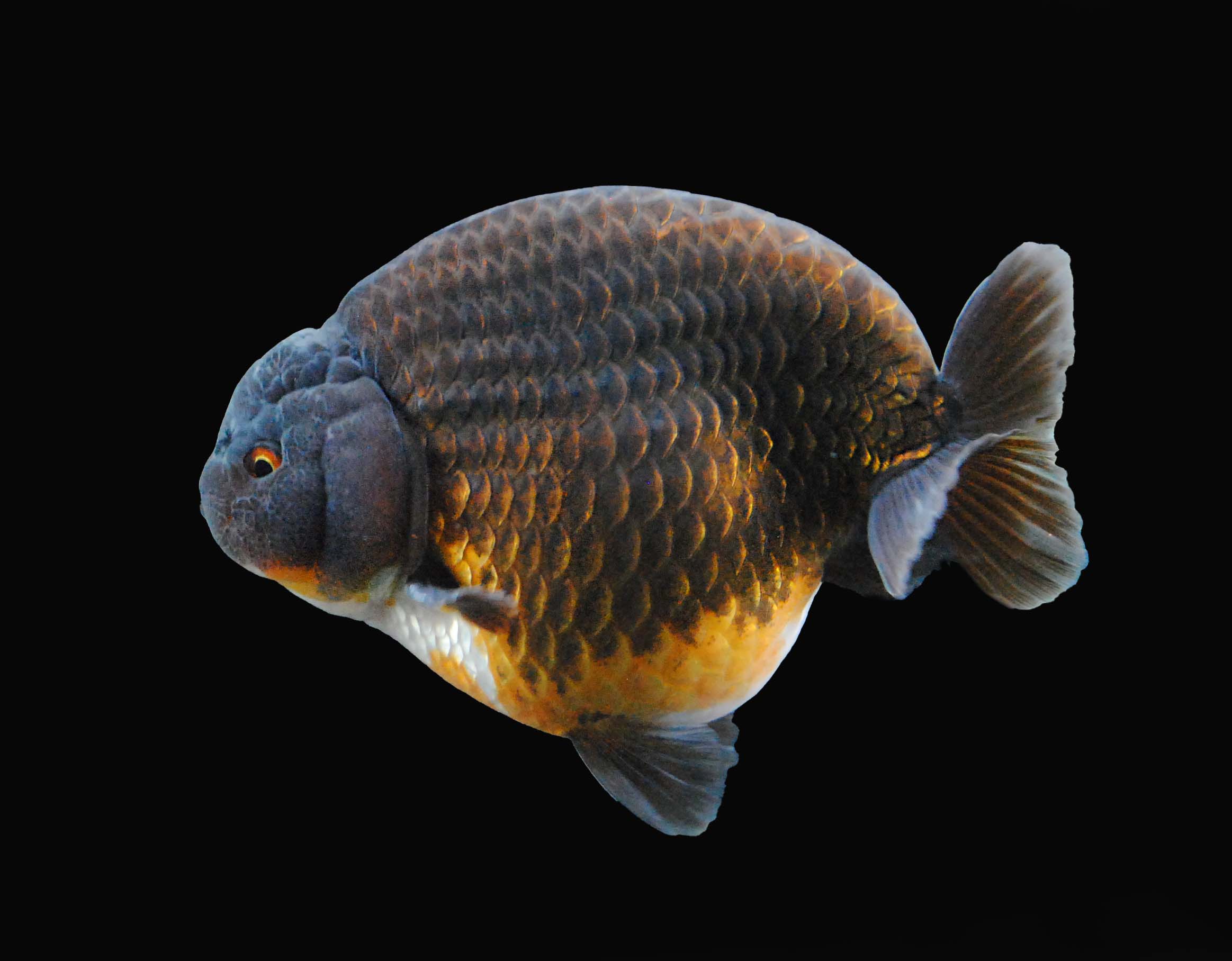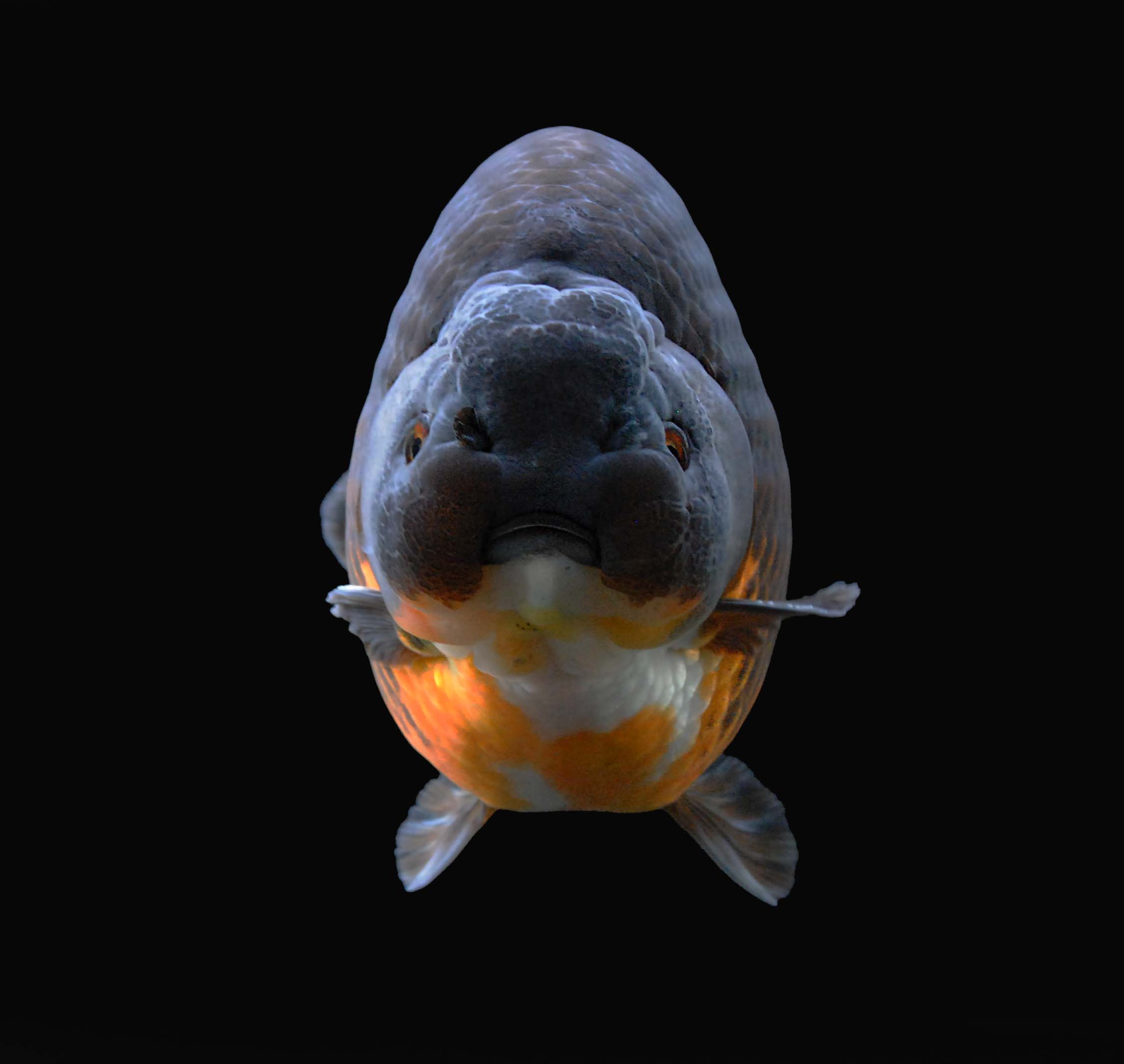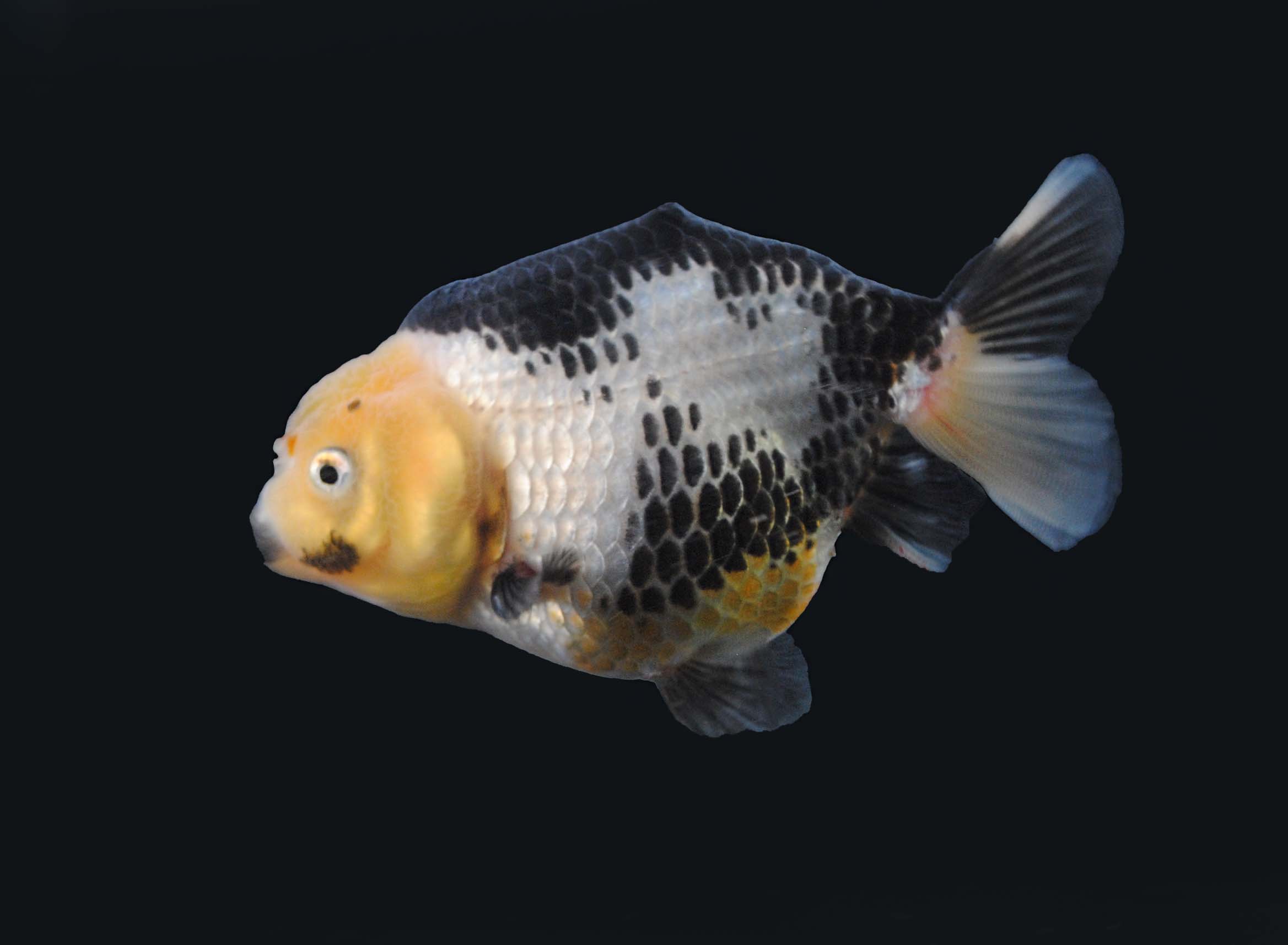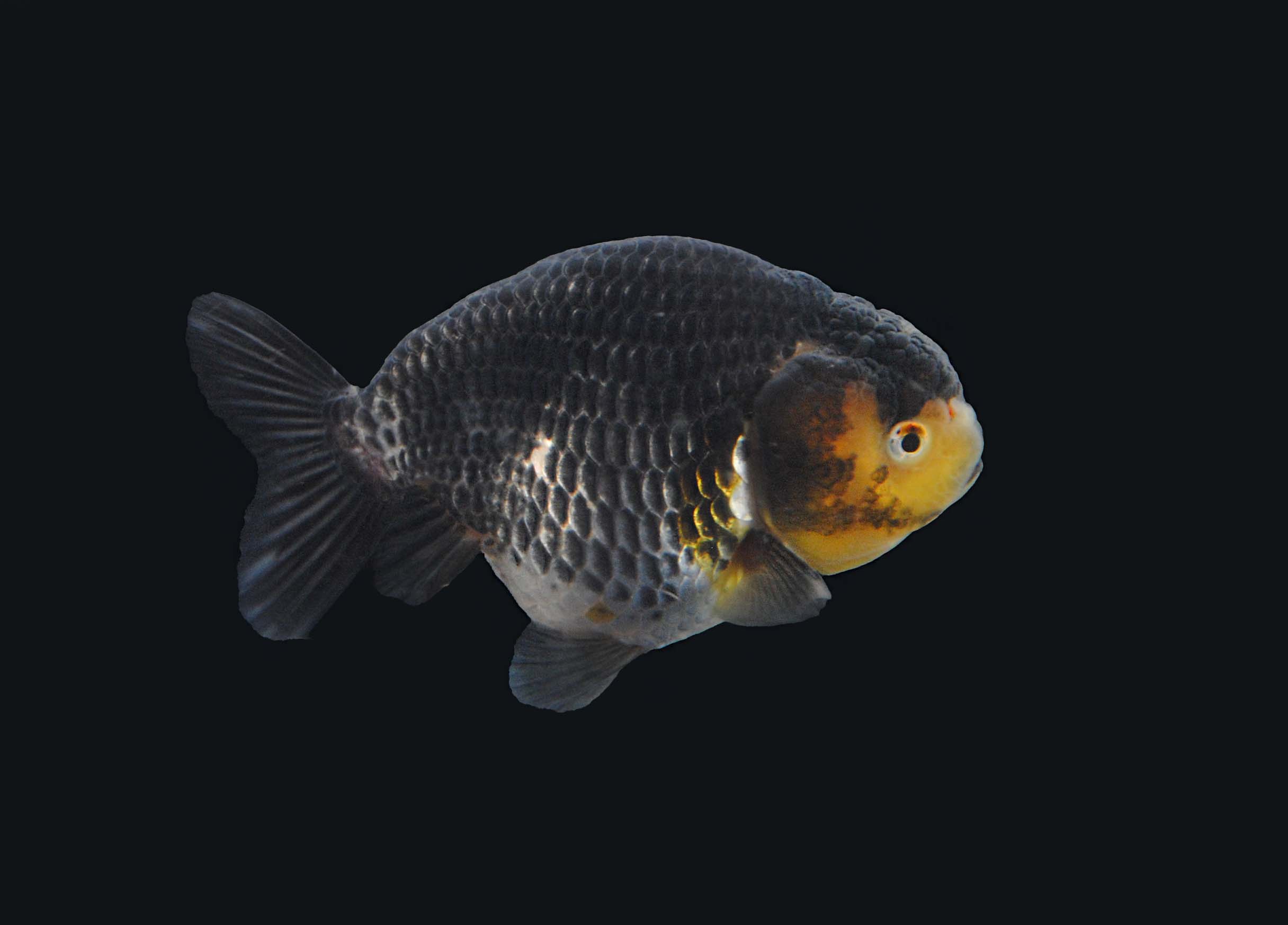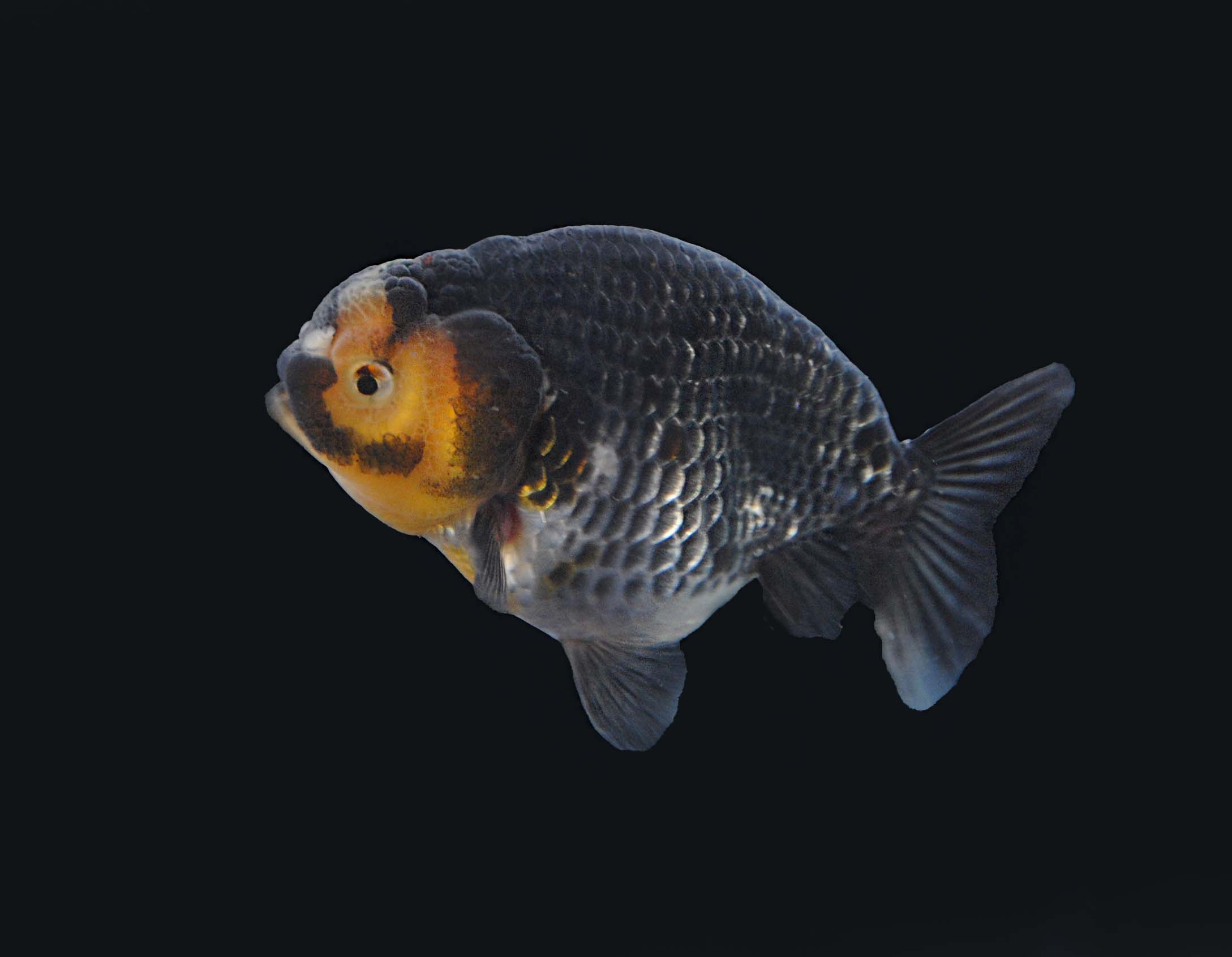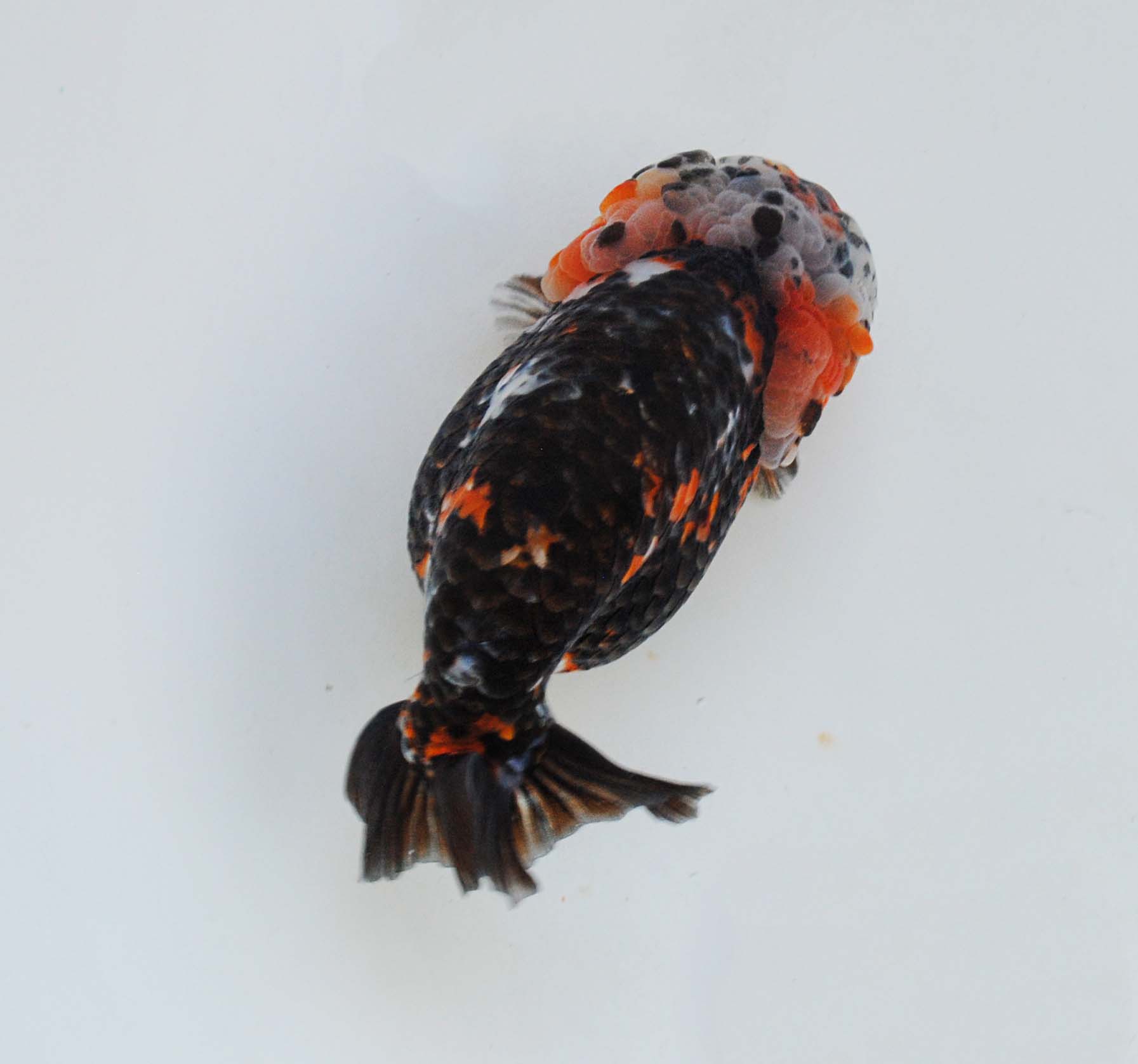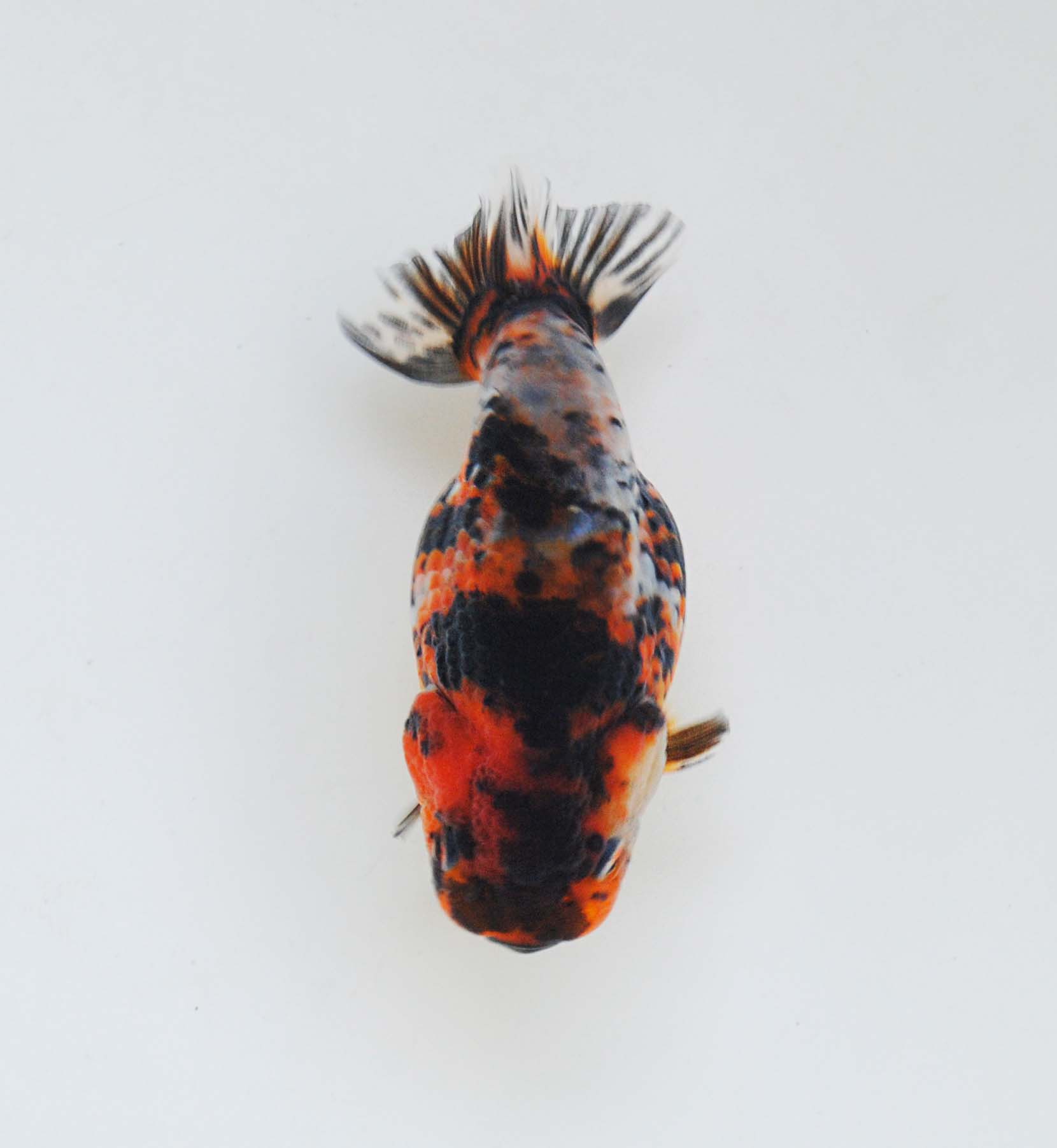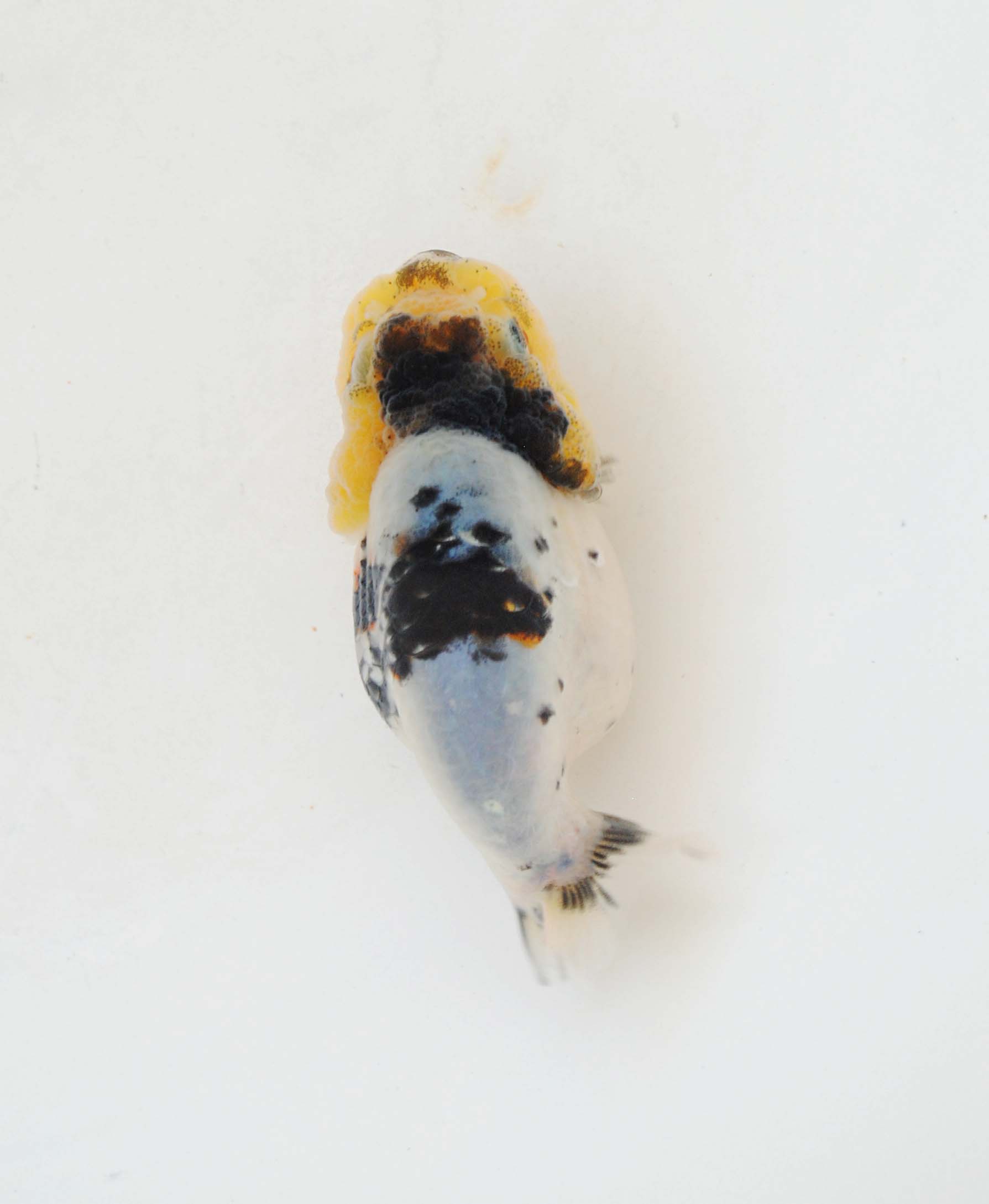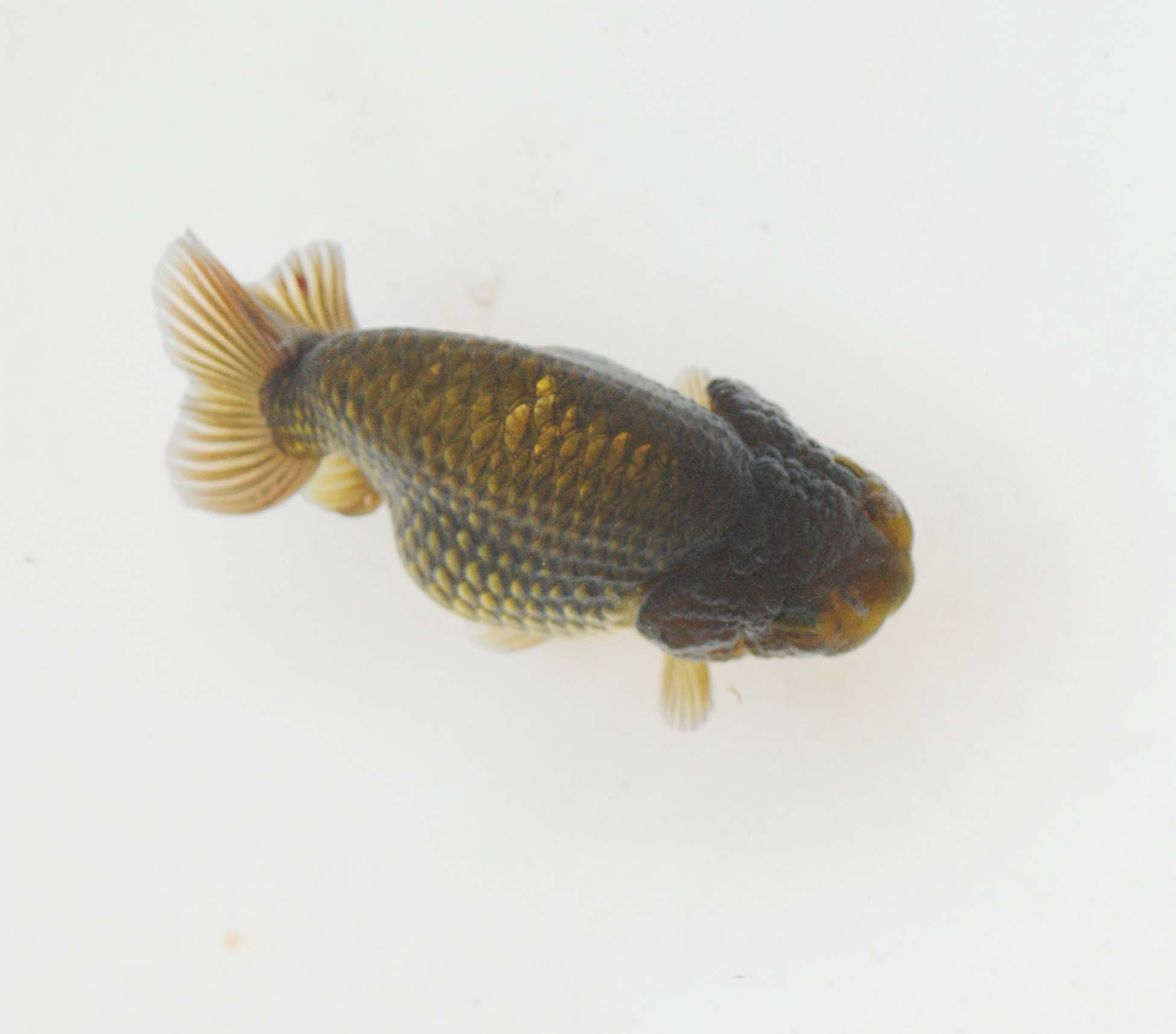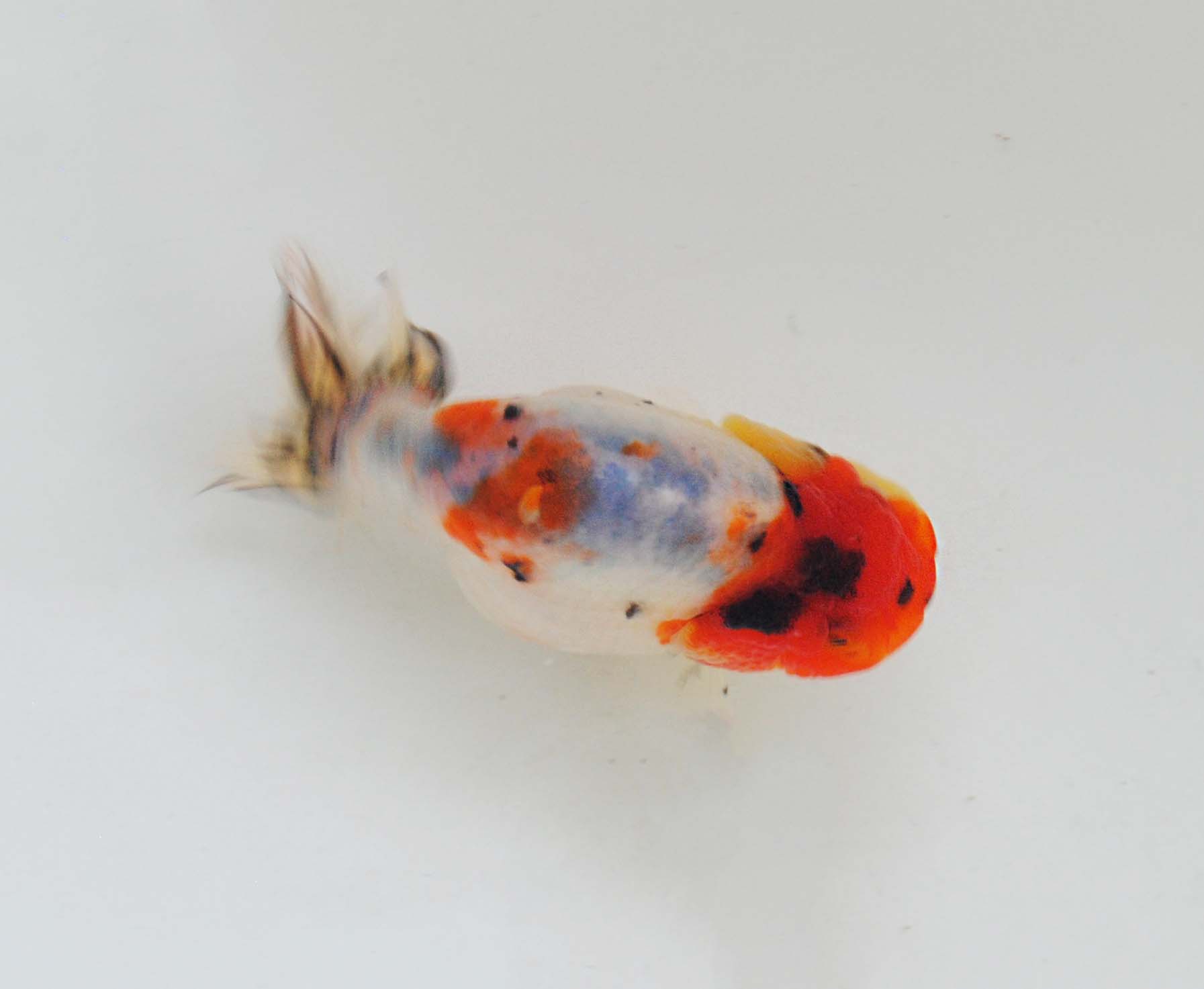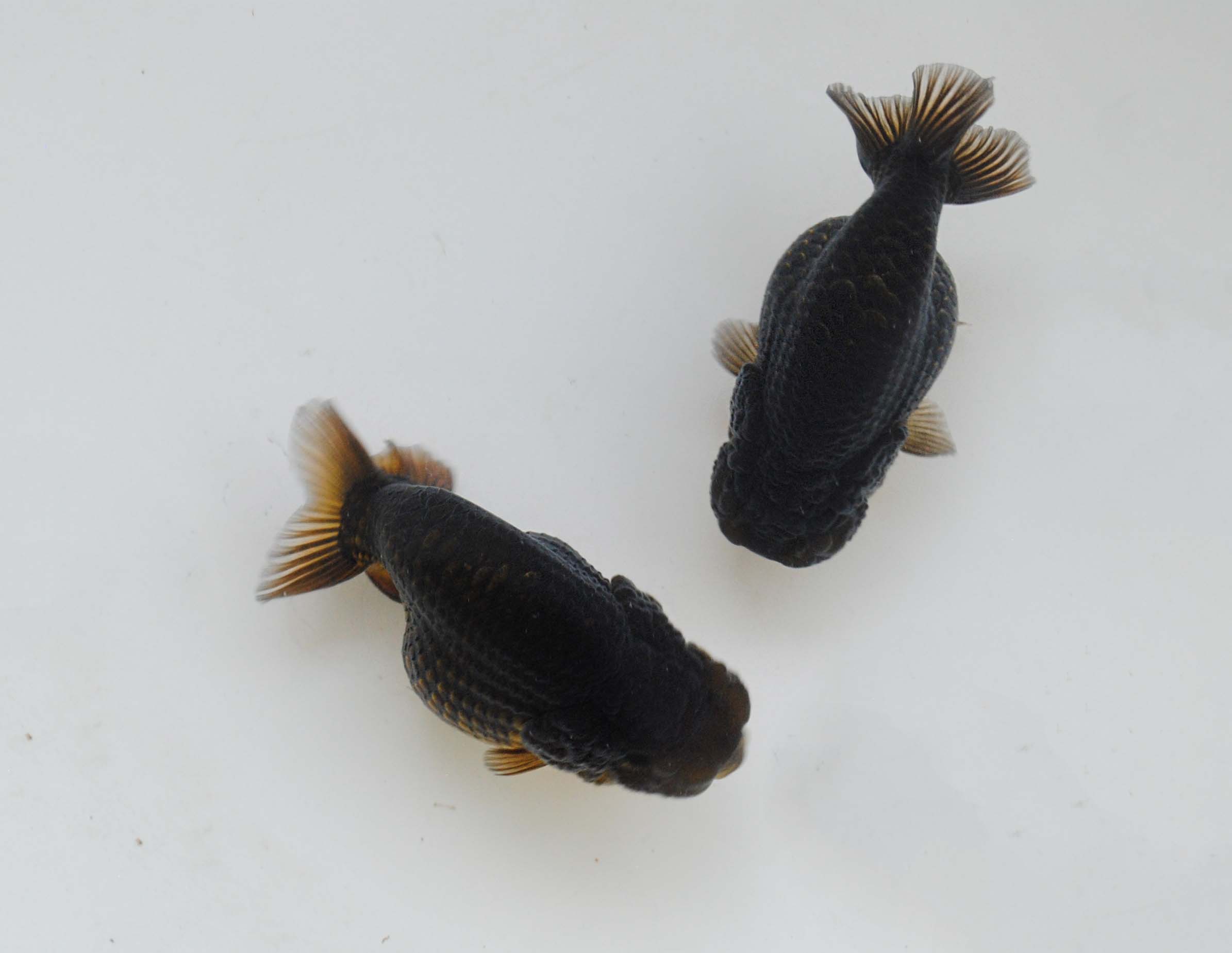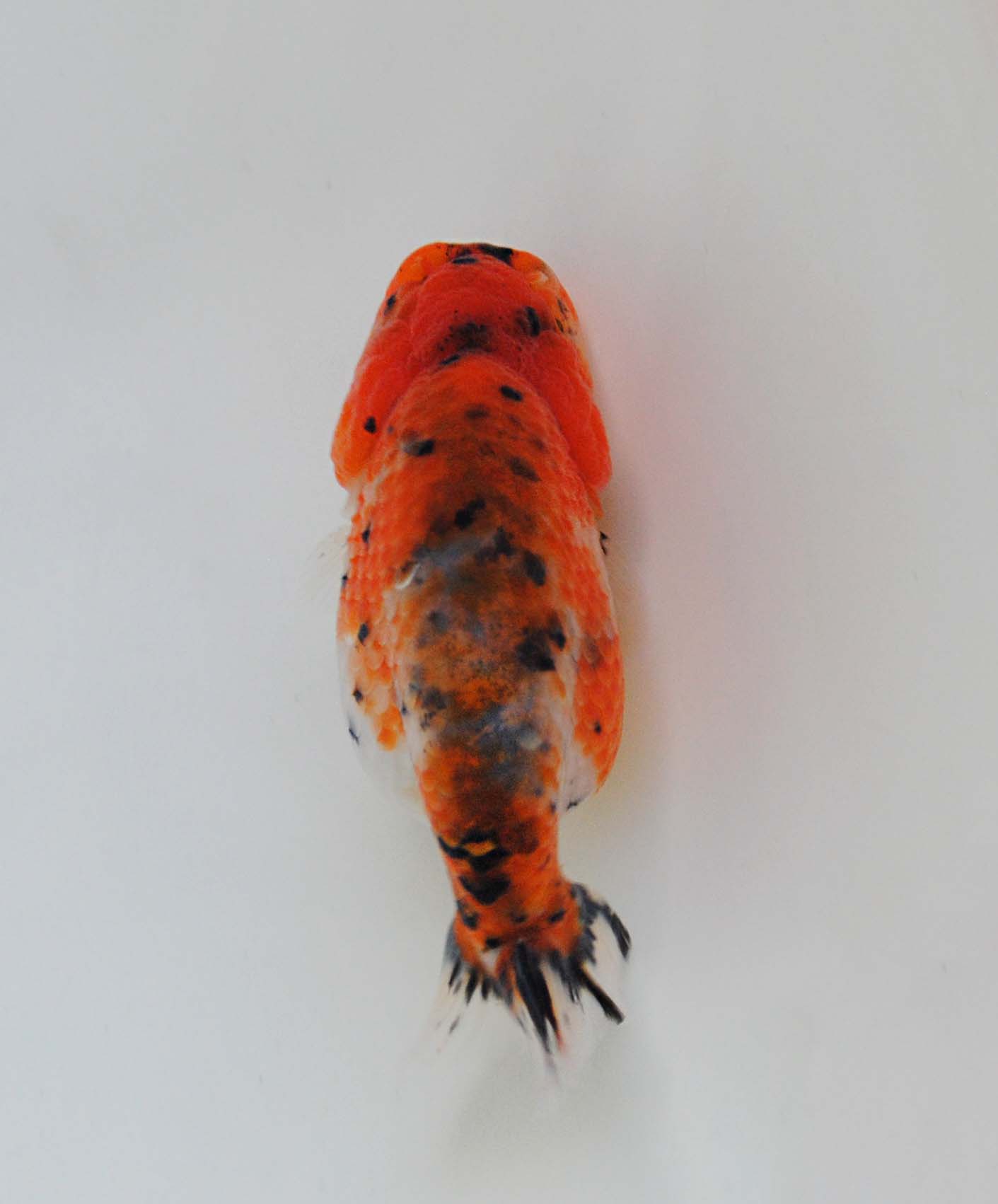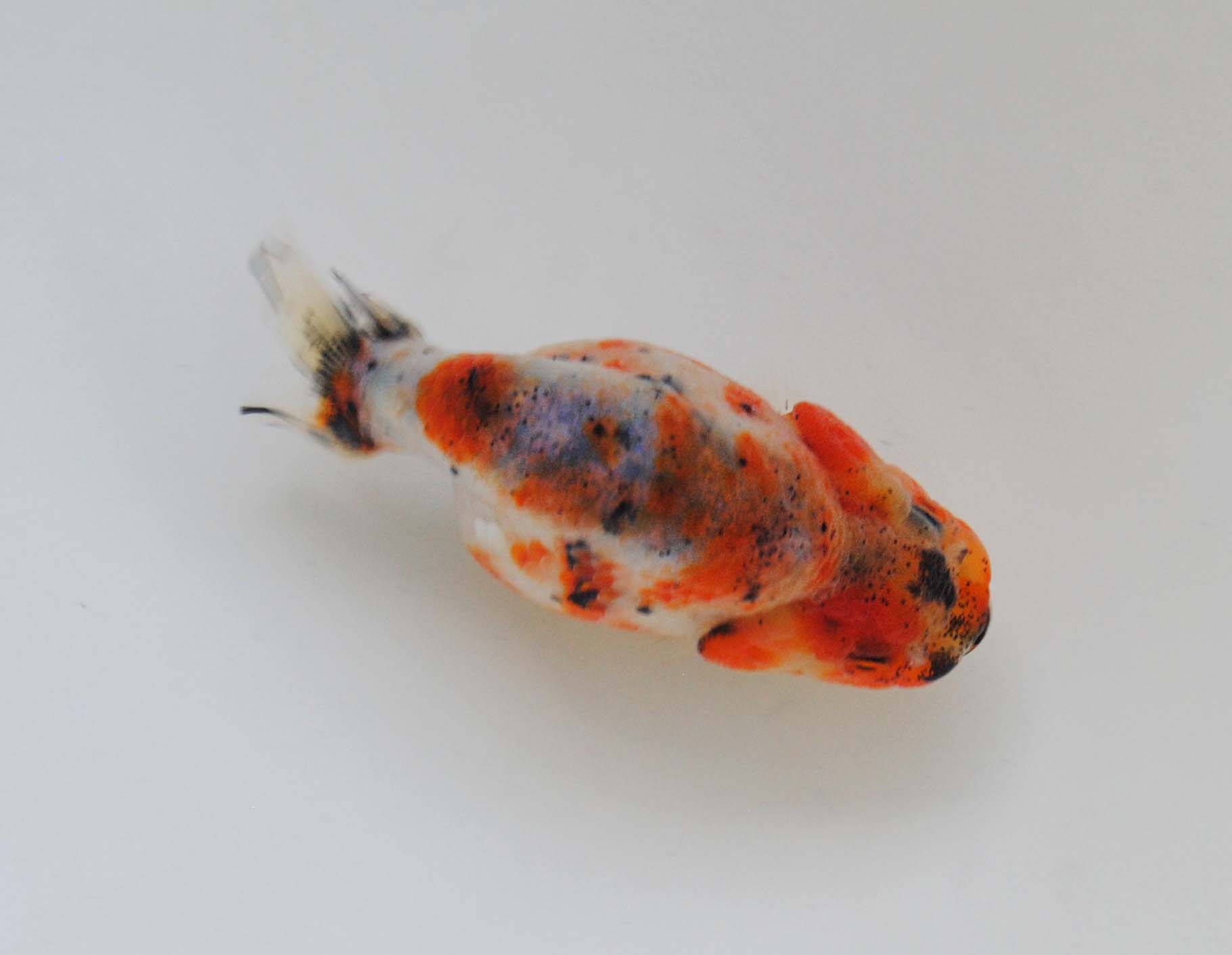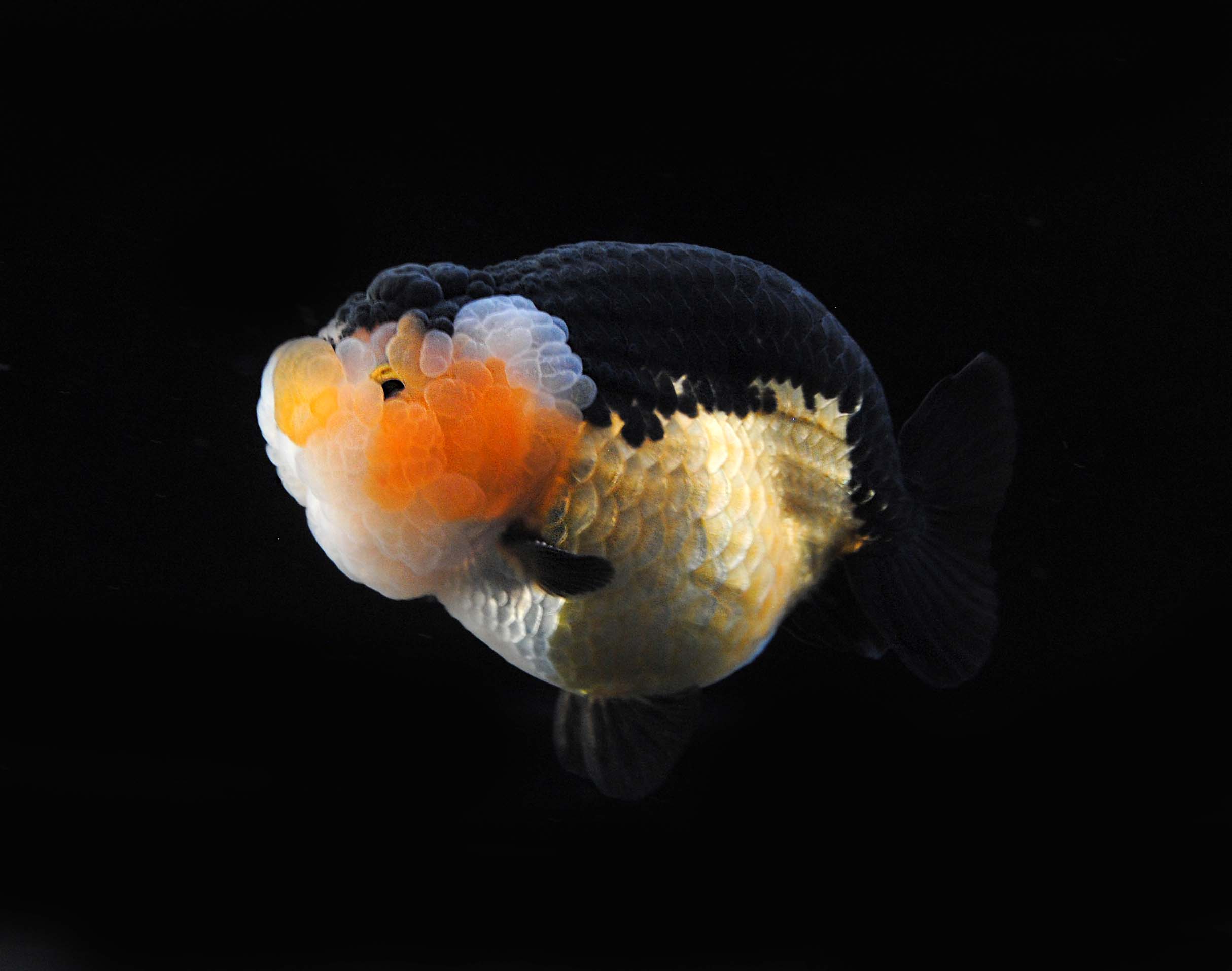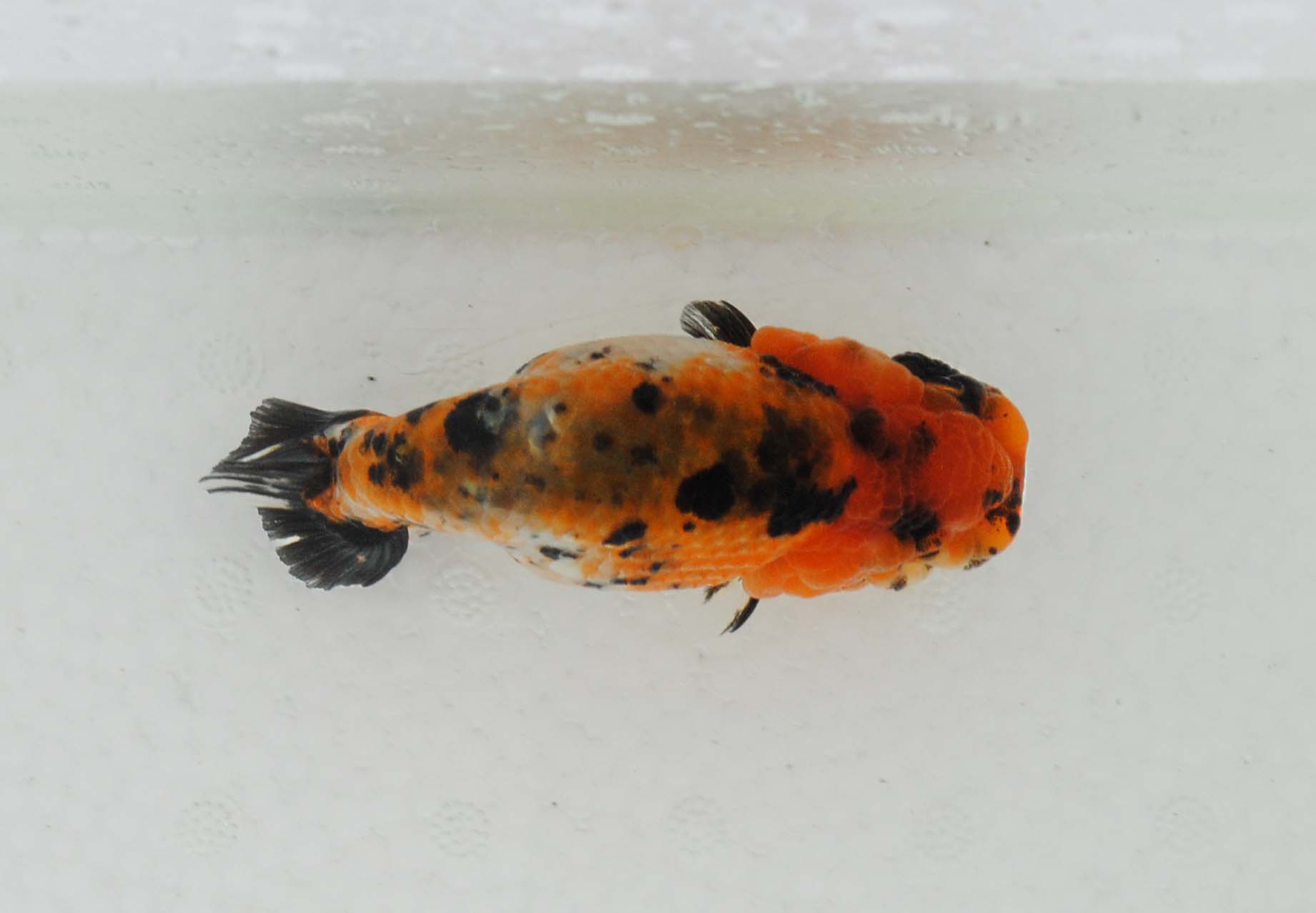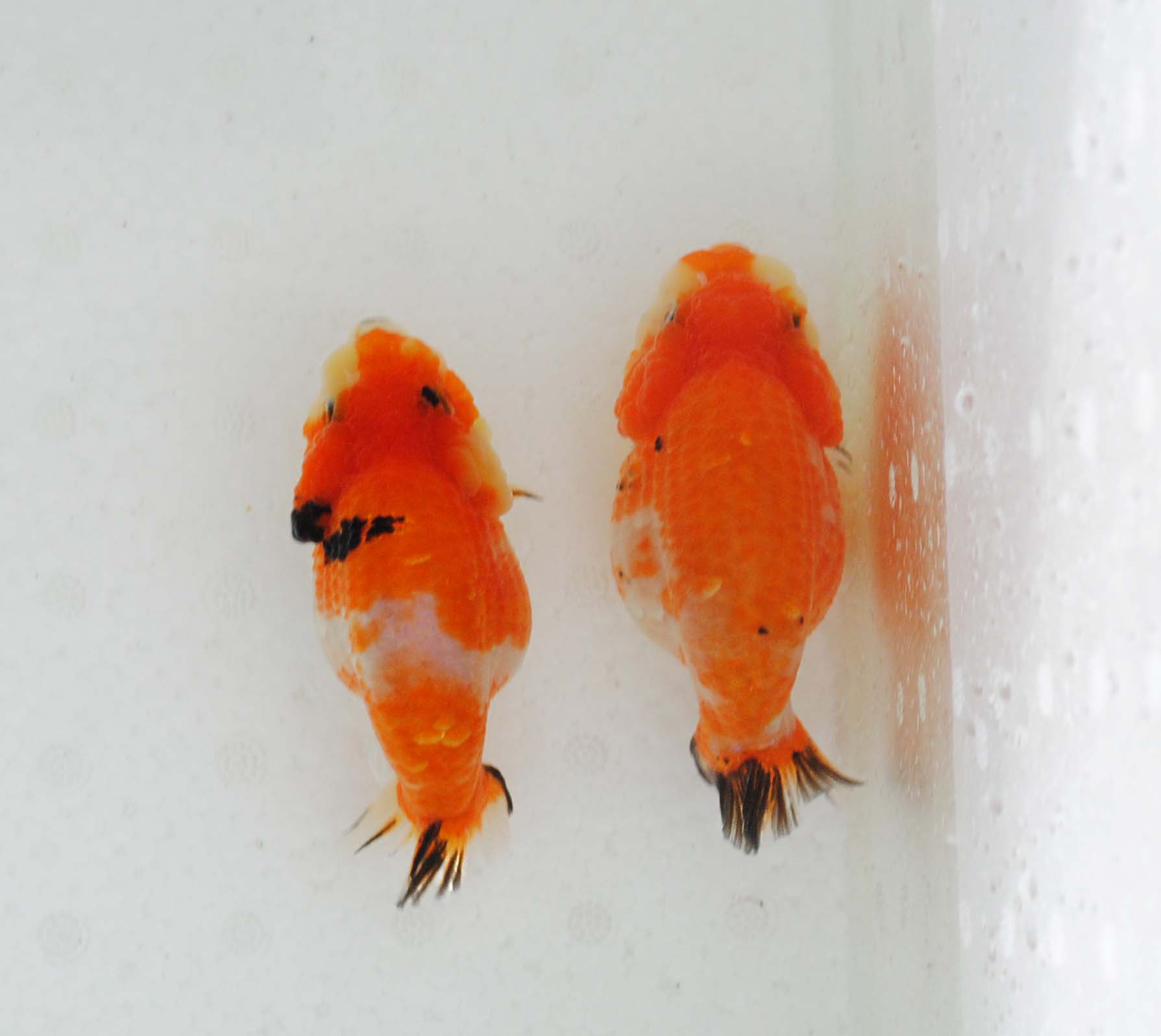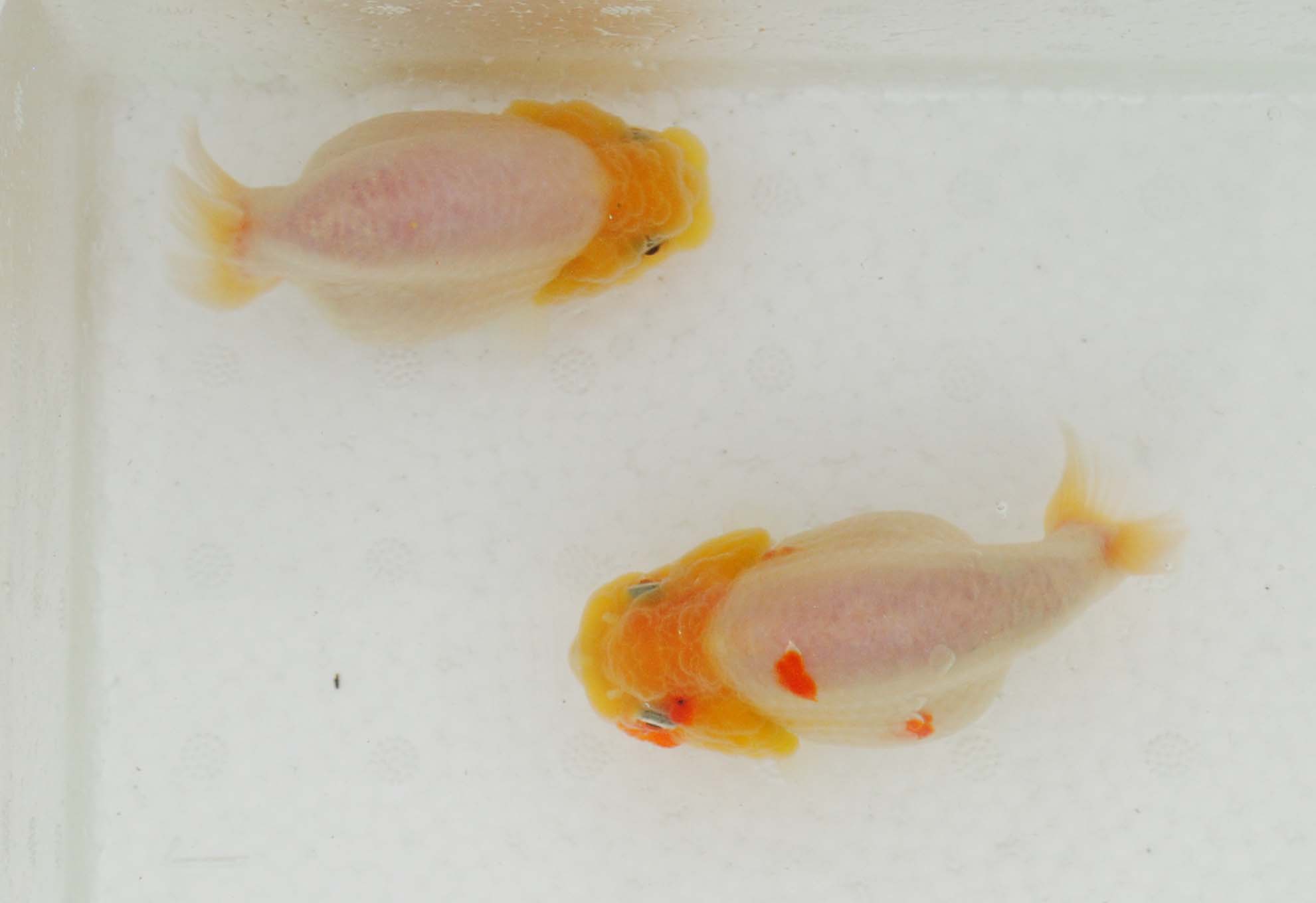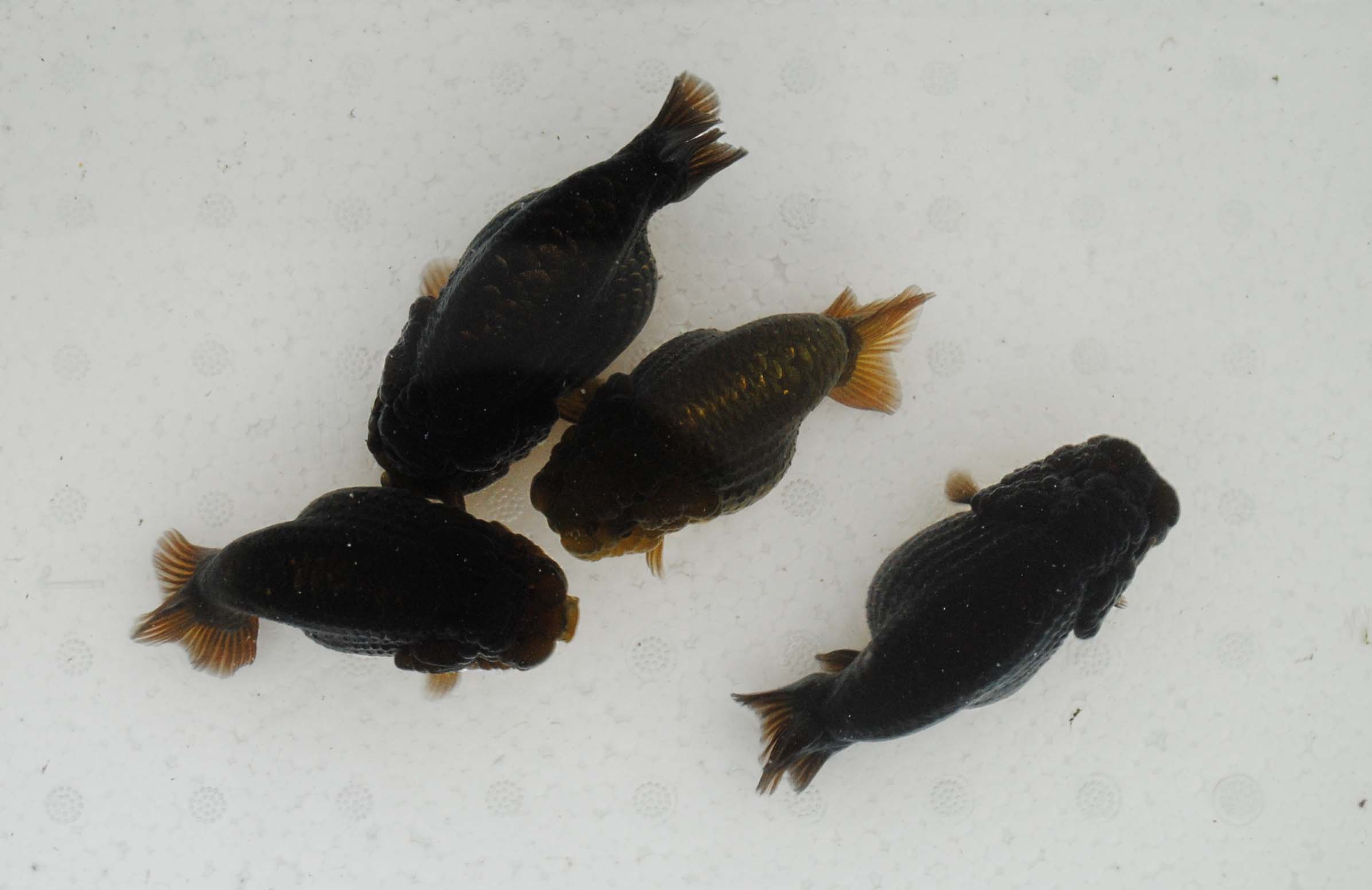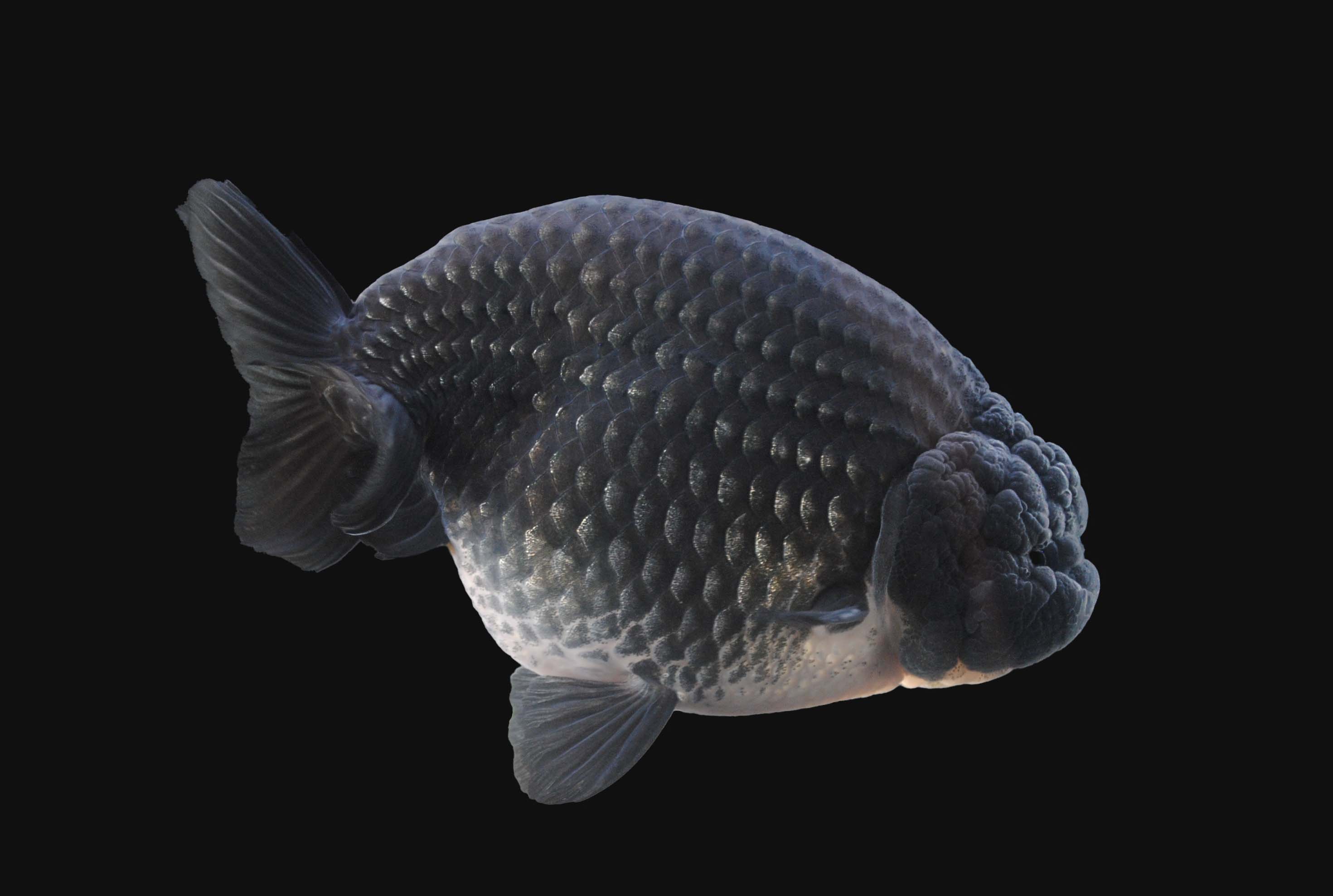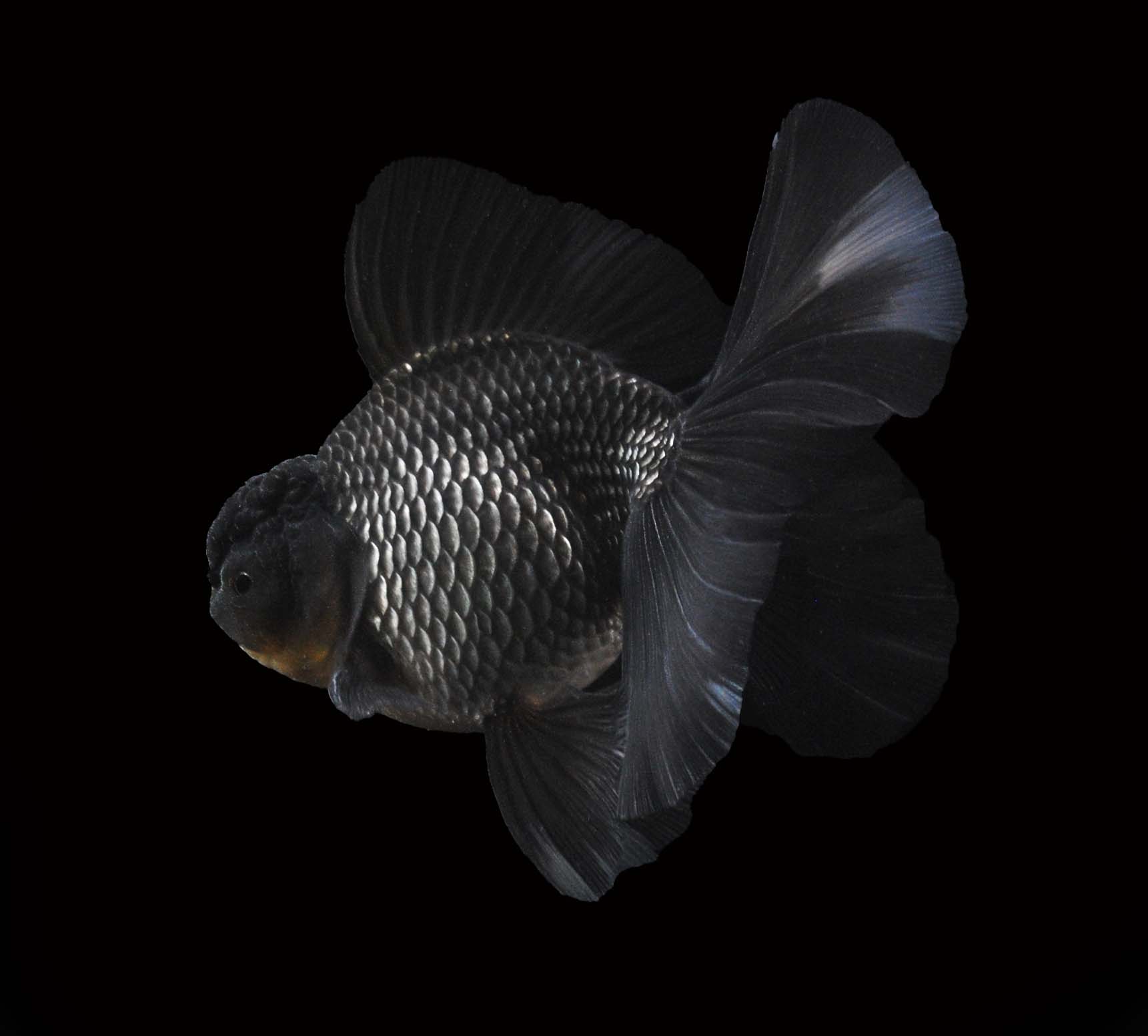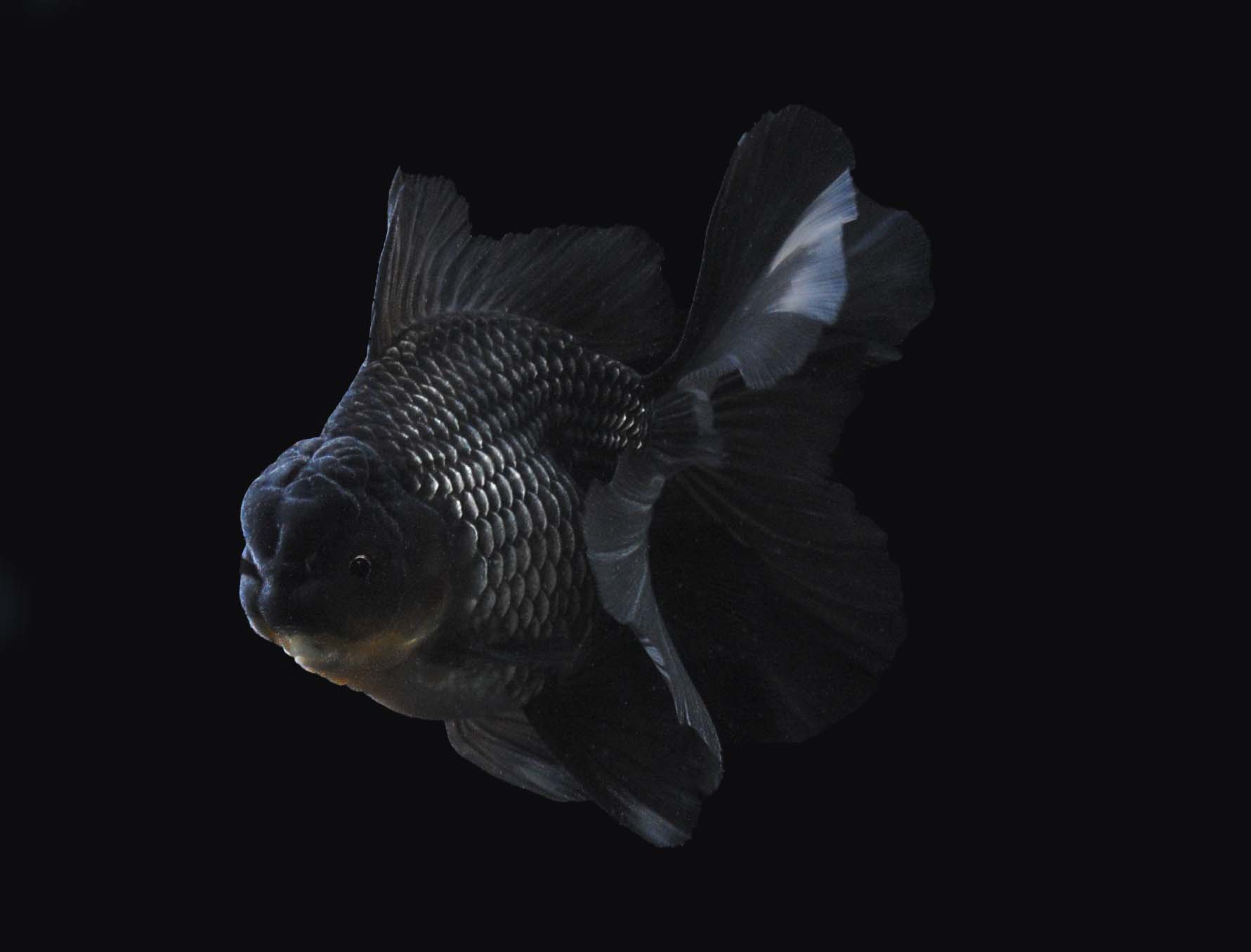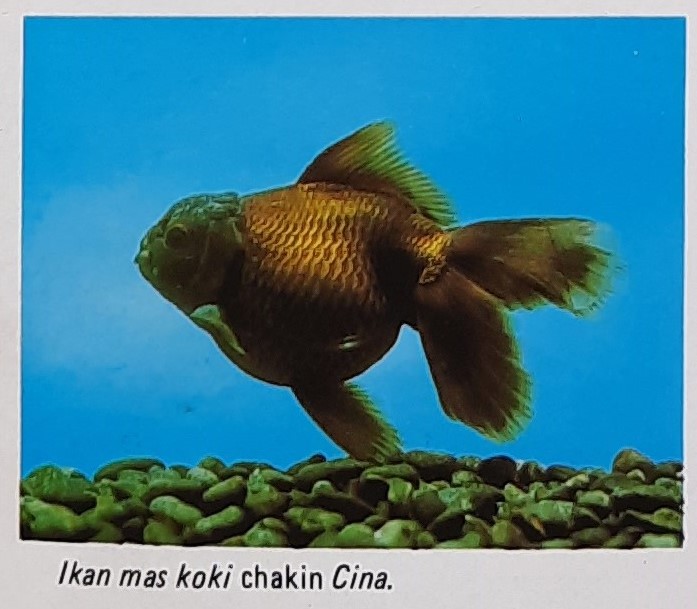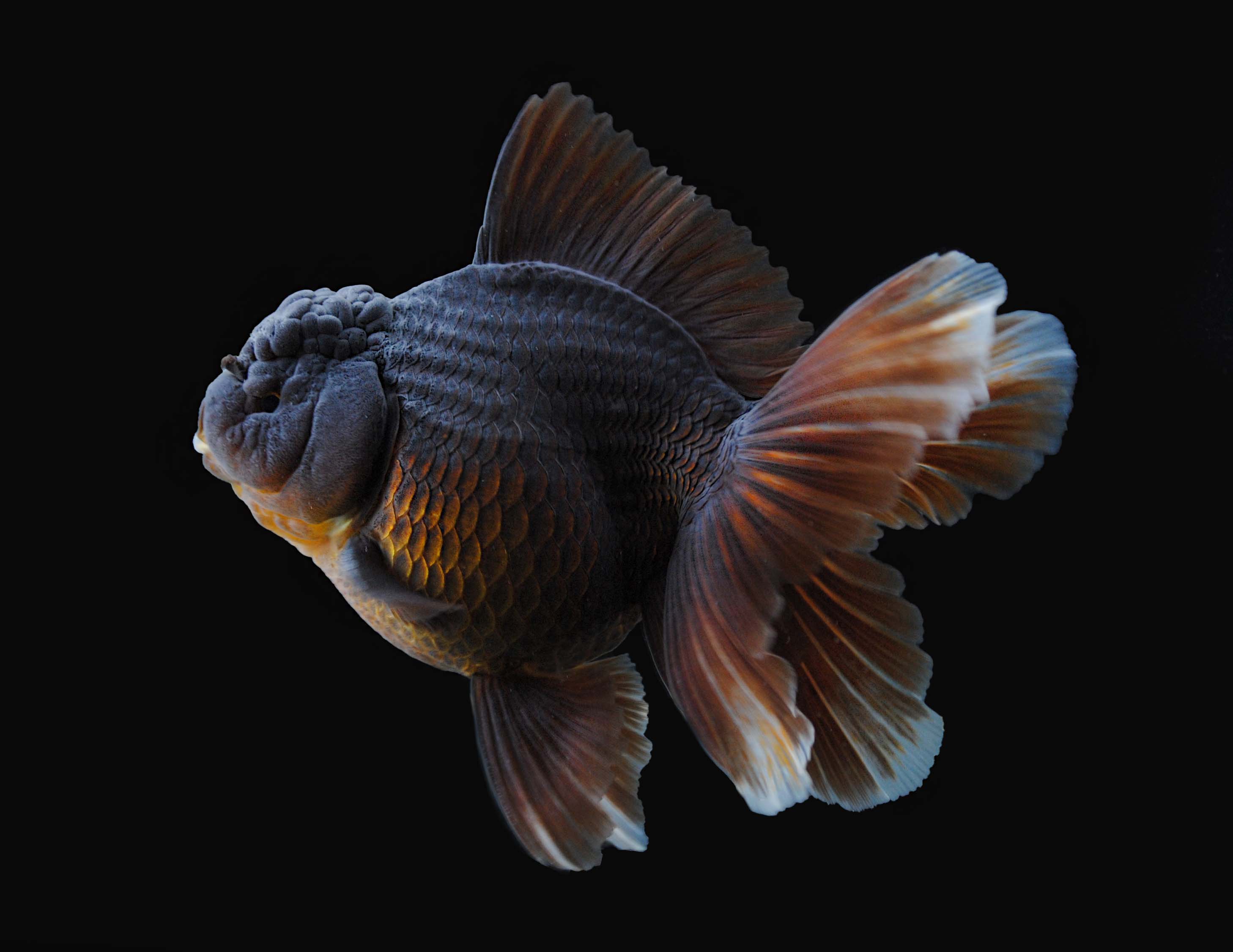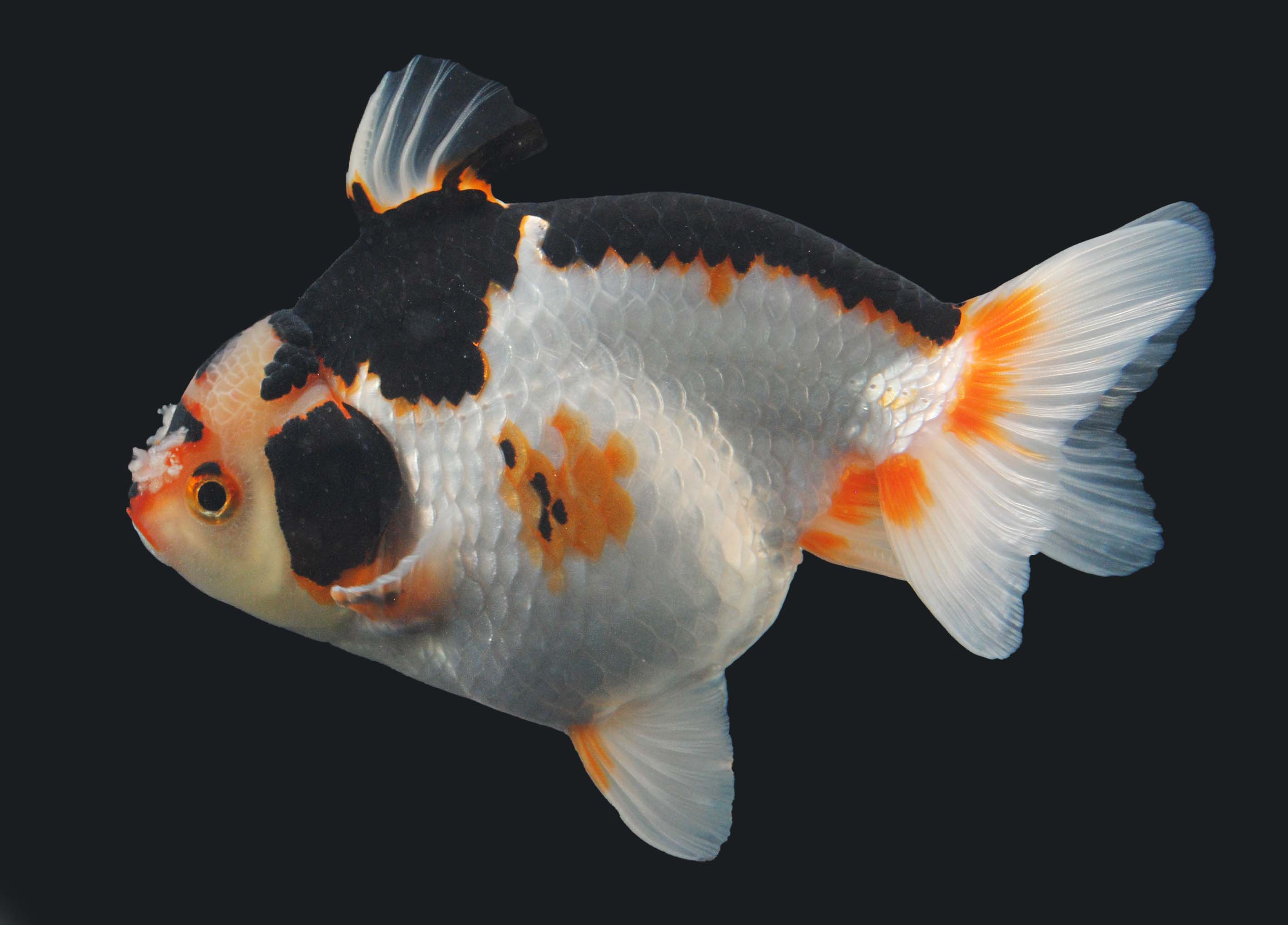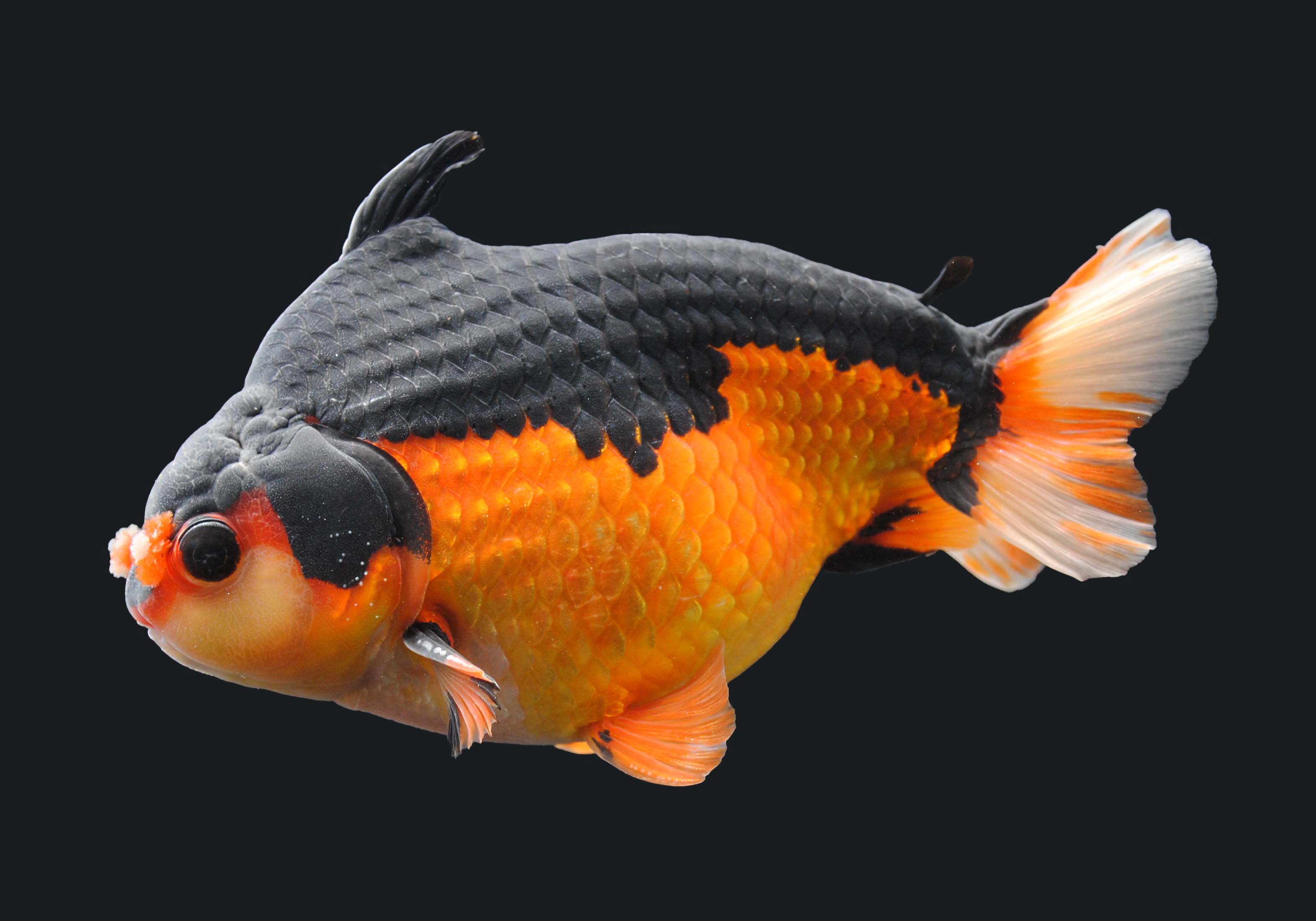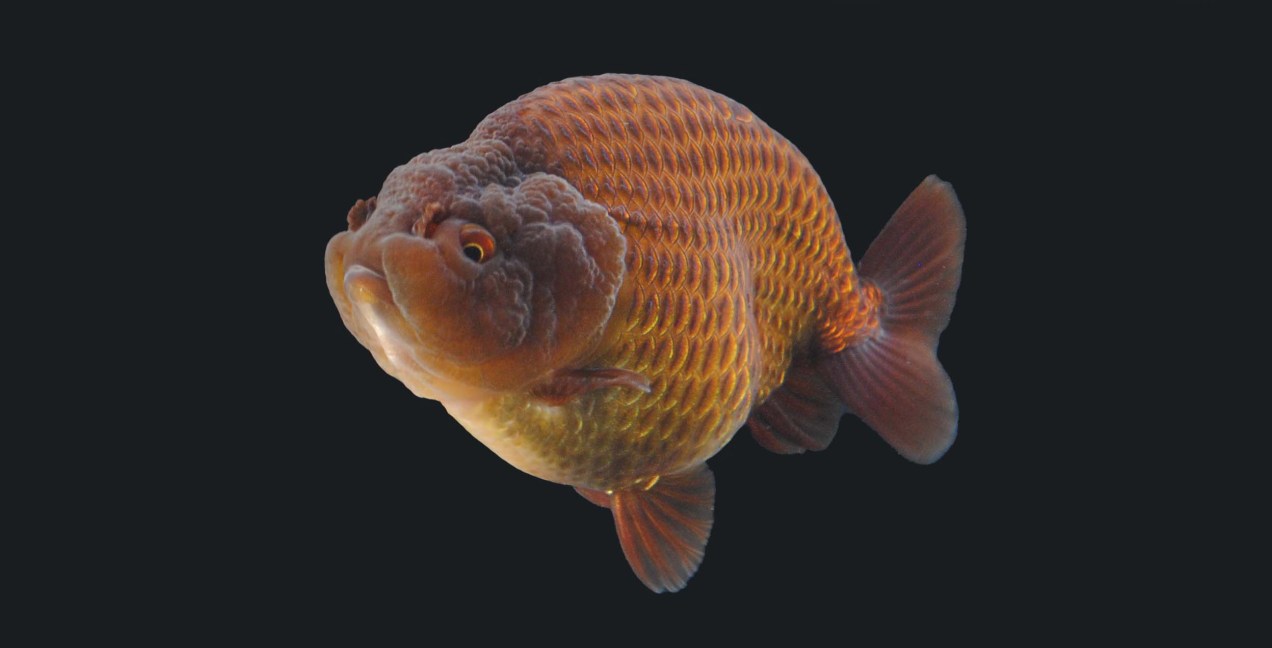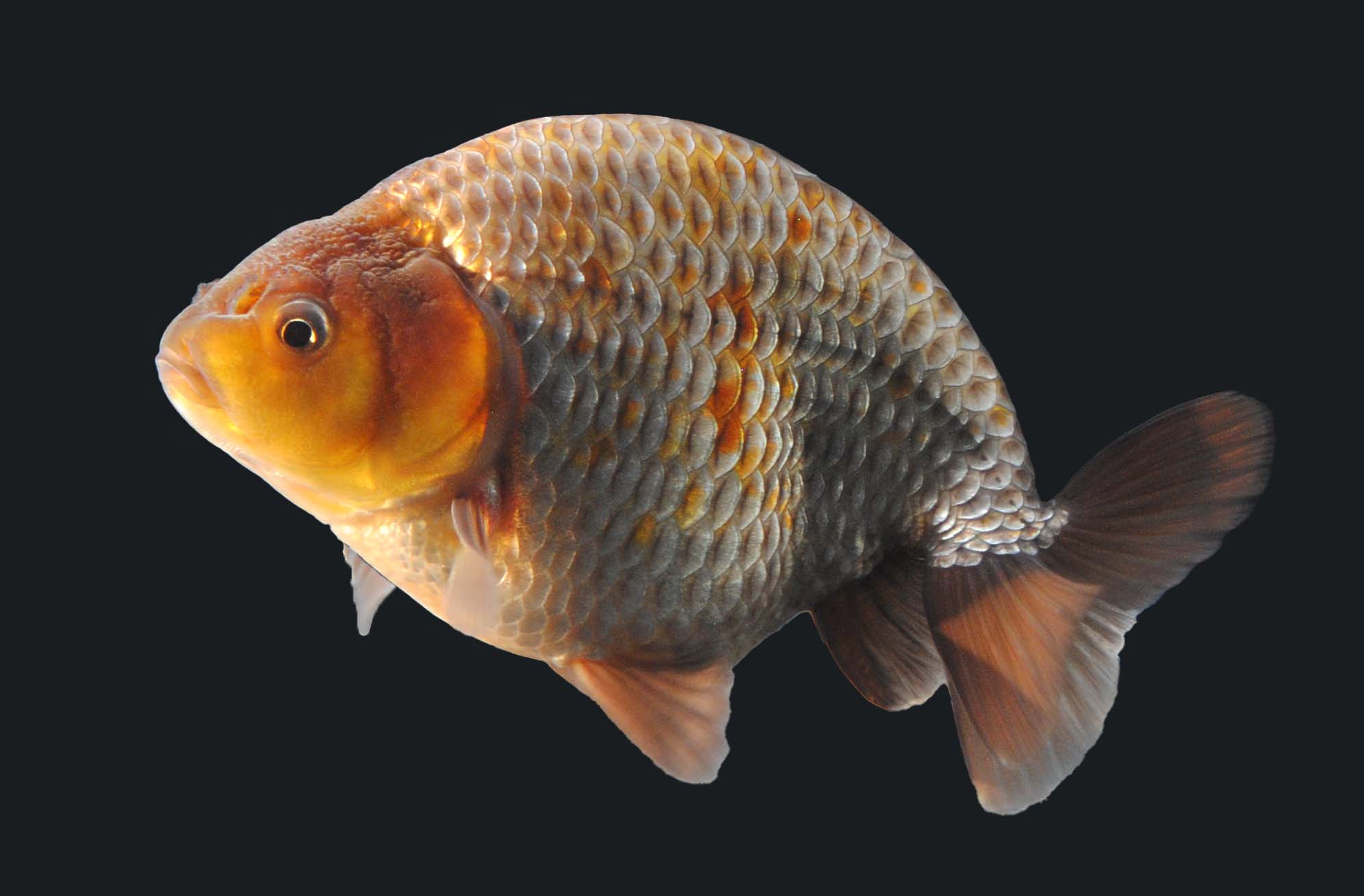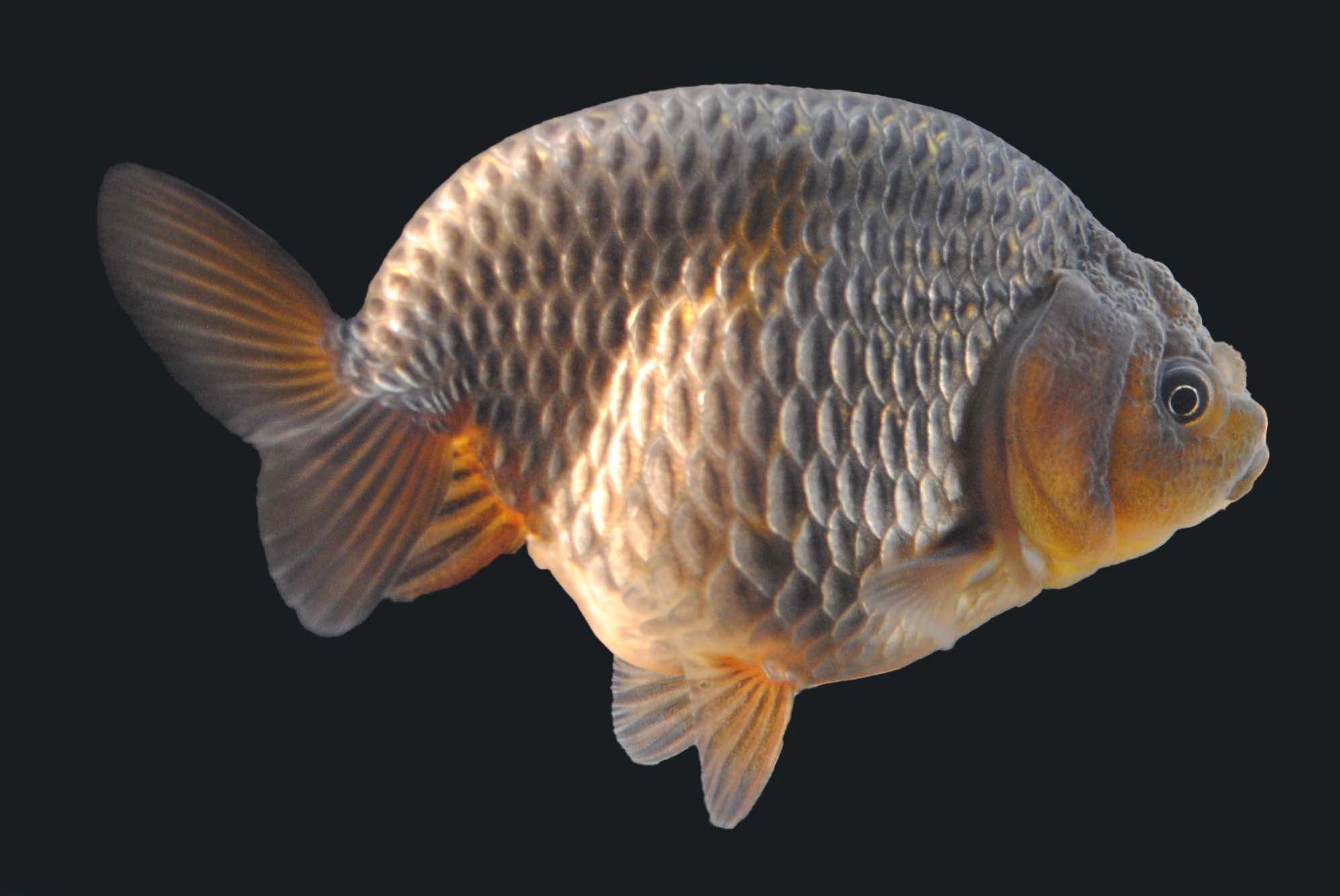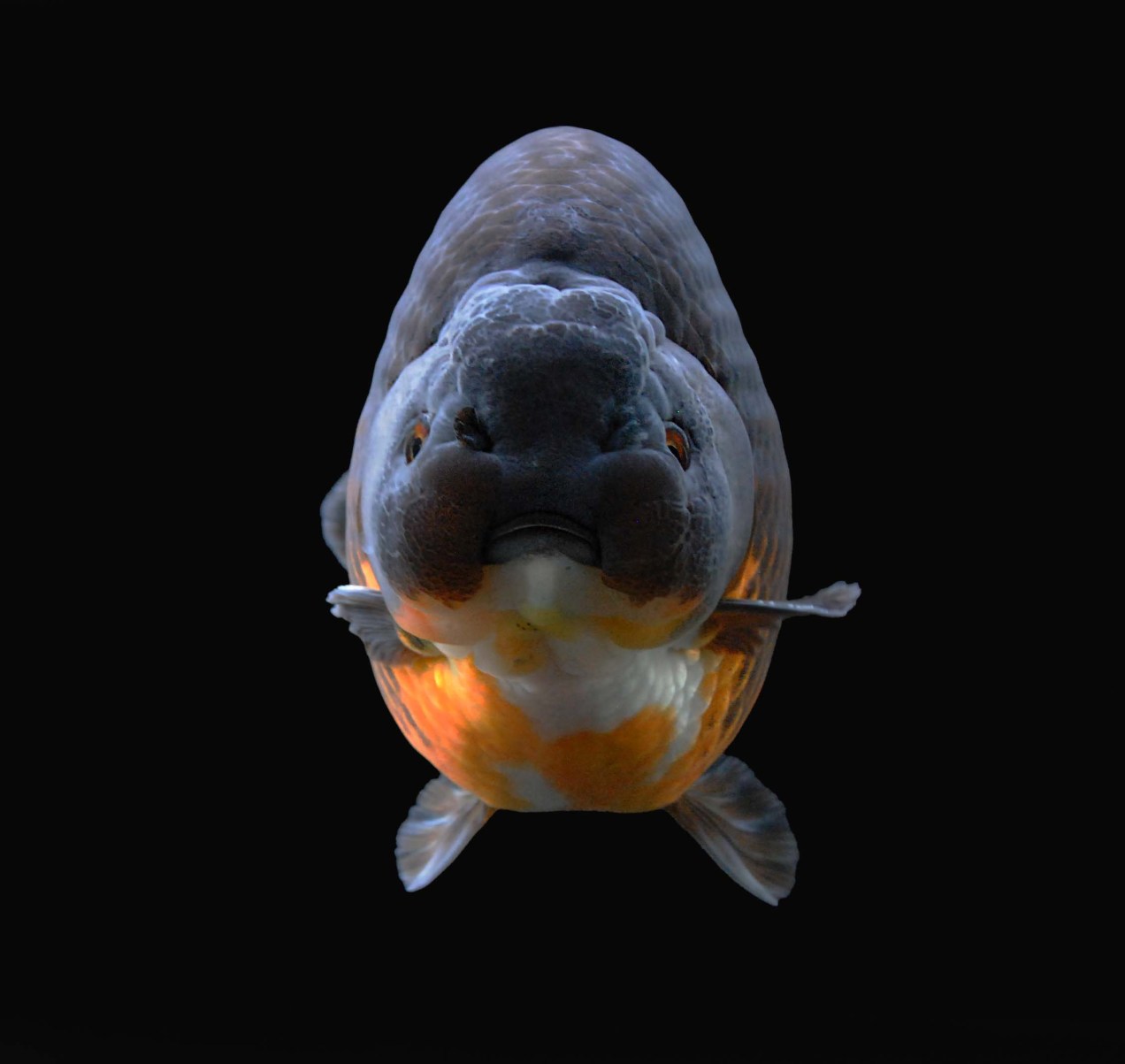
Panda Ranchu, tricolor ranchu

The Diary of a Goldfish Breeder 2025 (#4)

Update on: Tricolor Ranchu Project

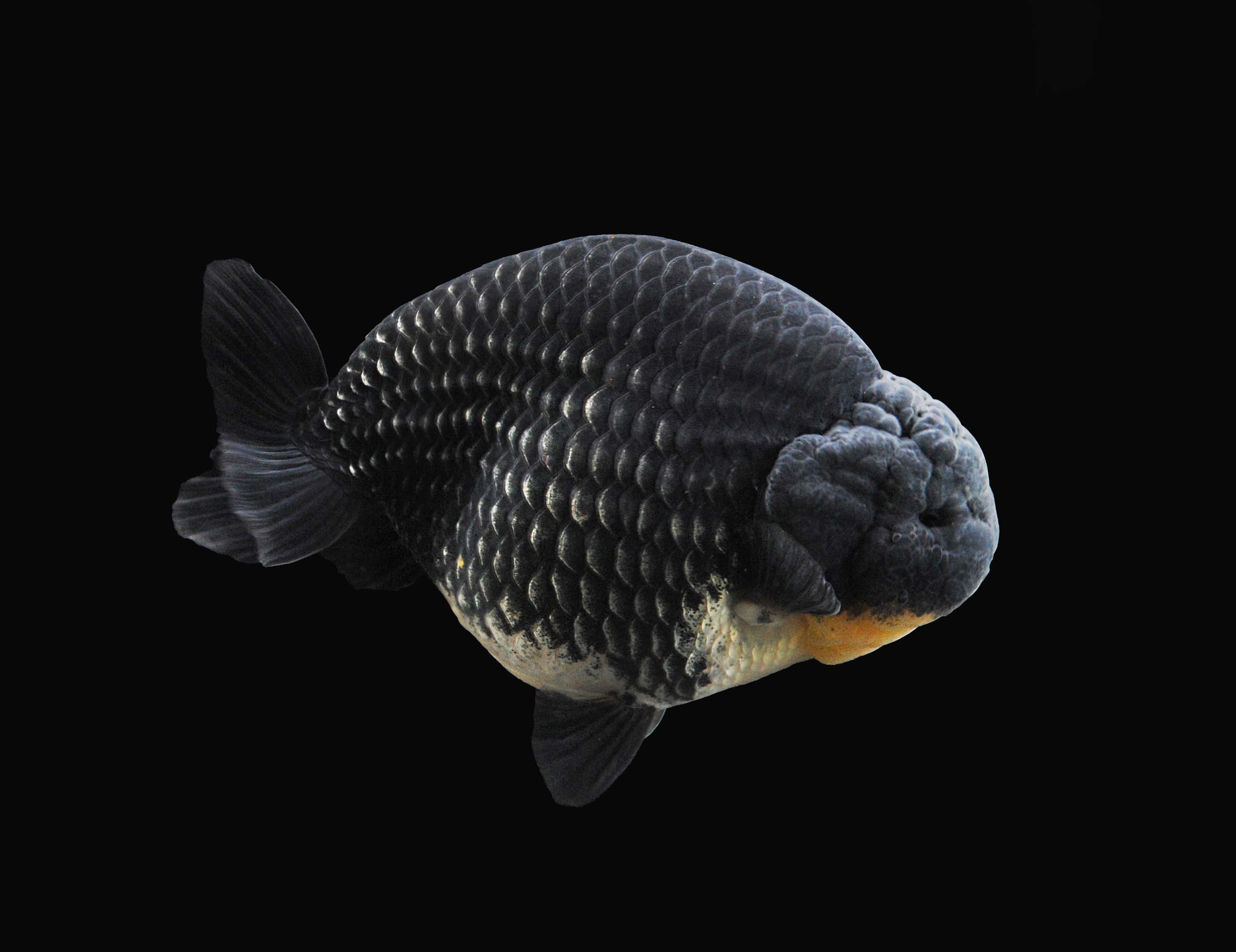
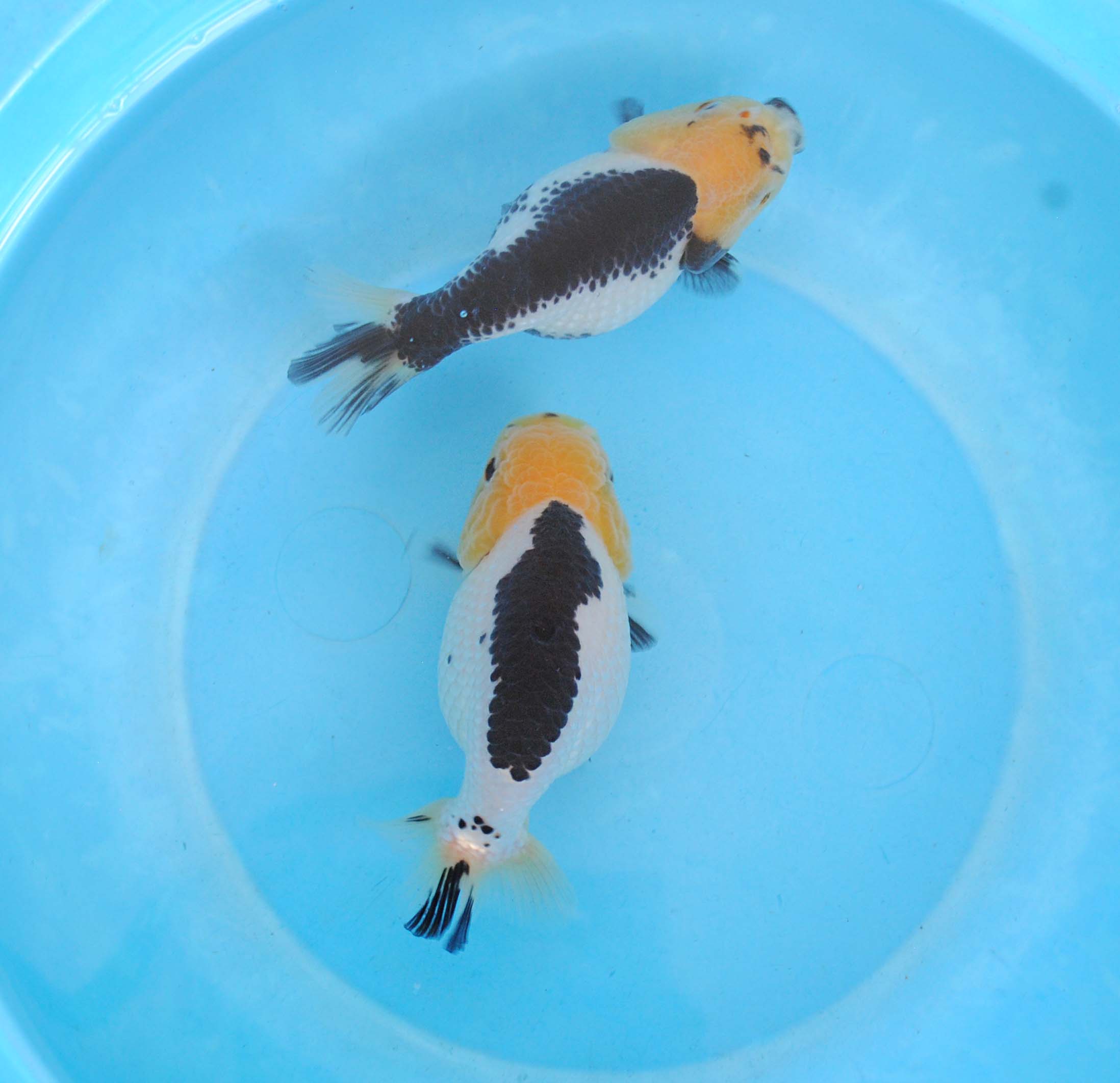
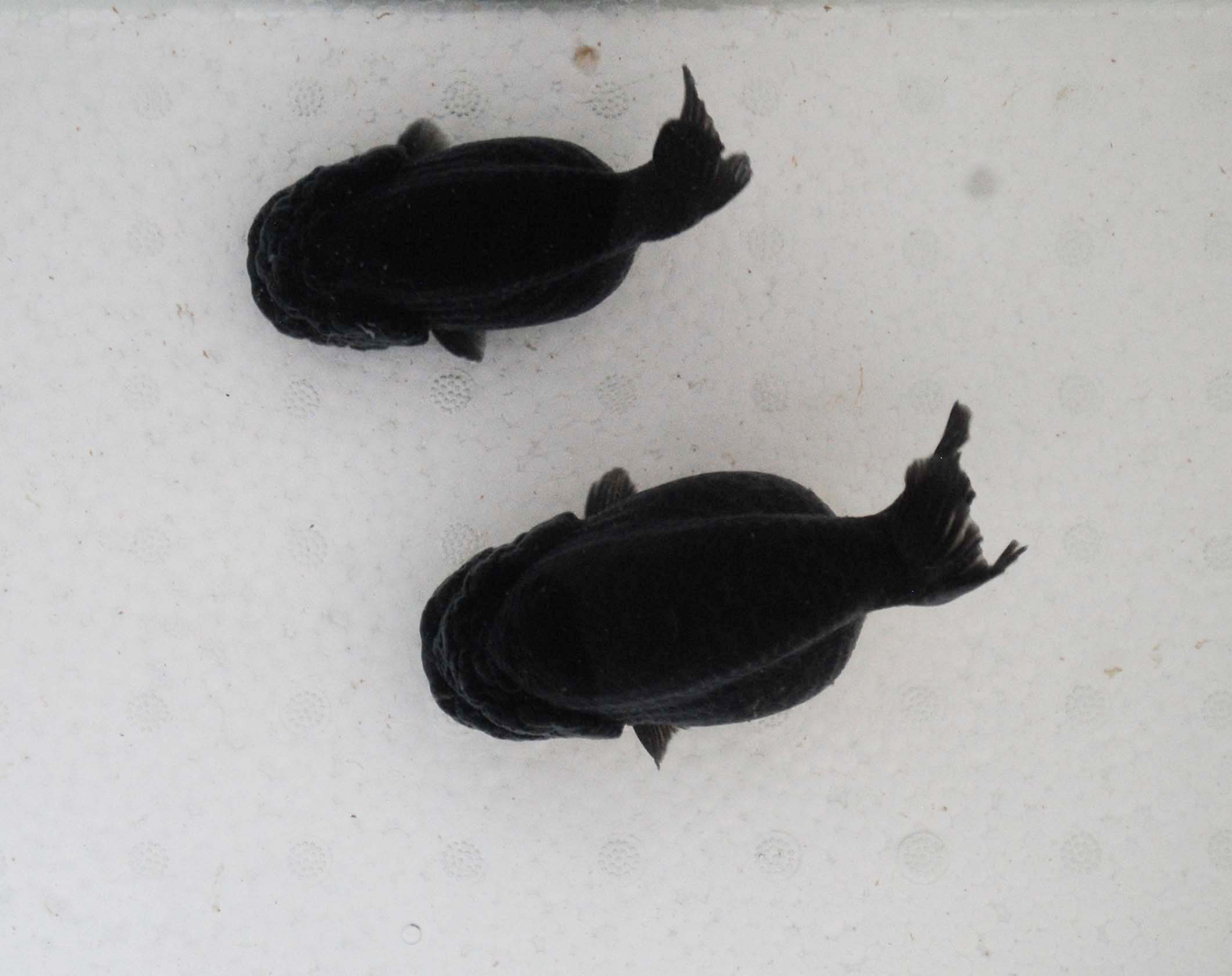
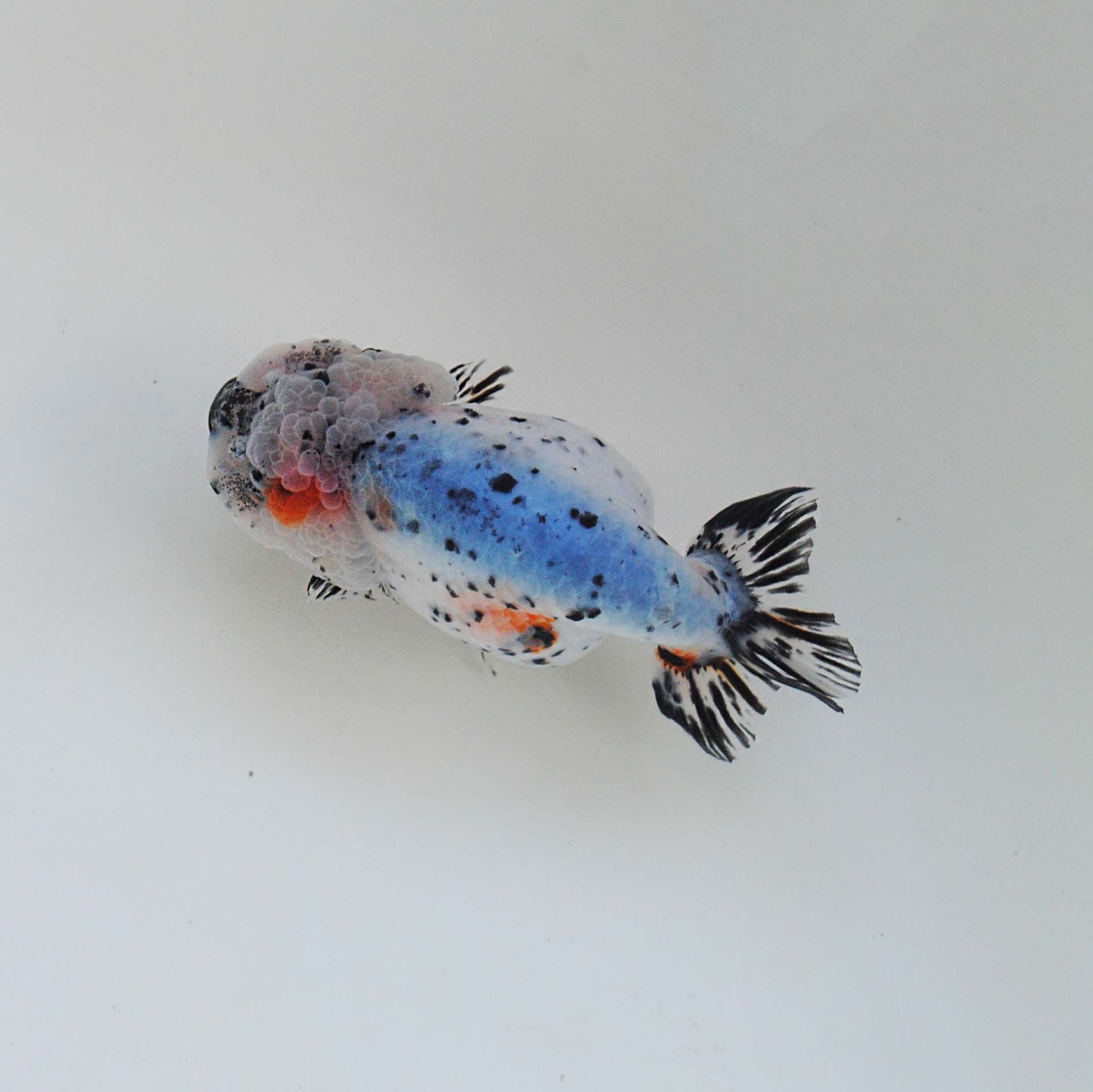
In my Diary #8 2024 I mentioned the emergence of a beautiful tricolor Ranchu out of nowhere. Well, it is not really from nowhere, but from (unexpectedly) my cow ranchu project. From that moment on, my tricolor breeding strategy diverged into two separate paths. The first path was to follow the inbreeding of my initial stocks. The second path was to cross the unexpected tricolor ranchu with my initial stock. In this diary, I will talk about the second path, that is from the cross between these two:

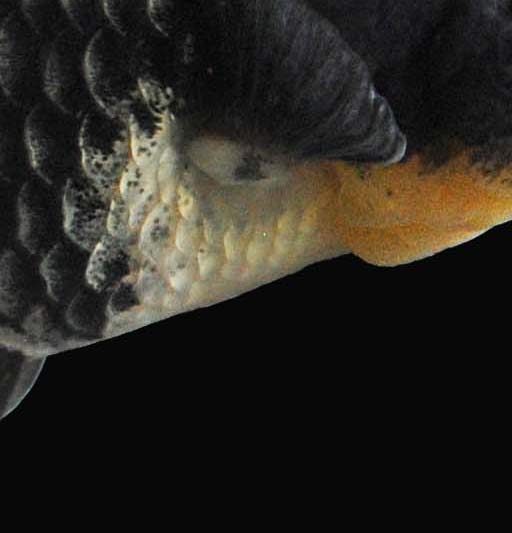
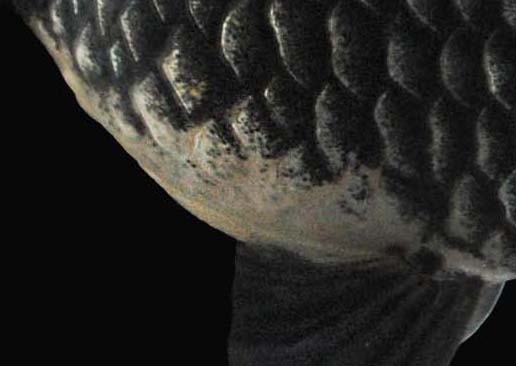
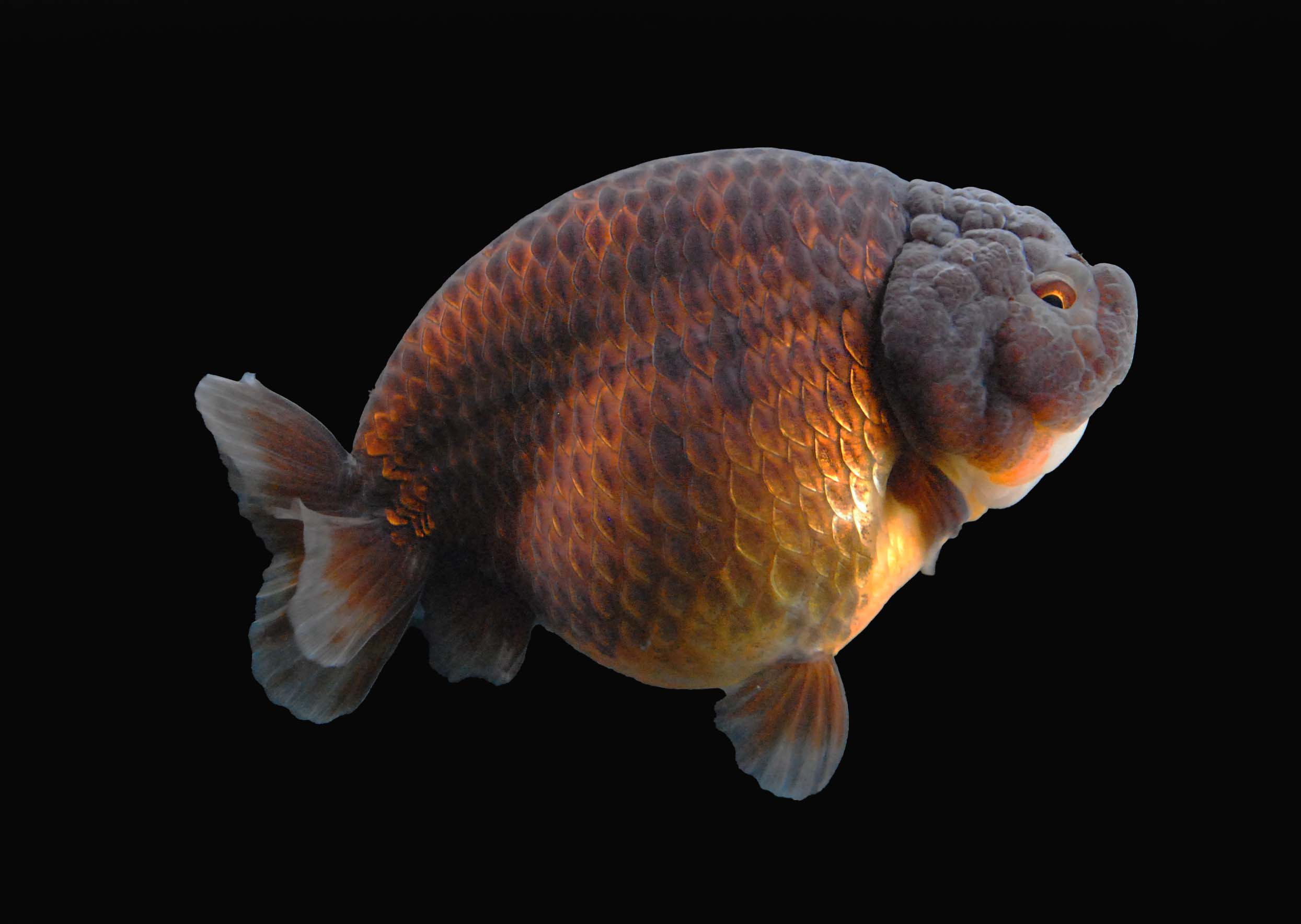
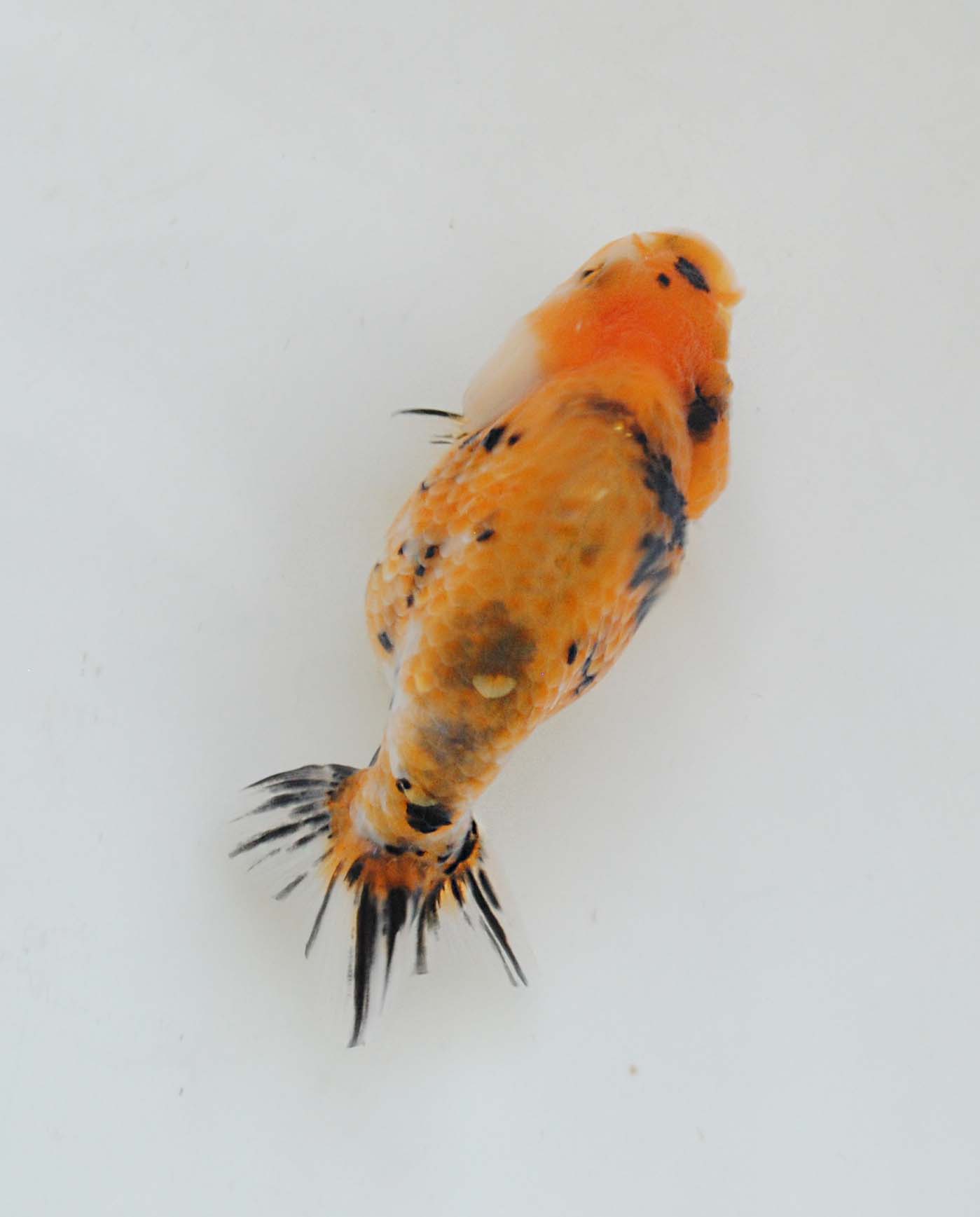
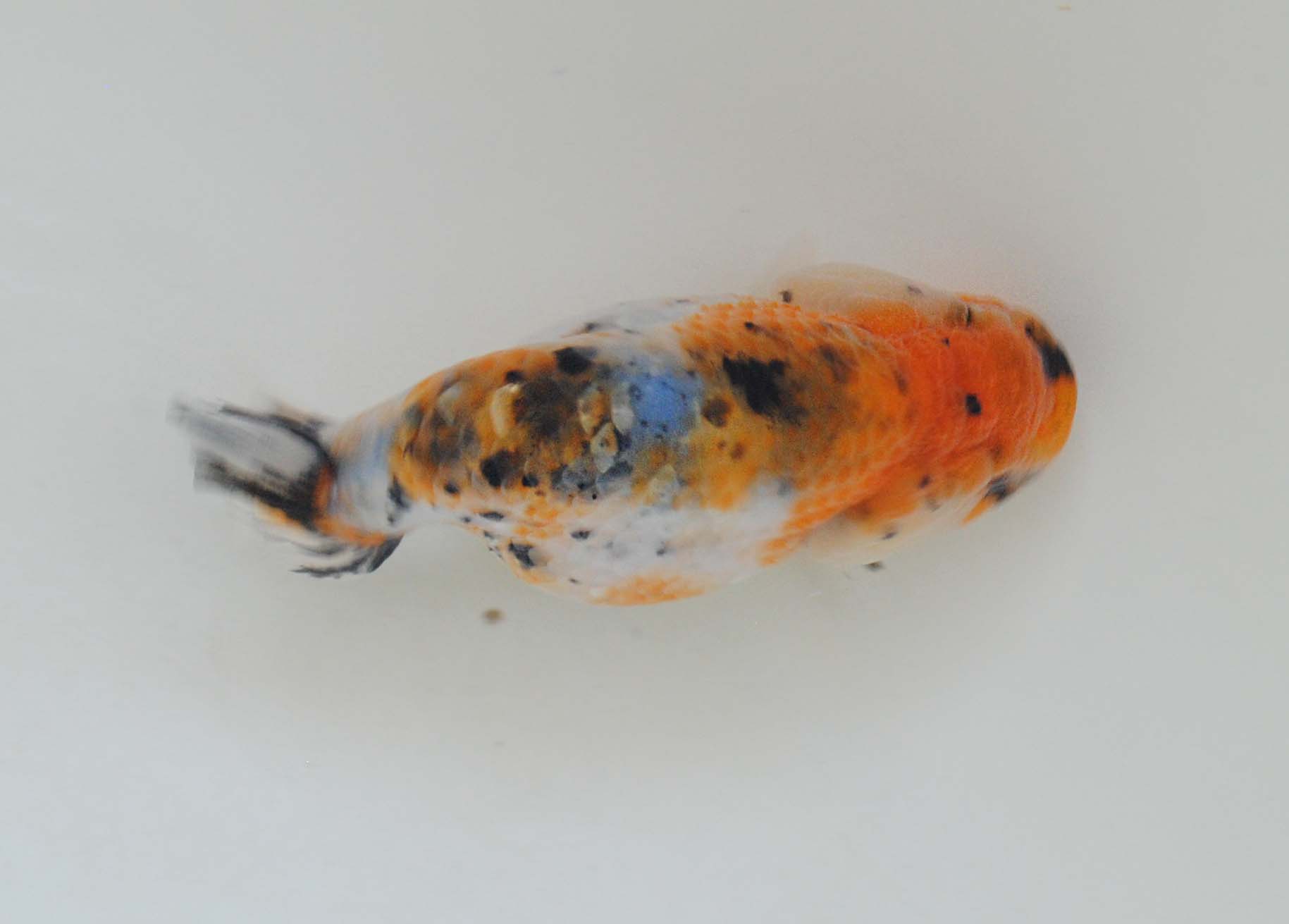
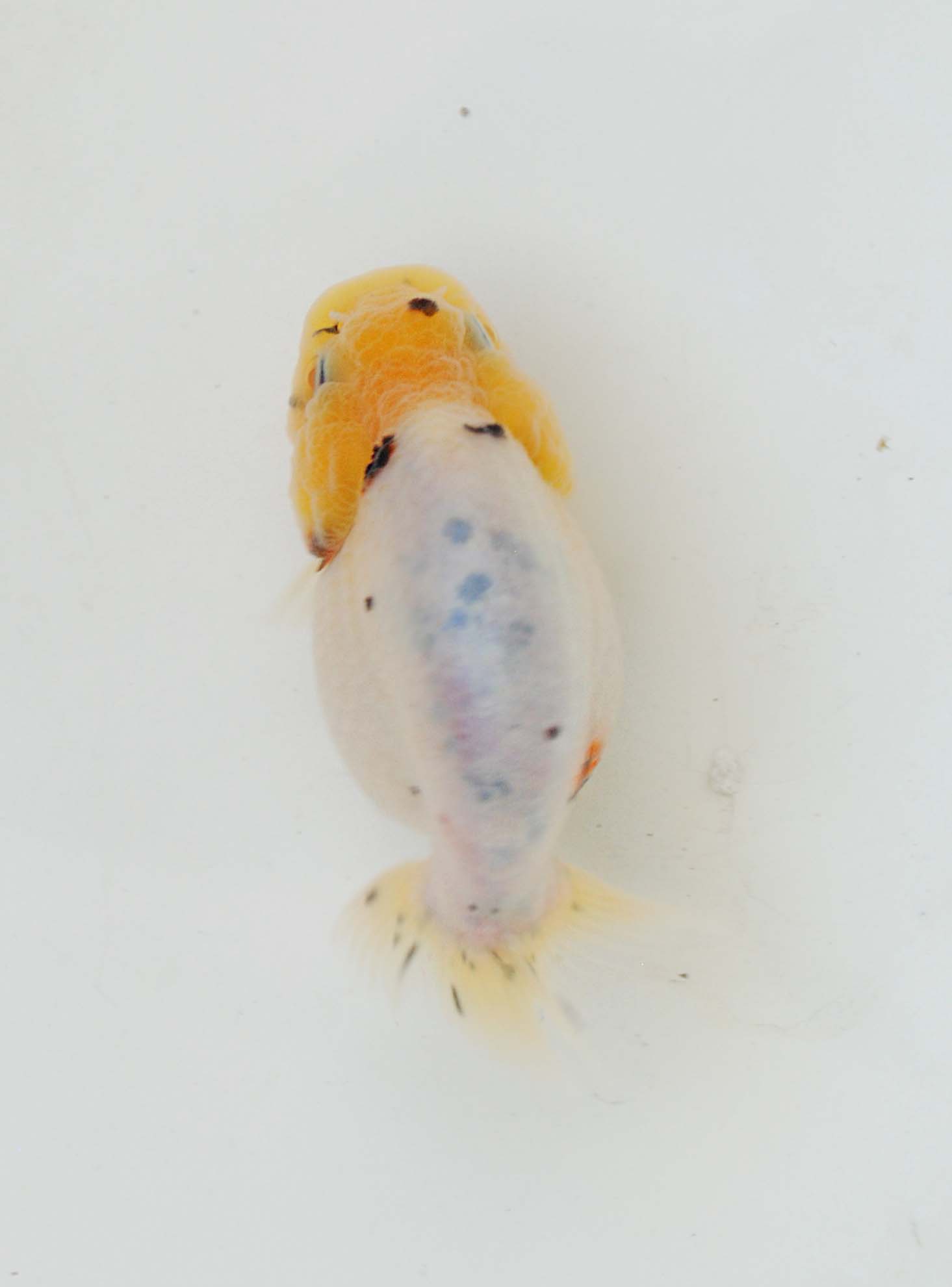
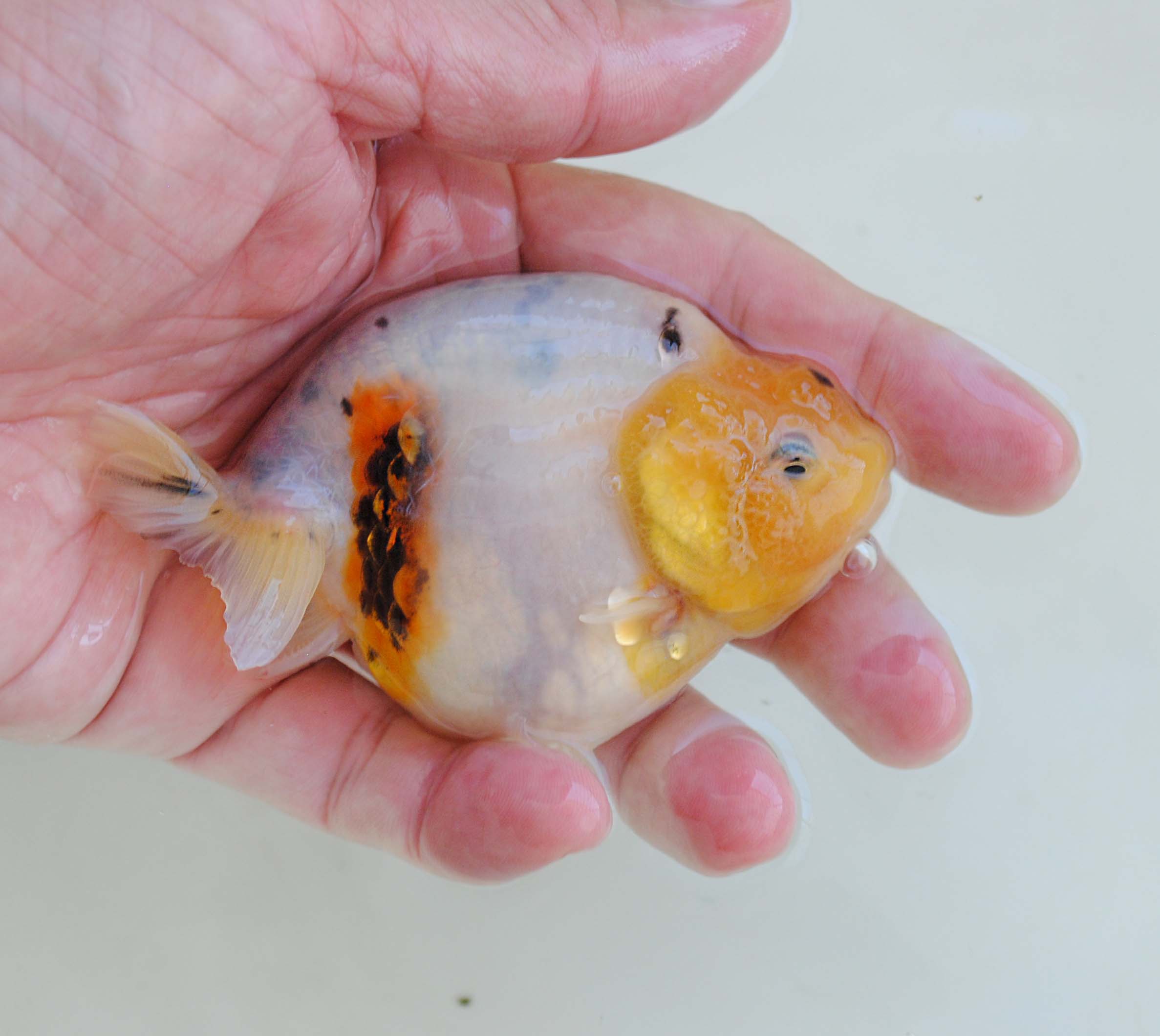
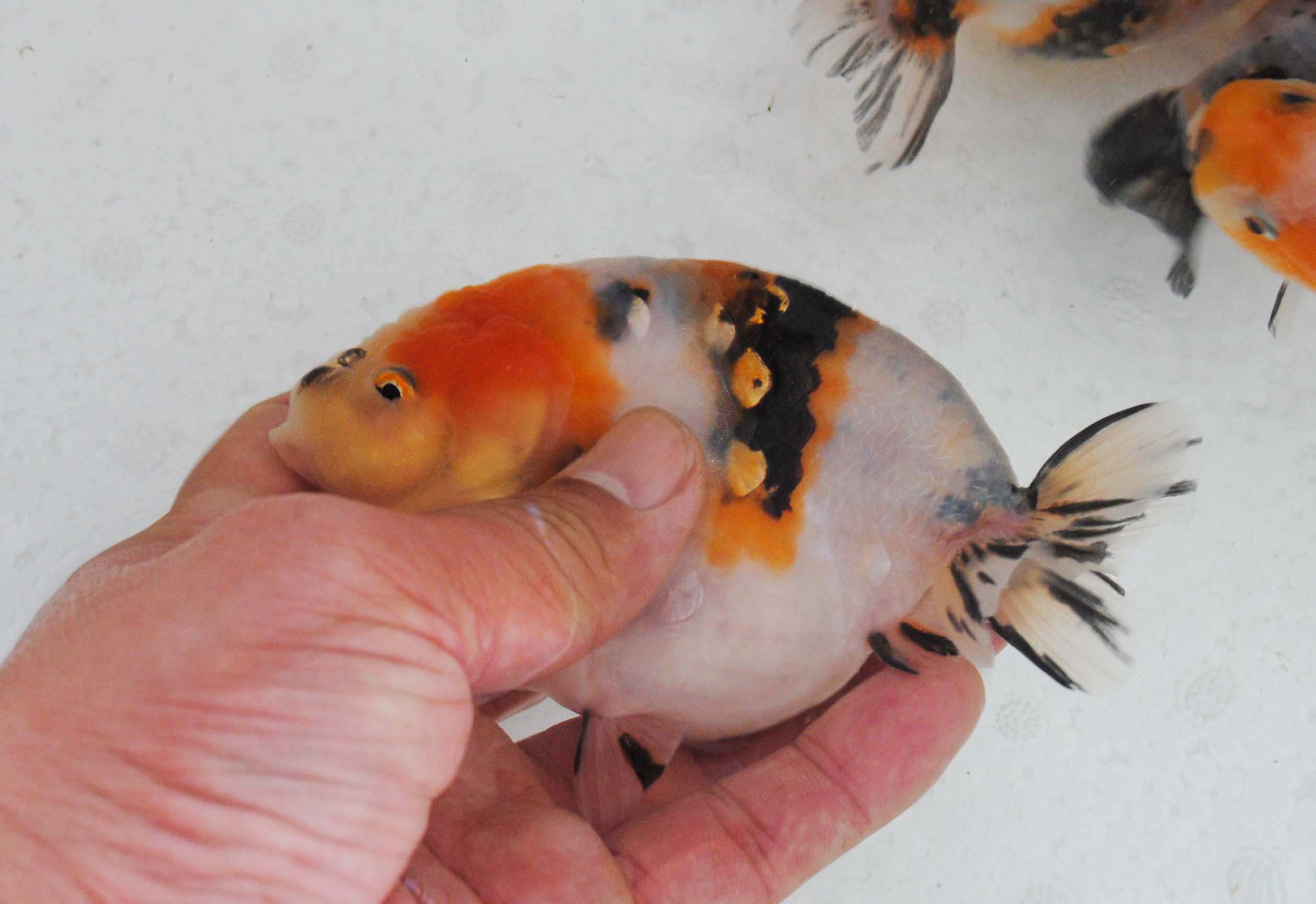
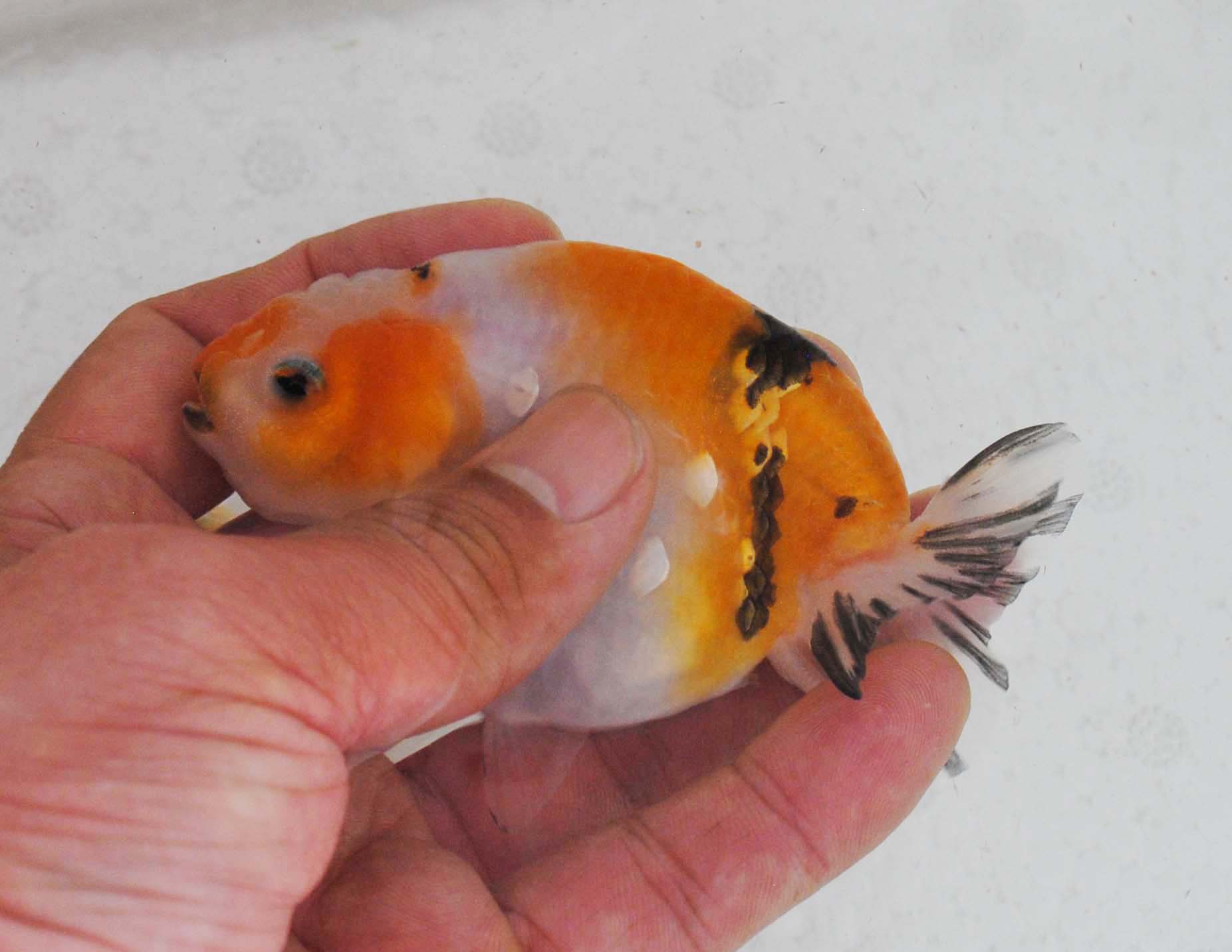
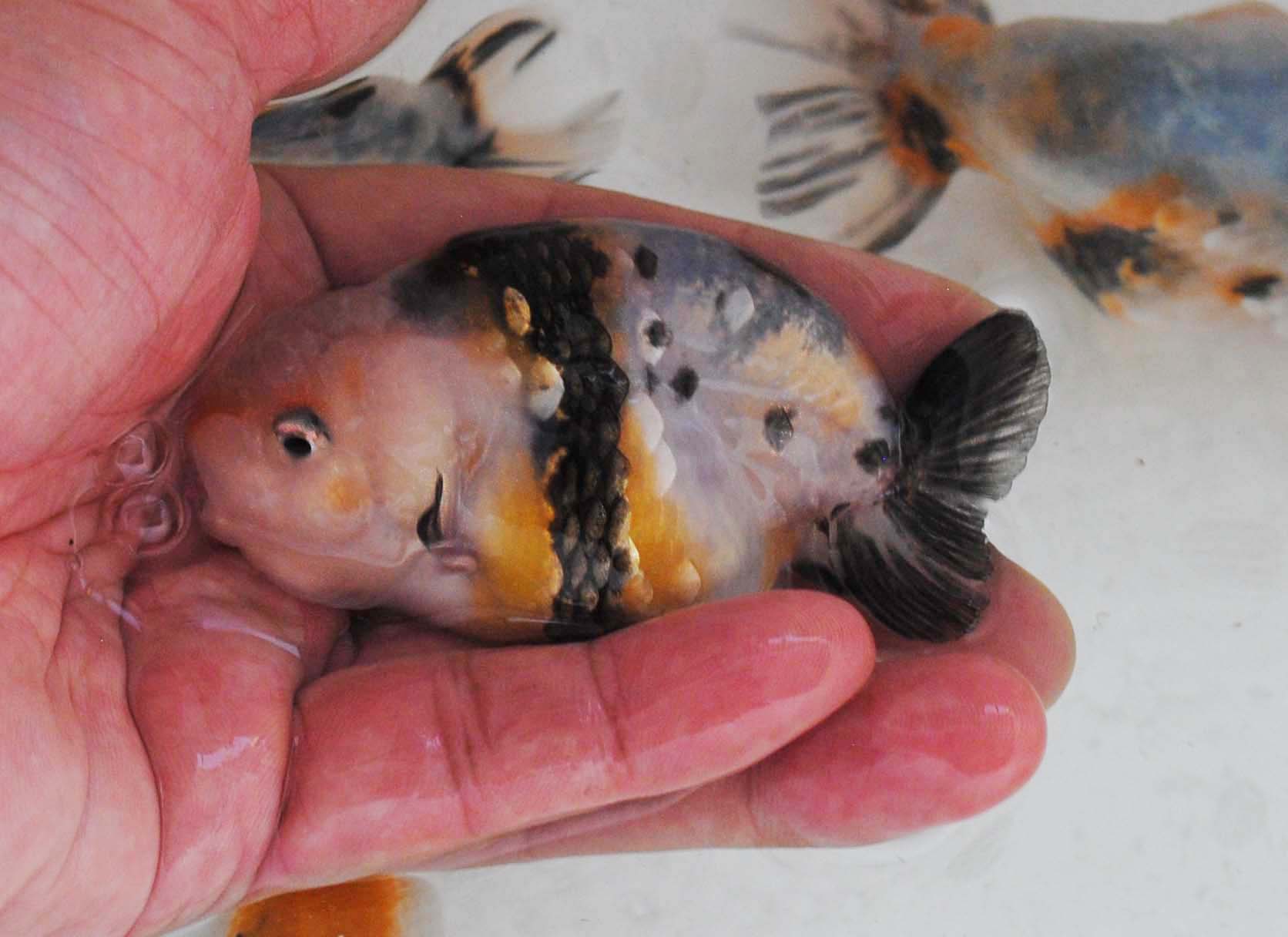
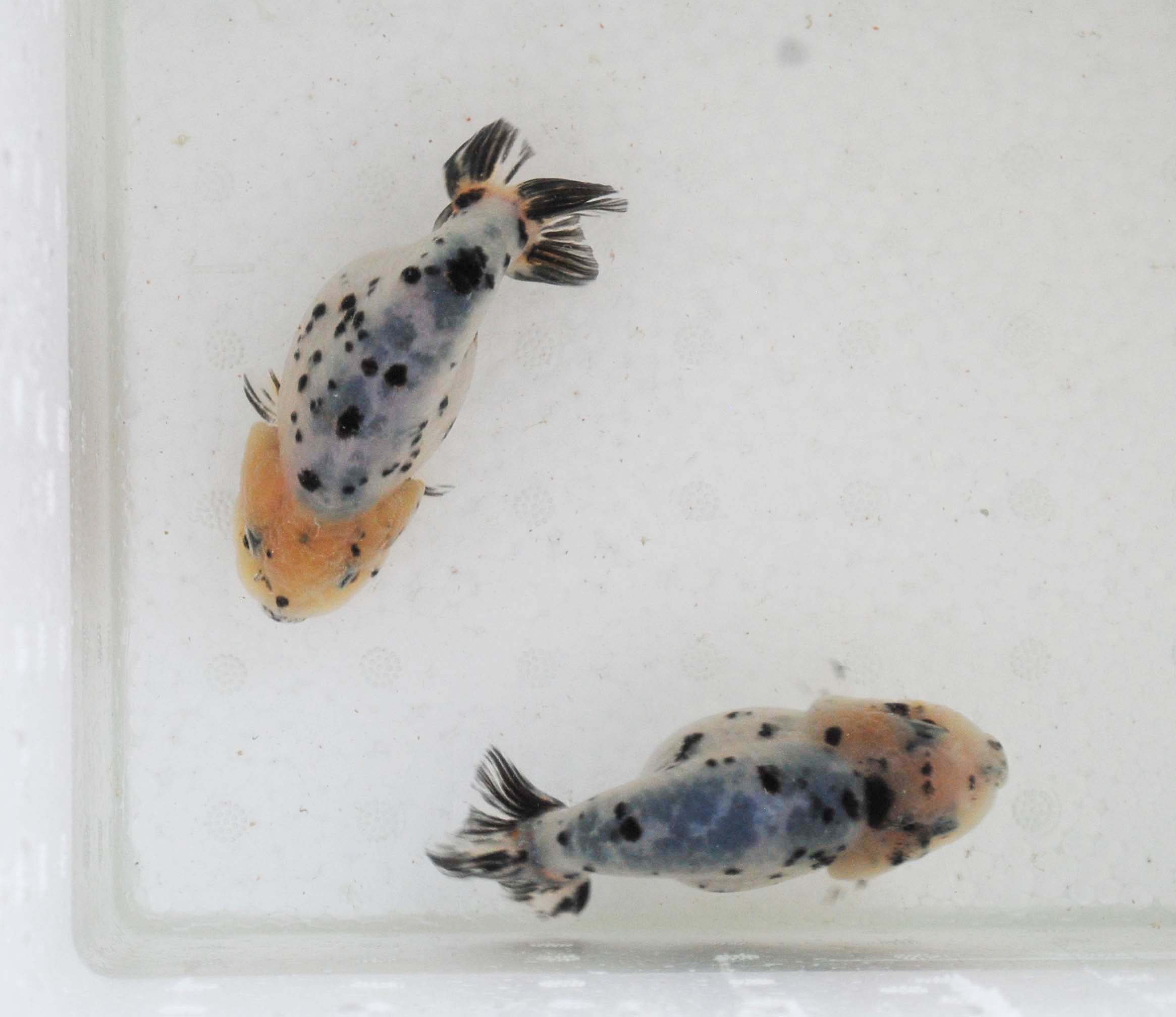
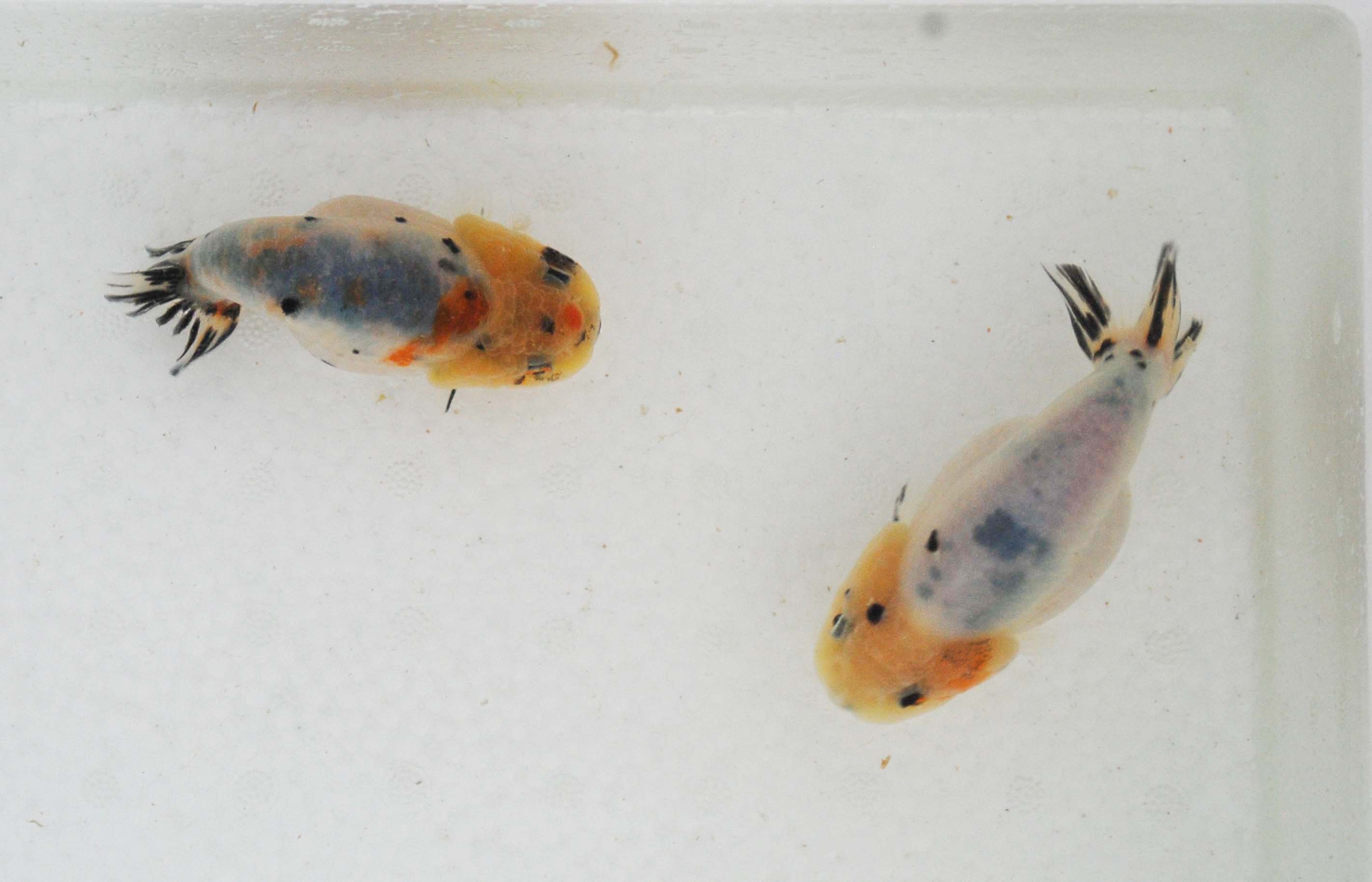
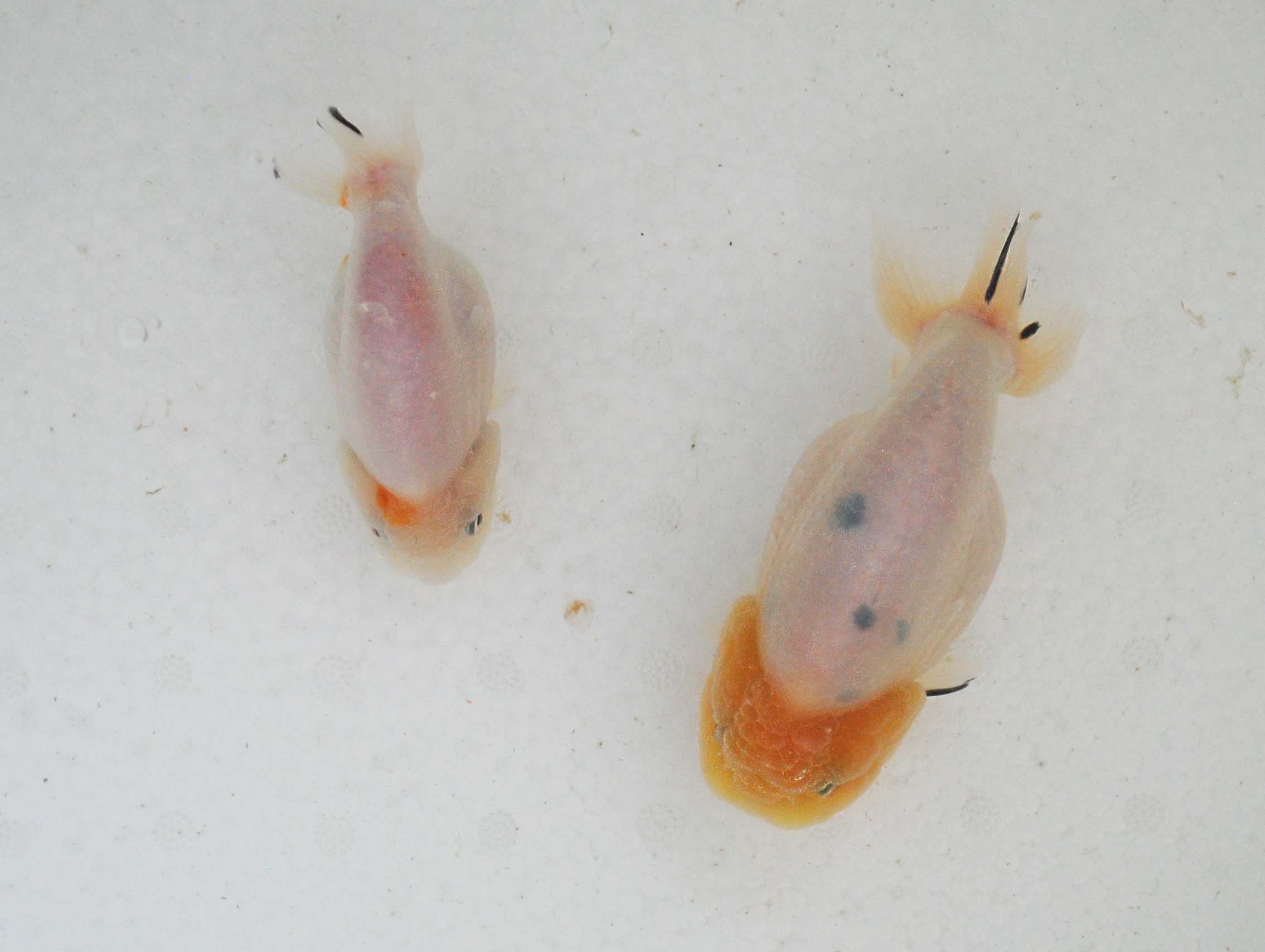
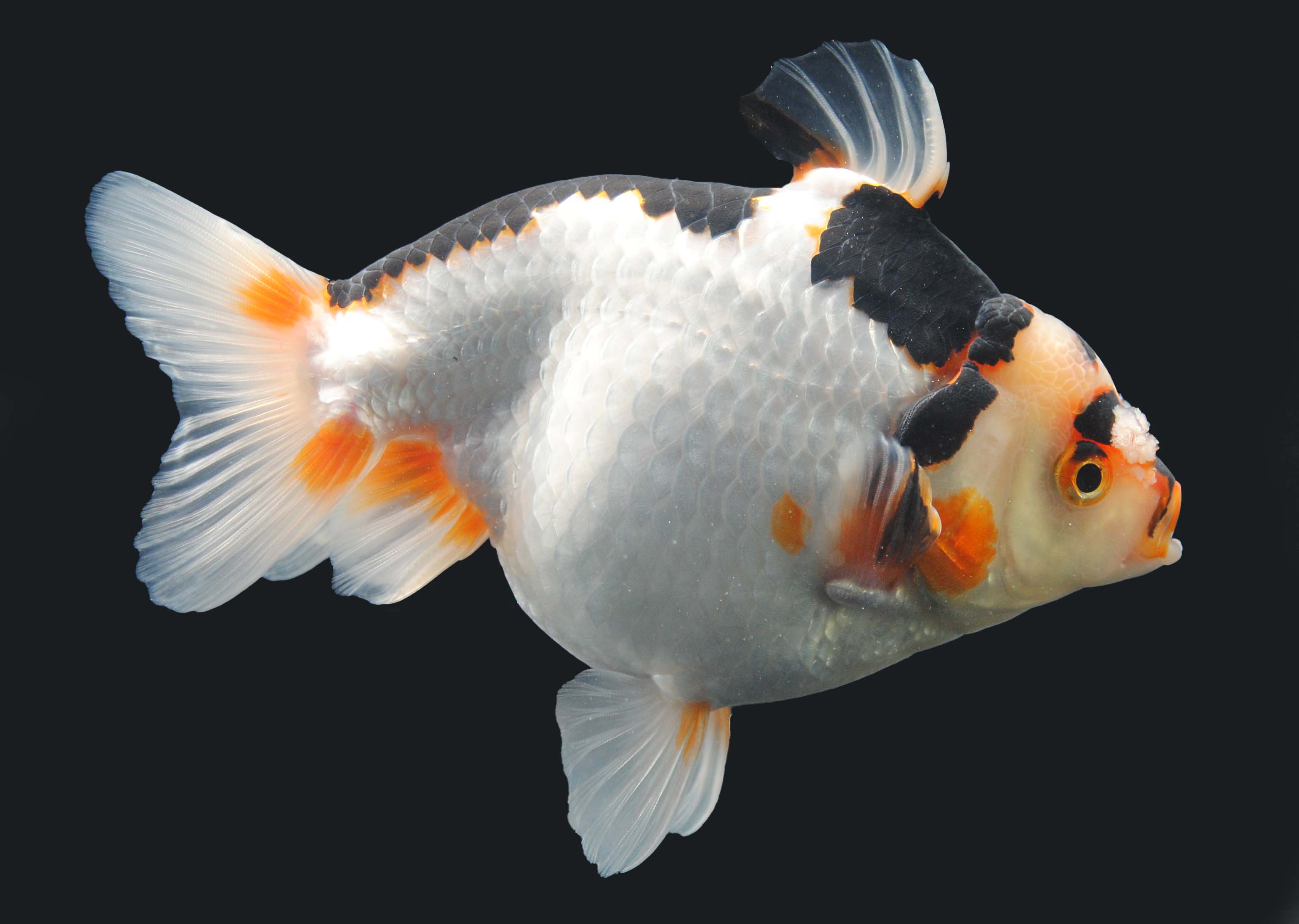
The offspring shows some interesting result in terms of coloration. Some exhibits strong black pigmentation on top of white or red-white color. This leads me to think that they are decent panda / tricolor ranchu! The quality of the body form varies. But as long as I can get the color genetics right, it is not that difficult to improve, I think.

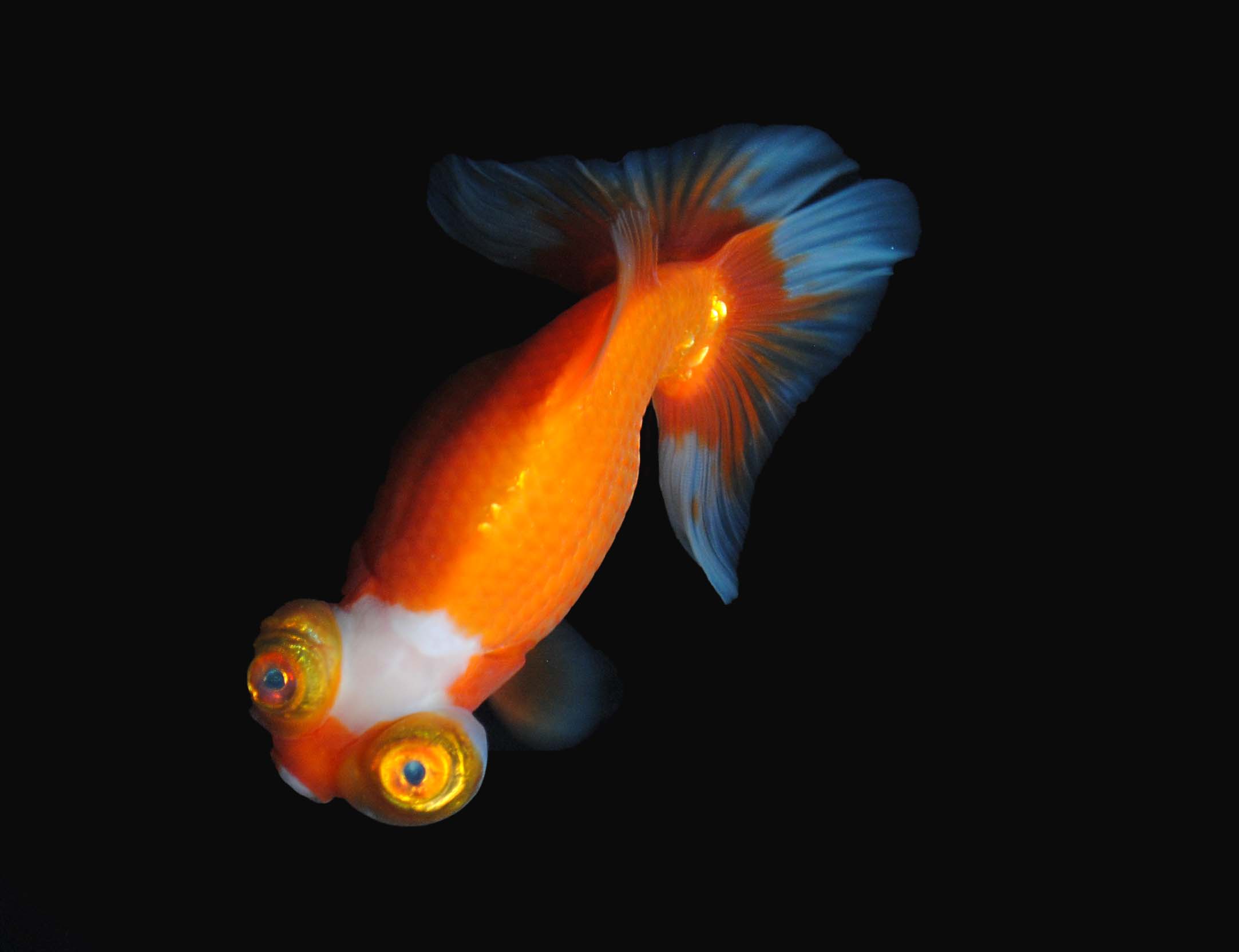
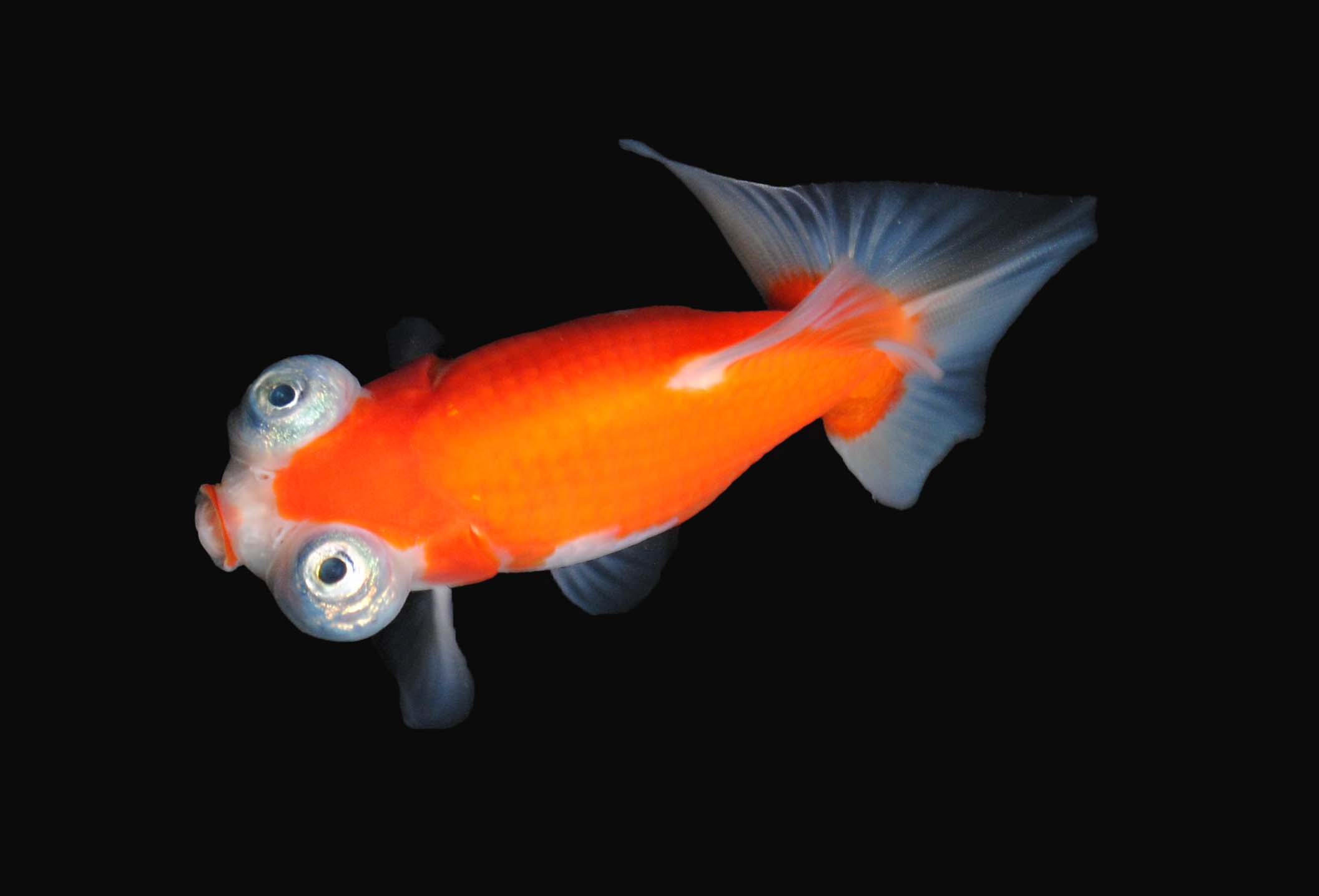
Here are four of the results. In fact, one of them has become a decent tricolor ranchu!

From the topview, some of the black and white color look startling!

I do hope I can realize my goals of creating panda / tricolor ranchu from these fishes.

The video is available in my youtube channel:

Standard
calico ranchu, cow ranchu

The Diary of a Goldfish Breeder 2025 (1)

Update on Cow & Calico Ranchu

As a follow up to Diary 2024 (5) and (8), I would like to refresh our memory that I was left with these fellows:

The bad news is that all are male.

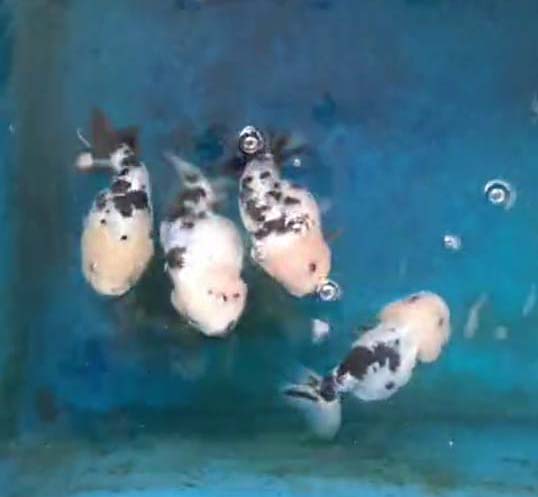
So, to continue the project, I acquired several Cow Ranchu from a local breeder, two male and two female specimens. Too bad, they did not last long. I did not have a chance to take proper pictures of them. Here is a lousy picture using my handphone:

My first instinct was to cross the three male Ranchu (left picture) with these cows. They did not carry black fish nor cow pattern in the offsprings. Some were white, sakura and calico with dotted black patterns. I got rid of the white. Here are two offspring that I keep. Both of them are female:

The first to lay eggs was the calico. It was about three months ago. So, this diary is about the offspring of this calico female. The sakura lays eggs recently and the offspring is just 2 centimeters long. It will take a couple more months or so to update on them.

Since the calico female was so productive, I mated her with several male fish.

First, I mated her with her uncle. Remember the calico fish in the upmost middle picture? It has turned into a calico with lots of black patterns:

So, just to be more systematic, the first cross is this:

And the offsprings I kept after lots of culling are:

Fish 1 seems to inherit the strong black pattern from the father. I treasure this strong black pattern feature for the next breeding.

Fish 2 seems to be a balanced mix from both parents, creating a pleasant pattern. I do notice there is a large block of black pattern in the back, which is good. If the fish can get rid of the red, blue and little dotted black pigment, it will be left with white color and that large black block. It will be a beautiful cow ranchu.

Fish 3 is the closest to the cow pattern I am looking for. I hope I can create more of this pattern. So, this fish is my first priority in the next breeding.

Fish 4 is weak, since it has no large black pattern. It has only few small dotted black pigments. It has no red and less of the blue shadow, which is good for a cow. I think if I cross this with a Ranchu with strong black pigment, there is a chance it will produce beautiful offspring. So, I keep it as a reserve.

Fish 5 shows that this cross can produce black / grey offspring, and also offspring with metallic scale. This is good, since this kind of fish might come handy in the next crossing.

The second cross is between the cow and the calico female:

And these are the results:

Do notice that this cross does not produce any black / grey nor metallic fish.

Fish 1 is a sakura which I will not use.

Fish 2 is a weak color. The red is not a strong red. It is more of a pale orange color. And the black pigmentation is weak. I will not use it.

Fish 3 is a calico with weak red and black color. I will not use.

Fish 4 is interesting. It is almost totally white with minimal blue coloration and red color, which is what I need. Too bad it also has less black pigment. But as the sideview picture shows, the black pattern is interesting, reminding me of a belt pattern. I think it is nice to see how the offspring will turn out when crossing this with a fish that has strong black pigment. I only keep this one from this crossing.

The third crossing is a metallic tricolor ranchu with the calico female. This tricolor comes from a black fish (also calico offspring from my previous breeding project) that turns into this spectacular pattern. There is only one specimen of this.

And the results are:

I think fish 1, 2 and 3 are pretty similar. They are dominated by white color with a little bit of red, blue and black which make them nice to see. They all have not so large but also not too small black pattern. I decide to keep them all.

Fish 4 show that this cross carries the black / grey and metallic gene.

Last crossing is between a black uncle and the calico female:

Let me show the results:

Fish 1 and 2 are calico with weak black pigmentation. The red color is stronger than the 2nd cross. I do not think I will use these two.

I guess my reader will know for an instance that I will keep fish 3 for the same reason I mention in the analysis of the previous crossing above. So also with fish 4. I will keep all black / grey fish at this moment.

Now my task is to wait for them to mature.

Wish me the best.

Thank you.

Standard
cow ranchu, tricolor ranchu

The Diary of a Goldfish Breeder 2024 (8)

Update On: Cow Ranchu & Tricolor Ranchu Projects

For friends who follow my Cow Ranchu projects and anticipate much (like myself), I must inform two bad news. First, all the offspring from both the Cow x Black and Cow x Sakura result in 100% male fish! That is a disaster for a breeder. Before I finish lamenting, there was an outbreak in my farm that cost me almost all of them. The Cow x Sakura line was totally wiped out. Fortunately, I managed to save few from the Cow x Black line.

These three patterns from the Cow x Black survived:

My main plan was to cross the first pattern type (the left picture) with the black colored sibling. But it was not possible since all were male. As a change of plan, I buy another female Cow Ranchu and cross it with the first type. Too bad the female cow died after delivering her first offspring before I took any documentary of her. I might post the result later on. But for now I can report that there is no single black in the offspring. After this mating, I sell all the first type pattern since I do not think I need them for my project anymore. I still keep the second type pattern and the black. And here the interesting news comes!

The black offspring turn into two handsome princes!

I kept two best of them. One of them turn into a black gold, and another one into tricolor pattern!

Aren’t they handsome?

I find that the black color is so persistent in them. It makes me full of hope. At least, not for my Cow Project, but for my Tricolor Ranchu Project! It is like getting a lottery!

Of course, I know that the stability of the pattern here is under question. Will they stay? Well, I am still observing. And when I cross them with fish from my Tricolor Project, how is the compatibility knowing that they come from Cow lineage?

Now, let me update on my Tricolor Project.

The project had shown a good progress. My latest offspring consists of some male and female shark ranchu (bad body form) with strong tricolor pattern. I highlight the strong pattern here. After I achieve that, the rest of the project becomes easier. I just need to improve on the body formation.

But when the outbreak kills lots of my fish, I am left with one female only! I was heartbroken. If this single fish died, then I must restart this project that I have done for several years. So sad.
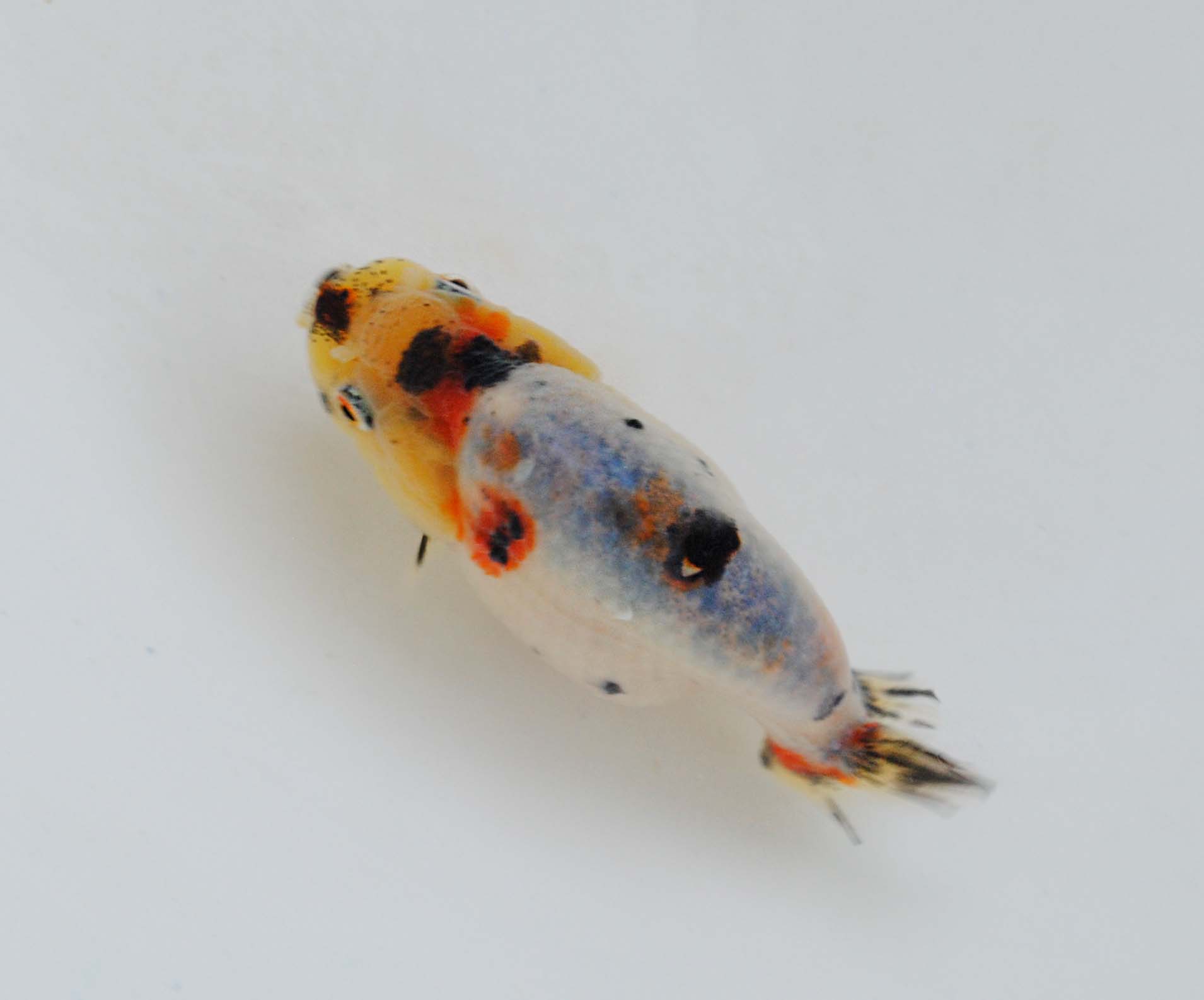
This is the survivor:

I mated this female with the two male Ranchu above. Frankly, it is hard for me to make a prediction of what will the offspring be. My hope is to have Tricolor Ranchu, of course.

First try, all the eggs cannot hatch.

Second try, no luck. I begin to suspect this female is infertile.

But I still try.

Third attempt, same result. Not even a single offspring. Actually, at this time I also mated this female with a ryukin just to make sure that the infertile ones were not the male. Same result, The possibility of the female being infertile is high!

Yet, I still try.

In the fourth attempt, I mated the female with the two princes above, with a ryukin, and with a tricolor Oranda! And guess what? All hatched perfectly!

If you ask me how come, I do not know.

Now, I am raising all of them. They are 3 cm in length right now.

Then, I try again to mate the female with the two princes for the fifth, and sixth time, and nothing hatched. The female resumes her infertility.

Well, I have no explanation for this. But I thank God for the one successful shot (the fourth attempt).

And let’s see the results in several months to come.

Standard
calico ranchu, cow ranchu

The Diary of a Goldfish Breeder 2024 (5)

In this Diary I will report the results of the cross between Cow Ranchu and Black Ranchu in this video:

The black is actually an offspring of my previous Cow Ranchu (Milk Cow Variant). Let me show the results and I will compare them with the offspring of Cow x Sakura reported in the previous diary (#4).

Here are the offspring:

The first category are fishes with large black markings in the shape of large blocks / islands. In these results they have red color. If they are free from the red color, they will come close to true Cow Ranchu, I think. At least when being watched from the top. Interestingly, from the side viewing, the black markings extend to one side of the body (sadly, only one side) to appear like large belts.

I think this is an interesting phenomenon. The project can be directed to create Cow Ranchu and Ranchu with Belts.

This one also has a belt in one side of the body, but the black marking does not extend to the top of the body. I will put this in the same class as category one, I think.

All these four will be in my breeding plan.

This is the 2nd category. It has lots of black marking, in the shapes of large blocks and dots. But the black marking does not produce a belt appearance. It is more towards irregular pattern. It can be considered as calico with lots of orange color. I am still undecided whether to use this in the project or not.

This third category is also interesting. They are close to the pattern of snow leopard, except that the snow leopard does not have blue and the black dots are smaller and many.

The fourth category resembles calico but a weak one. The blue and white are dominant while all the other three color are minimal. I do not think I can use them to propel this project.

The fifth category is the almost white fish. I notice that the black color is stubborn, though minimal.

This sixth category is the Sakura. Once again, the black color still appears in a minimal proportion.

And the last category is the black color. They always come out from the Milk Cow crossing. Of course, I will use them as my main ingredient in this project.

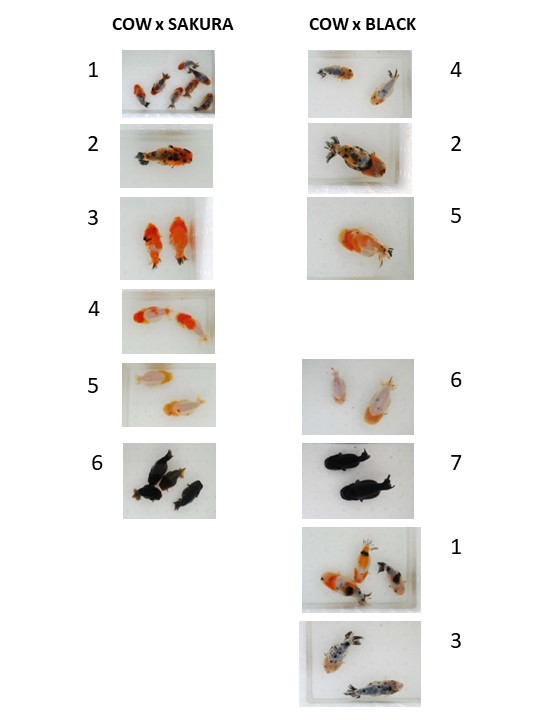
So, to compare with the Cow x Sakura, let us examine this table:

In the cross with Sakura, we do have offspring #4 (left) which has beautiful proportion between the red and white color (roughly 30% – 70% or 40% – 60%). This is different from #3 (left) which is dominated by red color. And #4 has no trace of black pigment. We do not see this variant in the Cow x Black offspring.

The offspring that comes up only from the Cow x Black are the #1 (right) and #3 (right). Yes, the cow / belt variant and the (somewhat) snow leopard variant only appears in the cross with black. I find this finding interesting.

The beautiful calico variant only appears in the cross between milk Cow and Sakura. This is also a thing to ponder.

The black appears on all of the crossing.

I think there is a lot to think about from this observation. I will make my next breeding plan based on this information. Tell me if you find any interesting interpretation to this information.

Standard
cow ranchu

The Diary of a Goldfish Breeder 2024 (4)

My experiment with Cow Ranchu is still ongoing. After so many attempts, I still have no clue of how to produce the color pattern. I had bought Cow Ranchu many times with limited success in breeding them. I grew suspicious concerning whether the fish (both male and female) had been treated in a certain way to prevent successful breeding. I had few offsprings, though. But at this point, none can be categorized as cow. The suspicion makes me reluctant to buy more import of Cow.

Yet, when an seller imported them once again, I was tempted to try this project once more. But I did not want to buy many. This time, I bought just one male. In my mind, this will be my last attempt to buy Cow Ranchu. If this also fails, I will stop buying them. To my surprise, this male is very vigorous! I bred him twice, with different female, and they gave me lots of offspring. He died afterwards. I have not taken a decent picture of these parents, but I have short videos of them.

In this diary, I will show the offspring from the first cross. It is between this male Cow Ranchu with a Sakura Ranchu. Well, it is not really Sakura since it has several black dots. But the dots are minimal, so it is closer to Sakura pattern. This Sakura is the result of my previous experiment with previously imported Cow Ranchu.

The Male
The Female

I am interested in knowing what color patterns are produced. And it is interesting to compare with the next diary where I cross the same male Cow with another fish.

I just take the pictures from top view for quick reference and classify them based on the color pattern. Here are they:

Many become Calico with good pattern quality. By definition, calico should have five colors visible. These offspring have blue, white, red, black, and orange / brown color. The blue color is strong. All the color is in good proportion. Actually, I like these offspring. But for my purpose (in understanding cow), I will not use them to further my project. So, I will sell all of them.

The second category is with lots of orange color and with no blue, so I put this in a different category from the calico. Perhaps, this fish can be said to have four color: orange, black, white, and the black pigment under the orange color (I do not know what to call it, it is definitely not blue). I will not use this one for my project, either.

This third category can be called three colors since it has red, white, and black color. But the black pigment is so minimal that this category can also be called Sakura. I am interested in this category. There is a story to it. I once bought a strikingly beautiful three colors transparent Ranchu from a farmer. This is the fish:

Such a marvelous color, isn’t it? Too bad, the breeder only had one. I asked him to find similar pattern in the batch and he could not find any. Upon questioning him how he came up with this color, he said he crossed the Cow Ranchu (from my lineage) with a Sakura Ranchu! He described the Sakura to have lots of red color with minimal black markings and several metallic scales in the body. This description matches the third category of the offspring I am talking above! That’s why, I will use this third category to further my experiment. If my experiment with Cow Ranchu takes a different turn to result on this kind of three colors, I do not mind at all! (Note: the three colors is female. It grew large in my facility and died without ever producing any egg).

The fourth category is the true Sakura. Actually, I do not think I will need them for the Cow Ranchu project. But one has an excellent body quality, which whets my appetite to breed it. I am sorry I have not taken the pictures right now. Hopefully, I will have the pictures next time.

The fifth category is the totally white / almost white fish. I am still considering their usage on this project. So I am undecided right now and will keep one. Perhaps the totally white one.

The last category are the black metallic fish. This is what I learn from the presence of this category. The fact that Cow Offspring (the milk cow variety) always produces decent number of black offspring means that black fish are involved in the making of milk Cow variety. Well, it is my conclusion. I can be wrong. But unless proven otherwise, I will keep this category and use it in my cow project.

And this is the end of my report today.

Enjoy!

Standard
blue ranchu, brown ranchu, purple ranchu

The Diary of a Goldfish Breeder 2024 (2)

For the last several years I focused too much on developing my Blue, Brown, and Purple Oranda line. I postponed the Ranchu projects on the same color to the point of neglecting them. I must confess that all my Blue, Brown, and Purple Ranchu line were wiped out almost completely. There is only a single old male Blue ranchu left. I can hardly do anything with that. So, basically, these projects must be restarted from zero.

Is he not handsome? He is a large fish. Personally, I like his strong body type. It is a bit long but with a balanced body width. And he has a thick waist. His headgrowth is decent. Yes, he has some obvious weaknesses in the smoothness of his back curve and the angle of his tail. Hopefully I can still have his offspring that carries the positive features. But I must act quickly, because he is losing his vigor due to old age.

I tried to find other breeders that might carry the blue and brown genetics. I do not worry about the purple, since if I can get blue and brown, I can recreate the purple. Gladly, I find breeder friends who bought from me before and are still keeping the genetics of these rare colors.

From Mr. Malek I bought some of his Blue Ranchu. He acquired the gene from my line before, and he crossed it with his own fishes. These two females are in my possession right now.

They are very fertile, and that is the most important thing for me. I also bought a male blue from him just for a reserve. But since these two females are good at laying eggs, I do not want to mate the male with them. Looking at the specimen here, I must admit they have their charm. I do not want to produce the same line. I want to differentiate a bit.

These two females show two spectrums of blue color, the lighter and the darker ones. Their body type can be considered medium short. This is the first point of difference with my male. The curve is varied, but I believe my friend has lots of good quality ones. The tail is also varied. The headgrowth is more well -developed than mine. This is the second point of difference. I make a cross between my line (the old male) with these two. I am tending their newly hatched offspring right now. Wish me success.

From Mr. Aji Linting I acquired this Brown Ranchu:

He acquired the brown (and also purple) from me a long time ago when I have just started. At that time, my line was of low quality. My friend crossed it with the previous type of Thailand’s Black Ranchu since he appreciated that variant very much. We can see the trace of the Black Ranchu feature in this male specimen. I was breeding that Black variant twenty years ago, so I am familiar with the features. New hobbyists might not be familiar with it. Anyway, looking at the bright brown color, I am very enthusiastic!

I acquired several male and female. Some with purple combination. But I focus on this brown male Ranchu as my material. I already crossed him with the two female Blue Ranchu and am waiting for the offspring to grow. Wish me success also on this project.

I also acquire a red and white Ranchu from local breeder to use in my crossing:

He is an enormous fish. He is handsome in his own way. But for me, I do not like the indentation in his upper neck and his excessive headgrowth covering his eyes. But still, this is the best I can find so far. I plan to cross him with the two Blue Female to enrich the blue genetics I have. The richer the gene pool the more choices I have to work on improving my Blue Ranchu quality. And also, I think I might need to have my own red and white lineage. Hmmm, let’s see ….

That is the update so far. Stay tuned.

Standard
miscellaneous

The Diary of a Goldfish Breeder 2024 (1)

It has been a long time I did not update this blog. More than half a year, I think. I apologize for that. Business concerns, family matters, health issue, facility upgrades, employee’s absence, and vacations have prevented me from taking pictures and making updates. Now is a long Moslem holiday. I have a chance to catch up.

Last year, in the midst of my busy schedule, I managed to give an online talk to goldfish enthusiasts in Malaysia. They asked me to talk about my breeding projects. And a realization came to me that some of my projects are actually inspired by my childhood. I would like to start this first 2024 diary with this topic.

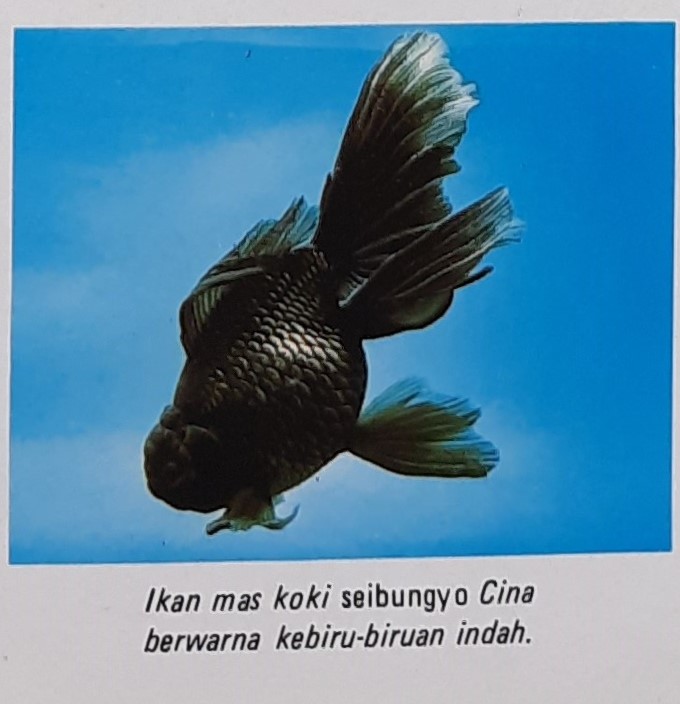
I mentioned before about an encyclopedia my Mom bought me more than 40 years ago. There is a page – yes, only a page – containing goldfish pictures. That page had become my daily childhood contemplation. My mind wandered wild, imagining whether someday I will have such beautiful fish.

In that talk to Malaysian friends, I realized that some of my projects correspond to this picture!

First, there is Seibungyo in the bottom of the picture.

The description is: a Chinese Seibungyo goldfish with beautiful bluish color. I always wondered what Seibungyo means. It sounds like Japanese word, but the description says it is a Chinese goldfish. As a child I remembered asking goldfish sellers whenever I went to local fish shops about that name. As you guessed, nobody ever heard about it.

But now I think I know what variety of goldfish this is. Is it not just a blue oranda? Yes, it is! And it is one of my main projects! My blue oranda line has improved significantly. I think I have a better quality of blue oranda than the seibungyo in the picture. One of my childhood dream has come true!

The Blue Oranda above is my most recent male. Some people nowadays prefer to call this color as Platinum.

Second, there is Chakin goldfish.

The description only says Chinese Chakin goldfish. It took me a long time in my childhood to understand that “cha” refers to “tea-color.” Yes, this is actually a tea-colored goldfish. Is this not the Brown Oranda line I have been developing so far? I have even gone further than that. I have also developed Purple / Lavender colored Oranda! With better quality, I think. Another childhood dream comes true!

Yes, my brown oranda is a bit darker. I find out that the brown color has at least two main types: the light one (which is the tea-color) and the darker one (which is the dark chocolate color). The darker one seems to have the ability to elicit white color – a quality I do not see in the lighter / tea-colored one. The tea-color seems to elicit orange color only when the dark pigment (melanin) fades away.

The picture above is the comparison between the dark and light color of Brown Oranda.

Third is the Chinese Goldfish with silver color and no dorsal fin.

Silver is just another name for blue or platinum. The fish resembles ranchu with long tail. I do not have such variety, but my blue ranchu is a good substitute for this fish, I think.

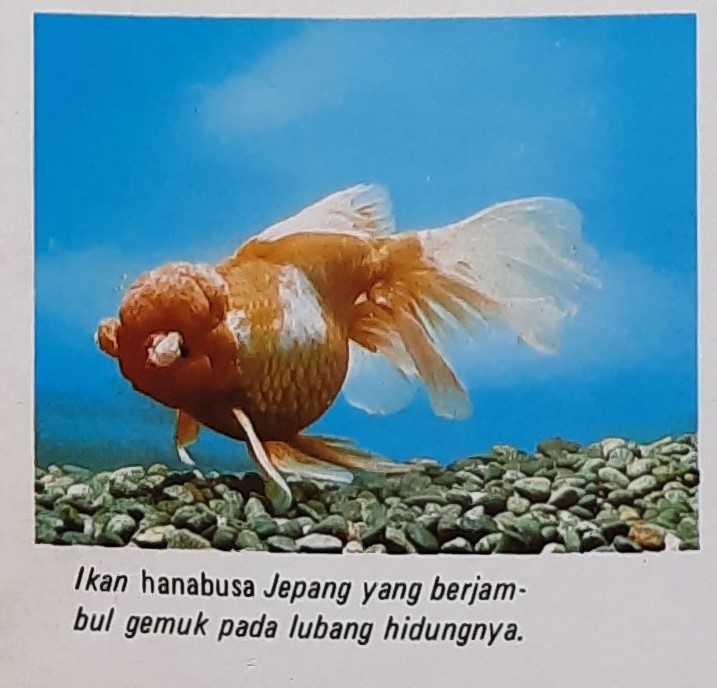
Fouth is Hanabusa!

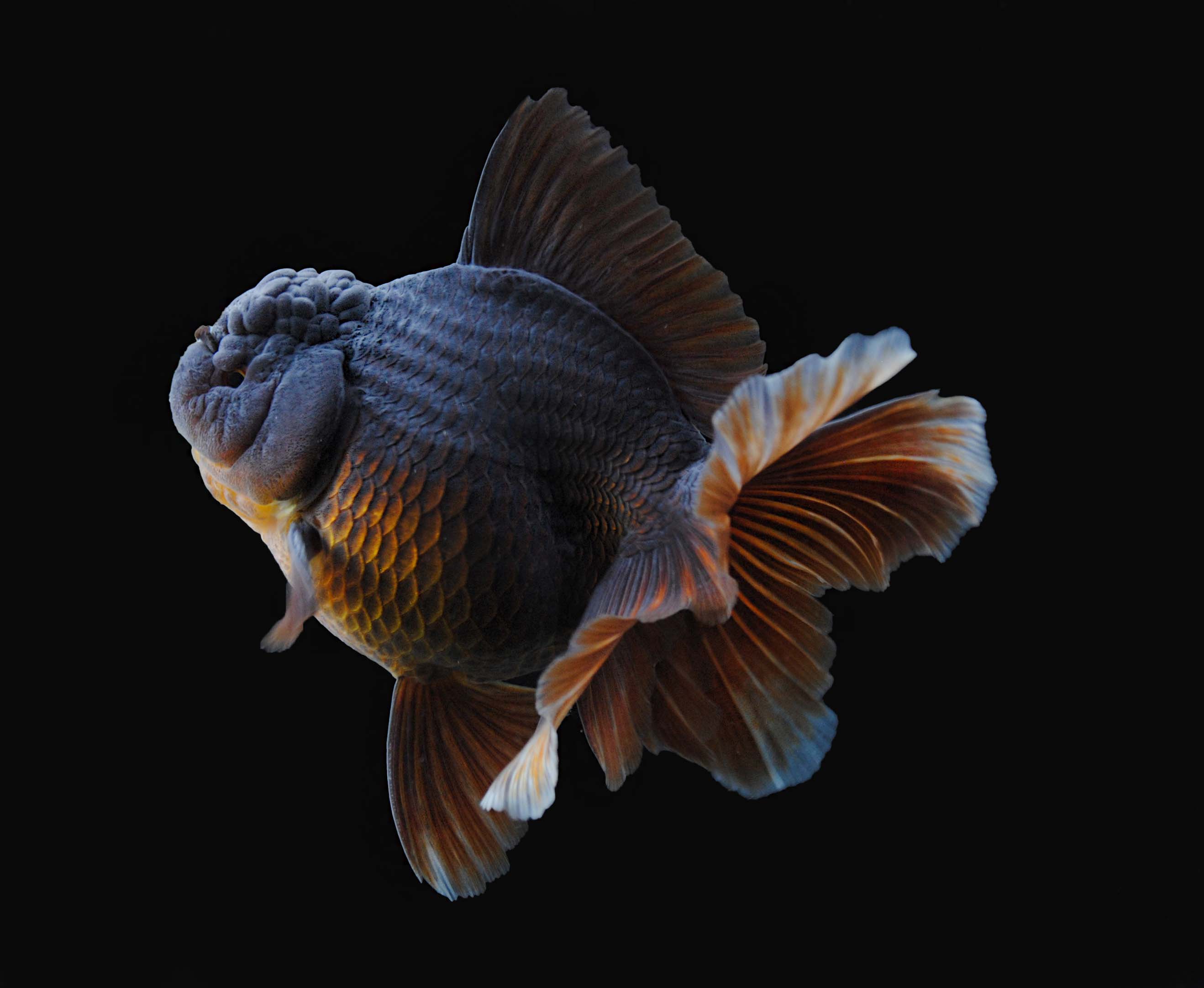
What in the world is Hanabusa! Thanks God the description gives us a clue. It says Japanese Hanabusa with large headgrowth in its nostrils. Headgrowth might not be the right terms. But now I know it is an oranda with pompom. I do not breed pompom oranda. But I mentioned before that I use the Chinese chocolate pompom to create my brown oranda line. Although I do not specifically breed pompom, once in a while the pompom feature just show up again and again in my facility. The latest I have is this piece of short tail oranda with pompom (or to be more precise, it is a ranchu with dorsal and pompom!) This piece shows up in my breeding unintentionally.

Isn’t she adorable? I cannot help bring her up to maturity due to its cuteness. And I am thinking of creating ryukin with pompom in the future by mating this piece with ryukin.

The last one is this rare specimen.

The description just says celestial goldfish. And I have a hard time figuring out what is in between the eyes. I think it is a headgrowth – the goosehead type of headgrowth. I think there is no such variety anymore nowadays. Perhaps the combination of headgrowth and celestial eyes features decreases the fish ability to acquire food and this might contribute to its continual creation.

I think I have a better ideal. One of my ongoing project is to create Celestial Eye with Butterfly Tail. It will be a fish with dorsal. The project has show positive improvement.

I think one more crossing with Butterfly will finalize this project. Wish me success.

Enjoy!

Standard
The Diary of a Goldfish Breeder 2023, tricolor ranchu

The Diary of a Goldfish Breeder 2023 (13)

Update on Tricolor Ranchu Project

I managed to keep two pairs with very good black pigmentation. Some are lacking white color, so they become black gold. But the characteristic of the black color on these black gold is superb, to differentiate them from the commonly seen black gold which deteriorate over time to become orange fish. Here, the black color stays.

But the fish have not produced decent ranchu back curve. At best, they are still what we call shark dorsal fin type. It is ok for me, since I see it as an improvement for this project.

The female 1:

Female 2:

Male 1:

Male 2:

All of them have pompoms, which I do not know where those come from!

Well, I was hoping that their offspring would yield some dorsal-free back curve. It was the most logical thing for me. Yet, it does not work that way. Almost all of the offspring have perfect small dorsal fins! I do not know why. But this is frustrating for me. I have tried to breed using these pairs more than twice with the same results. So, I think I need to adjust my strategy.

Among the plans I execute are to cross them with a male blue ranchu, and with a female grey ranchu. Both the blue ranchu and the grey ranchu still have genetics connection with them as a side result from the previous crossing. I also plan to cross them with true blue ranchu in the near future.

That’s all the update I can give right now concerning the tricolor ranchu project. Wish me luck.

Standard
blue ranchu, brown ranchu, Chocolate Ranchu, purple ranchu, The Diary of a Goldfish Breeder 2023

The Diary of a Goldfish Breeder 2023 (12)

Project #9,10,11: Blue, Brown, and Purple Ranchu Update

The fish I mentioned in the diary #6 show promising results. The cross produces four colors at once: grey, brown, purple and blue. I do not post the grey here. I will focus on the brown, purple, and blue. These are the champions after the final cull.

Brown Ranchu:

I am satisfied with these two brown ranchu, especially the first one. She shows beautiful smooth and thick curve. She can grow into a large and beautiful fish. Yes, she has weak headgrowth, and the size of the head is a bit small compared to the body. I plan to improve it by crossing with red-white ranchu that has better characteristic on this area. I think I will have beautiful offspring from this crossing next year.

The second fish is also female. So I do not have a male brown ranchu right now. The second fish is cute. She has a better headgrowth with more proportional head and body ratio. Well, actually I do not mind which one will be the next mother for my brown ranchu project. Both are adorable in their own ways.

Purple:

Well, this is the only purple that can survive the cull. And the quality is far below expectation. The head is totally bald. The peduncle is long and slim / thin. Those are two characteristics I would like to avoid. But he is the only one I have. So, my future purple ranchu lineage might depend on him. The color is attractive, though.

Blue:

The pictures were taken under afternoon sunlight. So the blue color looks a bit like purple due to the excessive sunlight. The first fish is female. I am not sure about the second one. The headgrowth is unique. The first has a little headgrowth, while the second one is bald. The curve of the first one is almost flat in the upper back, and sharply curves down before the tail. The second one has highest point of the back curve a bit to the front, which then slopes down not in a sharp manner. The color of the second fish is rich in gold combination.

I will certainly consider these blue to be my next parent fish. But I also have with me a different line of blue ranchu with a totally different character. I will compare them to decide what to do when they are ready to breed.

As a conclusion, I think my prize in this project is the brown ranchu.

Standard
cow ranchu, The Diary of a Goldfish Breeder 2023

The Diary of a Goldfish Breeder 2023 (11)

Project #12: Cow Ranchu

Update: Cow x Black

I would like to report the result of Cow Ranchu (male) x Black Ranchu (female). These are the parents:

The offspring consists of two types: the grey / wild color, and the transparent color. I cull the grey out early. So, I do not know whether they will turn into some other color or will continue to be grey. I keep the transparent color only.

I also cull out the defects in finages from the transparent color. I end up with 7 of them. Let me first show them from top view.

1. The black pattern is a combination between type 1, 2, and 3 mentioned in my previous writing (diary #10). The blocks, dots, and irregular pattern appear here. I cannot say this is desirable. But it is not a bad thing, either.

2. The black pigment exist throughout all the offspring. Unlike my offspring of cow x cow which yields lots of casper fish (totally white), the existence of black color in this cross is a good thing. I can say that the black pigment of the black ranchu contribute to the abundance of black color here.

3. The red color is dominant and is not a good thing in a cow project. I will say that this red color is due to the black ranchu genetics, also because underneath the black coat of a black ranchu is actually a red / orange color. This is visible when we (accidentally) scratch the skin of a black ranchu.

4. Some of the fish shows thick peduncle, following the genetics of the male parent. This is interesting.

Now, let’s examine the side view of the fish. The pictures are in the same order.

1. One interesting observation is that all of them have white belly! The red color tends to be dominant in the upper part of the fish, while the abdoment tend to be white.

2. All have hints of black pigment in the fins.

3. Black pigments in the body tend to be more in the top part of the body, and get lesser below.

4. The tails are large since both parents have large tails.

My Plan:

Actually, I am not sure whether to use them further for my cow ranchu project or not. It seems that I will have a hard time getting rid of the dominant red color here. It is still interesting to see the result if I cross them back to cow, though. Will the cross diminish the red? It is possible. Will the black color stay? It is also possible. And if this happens, then I will have fish with good black quality (though the pattern type is unpredictable) with less red color.

Crossing them back to black might also be interesting. Observation sideview number 1 reminds me of my attempt to produce Kirin ranchu years before. Kirin tend to have dark color on top of the body and light color in the abdoment. Well, this cow x black shows red color on top and white in the abdoment. And the black pigment tend to be more on top. This seems to be half way in the process of making kirin. So, crossing back to black arouses my curiosity.

But I am not sure I will have time to do all these. I have some other crosses with cow which results I will compare with this. If the other crosses produce closer results to cow, I might prioritize them. If that happens, then this cow x black project will be terminated.

Concerning crossing back to black, I must buy another black ranchu which I am somewhat reluctant to do. Black ranchu is out of my projects. I will think twice to enlarge my projects right now. So, I do not think I will do it.

As a conclusion, this cross might not continue. But it helps me understand crossing better.

Standard