Uncategorized

Sakura Coloration on Ranchu-like Goldfish

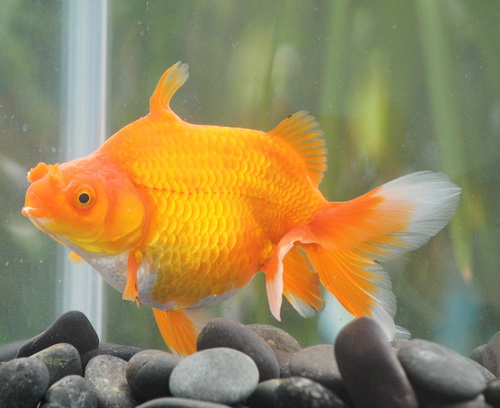
As mentioned before, I am trying to create tricolor metallic scale ranchu. This project directed me into crossing a tricolor metallic scale tosa with ranchu. By tosa I mean the ryukin which has no hump. It turns out that all of the offsprings shows a combination of metallic scale and transparant scale on the body. My conclusion is that the tricolor metallic scale I used is actually a variant of calico (transparant scale) goldfish which somehow develops metallic scale all over the body. This is not a genuinely metallic scale. The piece I have here shows minimum metallic scale. The body is mostly covered with transparant scale. And it looses the black color and turns into sakura color.

Image

Don’t ask me about the body form resulting from this crossing. Horrible. This one is the best in terms of the back smoothness. The shape is not ranchu yet, that’s why I cannot call this a ranchu. The head resembles a tosa or ryukin since it has no headgrowth. And it has a hump! My first impression when I look at this piece is the image of a cow. But instead of a black and white cow, this is a red and white one.

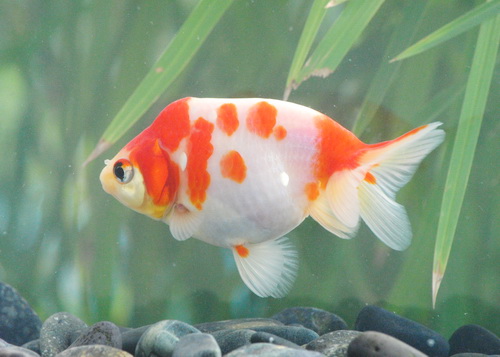
The sakura color is impressive on this one. The red is truly red, it is not orange. And the white is milky white. Adorable. And the pattern is pleasing to the eyes. When the sakura is dominated by the red or orange color, it looks horrible to me. But this fish has the right amount of red and white combination, according to my perception. This is the sakura coloration I want to create, though not in this body form. The large red dots look like the brush strokes from an expert painter.

Image

Standard
Uncategorized

A Sea-Horse?

Image

People must think me mad to raise and post such a fish! This kind of fish will be culled out early in any farm in the world. No breeder will give it a chance to live since the defect is considered serious. It does not fit in any standard of goldfish, and so, it should not be considered as a beauty.

Actually, I do not create this fish purposely. I tolerate this because this is part of a project to create chocolate ranchu. As might be obvious from the body form of the fish, I was mating a red ranchu with a chocolate pompom. I cannot think of a better source to obtain the chocolate color than from a chocolate pompom. This fish is an F1, and is still a long way to go to become a decent chocolate ranchu. Last time I was mating a ranchu with a panda telescope in order to create a panda ranchu. It has shown some success after three and a half year. Now I am redoing the same type of project, except now with a chocolate pompom to create a chocolate ranchu. The difficulty is pretty much the same, I think.

So, yes, this fish is a monster to most of us, but to me, this is very valuable. However, as I behold this creature, I am getting an impression of beauty out of it. I immediately think of a sea-horse as I watch this fish. Perhaps it is due to the small dorsal fin in the posterior of the back. Does anybody have the same impression?

And this is a wild thought. Why not create a new goldfish category out of it? A sea-horse goldfish, maybe? I know that this will be a hard thing to accept, since it is a bit far from the normal goldfish standard. But if many people can see the beauty, why not?

Image

Standard
Purple goldfish

Chocolate and Blue

Image

I have some chocolate pompoms. Their bodies are dark brown, and their pompoms are bright orange. This brown color is unique. In my observation, the brown color can get so tense as if there is an additional chocolate blanket covering the scales. This covering is similar to the deep black covering in the Thai black ranchu. When the color is not intense, they look like a lighter brown color with metallic shine.

The offspring of the pompoms show light brown color from the day they hatched, which is a different characteristic from the common red or red-white metallic scale offspring.  So, there are three types of color in the metallic scale offspring, namely the grey (as produced by the red or red-white fish), the blue (as produced by the metallic blue fish), and the brown (as produced by the brown or chocolate fish).

This is the offspring of the brown or chocolate pompoms.

Image

It must be noted that the brown color in chocolate pompoms is different from the brown color that usually appear in blue metallic fish. So, in goldfish, we have two types of brown. The reason of my saying them to be different comes from the observation of their offspring. The blue brown goldfish comes from blue fries, while the brown or brown-orange pompom comes from light brown fries. The difference of color in their juvenile stage is enough to conclude that they have different color genetics.

To produce chocolate pompoms from chocolate pompom parents is easy. I do not see much challenge on it. But there is still one area I would like to understand about this chocolate color. So far, the body is totally brown. There are few instances where the bodies become orange. The tails are sometimes orange, but most of the times are brown. The pompom balls are most of the time orange, but few remain brown. I have not seen the white color appear in the body. So I would like to know if it is possible to produce a brown and white color from this breeding project.

We know that the color of black ranchu cannot exist with white color. That’s why we can never create a black and white ranchu by crossing a black ranchu with a white ranchu. It seems that the black color expels the appearance of the white. But the black color does not expel the orange / red color. That’s why we can sometimes see a black gold / black-orange goldfish. There should be a name for this behaviour, unfortunately I do not know it. Maybe it can be called the white-repelling behavior. In the chocolate breeding project, I would like to know if the chocolate color also has a white-repelling behavior, or is it possible to create a brown and white fish.

Another area to understand is what will happen if the chocolate is crossed with the common red metallic fish. I think I can answer this without even do the experiment. I will say that the red color is dominant to the chocolate, so the offspring will show the grey color only, and will eventually turn into red or red-white goldfish in F1. Then if we mate F1 x F1, the result will be some red or red-white fish and some chocolate. This is exactly what happens if we cross the blue or panda color with the red or red-white color. I expect the same thing to happen when we cross the chocolate with the red or red-white. (Just for a note, the cross between black color with red or red and white goldfish does not behave this way. The black color can sometimes, not always, occur as early as in F1, with varying degree of color density).

A more interesting understanding is to know what will happen if we cross the chocolate with the blue! Will they be blue-chocolate goldfish? Or will they be blue-chocolate-white and orange goldfish? What will the color of their fries be? Which is more dominant, brown or blue?

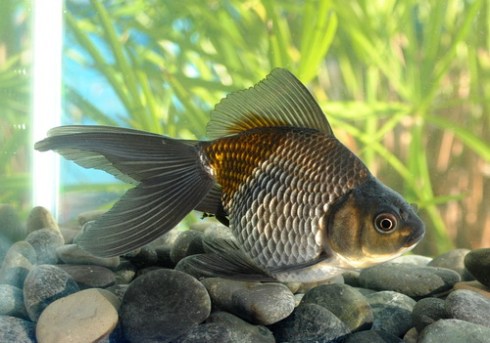
This is the blue goldfish. It has a brown coloration also.
Image

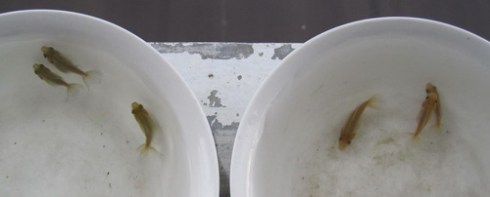
To my surprise, I do not get blue nor brown fries. I get grey fries! This is out of my expectation. But it is an interesting fact. Too bad I am weak at my biology, so I do not know how to interpret this. But I am excited to see what they will be as they grow. Will they be just common red or red-white? And if so, what will the F2 be if I inbreed the F1? I will continue the experiment just to see what will happen.

Image

Image

As a note, I remember there was already such an experiment done by Shishan C. Chen before the 2nd world war. As I consulted to the paper, I am amazed to know that I am repeating some of what he has done. In the experiment, Chen used wild goldfish to cross with blue. The result confirms my conclusion. I have done the same. But for the cross between the wild goldfish with the chocolate, which I have not done, my assumption of the result confirms partially the conclusion of Chen’s experiment.

Concerning the cross between the blue and chocolate, Chen confirms my result. And he gave me a better understanding of what to expect. If I inbreed the F1, he said that I will get grey, black, blue, brown, and some intermediate color between blue and brown which can be distinguished clearly from blue or brown. I wonder what that intermediate color will be! He also mentioned the blue-brown color. I am not sure if this is the same as the intermediate color or a different one. I guess my project will let me know about it.

Chen did not talk about the white-repelling behavior since it was not his concern. I think I must do it myself to know the answer then. Hopefully I can produce a brown-white goldfish, which will be interesting J

Standard
Tricolor Metallic Scale

Tricolor Metallic Scale Ranchu Project

I have crossed two female orange metallic scale ranchu to my tricolor metallic scale goldfish (as depicted in my previous posting). The aim is to create tricolor metallic scale ranchu.

First, it must be noted that the metallic scale here is not a true metallic scale, but it is a derivation of transparent scale calico fish which has acquired metallic scale appearance.

Second, after second consideration, this choice of orange metallic scale ranchu to cross might not be the best choice. The reason is that the demelanization process (the process of getting rid of black color) in orange metallic scale ranchu is working strongly. This combination of parent might result in the offsprings loosing its ability to retain its black color. Blue ranchu or black ranchu might be a better choice. Anyway, the cross has been made, so I will stick with this to see how it will turn out.

Third, the two female orange metallic scale ranchu that I use came from two different lines. The first is a thailand metallic scale ranchu, and the second is my own breed, which though the appearance is an orange metallic scale ranchu, it carries a recessive blue (or panda) color in its gene. I don’t know how will a recessive blue help, but I hope this second fish will be my luck in repressing the demelanization process. It is interesting that the offsprings of these two fishes behave differently.

This is the male parent

Image

This is the first female parent, which does not have the recessive blue genetic. The second female looks similar, so I do not post a picture of it.

Image

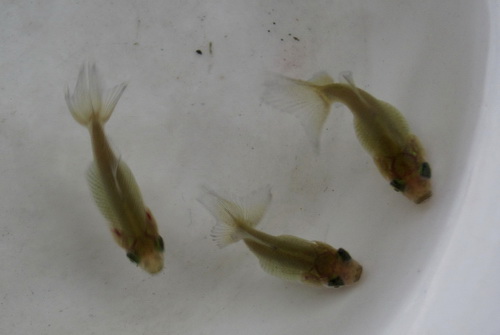
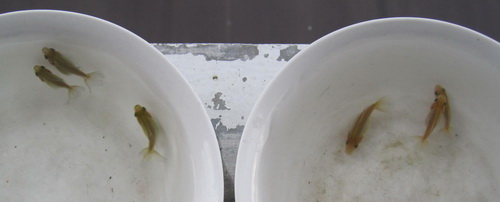
From the first female parent, the majority of the offspings have complete dorsal! This is out of my expectation. My rough estimate is 90% have complete dorsal. I cull them out, leaving only few with irregular dorsal. Though the observation is too early, I think I saw more scales in the offsprings, but less black color. This lack of black color is not conclusive yet, since I keep them in light-colored background due to lack of facility. The offspings which resemble transparant scale  (such as calico color) with few metallic scales are very few. A sample of the first offspings is shown below

Image

The second female parent yields roughly 50 percent of complete dorsal offspings, which I culled out early. From the irregular dorsal ones, roughly half show the characteristic of transparent scale with few metallic scales on its body. The other half show more metallic scales – more than half of their body are covered with metallic scales. This is the trait I am looking for. Concerning color, they seem to retain more purple color. This is a sample of them:

Image

When I made this cross, I did not know what to expect and what to cull out. Now I have a better idea. I will keep those with have more metallic scales – the ones that have more than half of their body covered with metallic scales. This is the first priority. Then I will choose the ones with more black / purple color among them.

Any suggestion is welcome. I will update this project in some more months.

Standard