Purple goldfish

What color is this?

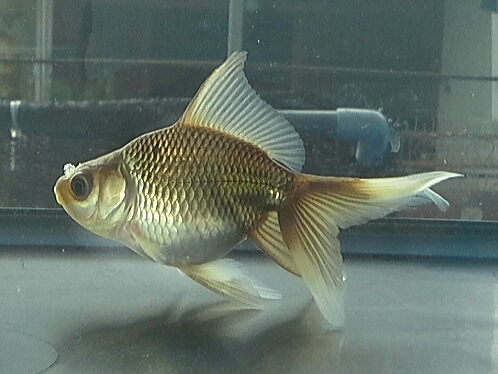
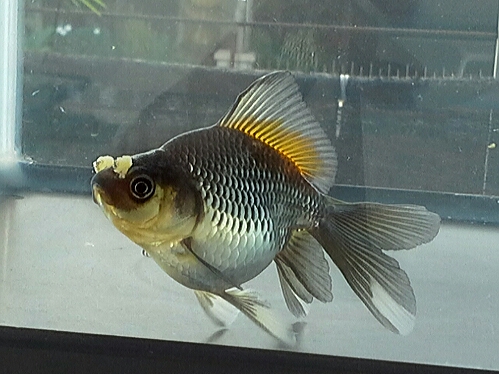
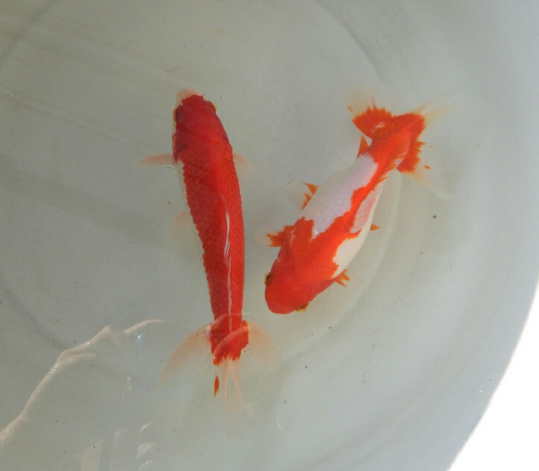
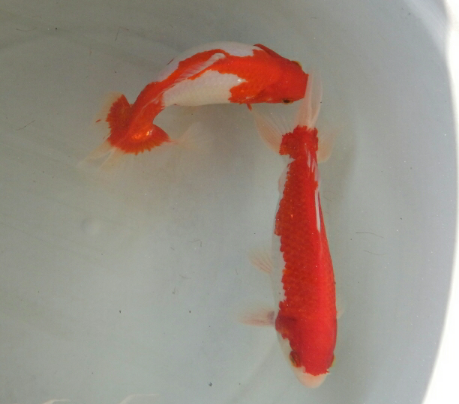
This is the most unique color I find in this purple goldfish project. It started as purple fish. But then it develops white coloration. The purple color becomes darker, to make it look like light brown. I do not know what to call this combination. Purple and white? Chocolate and white? It surely looks like brown magpie bird to me.

20150723_072508(2)

20150723_072449(1)

Many of the purple develop the white color, but most turn into totally white. So, I guess the behavior of this pattern is basically similar to the panda. That means there is a room for stabilizing the pattern through selective breeding.

unfortunately, there is only one with this kind of pattern. I hope the pattern will stay, though it is very probable that it will fade. And the purple goldfish is always the smaller compared to the blue and brown in the same batch.

My plan is to strengthen this pattern and multiply them in the form of pompom goldfish. Next, I would like to develop ranchu in this pattern. Wish me the best 🙂

Standard
Panda pompom

Panda pompom

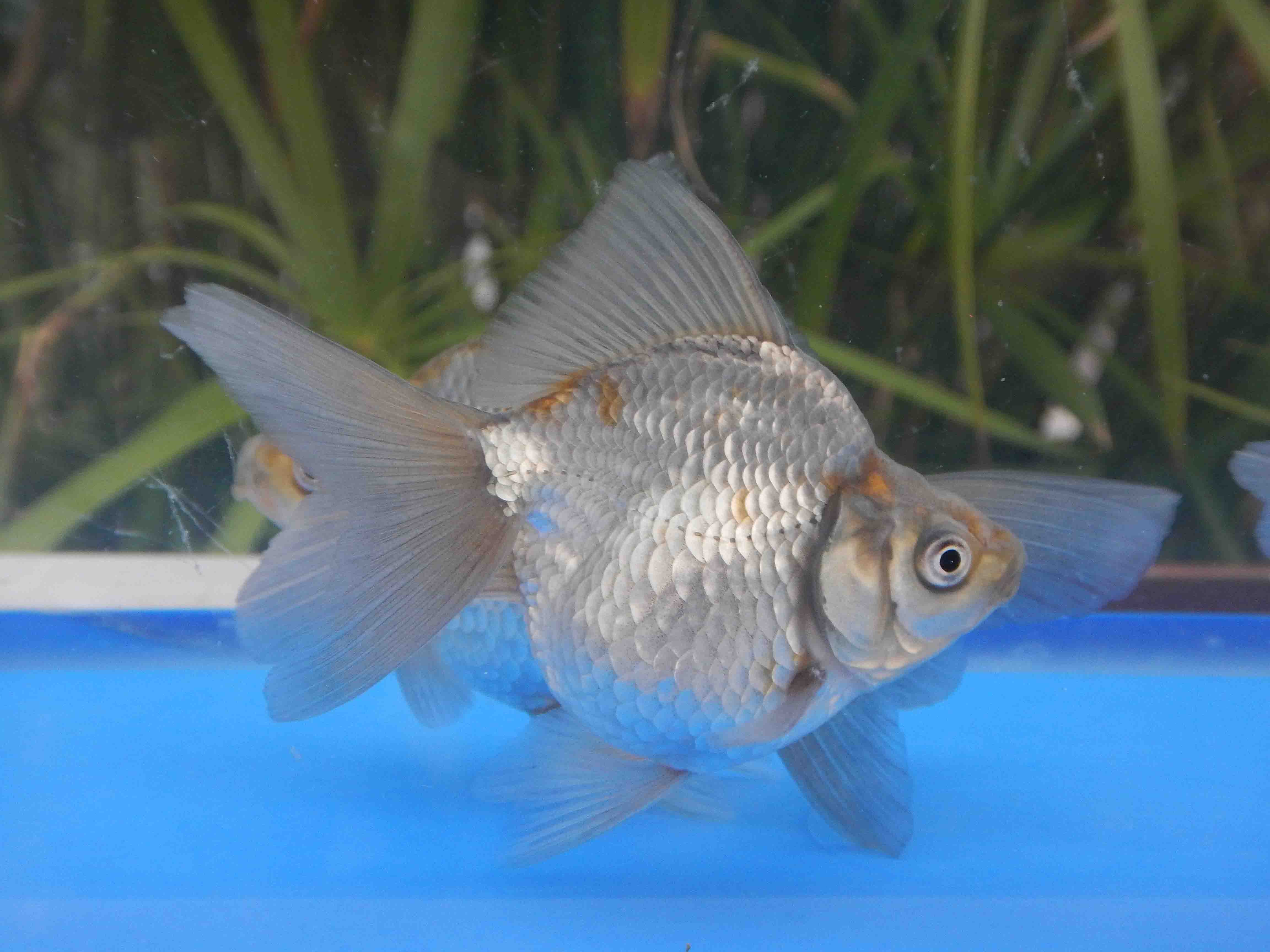
From my experiment to create purple goldfish, I accidentally create panda pompom. This is predictable, since I use chocolate pompom and metallic blue fish as the grandparent. Some blue fishes appear in the offspring. Some have pompom, some do not. But most of the pompom feature are blue also. This one is extraordinary since the pompom feature is white, giving it a good contrast. If today we usually find pompom goldfish with chocolate body and orange pompom features, hopefully we will see more of blue or panda body and white pompom features. I can’t wait to see this piece mature. Enjoy.

20150723_072638(1)

Standard
Playing with patterns

Playing with pattern

Pattern is not one of the judging criteria in competition nowadays. However, pattern always has its own way to fascinate hobbyist all the time, from beginners to experts. History shows that some breeders had focused on pattern appreciation all along. Red cap oranda is one famous pattern that still exists until today. Jikin breeders are masters of pattern creation with their 12 red goldfishes. I am sure pattern will always find its way in the heart of goldfish hobbyist.

There is a science to the pattern manipulation. Unfortunately, this science is mostly unkown. I believe much of the knowledge is lost. Some who know tend to keep it secret. Most hobbyist are not aware that this can be an area to pursue. The undermining of pattern criteria in competition might contribute to this ignorance. The ethical assault faced by those who practice this art also contribute to the secrecy of this knowledge.

For me, I tend to think that this is interesting. My own experiment has led me to conclude that water parameter, food content, and background color can be used to manipulate the pattern. Other things such as whether it is outdoor or indoor, whether to use biological filtration or routine water change, the density of fishes, the PH parameter, and so on, seem to contribute to the pattern building. Tricks employed by Jikin breeders also seem to work but not to all goldfish. Some goldfish are easier to manipulate while some seem to resist manipulation. This need to be explained genetically.

Wakin and jikin are among the easiest to manipulate. Some oranda react well to manipulation tricks, while some like orange oranda are harder to manipulate. In my experience, ranchu is more difficult to manipulate.

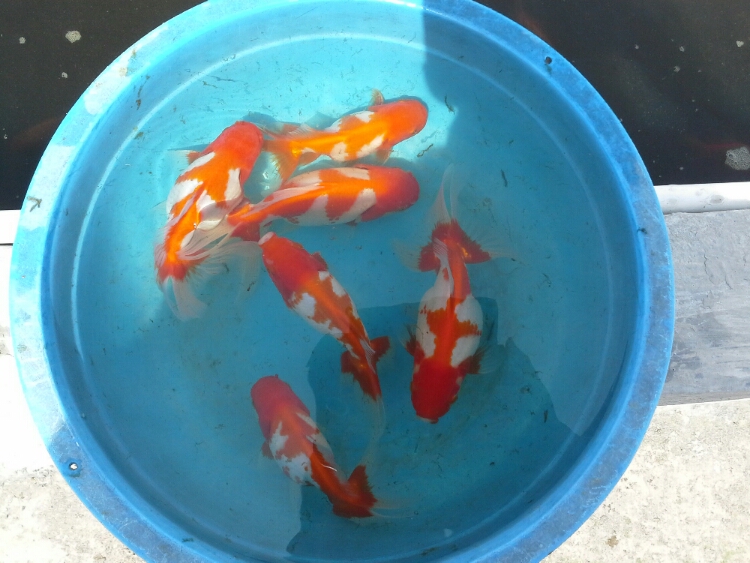
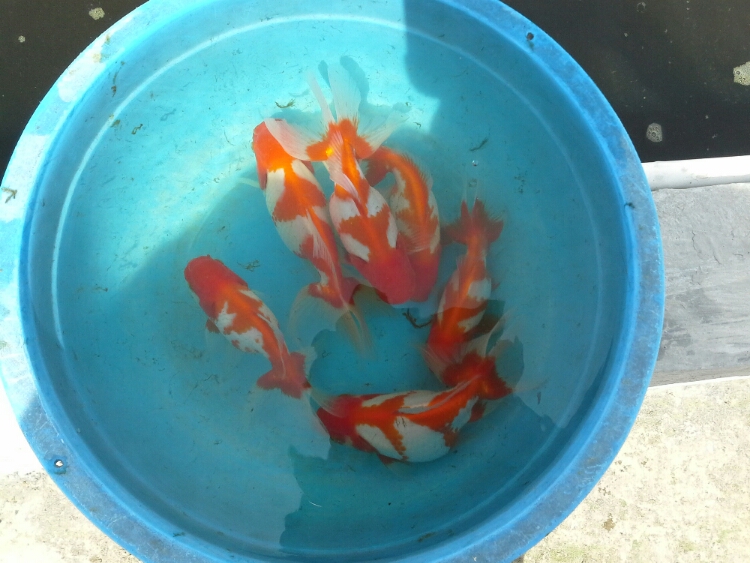
Below is the results of my experiment on pattern building. I am not in the position yet to tell readera what I have been doing. I am still learning. Perhaps later on as I understand more, I will tell. The fishes I used are the oranda that have wakin genetics. They are my F3 from my oranda – wakin cross, which have been crossed back to oranda. I find that most of them are easy to manipulate, but not as easy as wakin. Some from the same batch cannot be manipulated, no matter what I do. Seems that the fish that mutate earlier from its wild color state into red and white is easier to manipulate. The one that takes longer to mutate is harder.

Enjoy.

20150609_103254(1) 20150609_103246(1) 20150609_103244(1)

Standard
Wowkin

wowkin update Jan 17th, 2015

My wowkins have passed its one year life span now. Some show the desired tail shape. The size is satisfying. They can grow large enough. The red coloration is also good. The body shape deviates a bit from the plan, though. I was thinking of a body exactly like the wakin. But my best wowkin (in terms of the tail shape) has a body in between wakin and tosakin. This can be seen clearly in the picture

DSCN0773(1) DSCN0772(1)

My attempt to inbreed the wowkins results in body types just like the current wowkin and also shorter type, but the tails are long. I think I cannot get the desired wakin body from inbreeding. So, right now I am crossing  my current wowkin back to wakin. The pair is shown in the picture above. The wakin is the male.

What to expect from this cross? I think I will get the body right. The tail might have a drawback, though. But I am hoping a small percentage of the ideal wowkin to occur from this cross. If this happens, then the rest is just selective breeding.

Standard
Panda Ryukin

Update on Panda Ryukin Dec 25th, 2014

This article is the update on my panda ryukin breeding project. The fishes here are the F2.

blue ryukin 1

blue ryukin 2

The first fish has the best shape resembling ryukin.  The second one is a bit elongated and has smaller hump. The rest of the batch have almost no hump. So, in term of the body shape, there is a need to cross once again with a good and decent ryukin. But this cross will sacrifice the color. So, to finish this project, I need two more breeding step: to enhance the body shape, and then to enhance the color.

The fish might be ready to spawn in perhaps two months later. I am glad for the progress so far.

Merry Christmas, and Happy New Year.

Standard
Tricolor Metallic Scale

Tricolor Metallic Scale Ranchu Project

I have crossed two female orange metallic scale ranchu to my tricolor metallic scale goldfish (as depicted in my previous posting). The aim is to create tricolor metallic scale ranchu.

First, it must be noted that the metallic scale here is not a true metallic scale, but it is a derivation of transparent scale calico fish which has acquired metallic scale appearance.

Second, after second consideration, this choice of orange metallic scale ranchu to cross might not be the best choice. The reason is that the demelanization process (the process of getting rid of black color) in orange metallic scale ranchu is working strongly. This combination of parent might result in the offsprings loosing its ability to retain its black color. Blue ranchu or black ranchu might be a better choice. Anyway, the cross has been made, so I will stick with this to see how it will turn out.

Third, the two female orange metallic scale ranchu that I use came from two different lines. The first is a thailand metallic scale ranchu, and the second is my own breed, which though the appearance is an orange metallic scale ranchu, it carries a recessive blue (or panda) color in its gene. I don’t know how will a recessive blue help, but I hope this second fish will be my luck in repressing the demelanization process. It is interesting that the offsprings of these two fishes behave differently.

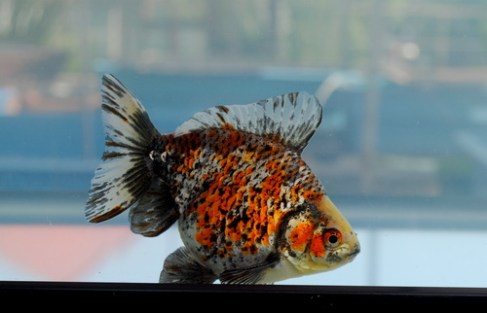
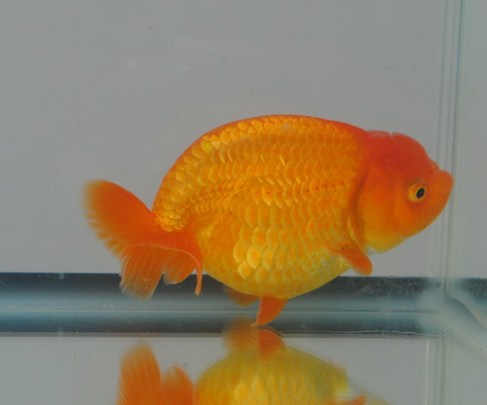
This is the male parent
Image

This is the first female parent, which does not have the recessive blue genetic. The second female looks similar, so I do not post a picture of it.
Image

From the first female parent, the majority of the offspings have complete dorsal! This is out of my expectation. My rough estimate is 90% have complete dorsal. I cull them out, leaving only few with irregular dorsal. Though the observation is too early, I think I saw more scales in the offsprings, but less black color. This lack of black color is not conclusive yet, since I keep them in light-colored background due to lack of facility. The offspings which resemble transparant scale  (such as calico color) with few metallic scales are very few. A sample of the first offspings is shown below

Image

The second female parent yields roughly 50 percent of complete dorsal offspings, which I culled out early. From the irregular dorsal ones, roughly half show the characteristic of transparent scale with few metallic scales on its body. The other half show more metallic scales – more than half of their body are covered with metallic scales. This is the trait I am looking for. Concerning color, they seem to retain more purple color. This is a sample of them:

Image

When I made this cross, I did not know what to expect and what to cull out. Now I have a better idea. I will keep those with have more metallic scales – the ones that have more than half of their body covered with metallic scales. This is the first priority. Then I will choose the ones with more black / purple color among them.

Any suggestion is welcome. I will update this project in some more months.

Standard