miscellaneous

The Diary of a Goldfish Breeder 2024 (1)

It has been a long time I did not update this blog. More than half a year, I think. I apologize for that. Business concerns, family matters, health issue, facility upgrades, employee’s absence, and vacations have prevented me from taking pictures and making updates. Now is a long Moslem holiday. I have a chance to catch up.

Last year, in the midst of my busy schedule, I managed to give an online talk to goldfish enthusiasts in Malaysia. They asked me to talk about my breeding projects. And a realization came to me that some of my projects are actually inspired by my childhood. I would like to start this first 2024 diary with this topic.

I mentioned before about an encyclopedia my Mom bought me more than 40 years ago. There is a page – yes, only a page – containing goldfish pictures. That page had become my daily childhood contemplation. My mind wandered wild, imagining whether someday I will have such beautiful fish.
In that talk to Malaysian friends, I realized that some of my projects correspond to this picture!

First, there is Seibungyo in the bottom of the picture.
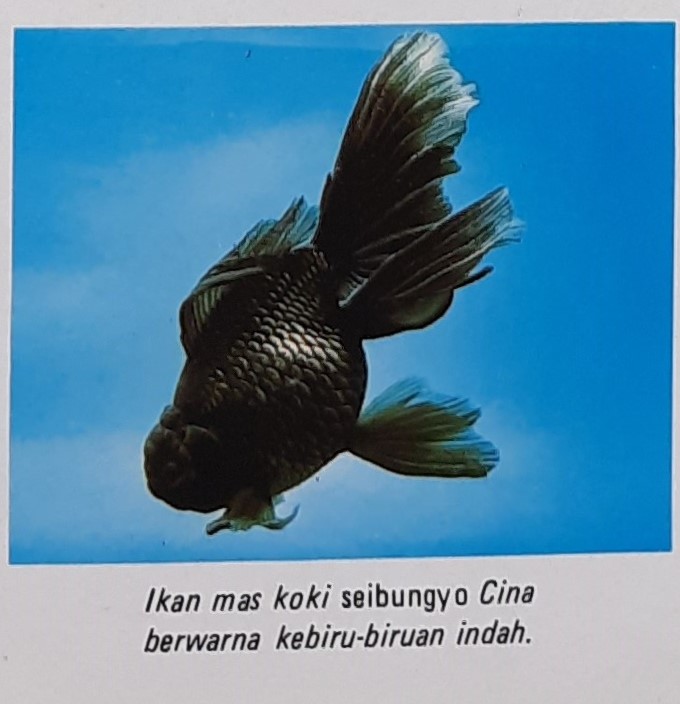
The description is: a Chinese Seibungyo goldfish with beautiful bluish color. I always wondered what Seibungyo means. It sounds like Japanese word, but the description says it is a Chinese goldfish. As a child I remembered asking goldfish sellers whenever I went to local fish shops about that name. As you guessed, nobody ever heard about it.

But now I think I know what variety of goldfish this is. Is it not just a blue oranda? Yes, it is! And it is one of my main projects! My blue oranda line has improved significantly. I think I have a better quality of blue oranda than the seibungyo in the picture. One of my childhood dream has come true!
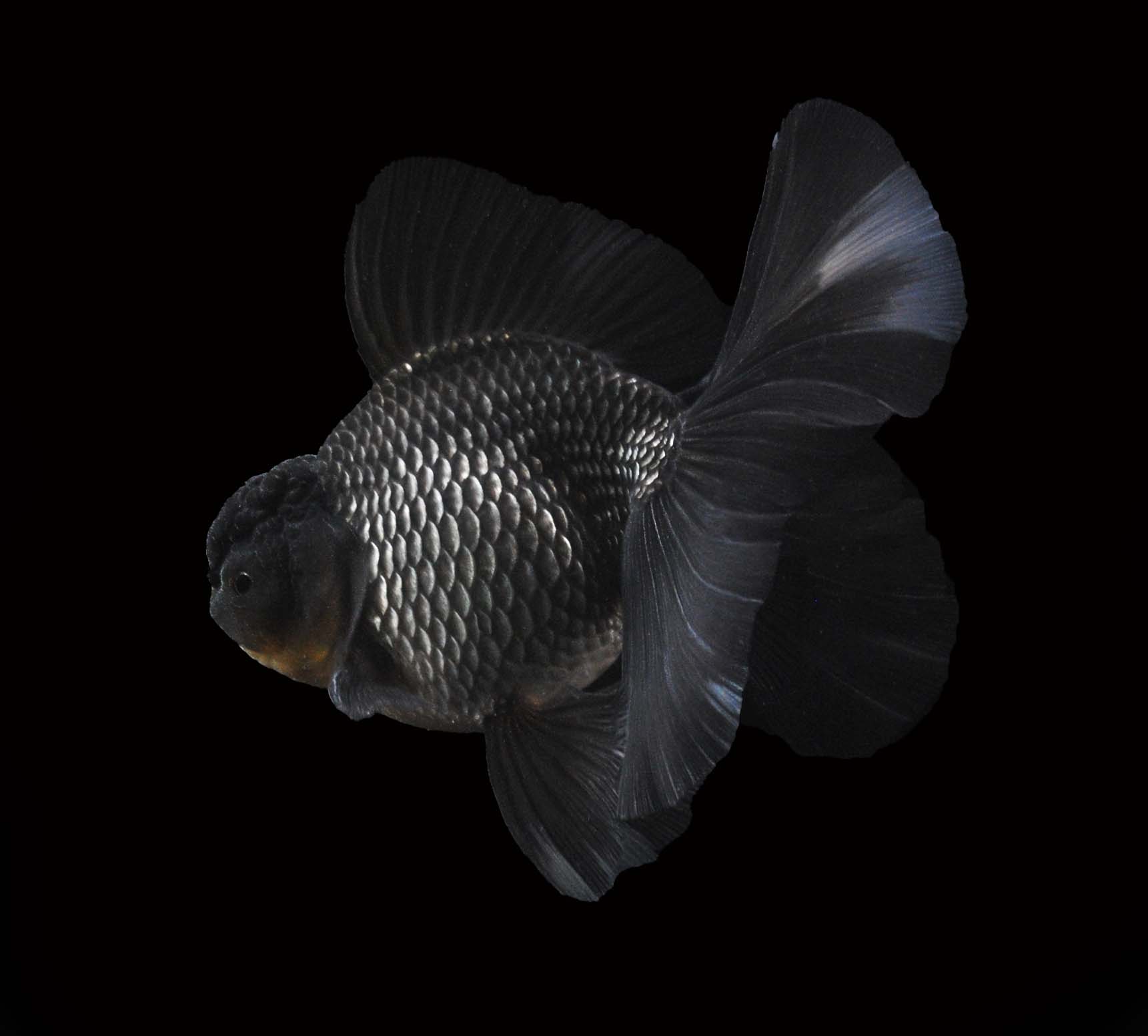
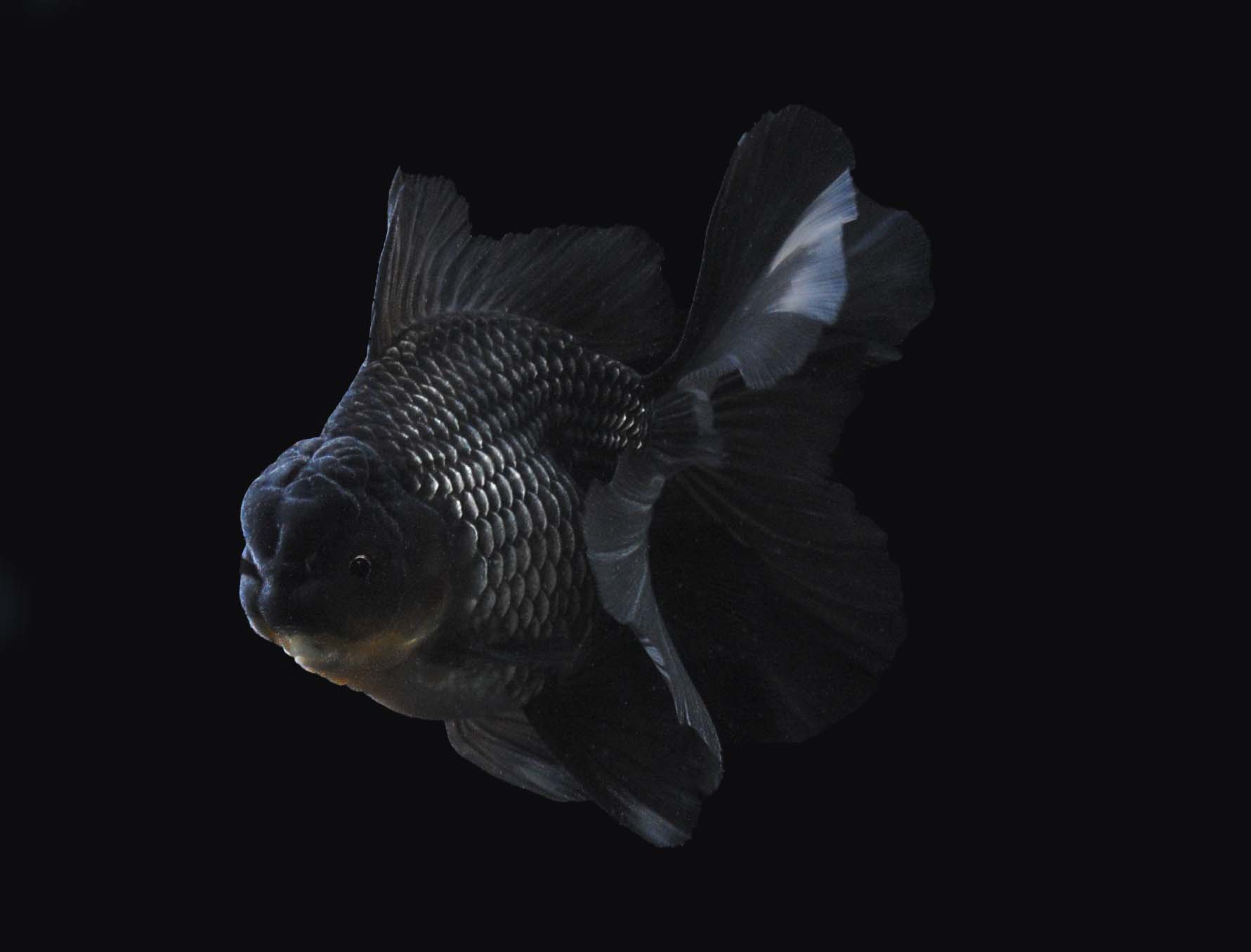
The Blue Oranda above is my most recent male. Some people nowadays prefer to call this color as Platinum.

Second, there is Chakin goldfish.
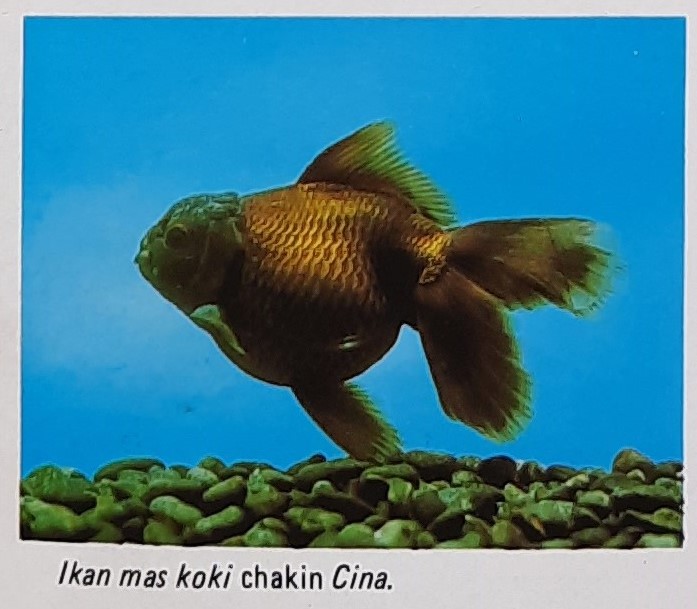
The description only says Chinese Chakin goldfish. It took me a long time in my childhood to understand that “cha” refers to “tea-color.” Yes, this is actually a tea-colored goldfish. Is this not the Brown Oranda line I have been developing so far? I have even gone further than that. I have also developed Purple / Lavender colored Oranda! With better quality, I think. Another childhood dream comes true!
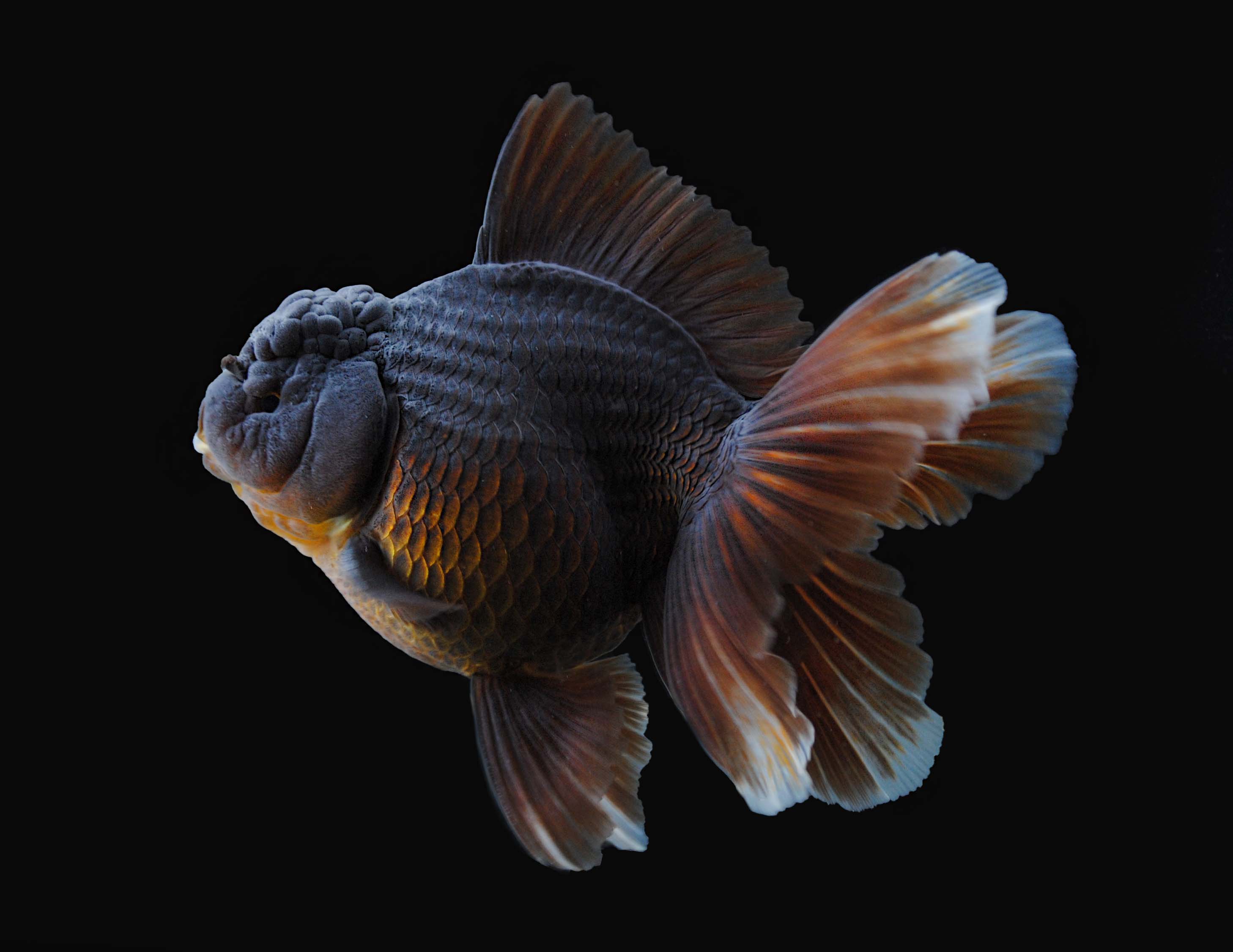
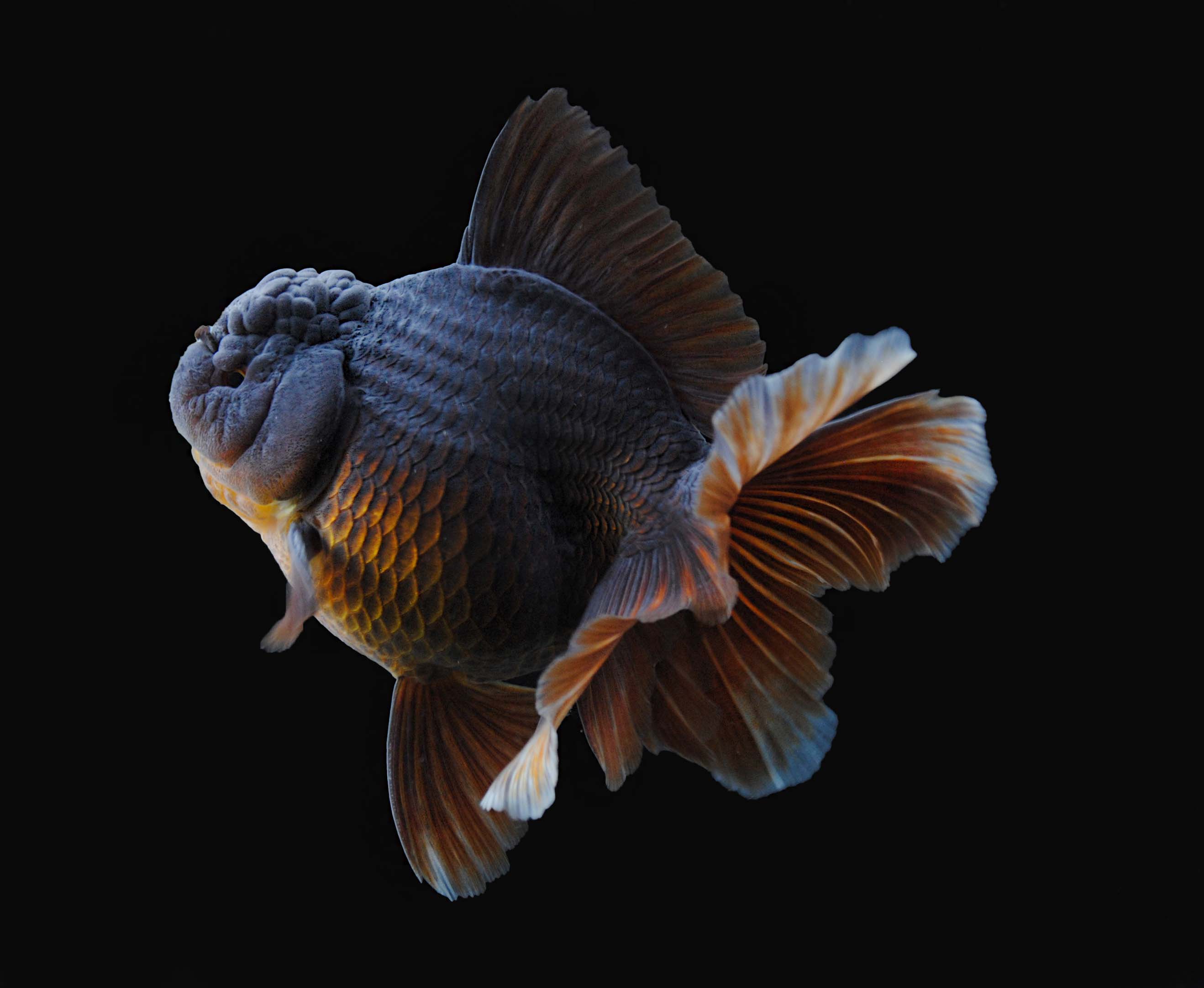
Yes, my brown oranda is a bit darker. I find out that the brown color has at least two main types: the light one (which is the tea-color) and the darker one (which is the dark chocolate color). The darker one seems to have the ability to elicit white color – a quality I do not see in the lighter / tea-colored one. The tea-color seems to elicit orange color only when the dark pigment (melanin) fades away.

The picture above is the comparison between the dark and light color of Brown Oranda.

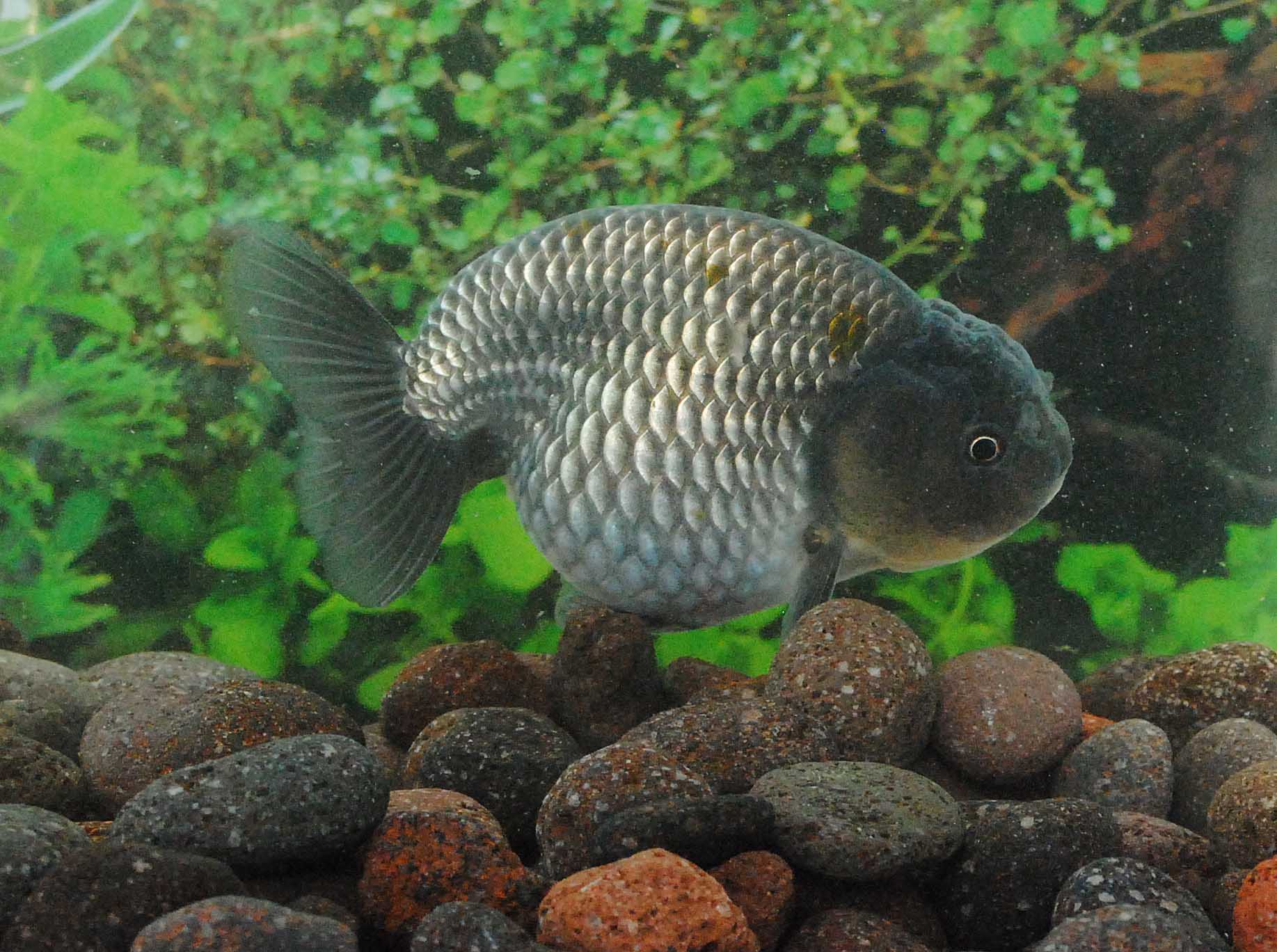
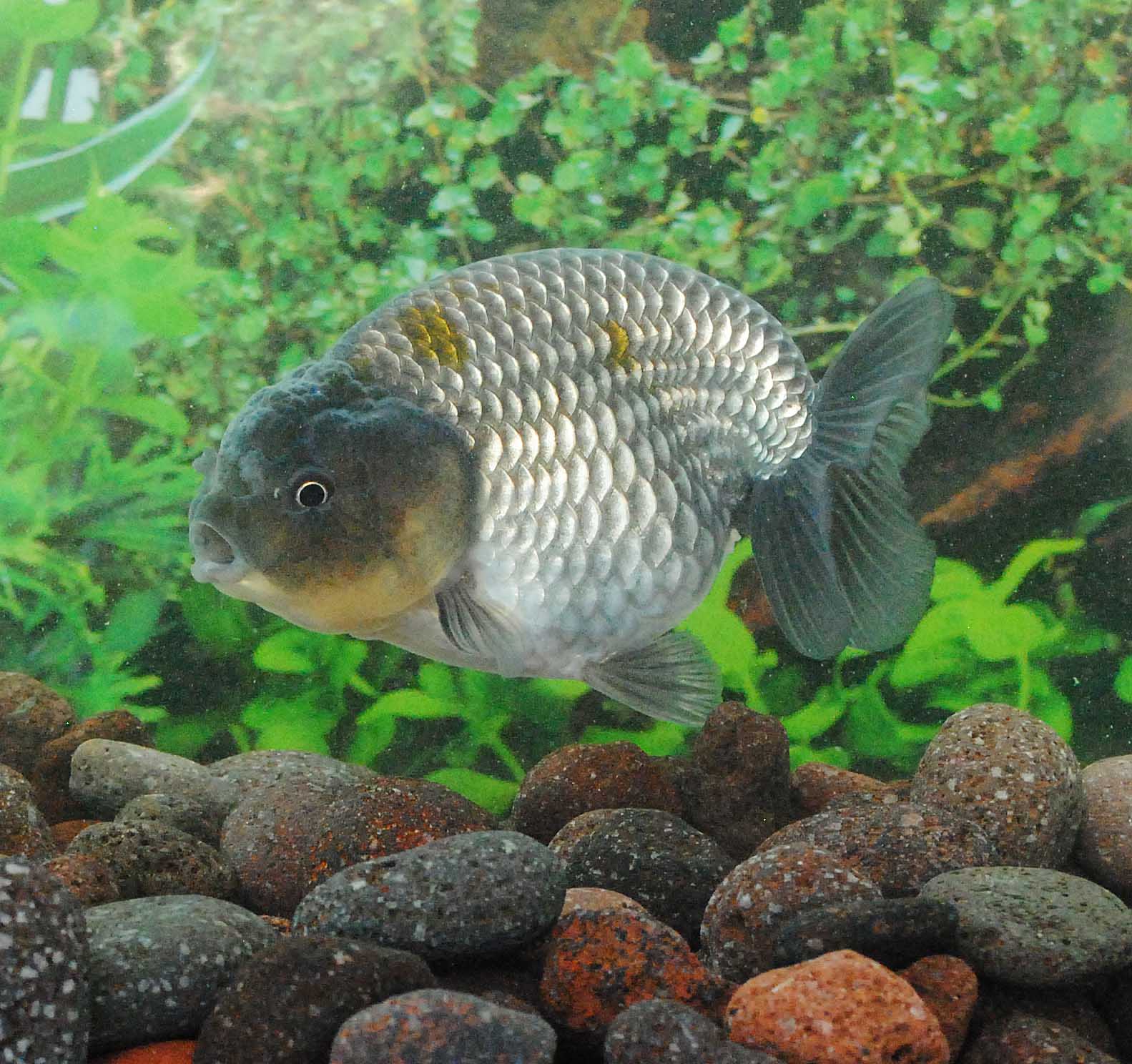
Third is the Chinese Goldfish with silver color and no dorsal fin.

Silver is just another name for blue or platinum. The fish resembles ranchu with long tail. I do not have such variety, but my blue ranchu is a good substitute for this fish, I think.
Fouth is Hanabusa!
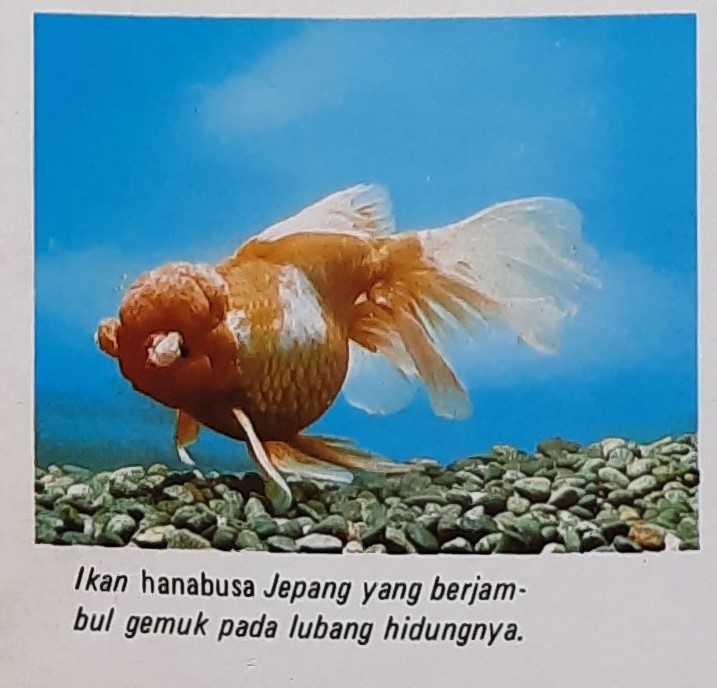
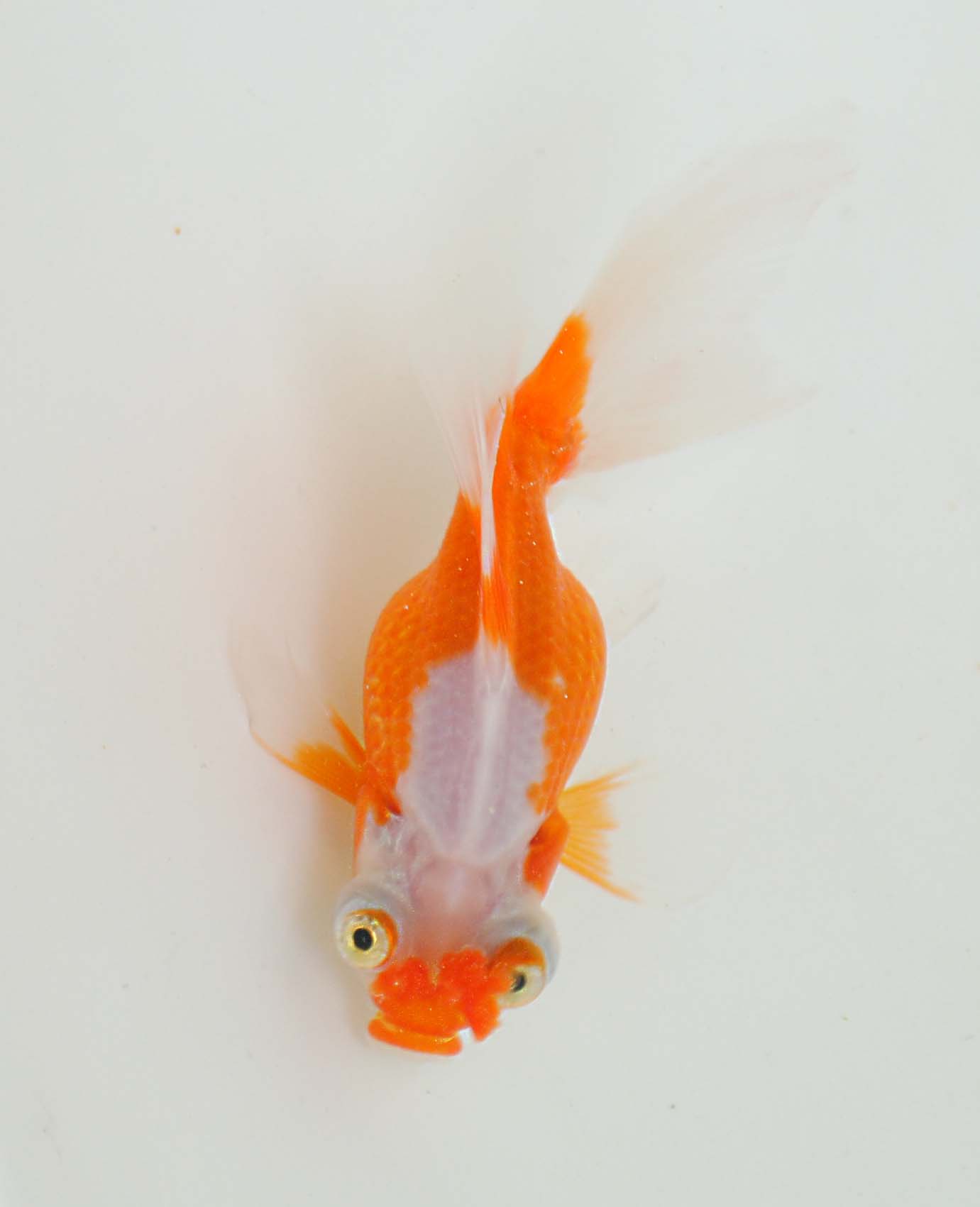
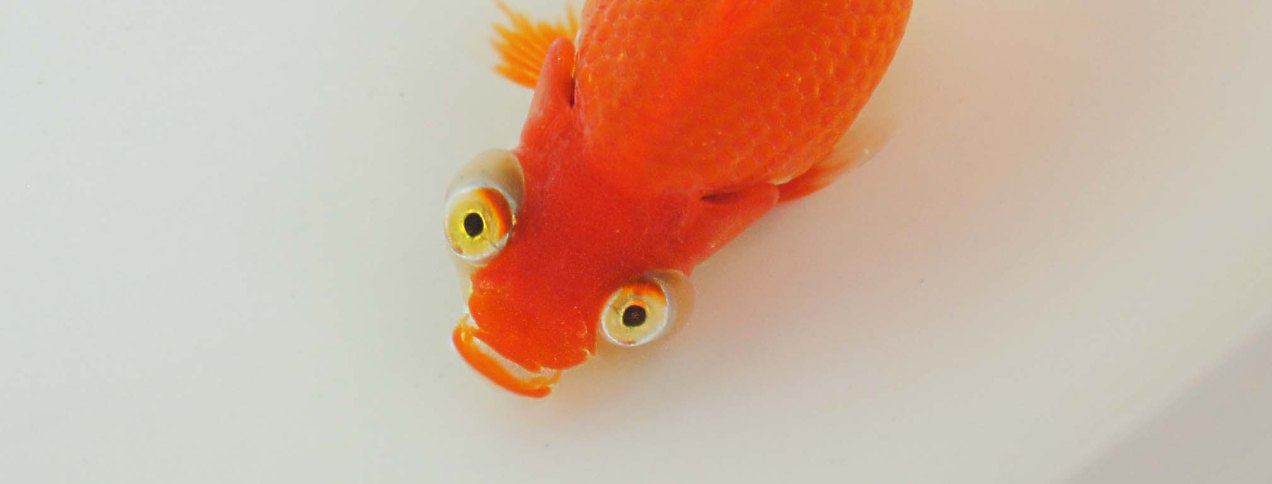
What in the world is Hanabusa! Thanks God the description gives us a clue. It says Japanese Hanabusa with large headgrowth in its nostrils. Headgrowth might not be the right terms. But now I know it is an oranda with pompom. I do not breed pompom oranda. But I mentioned before that I use the Chinese chocolate pompom to create my brown oranda line. Although I do not specifically breed pompom, once in a while the pompom feature just show up again and again in my facility. The latest I have is this piece of short tail oranda with pompom (or to be more precise, it is a ranchu with dorsal and pompom!) This piece shows up in my breeding unintentionally.

Isn’t she adorable? I cannot help bring her up to maturity due to its cuteness. And I am thinking of creating ryukin with pompom in the future by mating this piece with ryukin.

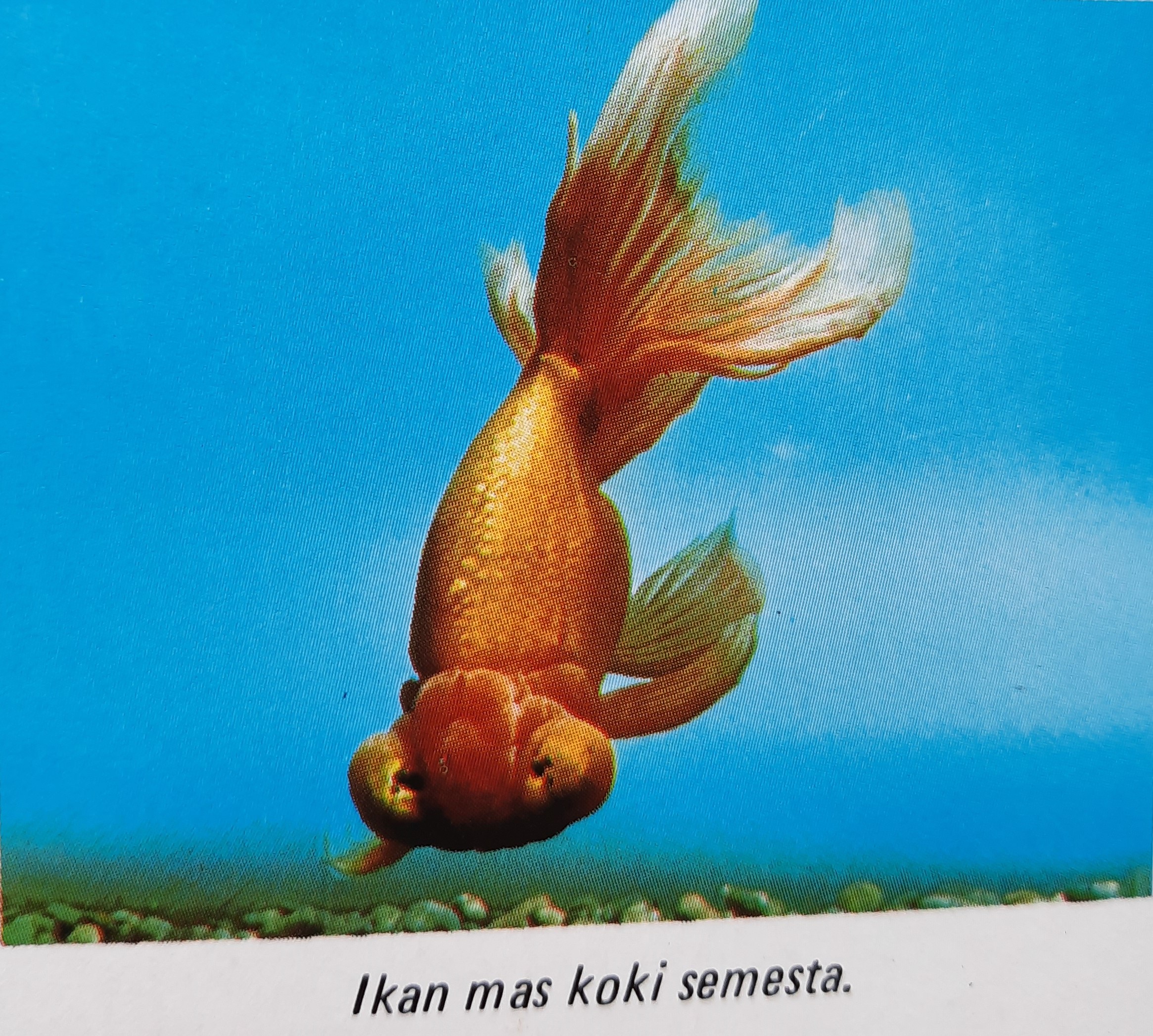
The last one is this rare specimen.
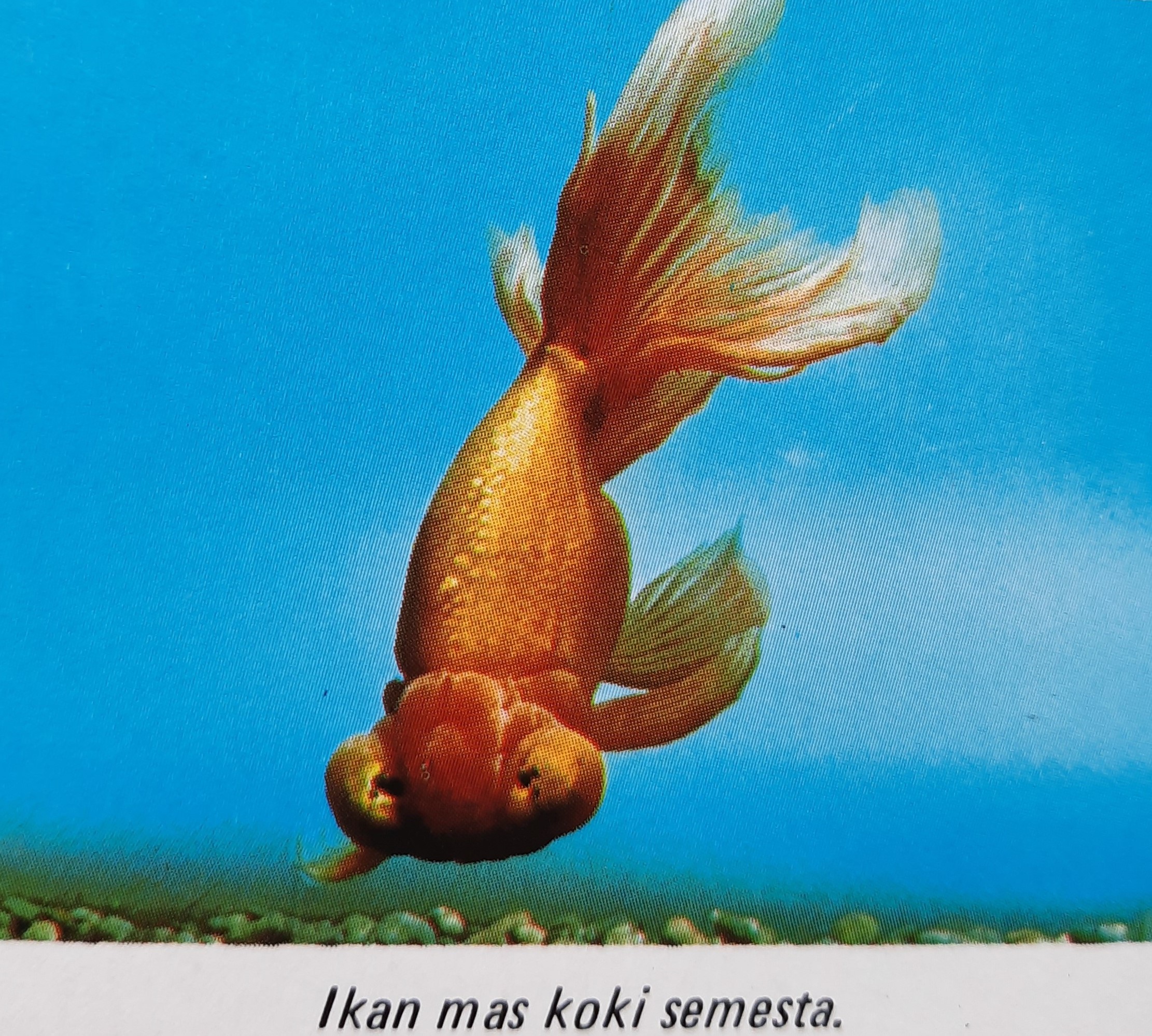
The description just says celestial goldfish. And I have a hard time figuring out what is in between the eyes. I think it is a headgrowth – the goosehead type of headgrowth. I think there is no such variety anymore nowadays. Perhaps the combination of headgrowth and celestial eyes features decreases the fish ability to acquire food and this might contribute to its continual creation.

I think I have a better ideal. One of my ongoing project is to create Celestial Eye with Butterfly Tail. It will be a fish with dorsal. The project has show positive improvement.
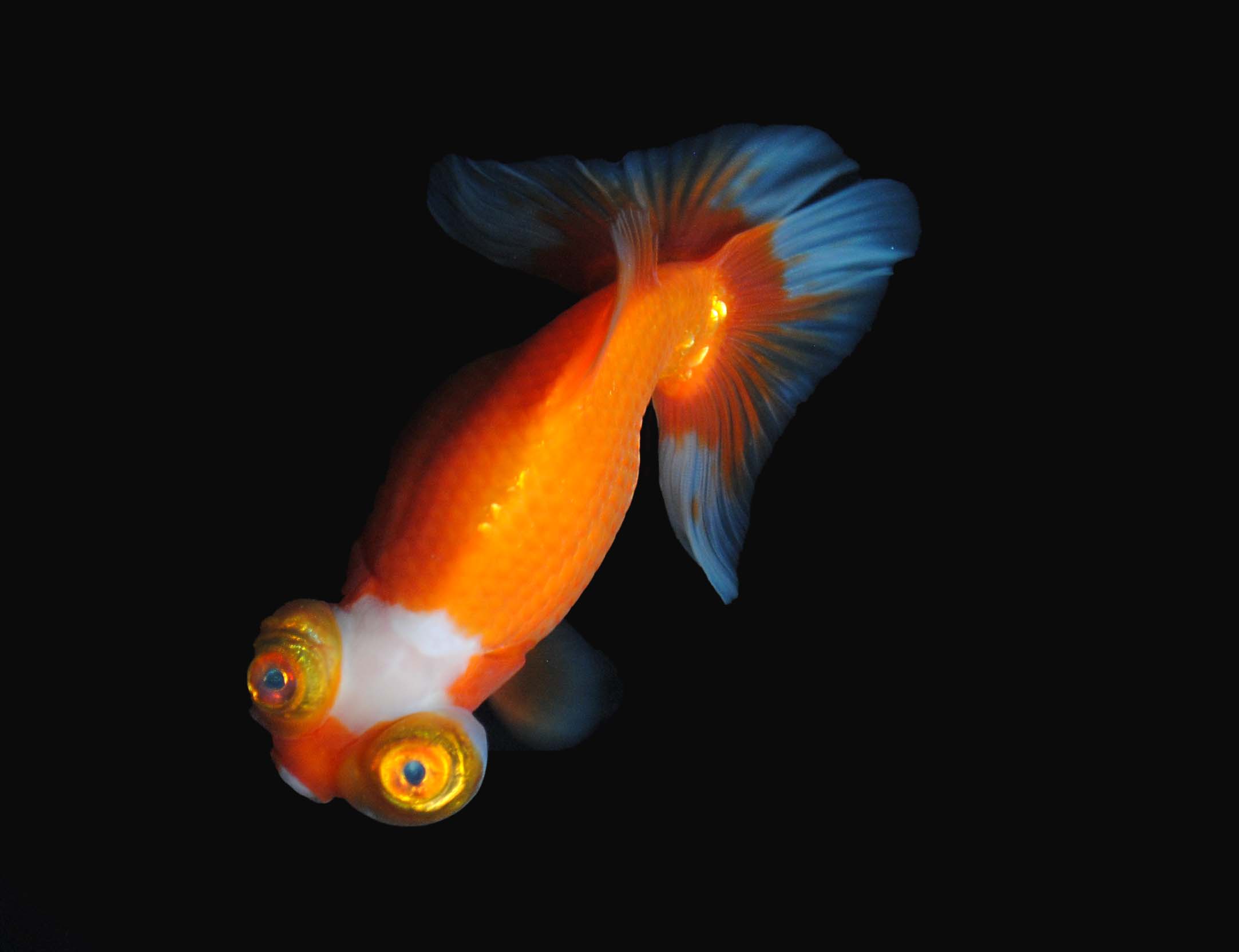
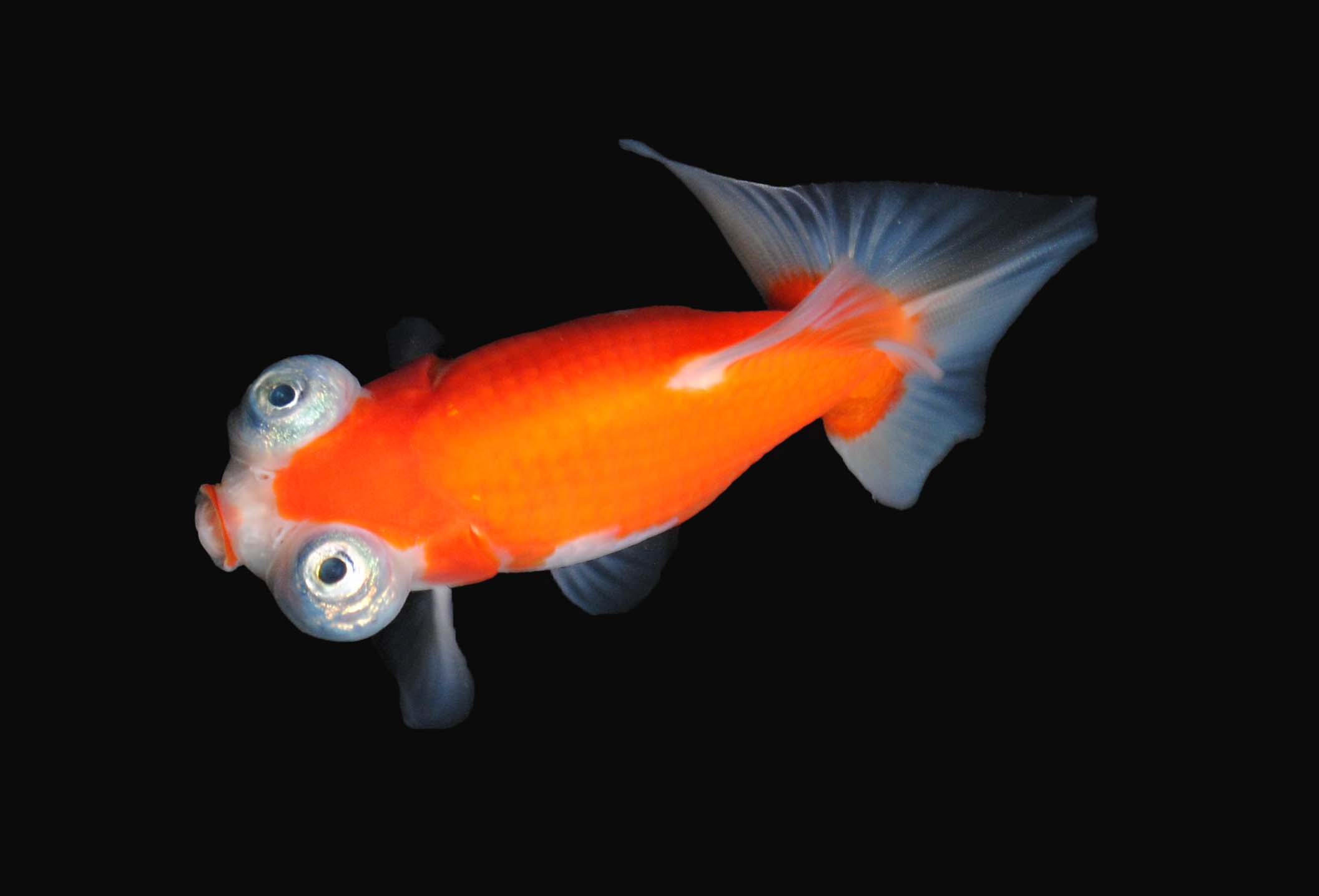
I think one more crossing with Butterfly will finalize this project. Wish me success.

Enjoy!
Standard
butterfly, celestial, The Diary of a Goldfish Breeder 2023

The Diary of a Goldfish Breeder 2023 (9)

Project #19: Celestial Butterfly

There is an interesting update on this project. I might succeed in a year or less.

I think it is time to tell the more complete story of this project. My original source were Celestial Pompom I bought in 2017. They are a variant of Celestial variety that has pompoms in their nostrils. Their other features are thick bodies and short tail. These were my collections:

I know this variant is adorable in its own way. But I do not plan to keep this line. My plan is to create Celestial Butterfly, that is a goldfish with celestial eyes, dorsal fin, and butterfly tail. I saw a specimen of it somewhere in the internet years before and was captivated by it. I do not know any who sells this variant in the whole world. I have never even seen anyone post a picture of this variant anymore nowadays. So, it is quite an interesting challenge to create one.

Before I go on, one important observation about the genetics of the eye is worthy to note. I crossed a celestial eye with ranchu before. The first attempt resulted in 100% normal eyes. I kept them till adulthood and there were no sign that the eyes will change. I did the same crossing a second time, and the result was totally different! There were normal eyes, telescope eyes, and imperfect celestial eyes! What I mean by imperfect celestial eyes are celestial eyes which are not looking upward 100% (there is an angle a bit to the front) or one eye being celestial but another being telescope. I was glad to see these results. But I was puzzled – and still am – about what was going on. I do not have an explanation of the two totally different results from a similar crossing.

The second important observation is about the development stages of the celestial eye. The offspring start from normal eyes (stage 0). Then the eyes will change into telescope eyes first – and this is what I want to highlight (stage 1). Then the telescope eyes will turn – not directly upwards, but – somewhat between frontward and upwards (so, not totally frontward, either) (stage 2). Then the eyes will continue its movement upwards to complete the process of being celestial eyes (stage 3).

This piece of information, especially stage 1, gave me confidence that crossing Celestial Eyes directly with Butterfly (Telescope Eyes) might result directly in few Celestial Eyes. The rest will be telescope eyes and no normal eyes. And my crossing (Celestial Eyes x Butterfly) proved this to be the case. We can say that being a telescope eye in this case is halfway towards being a celestial eye. When the process of stage 1 is halted, then the eye stays as telescope eye.

My confidence let me to cull the fry in stage 0 (normal eyes) based on the tail shape. I did not expect to get decent butterfly tail directly in F1, but I was expecting to get wide spread tail. So, I culled out all the collapsed tail. And this was a grave mistake. Most of the fry I kept turned to be only Telescope Eyes and only one or two fishes being imperfect Celestial. I think a safer strategy is to wait until the fry reach stage 3 and then cull out based on the tail spread. But it happened already.

So, the best thing to do with the mistake was to do inbreeding. I crossed the imperfect Celestial Eyes with his Telescope Eyes sibling. This time, I kept all the tails in stage 0 provided they had no defect. I raised them all, occupying lots of facility space. And now, I have with me all sorts of stages from 1 to 3. And there is one with almost perfect Celestial Eyes feature! And it comes with wide-spread tail, though still cannot be categorized as butterfly tail. Let me show my beautiful baby:

The two picture above is a pic of the same fish. Adorable, right? There is a slight imperfection on the left eye (the angle). I am still hoping that the angle is still in the unfinished process. And I do notice that the size of the eyes are not as big as the original Celestial Pompom Eyes I bought. I do not know whether in the coming descendants the size of the eyes can improve or not, I do hope so. But for now, I am satisfied with this boy (I suspect this one is a male).

The second best result from this batch is this one:

The eyes do not align perfectly upwards. There is a slight angle towards the front. So this one is at the end of its stage 2. I do not know whether it will stuck at this stage or will achieve the final stage. But surely it will be a candidate to be the next parents.

The fishes in this batch show thick peduncles. But lots of them have a bit tilted upwards middle tail. And the combination of such feature with wide spread tail spells disaster. The fish will swim in a rotating movement! I culled out lots of them with that tail trait.

Meanwhile – and this is another story that will merge into my story – my friend mr DBS (Dibyo Sasmita) acquired a different variant of Celestial Eyes. He bought the common Celestial Eyes goldfish which has no pompom, having slim peduncle and long tail. Here were his collections (I get permission from him to use the picture here):

A bit different from me who wants to create Celestial Butterfly, mr. DBS would like to create Celestial Tosakin. So, our final goal will be different but might appear closely related. But there was a problem. The fish did not lay eggs in his place. So, I tried to induce his fish in my facility and successfully mate one of his female with my Celestial Pompom (still without dorsal). Well, success might be an over statement since we only got two fry! This is one of them:

Do notice that the peduncle is thicker than the original Celestial Eyes. The tail still a long one but wider. And it has a small pompom! The Celestial Butterfly I created has lost its pompom feature.

From this specimen, mr. DBS crossed it with his tosakin, and once again managed to get two offspring only. I do not have their pictures, but they have dorsal fins already. Then he lends me the female to cross with my project.

So, to complicate the matters, I had several branches on this project:

  1. My Celestial Pompom x Butterfly (which I have told above)
  2. My semi Celestial Butterfly x mr Dibyo’s semi Celestial Tosakin
  3. My semi Celestial Butterfly x Butterfly (crossback to Butterfly again)

From branch number two, there is one interesting result:

The pompom appears again on this specimen!

The tail is collapsed. The peduncle is thin. Well, I have not observed others in this batch. I do not know whether the others have the same features or not. At a glance, they look widely varied. Some do not have split in the tail, for sure.

I still do not know whether to keep this pompom feature or not. I will decide later. My concern is to have too many variants from a project. My facility cannot afford that.

To wrap up this update, these are the links of the current fishes for you to enjoy:

Standard
miscellaneous

Four-Eyed Goldfish

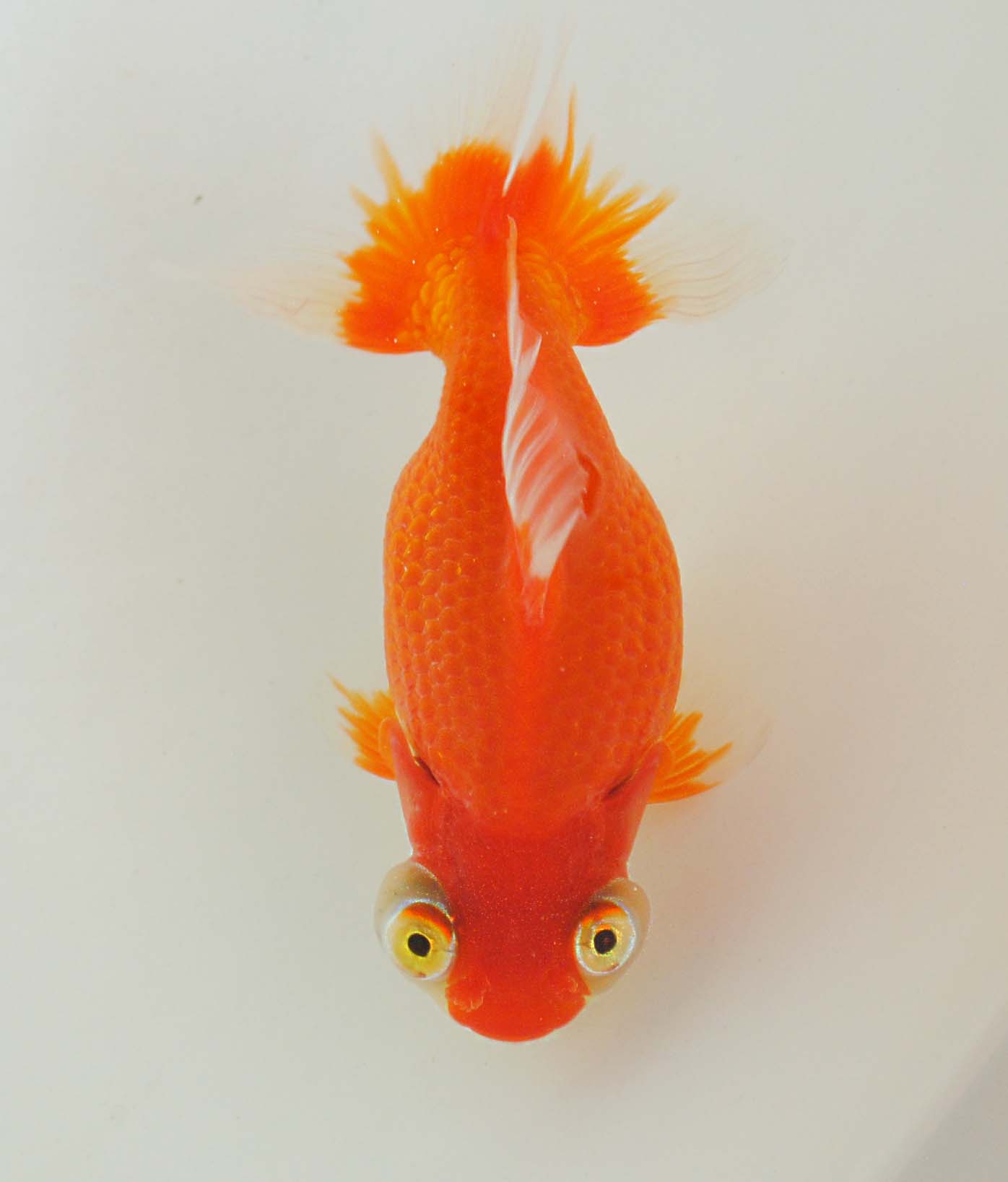
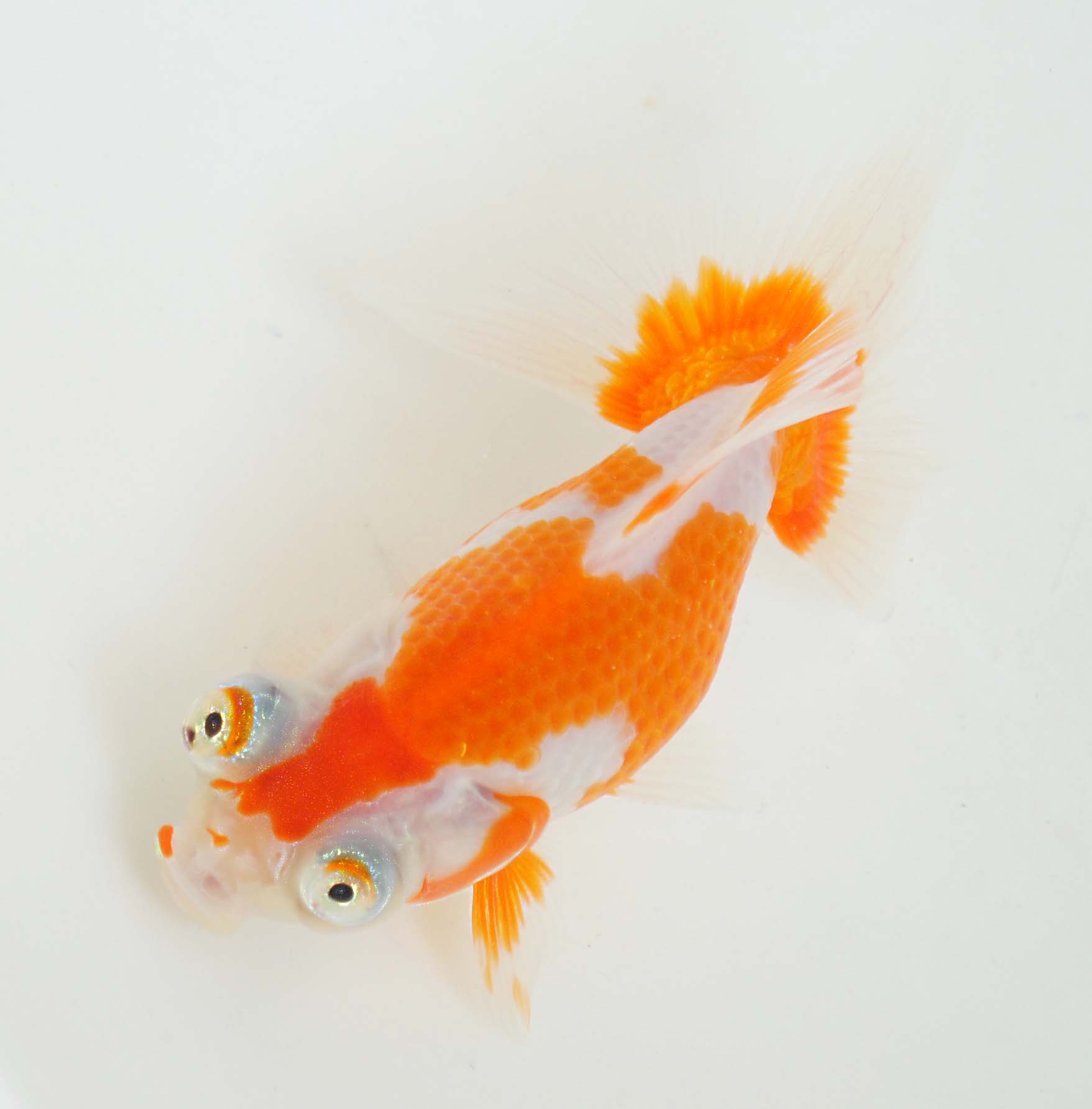
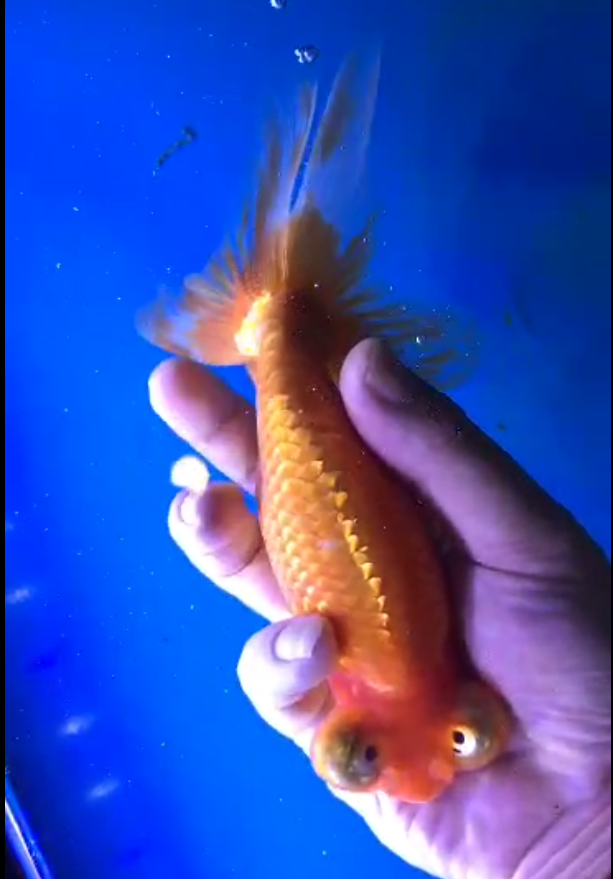
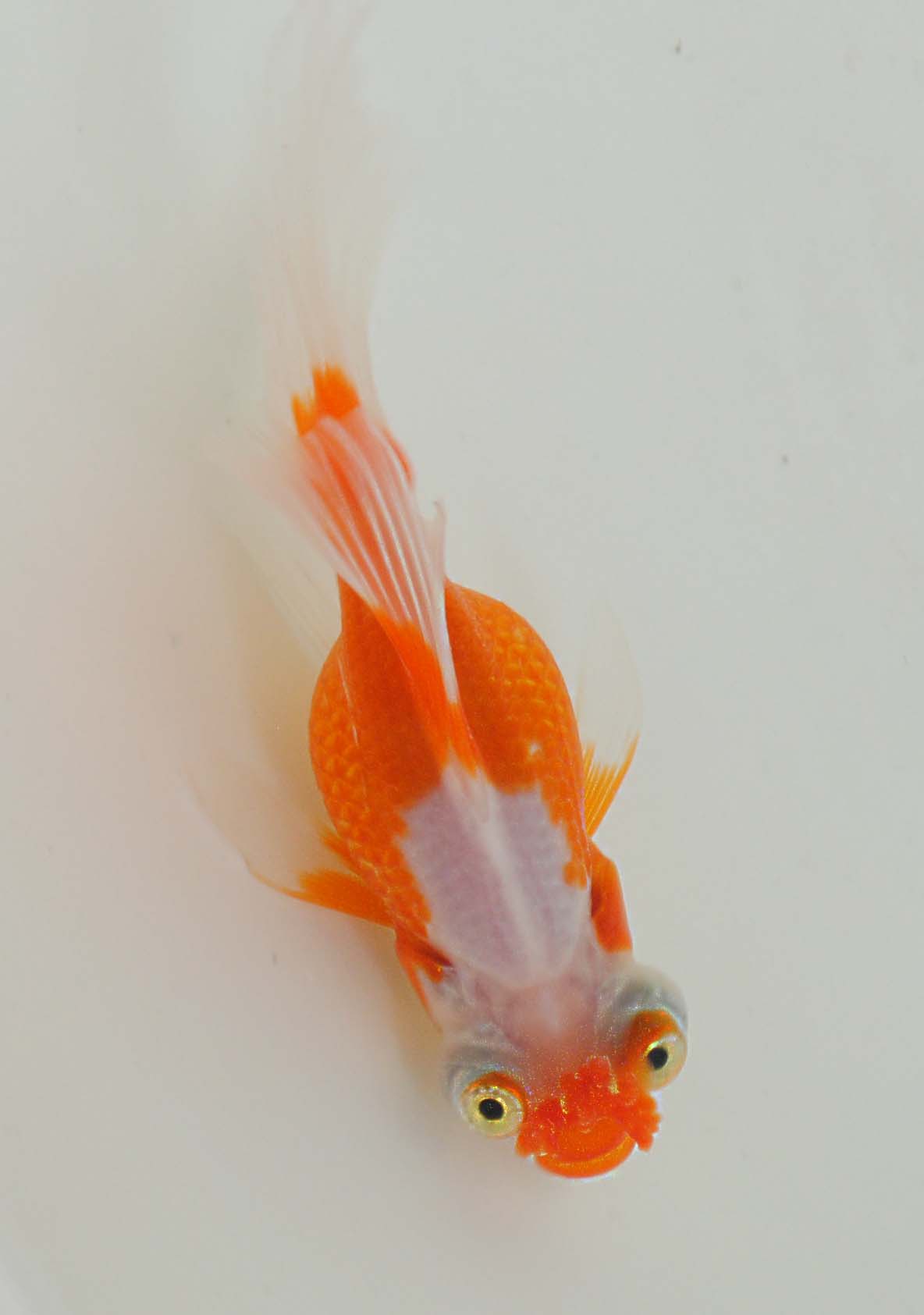
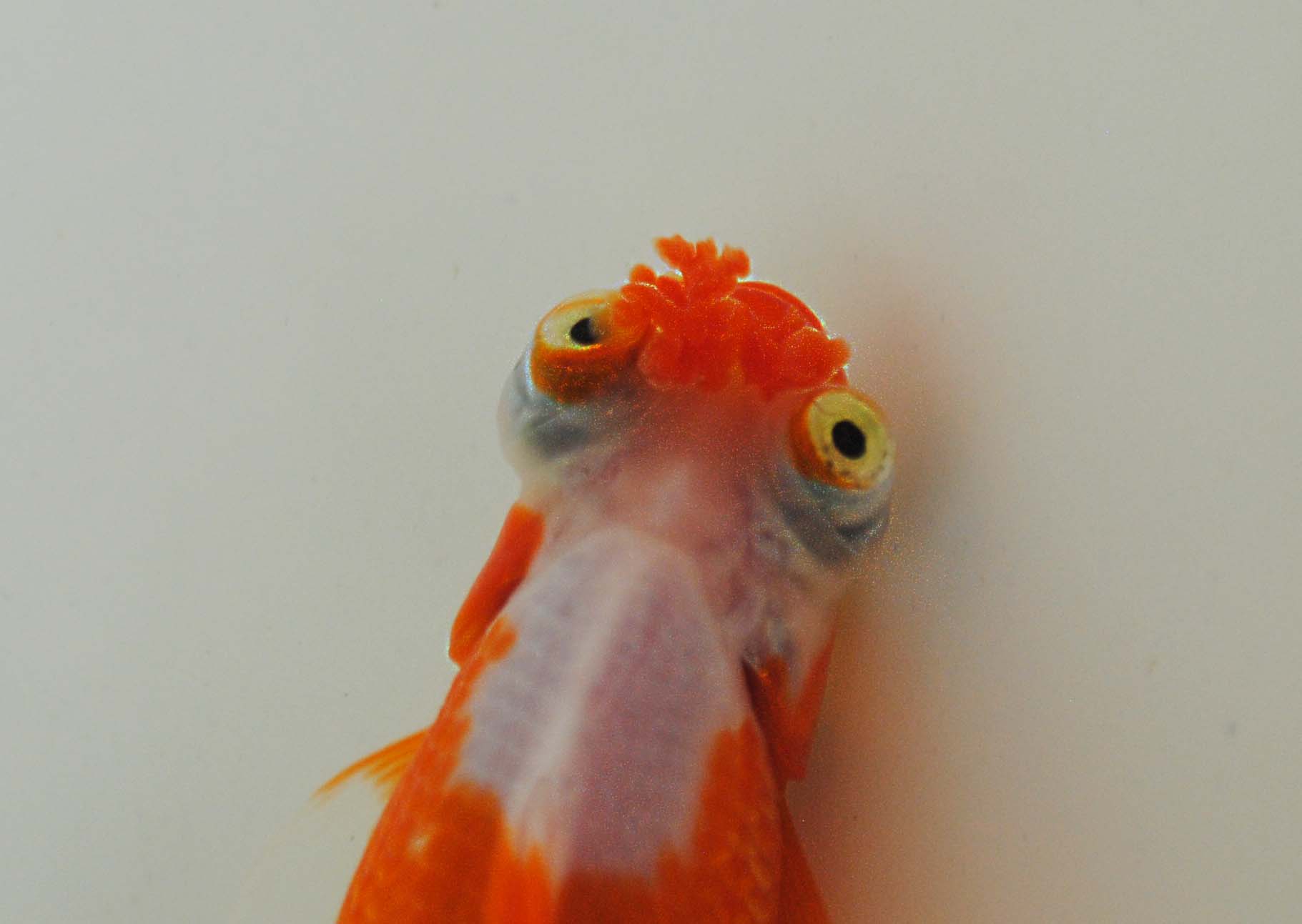
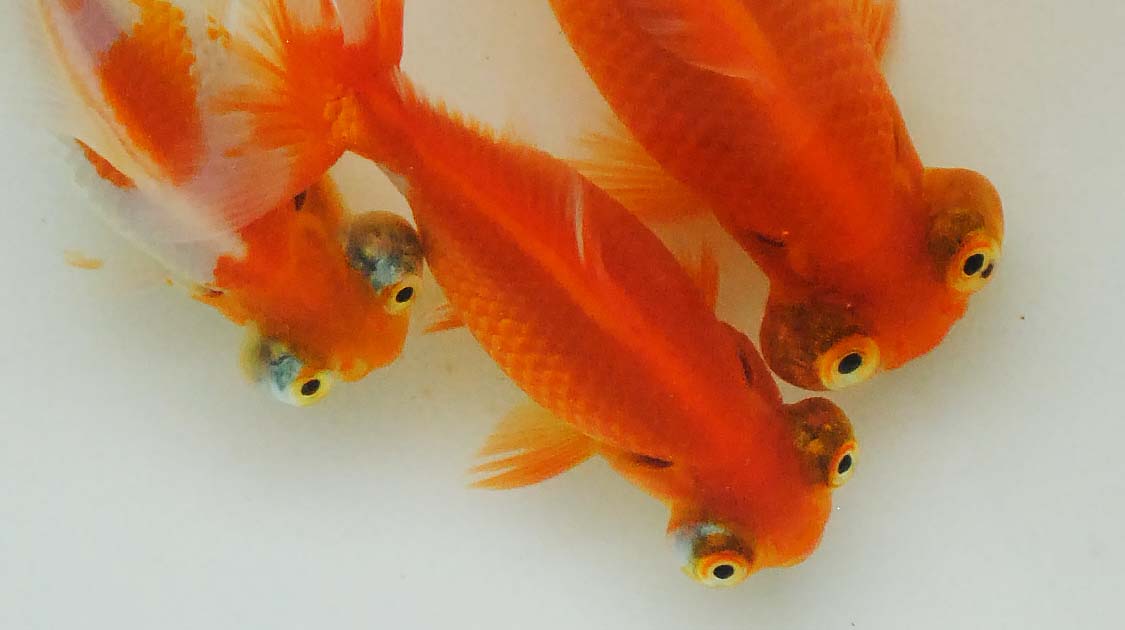
This fish is a cross between celestial goldfish and butterfly (dragon eyes / telescope eyes). There is nothing unusual from the side view of the fish. It resembles the common telescope eyes. But, there is something strange when seen from above.

Beneath the thin tissues covering the eye-tubes, when observed carefully, we will see other eyes glaring upwards! At a first glance, we might miss them. I was not aware of this phenomenon until I send the fish to my friend’s house. He helped me sell the fish. I just realized this uniqueness when I saw my friend’s video of the fish.

So, the fish has four eyes. Two of them protrudes to the side while the other two look upward. The eyes are the combination of telescope eyes and celestial eyes. The celestial eyes of the fish are not so sharp since they are covered by thin tissues.

Actually, I encountered this phenomenon several times before, but none of the upward eyes are so well-developed as in this specimen. While some might think this case unique, some might think it bizarre. I myself do not think I will continue to develop such feature. Nevertheless, this phenomenon makes me marvel at the mutation capacity of goldfish.

Standard
miscellaneous

Goldfish Now Unseen

Browsing through old books on Goldfish, I saw specimens I cannot find nowadays. In this writing, I want to mention three that capture my attention.

First, a celestial eye with headgrowth. This is rare. I have met two kinds of celestial goldfish: the popular celestial eye without dorsal (usually with slim body and long tail) and the celestial eye with pompoms (usually comes with short tail and thick body). From my experiment, I have created celestial eye with dorsal fin (Nicknamed Celestial Dragon according to Mr Lei in his youtube channel Goldfish Corner).

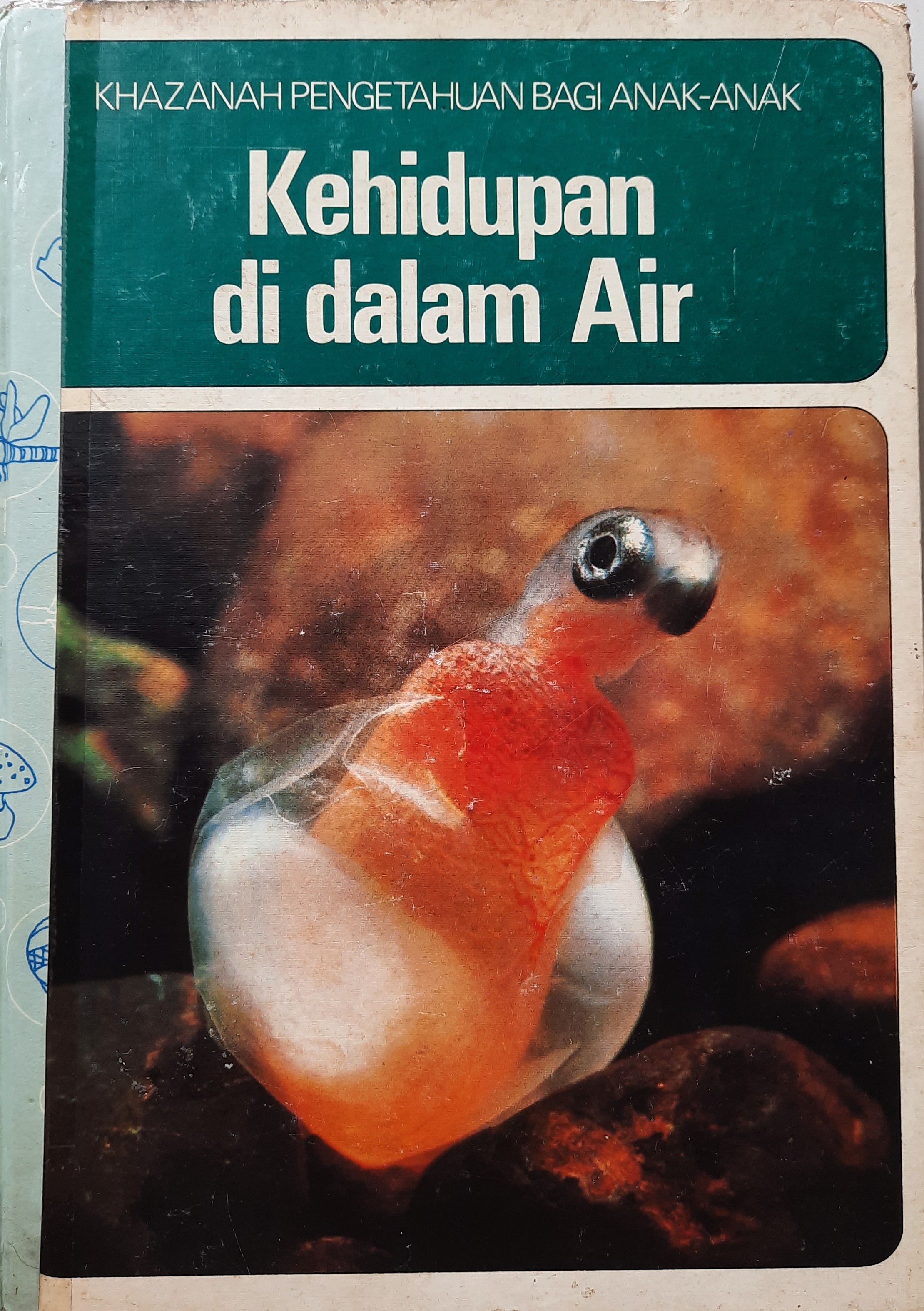
But there is another type of celestial I have never seen alive nor mentioned by anyone else. I find the fish in my old encyclopedia. In fact, it is the first book I read in my childhood that mentions goldfish.

The Indonesia edition has 1979 copyright. Very old! And it has only 1 page about goldfish, which I observed to my heart lots of time.

Beautiful goldfish for a child like me! I adopted the terms Hanabus, Seibungyo, Chakin, and more without knowing what they meant. At the heart of this picture is a weird kind of celestial:

This celestial has a headgrowth!

Well, nothing else I can say about it. No other information. It remains an out-of-this-world goldfish for me. Yes, there is a temptation to recreate it. But as I think again, I do not know if I want to do that. The fact that this specimen existed once but no more might be a hint that something might be wrong with it. Perhaps there was not enough market. Perhaps the fish lost a certain function which make it unable to survive. I do not know. I think a headgrowth like that (seems to be like a goosehead type) might intervere with the eyes, in terms of both the functionality and the appreciation – a conflict between two features). Yet, it remains a mysterious fish for me.

Second, a rare ranchu color from Joseph Smartt and James H. Bundell’s “Goldfish Breeding and Genetics” (1996):

On top of page 67 I see a beautiful but rare color:

There is no description about the color. I try to observe this picture many times to figure out if this belongs to metallic or transparent scalation category, but I just cannot be sure about it. And I have no idea of how to create such color! It occurs to me if this was a real fish or just a redwhite fish painted with black marker. But knowing the reputation of the author, I believe it was a real fish. This specimen reminds a mystery to me. Do tell me if you can throw some light on how to create this coloration.

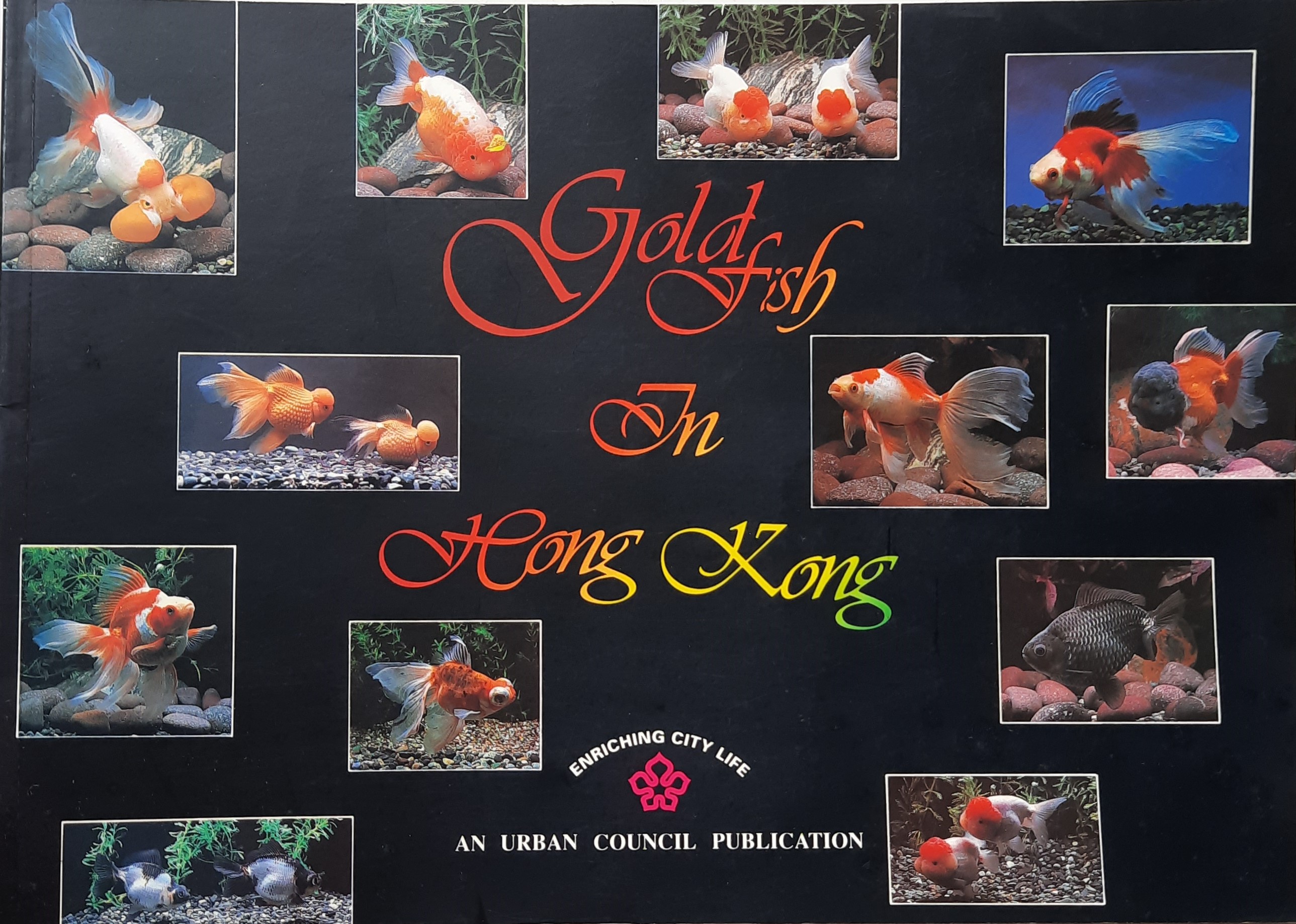
Third, a rare oranda color from “Goldfish in Hongkong” by An Urban Council Publication (1993):

On page 43 there are pictures like these:

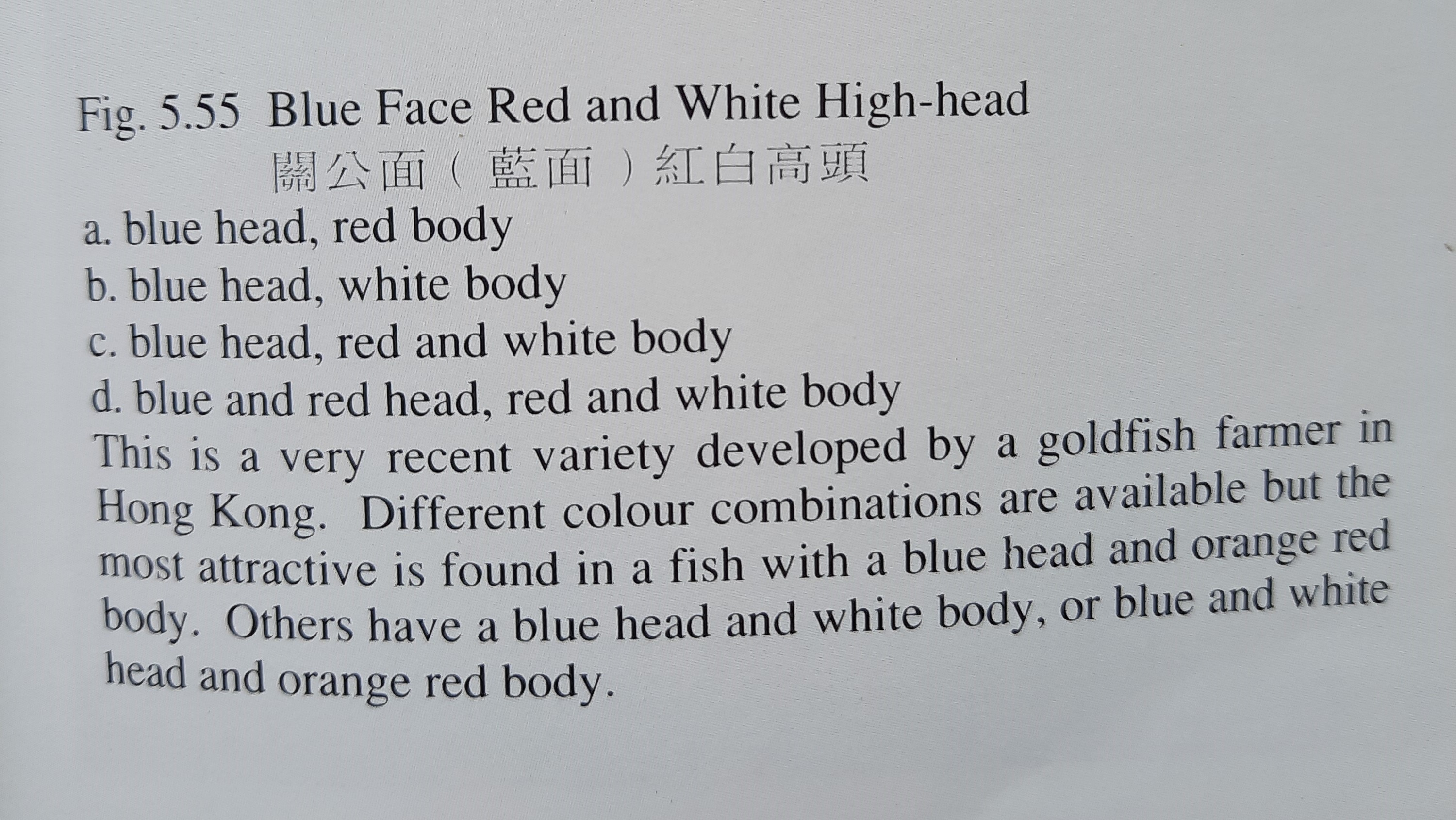
And this is the description:

Strange color, right?

For sure I have never seen such a color on the internet nowadays. I also do not know how to create such a fish. The description gives a hint that it has something to do with blue fish (blue metallic scale, I think). But how come the blue color only appear in the face of the fish in a uniform way?

Those three specimens are in the top category of the most mysterious goldfish for me. It will be a delight if one day someone will revive them.

Enjoy.

Standard
butterfly, celestial, The Diary of a Goldfish Breeder 2021

The Diary of a Goldfish Breeder 2021 (19)

One of my side project is to create a celestial eye butterfly goldfish. The inspiration comes from an old internet picture displaying a twelve-red goldfish with short body-type, beautiful butterfly tail, and celestial eyes!

I have been breeding Butterfly Goldfish and Celestial Eyes for some years. Both were rare in my country at that time. When a certain seller imported the fishes, I quickly acquired them in order to preserve the gene in Indonesia. There are two types of popular Celestial Eyes nowadays. The first one is the old style that has slim long body and long tail. The second one has thicker long body, short tail, with pompom in its nostril. Mine is the second type.

At that time, I was thinking that keeping these two goldfish varieties was a tedious job for me. I had lots of other projects as my priority. But, I did not want to lose these unique gene. So, I thought that combining these two varieties was a good idea. I started this project in the beginning of this year, in the midst of my Oranda Projects.

I was very certain that I would get some Celestial Eyes right in the F1. This confidence came from the fact that Celestial and Telescope Eyes are related (Butterfly has telescope eyes). If we watch the development of Celestial Eyes, the eyes start from protruding to the right and left, which is the same development as in Telescope Eyes. But if telescope eyes development stops right there, the development of celestial eyes continue. After protruding to the sides, the eyes will rotate to the front, and then rotate again upwards. So, their first eye-development stage is the same, which makes me think they are related. And this proves to be true in the result.

The body types of the two variants differ. Butterfly has short rounded body form, while Celestial has an elongated body shape. My goal is the butterfly body form. But it seems that the elongated gene is dominant. All the offspring has elongated body shape. I hope there will be some shorter and rounder body in the F2.

The tail shapes of the two are different. Butterfly has beautiful large and long tail, while my celestial has short tail. The result varies between short and medium tail in F1, but no butterfly tail shape. I hope there will be some butterfly tail in the F2. If this happens, then my project will be completed. But I prepare myself for disappointment which might take longer time to realize my goal.

Now the F1 has come of age and start to lay eggs.

I had two males with decent enough Celestial Eyes type. The females are all Telescope eyes. The eggs will hatch tomorrow, and I am excited to see the result in the next several months.

These are the two males:

I will update the results when the time comes. Enjoy.

Standard