Yellow Color in goldfish is a fascinating project for me due to its rarity. My main project is to create Yellow Oranda (or better, Yellow and White Oranda), which I have succeeded. This variant falls in the category of Metallic Scale. Now my task is to improve the quality of the fish in terms of its headgrowth, body shape, and tail.
A side project in this Yellow Adventure is to create Yellow and White Transparent Scale Oranda. I nickname the variant as the Yellow Sakura Oranda. I did this out of curiosity to satisfy my imagination. In fact, I have a doubt about its market acceptance. Can the fish be clearly differentiated from the common Calico Oranda and its variations?
I started this project last year. I mated my Yellow Oranda (metallic scale) with a Calico Oranda. The F1 were Sakura in its Phenotype. I had a chance to inbreed the F1 this January. Too bac, most of the offspring have single tail and I must cull them out. I was left with only four fishes, which grow into different colors. One become Sakura with strong red color, one is a black and white fish, another one is a color between yellow and orange, and the best one is clearly yellow with white and black / blue spots! This last one is what I am interested in.
The yellow color is pale, but it is clearly yellow. However, it is a bit hard to capture in camera. I must do some editing to try to bring out the real color. I cannot say it is nice, but surely it is an interesting combination when combined with the white color. My surprise comes from the melanin showing up in the combination in the form of blue and black spots. I thought the melanin pigment will go away when the fish grows up. But it stays.
Well, the fish is not a perfect one. The middle tail does not split (but invisible from the side viewing). Yet the body and tail shape are not bad. Concerning the color, let the reader be the judge.
One type of goldfish that I avoided in the twenty years of my breeding activity is the Pearlscale. Not because I dislike them. I just think they are hard to keep. In my three attempts to keep them (and to breed them once), all of them ended up developing bubble-like disease in their bodies. I do not know what disease it is. I do not find such disease in other goldfish varieties. The fishes that developed that bubble seemed to suffer. My heart ached when I saw them that way. That is the reason I avoided breeding Pearlscale.
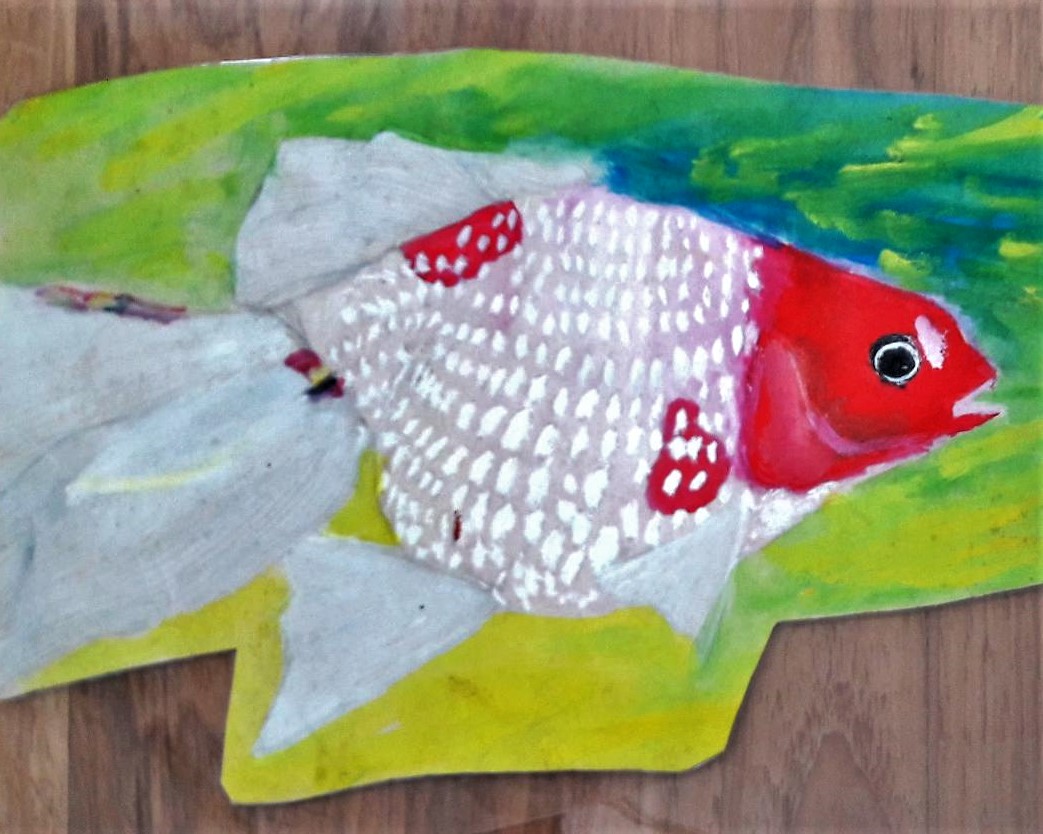
But Pearlscale was always in my heart. I remembered my childhood day when I had a Pearlscale in my tank. At that time, the Pearlscale was of the old style. It had a long flowing tail. This type is hard to find nowadays in my country. The market is now dominated by the Mutiara Tikus (translated as Mouse Pearlscale, developed by the Malaysian with the round body, sharp pointed head like a mouse, and short tail features). As a boy, I loved to watch my Pearlscale until I fell asleep in front of the tank. That fish became the model for my first goldfish childhood drawing.
In my teenager, my uncle gave me his giant Pearlscale. I could remember vividly, it was as big as a small-sized coconut, larger than a tennis ball! I put the fish in my pond only to find it floating dead the next morning. My happiness turned into sorrow. Concerning the size, I do not know if it was an exaggerated memory or if it was really that big. But it was always my desire to grow a Pearlscale someday towards that size. I never succeed to achieve it with all my Pearlscale during my life up to now.
My breeding projects so far was to experiment with unique varieties or color. I made sketches of new goldfish types. One of my imagination was to create a round-belly goldfish, such as Pearlscale, but without the Pearlscale. So it was just a round fish with metallic scale – a metallic ball. But it is a project that I never start. Just a wild imagination. Yet this shows that Pearlscale is always close to my heart.
Last year, out of nowhere, I found several Pearlscale in my offspring.
I was surprised. I did not keep Pearlscale for so long already, so there was no Pearlscale genetics in my fishes. I did not intend to breed any. How come they suddenly appeared in my collection?
These Pearlscale was a natural mutation from the Tosakin – Butterfly cross which I had done for several years. I did a lot of inbreeding and backcross breeding with Tosakin and Butterfly. For many generations, they never yielded Pearlscale, which was normal. I do not know why, suddenly there was a whole batch that turned to round belly, some with obvious pearlscale, some not so obvious. Well, I found this weird. But I welcome them.
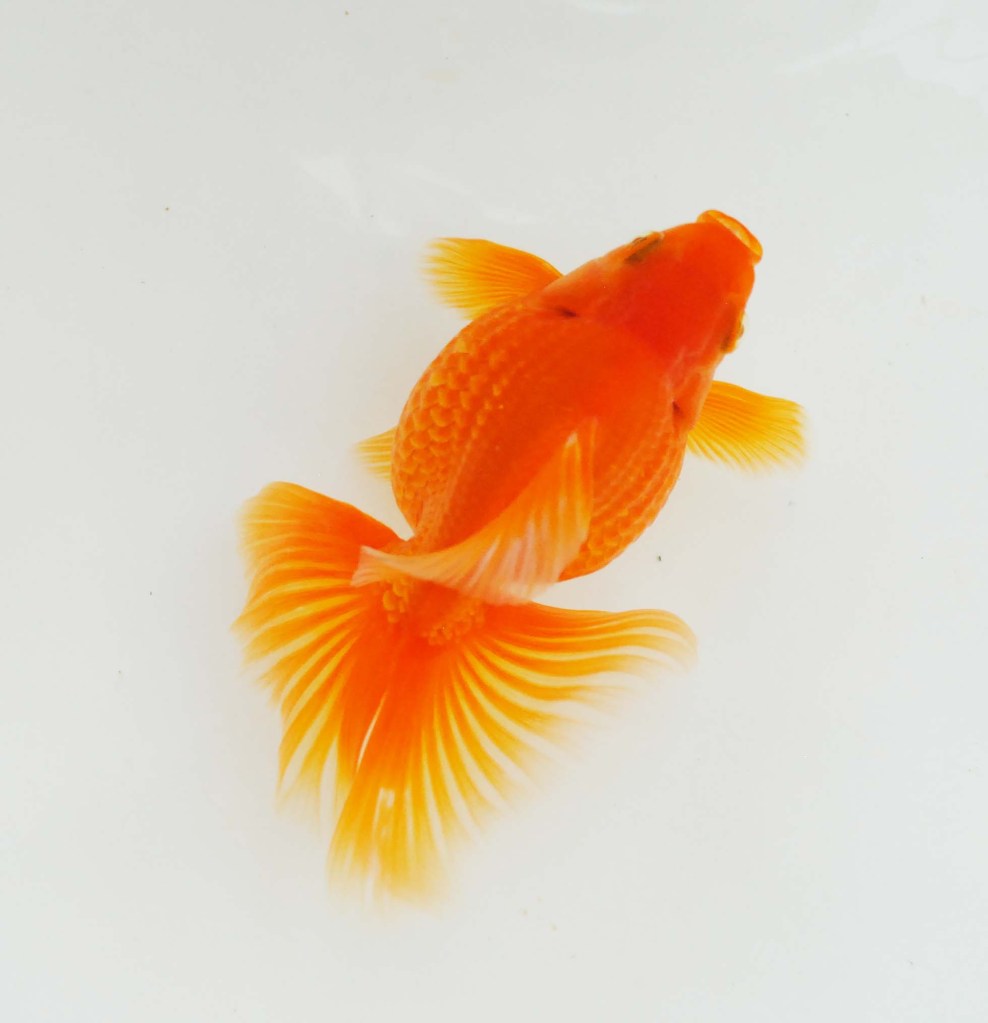
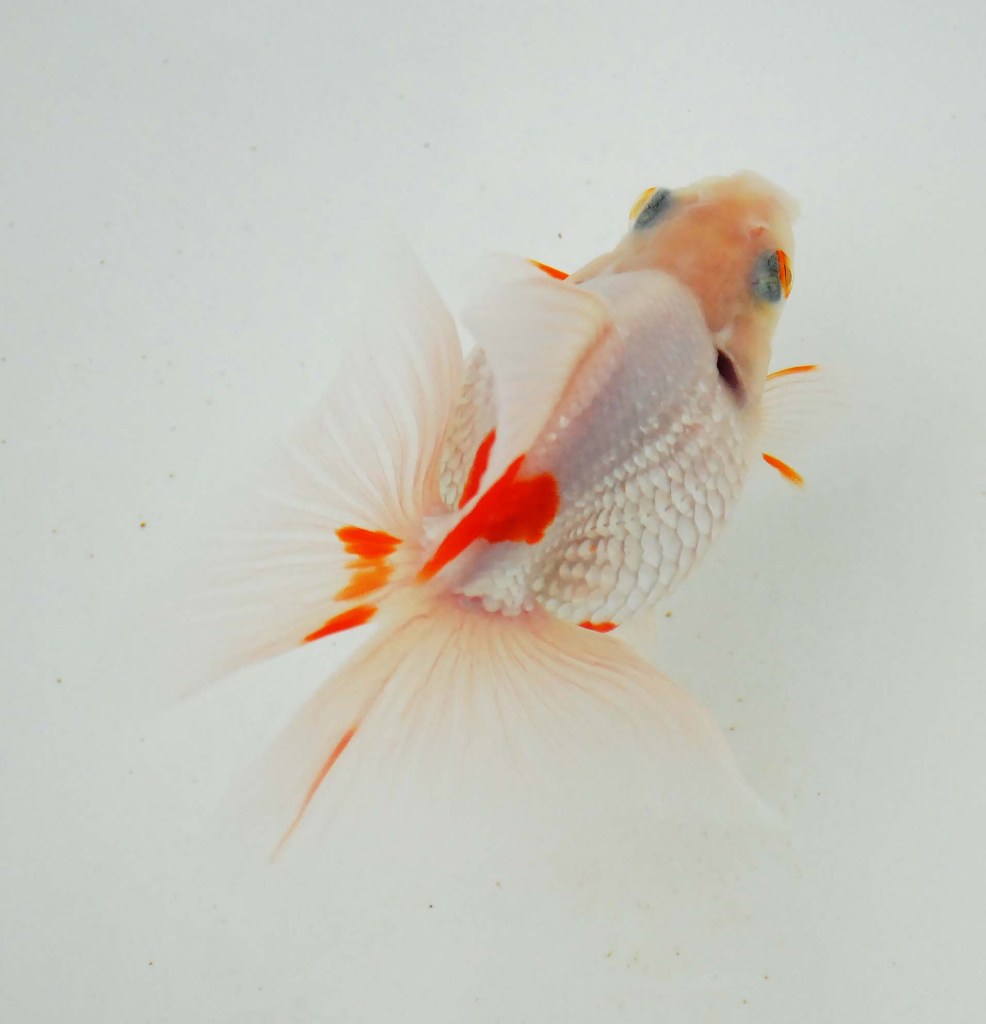
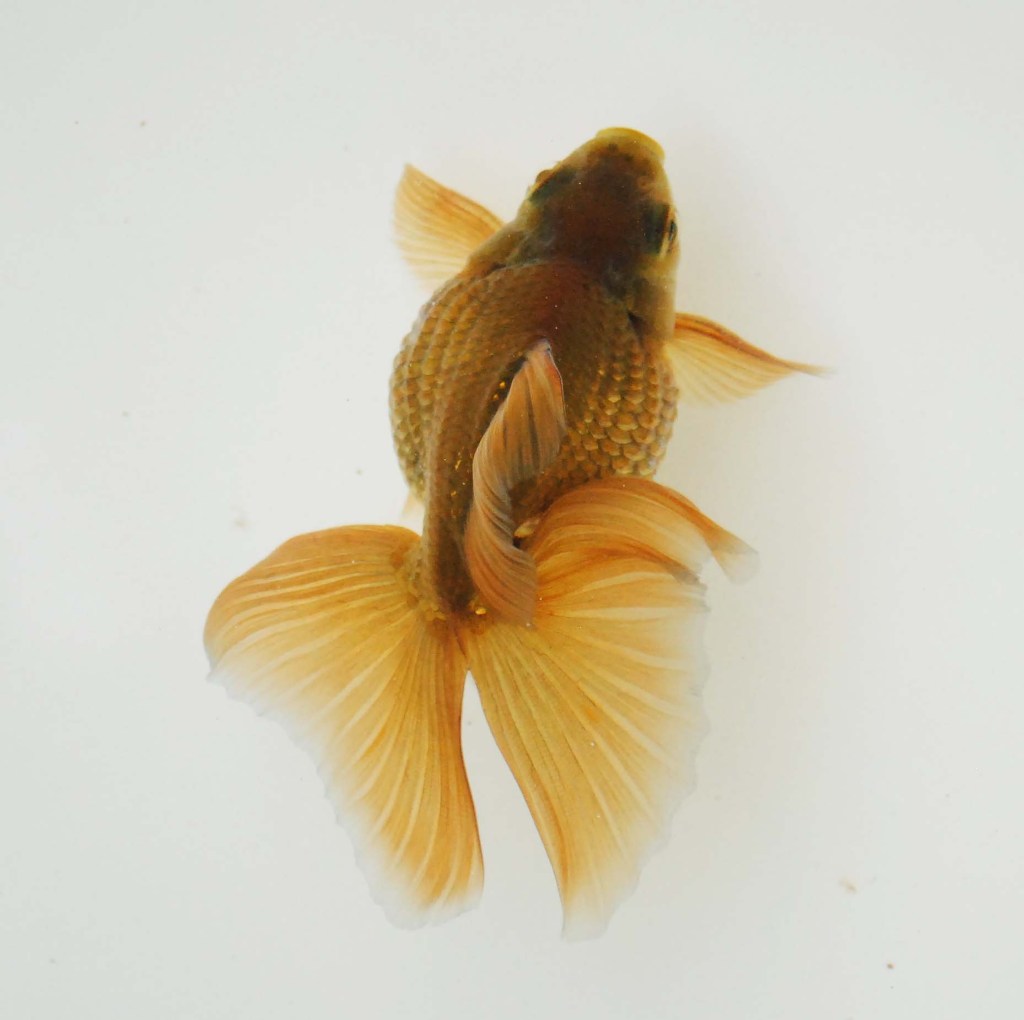
So, now, I have Pearlscale again as a gift from heaven. Never ask, but I receive. And they are different from the Pearlscale in the market. The popular Pearlscale is transparent scale type. Mine is metallic scale type – a variant seldom seen nowadays. The popular one is the short tail variant. Mine is towards the butterfly tail type. They are unique. I am happy with them. Since they are metallic scale, the Pearls are not so eye-catching. Some doesn’t even seem to have the protruding scales – and this will be my imagination come to reality without any effort! And more, they do not seem to develop the bubble disease!
From the offsprings, only four I found to be vigorous. The rest were weak or stunted. From this four, only one is male (the grey one).
I still do not know if they can produce true. Will their offspring be just normal butterfly without the telescope eye? Or will they become true metallic Pearlscale with butterfly tail? Or will they be the Steel Ball of my imagination? The first mating attempt produce infertile eggs. The second attempt produce less than ten hatchlings. This morning they breed for the third time, and hopefully produce a better result. Let’s wait for the updates!
Here are the four metallic Pearlscale with (semi) butterfly tail:



 hermantogoldfish