
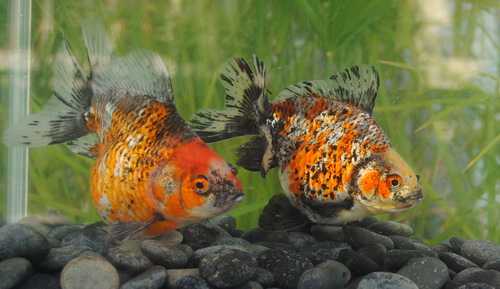
I have never paid any attention to this type. I worked on calico color for some times to understand it, then I tried to work on the kirin color (a subvariation of transparent scale goldfish) with no success. It is a fortunate event that a breeder friend introduced me to these two fishes. They caught my attention because I think they are unique. Their color looks like that that can only appear in transparent color scales, but their scales are metallic scales! It is amazing!
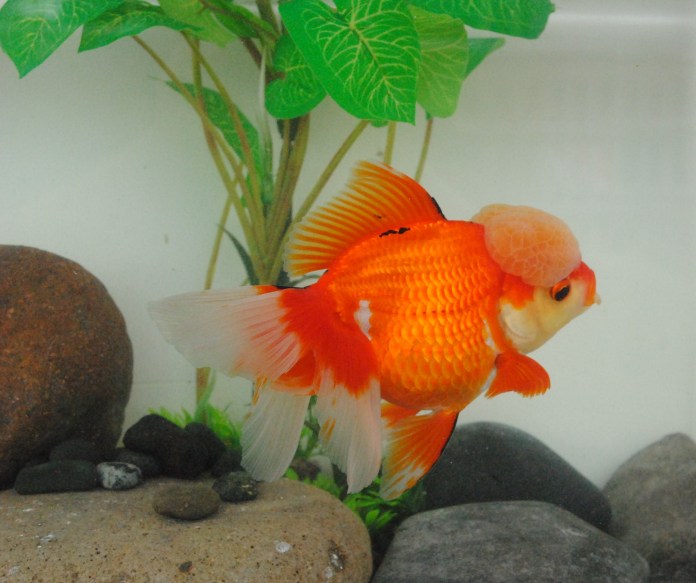
I know this kind of color is seen mostly in ryukin. I have never seen it in other goldfish variety. So it is possible that the specimens I have here are ryukin’s reject. Or they might be a stable variety of its own. I do not know what to call them, other than tricolor metallic scale goldfish. The Indonesian might call it tricolor metallic scale tosa, since we use the term tosa to refer to a ryukin without hump. I also know the term “mock metallic” used by American hobbyists, but I don’t really know what they mean. Could this be the mock metallic?
I am pretty sure now that this type of color is also a subvariant of transparent scale goldfish color. But I am not sure how this color come up in the first place. Usually, when we crossed a calico with a metallic scale, we will end up with many kinds of offsprings. I usually keep only the fully transparent scale that has no or minimal trace of metallic scale. I get rid of the rest. But some breeders usually keep those with more metallic scales on the body, for this kind of fish still have selling value. Both are commonly seen. But those that the breeders rejects, such as the seemingly grey metallic scale that does not seem to mutate, and I don’t know what else, maybe the tricolor metallic scale evolved from these rejects. I don’t know yet, this is only my guess.
The good thing is that this genetic is pretty stable. I mated these two, and this is the picture of the offsprings that I took yesterday.
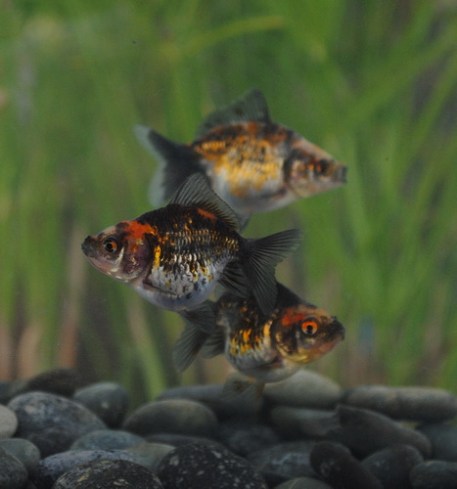
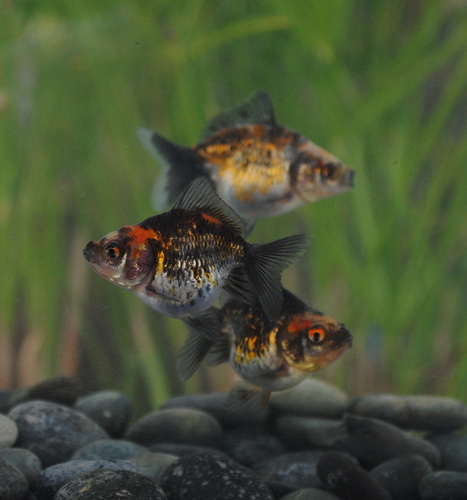
From these offsprings, the metallic scale types, and the black color look solid. There are few offsprings that look like transparent scales with few metallic scale. I reject them. I keep only the full metallic scales. So, the only thing I know so far is that the genetic is stable enough to pass on to its generation.
And this is the interesting thing. What I would like to do is to see whether this color can be transferred to sideview ranchu! Yes, it sounds crazy. But a tricolor metallic scale sideview ranchu will be quite nice, isn’t it? Yet it is also quite a challenge.
When I work with panda coloration, I was working with metallic scales only. Now I am going to work with metallic scale – transparent scale cross. I have no idea of how big is the problem. In my experience, when we cross a metallic scale with transparent scale, the black coloration is lost. Some show black marks when young, which will soon disappear as they grow. If this happen, I do not know how to introduce the black color again. I have tried to cross it with black fish (black ranchu) which created a different black marking from calico color. I also do not know how to create the appearance of full metallic scale like this since the cross usually creates partially metallic scale only. So, I think I should separate the color (black coloration) and the scale into two problems.
So to count the difficulties if I cross this fish with a metallic scale sideview ranchu, then it is a level 4 difficulty. First concerns the headgrowth, which is nothing to worry. Second concerns the dorsal fin, which I have the experience already and I will not worry about it. Since the fish is already a short tail one, then it does not count as a difficulty when being crossed with ranchu. Third and fourth is about the color and the scale appearance, which is a territory unknown to me. So eventhough the difficulty is only level 4, it is much more difficult than it appears, I think.
Actually, the cross has been made this morning. Now I am waiting for the eggs to hatch. I am very excited 🙂
I welcome any advice on this.


 hermantogoldfish