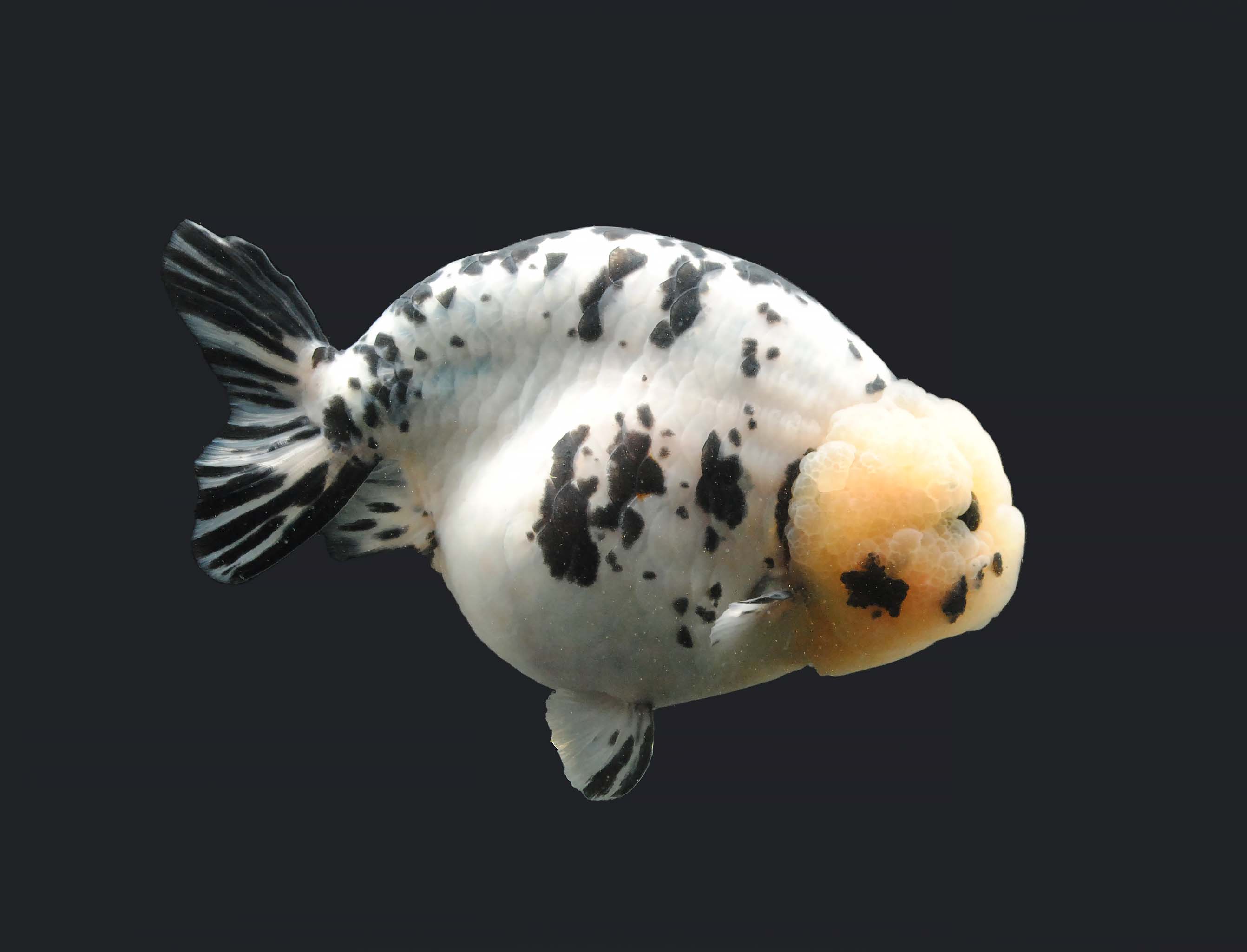
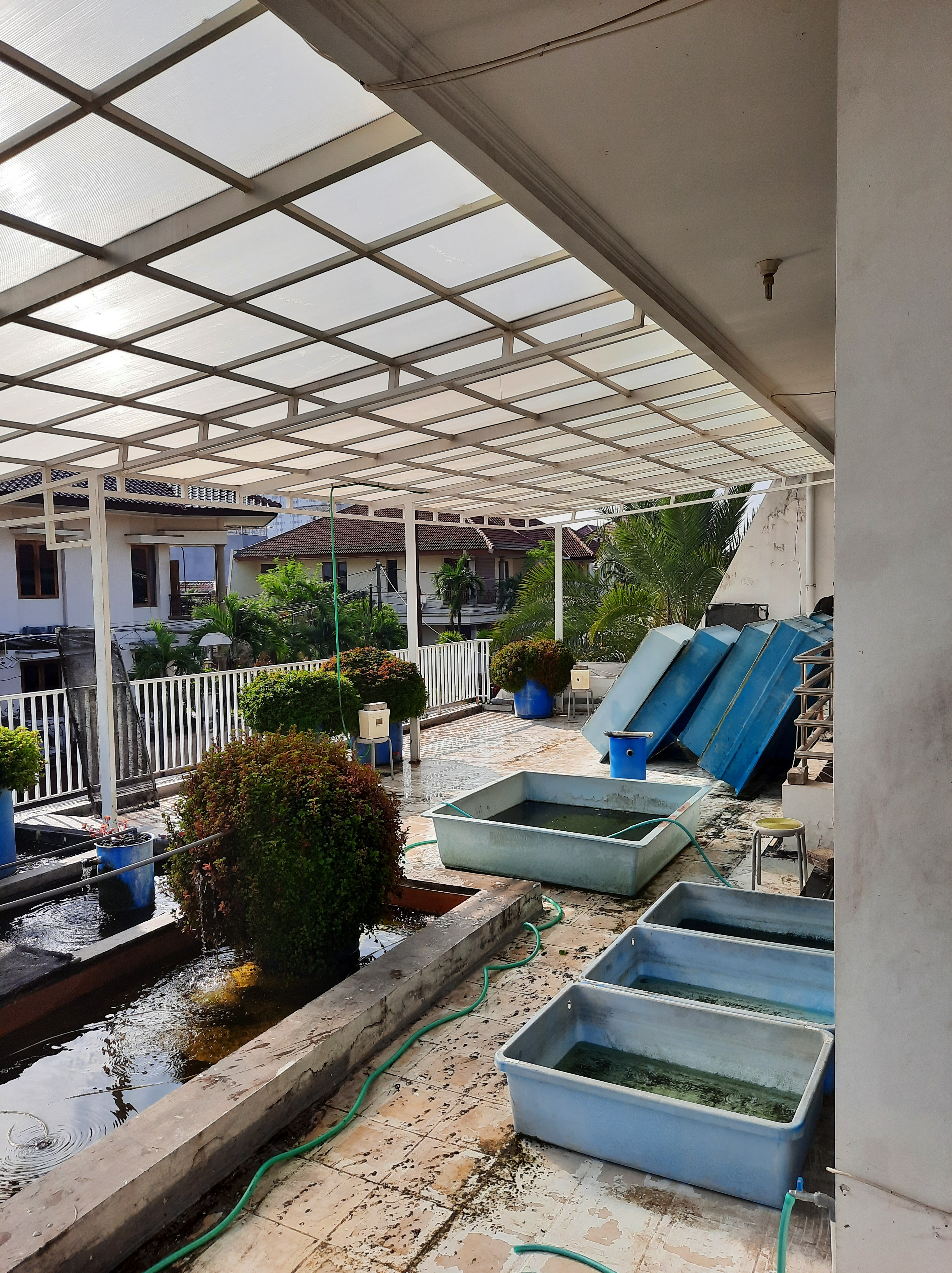
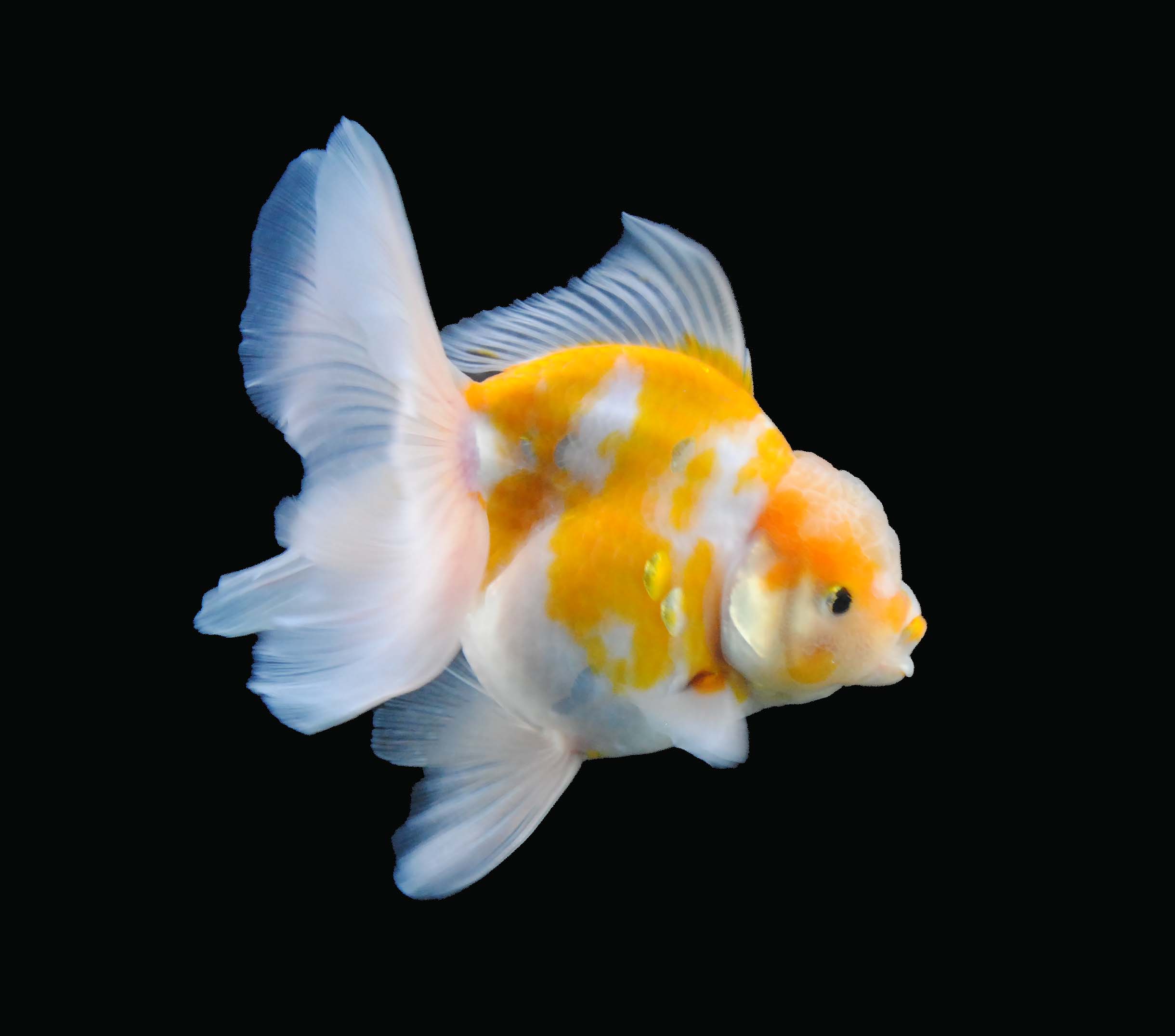
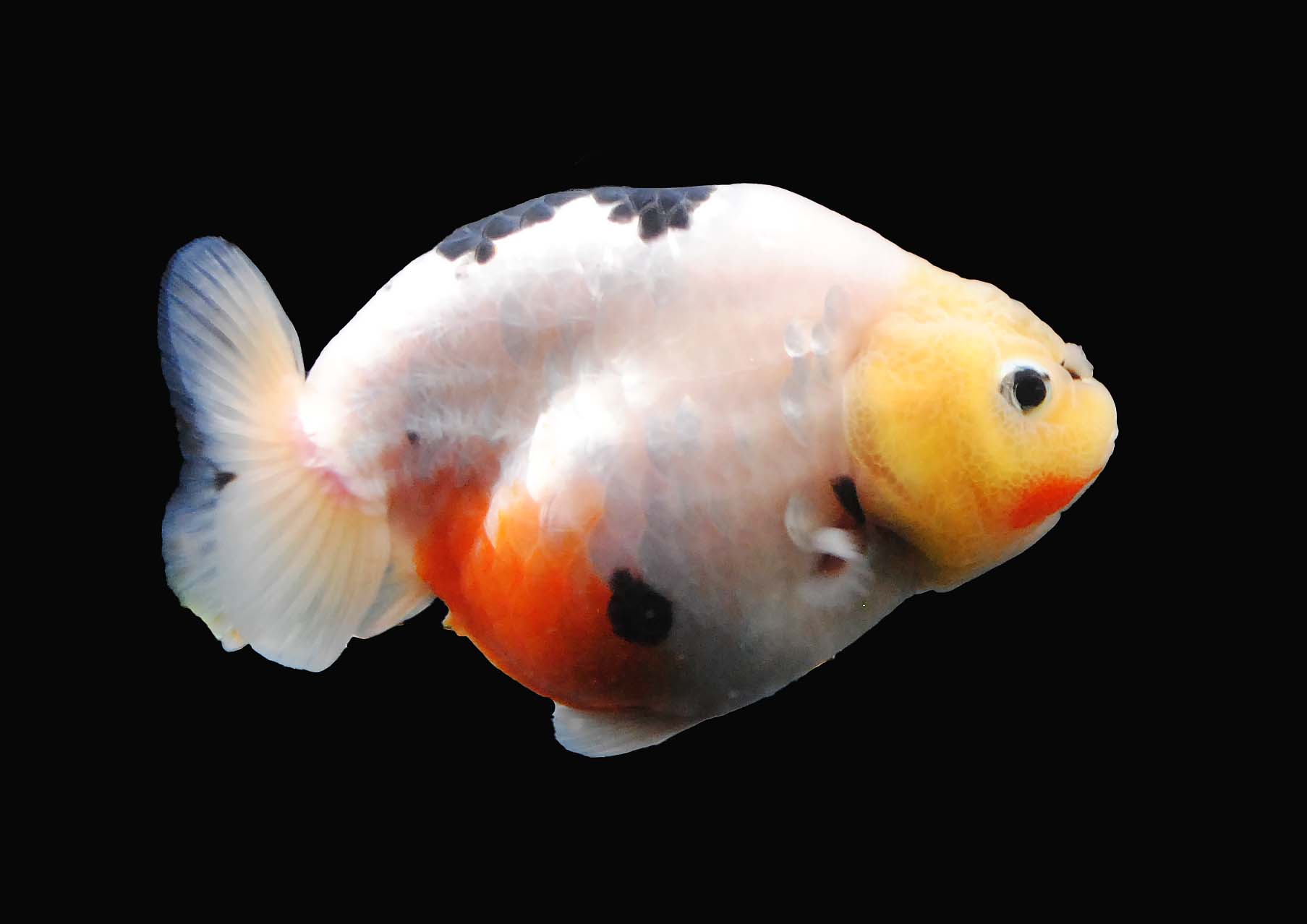
calico ranchu, cow ranchu, The Diary of a Goldfish Breeder 2022

The Diary of a Goldfish Breeder 2022 (4)

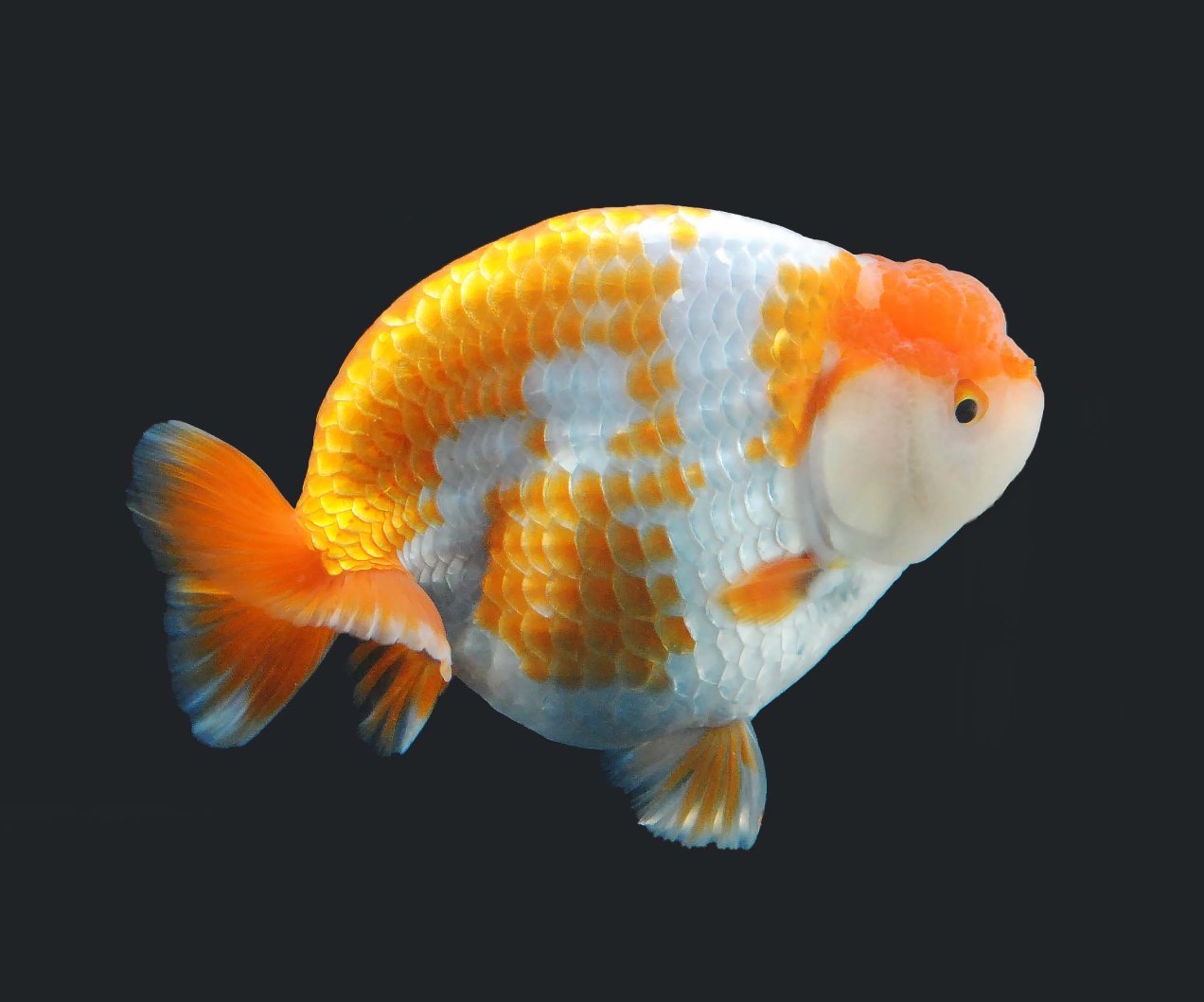
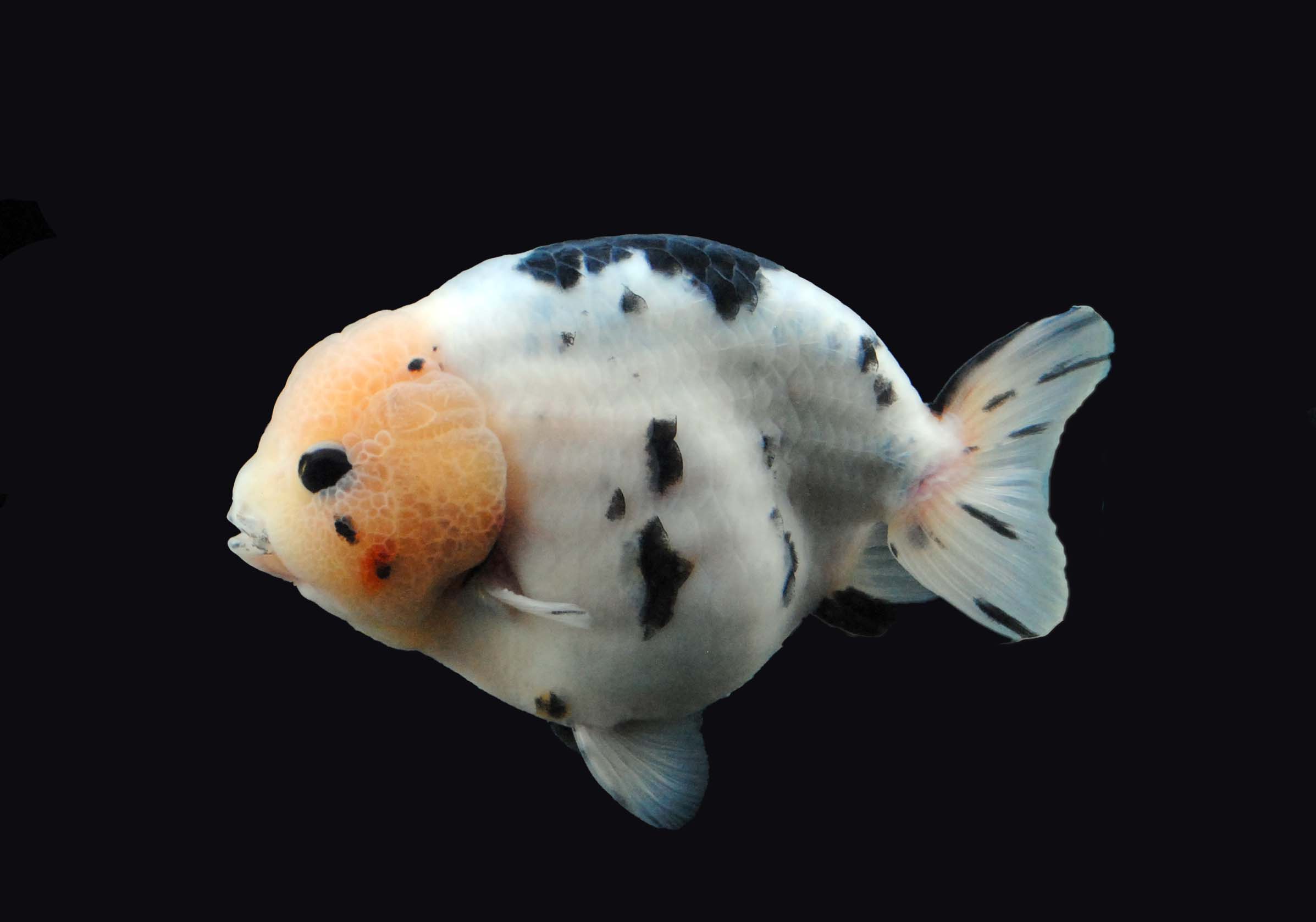
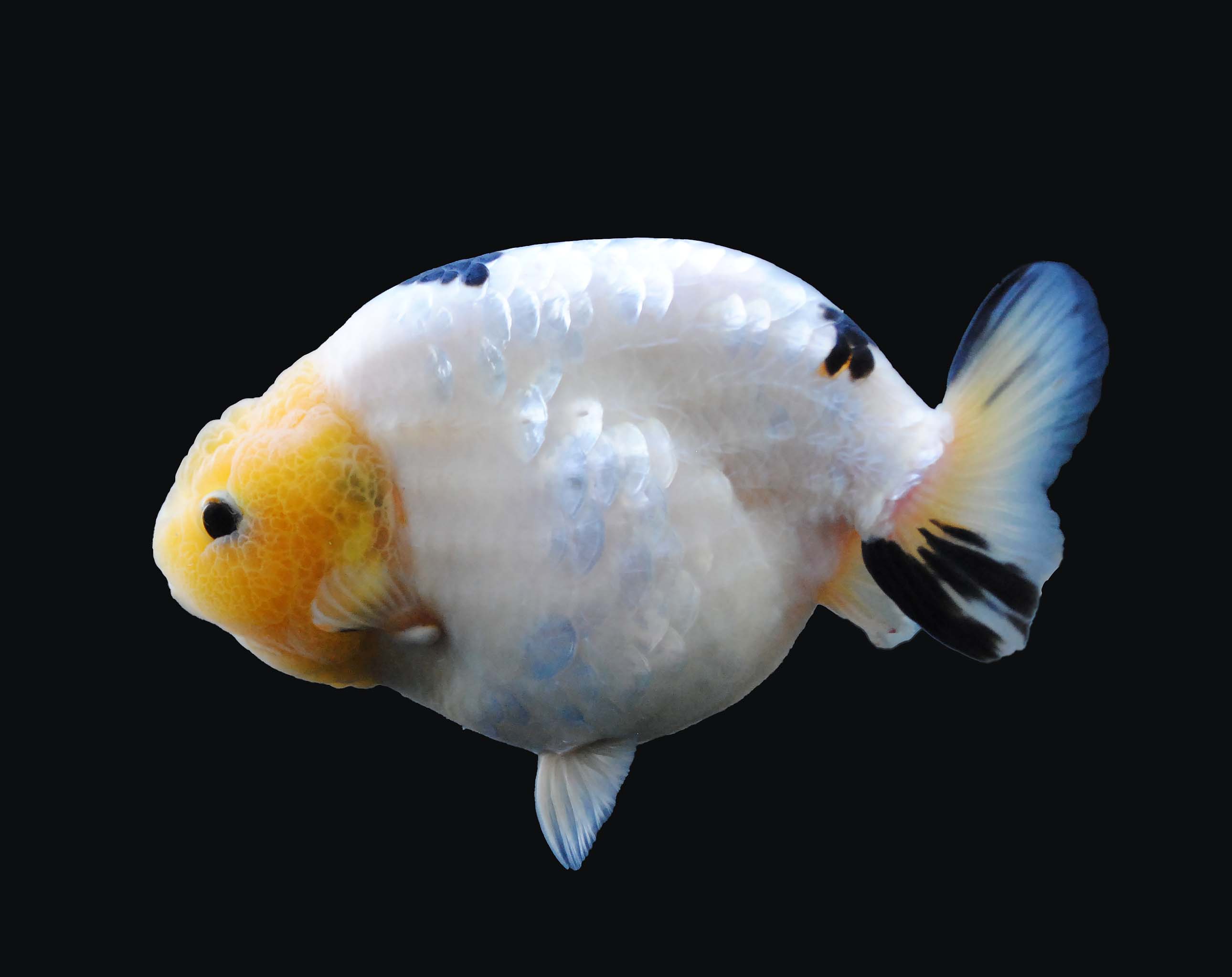
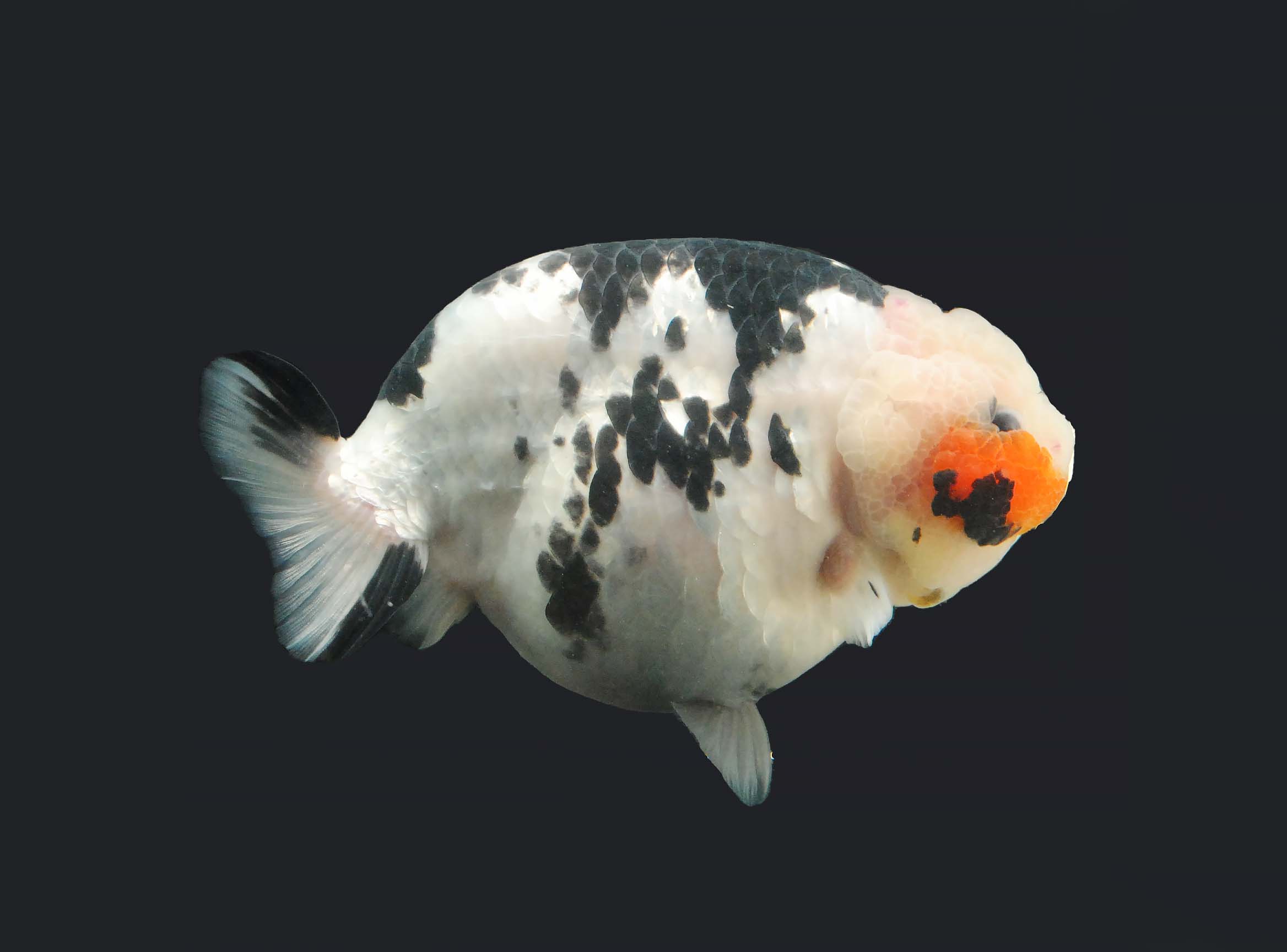
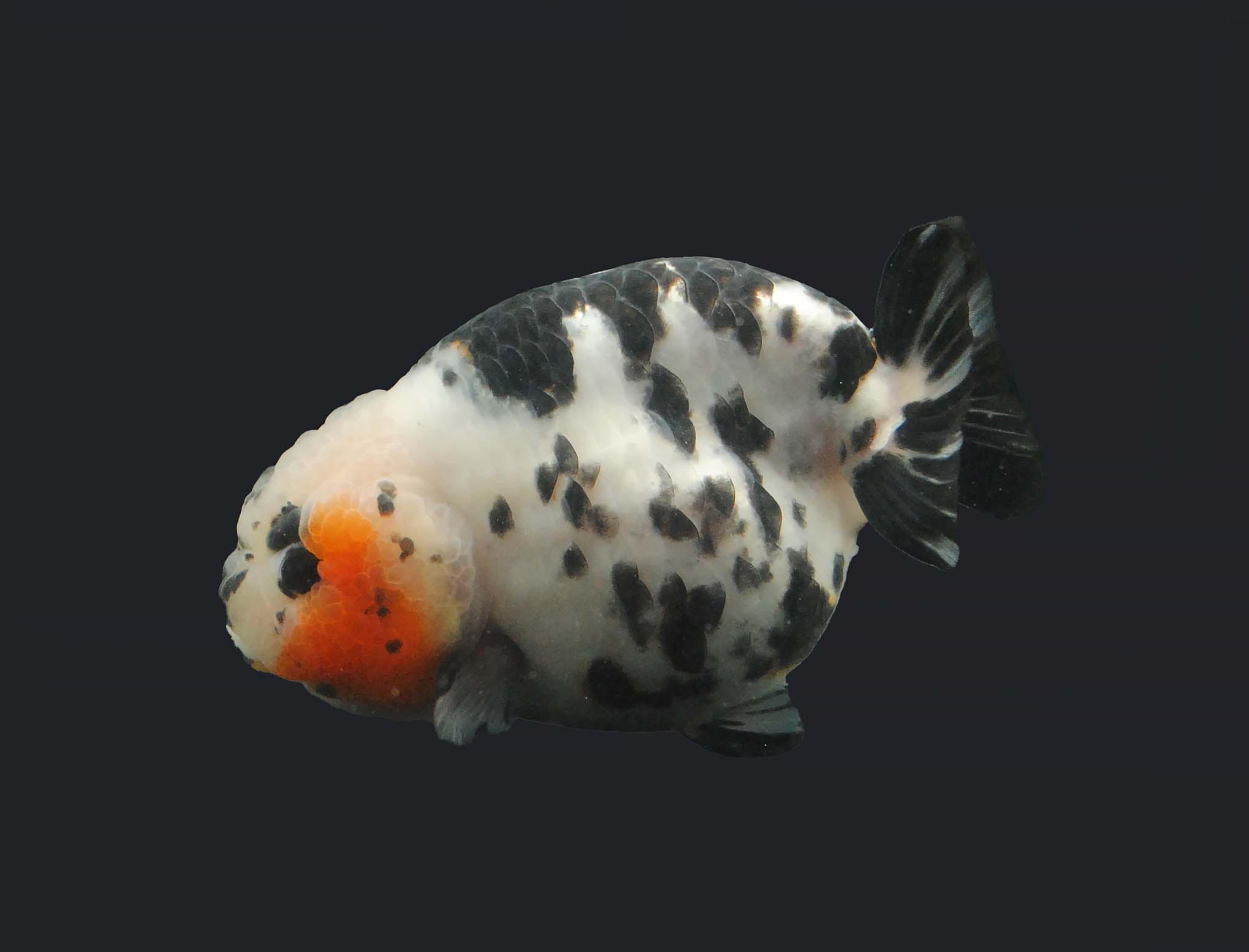
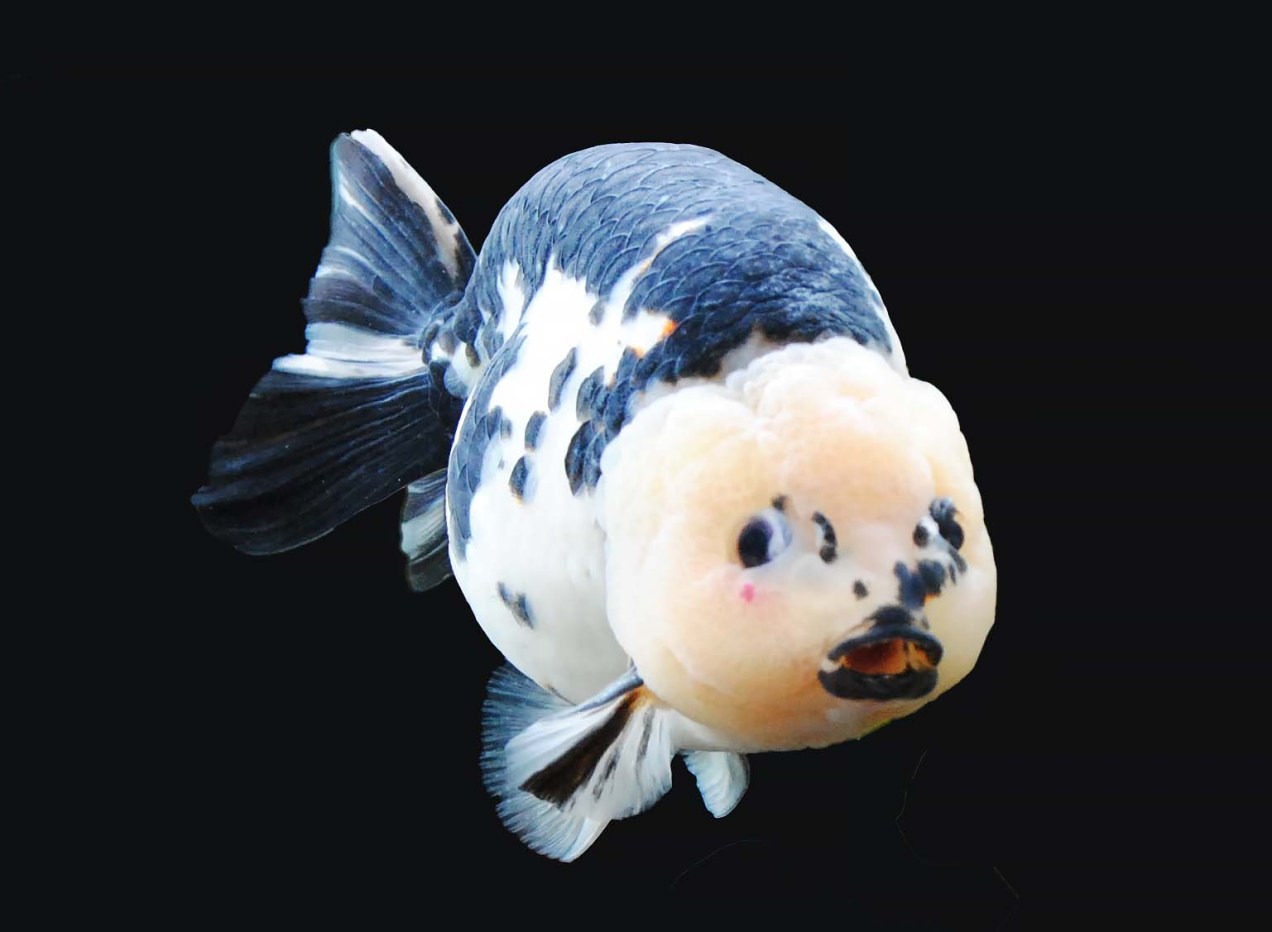
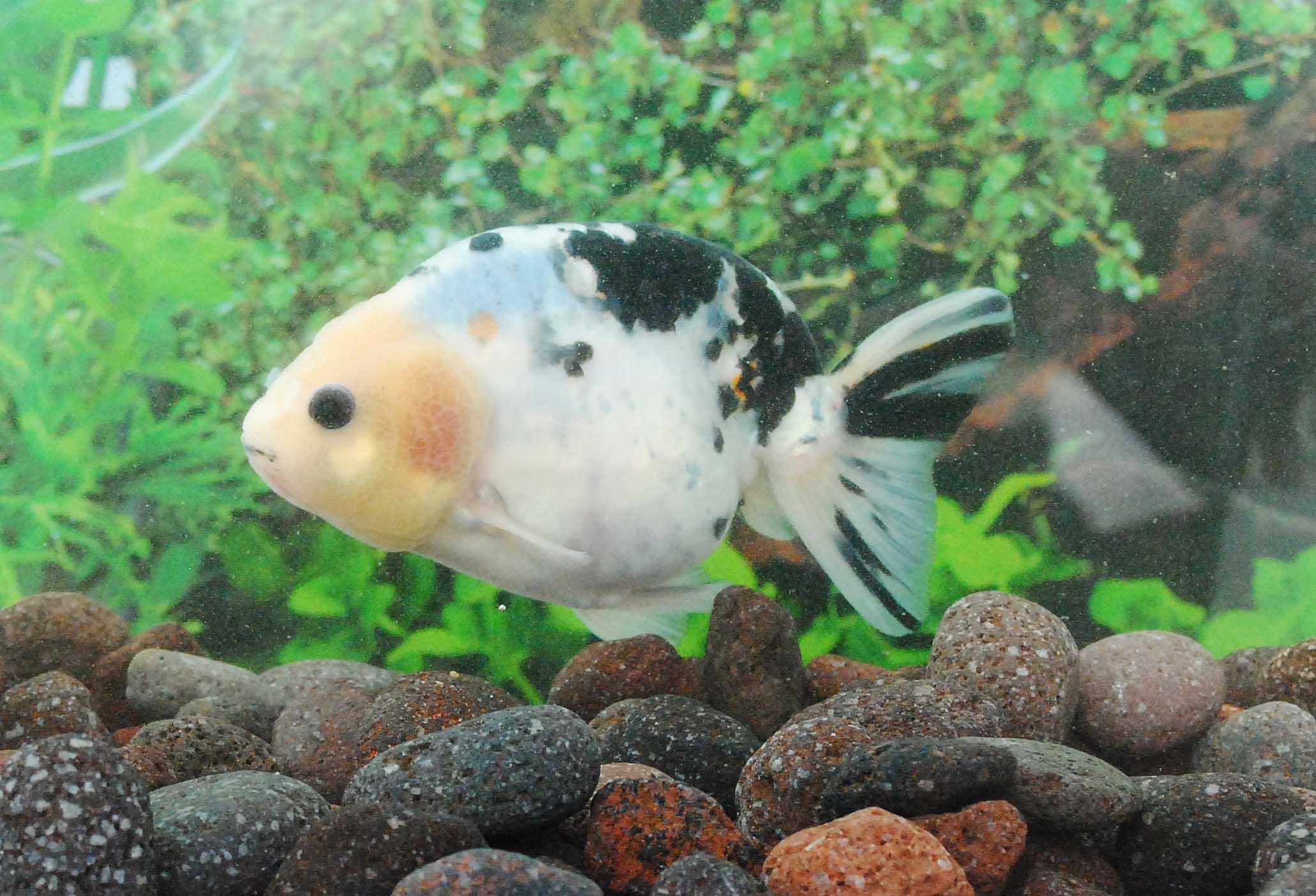
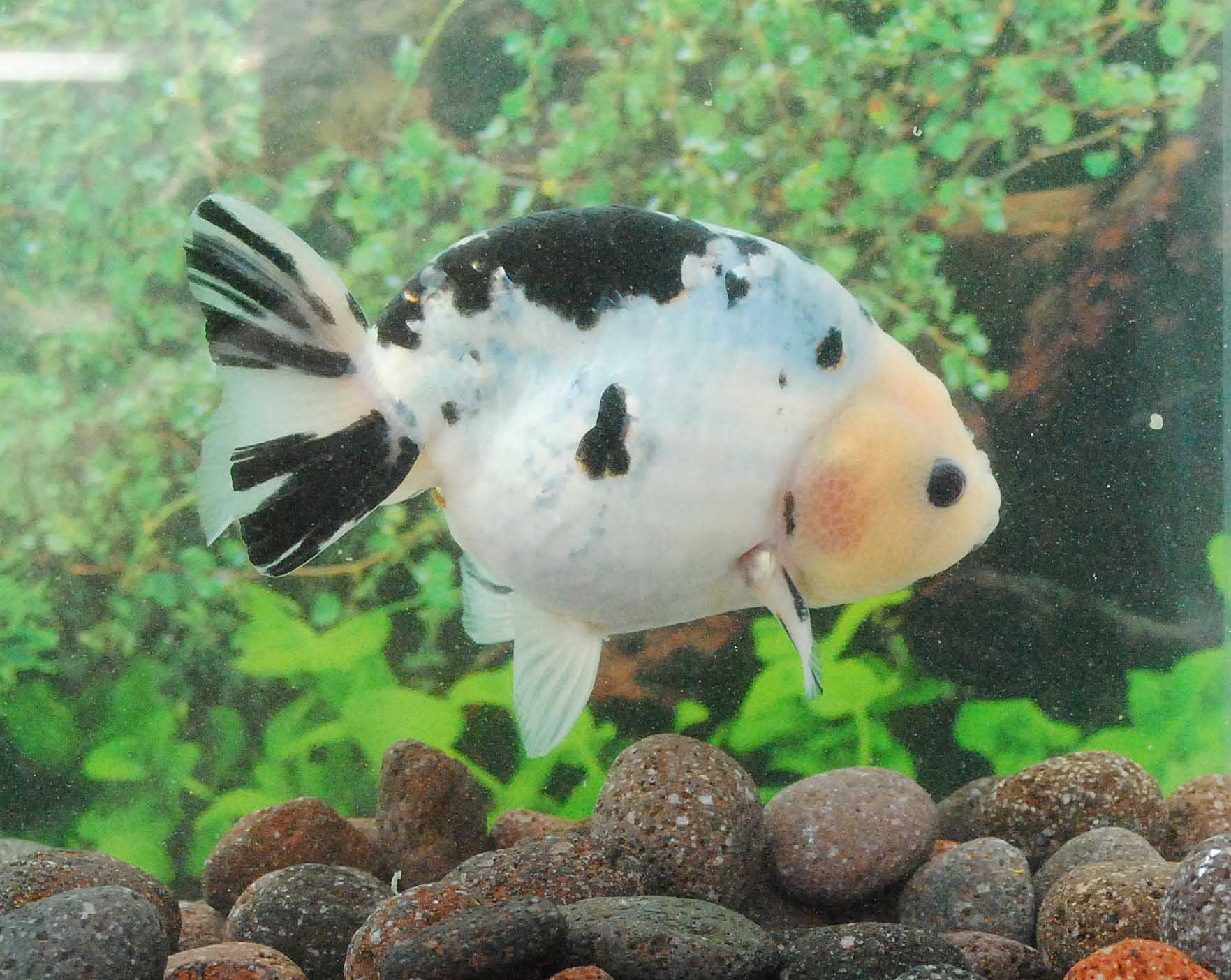
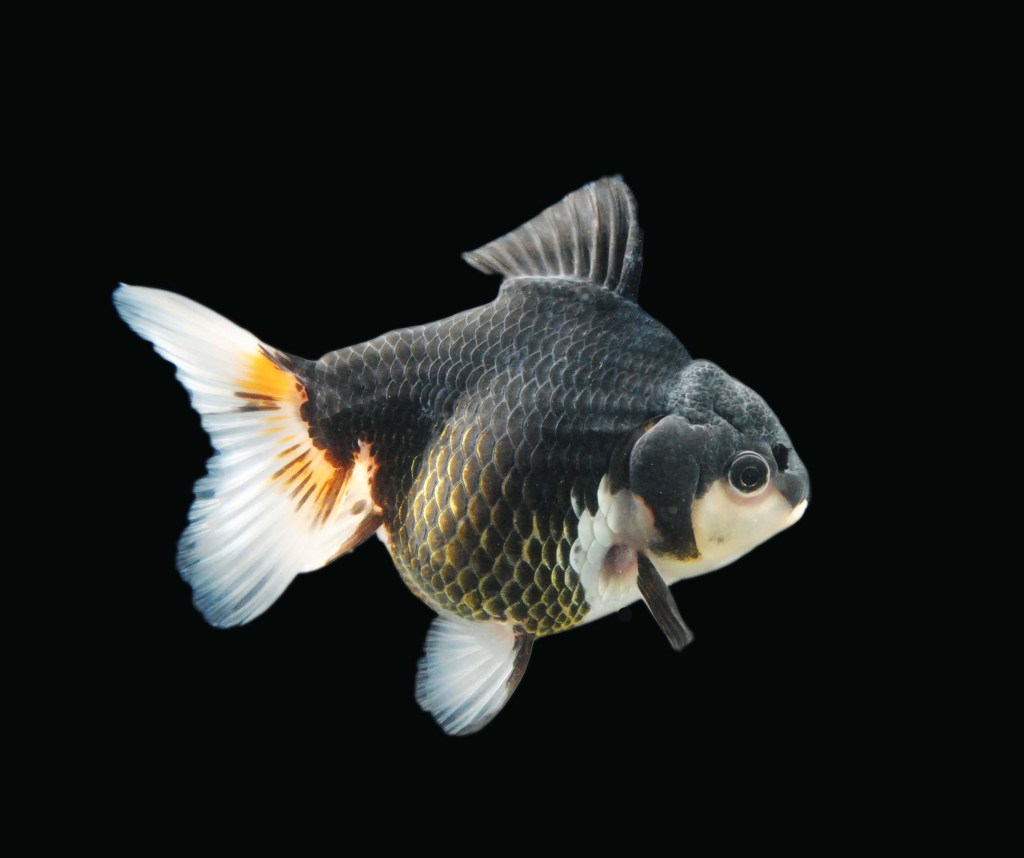
Update on my Cow Ranchu projects. I use a female with two males separately.

This is the first match, the female and the male:

I bought the female from a local farm and I do not know whether it is a local breed or an imported fish. My guess, it is an imported fish. The male is my own offspring. I have a feeling that they are from the same lineage (I mean, their parents / grandparents might come from the same farm in China).

And this is the second match, where the female is the same fish:

The male is an imported fish from Chine (through Vietnam, as I was told). It is sold with the label of milk cow since its white color seems to be free from bluish shadow. So, it is safe for me to assume that the female and the male come from different farm lineage in China.

And their offspring shows different results!

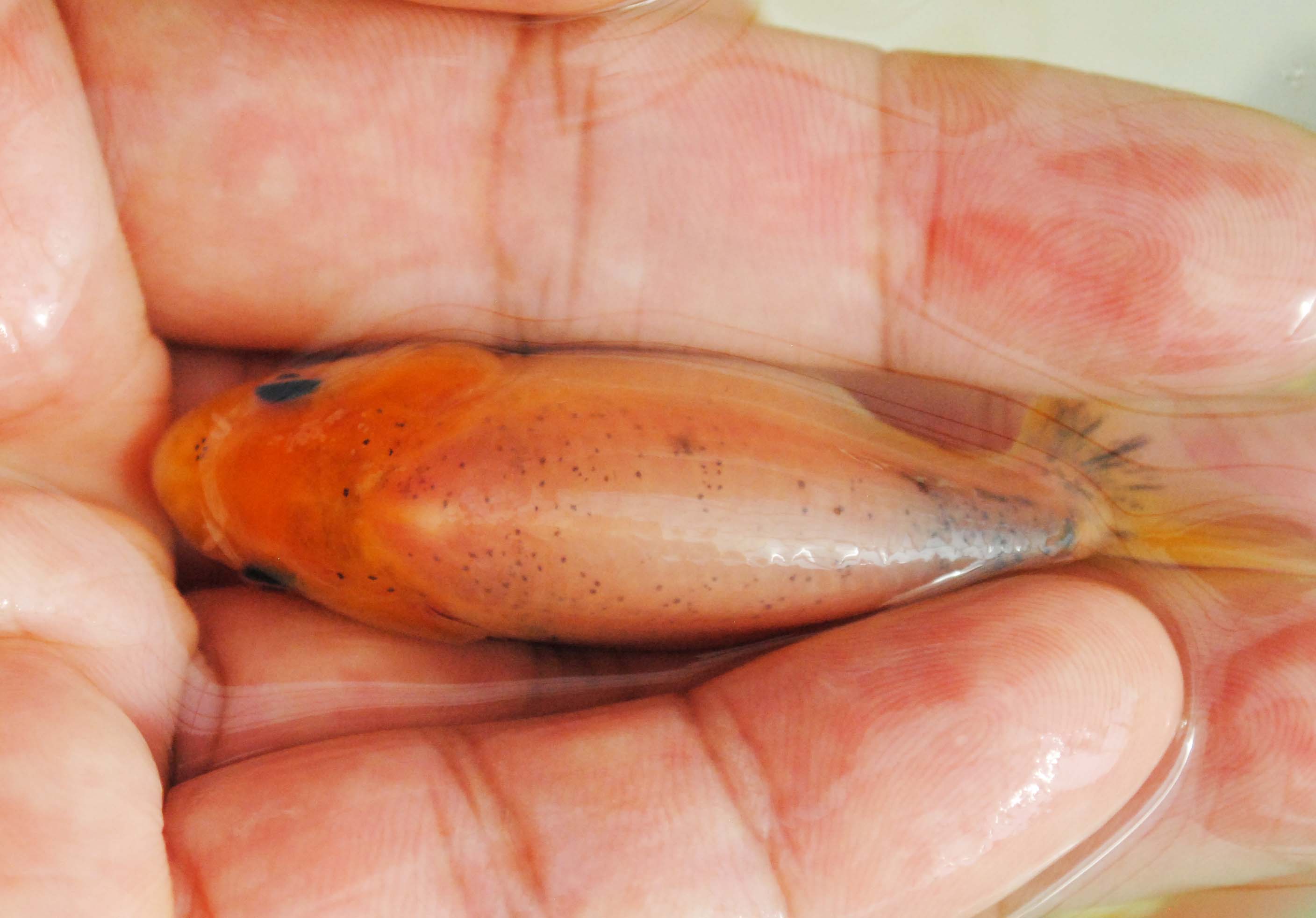
These are the offspring from the first match:

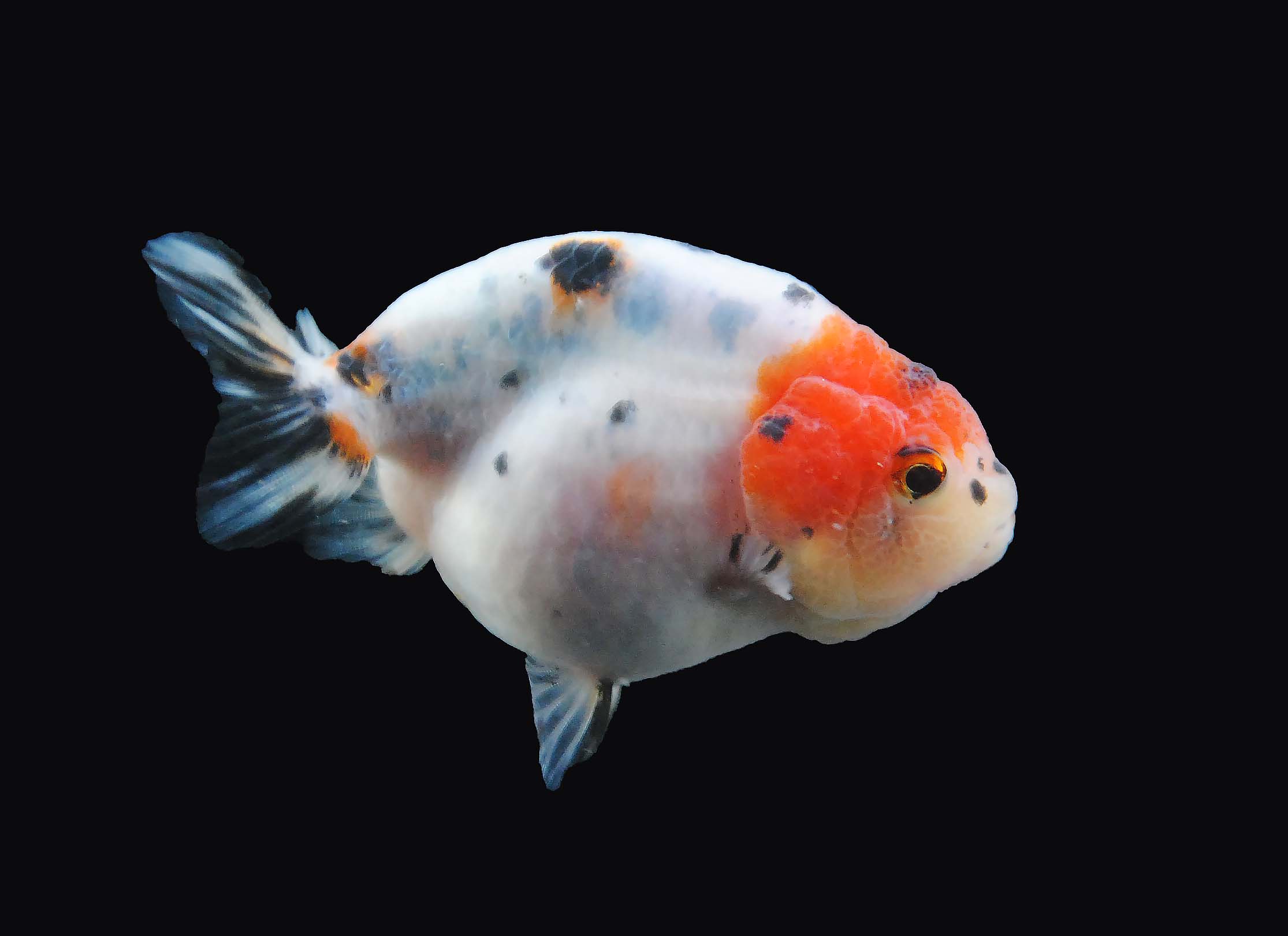
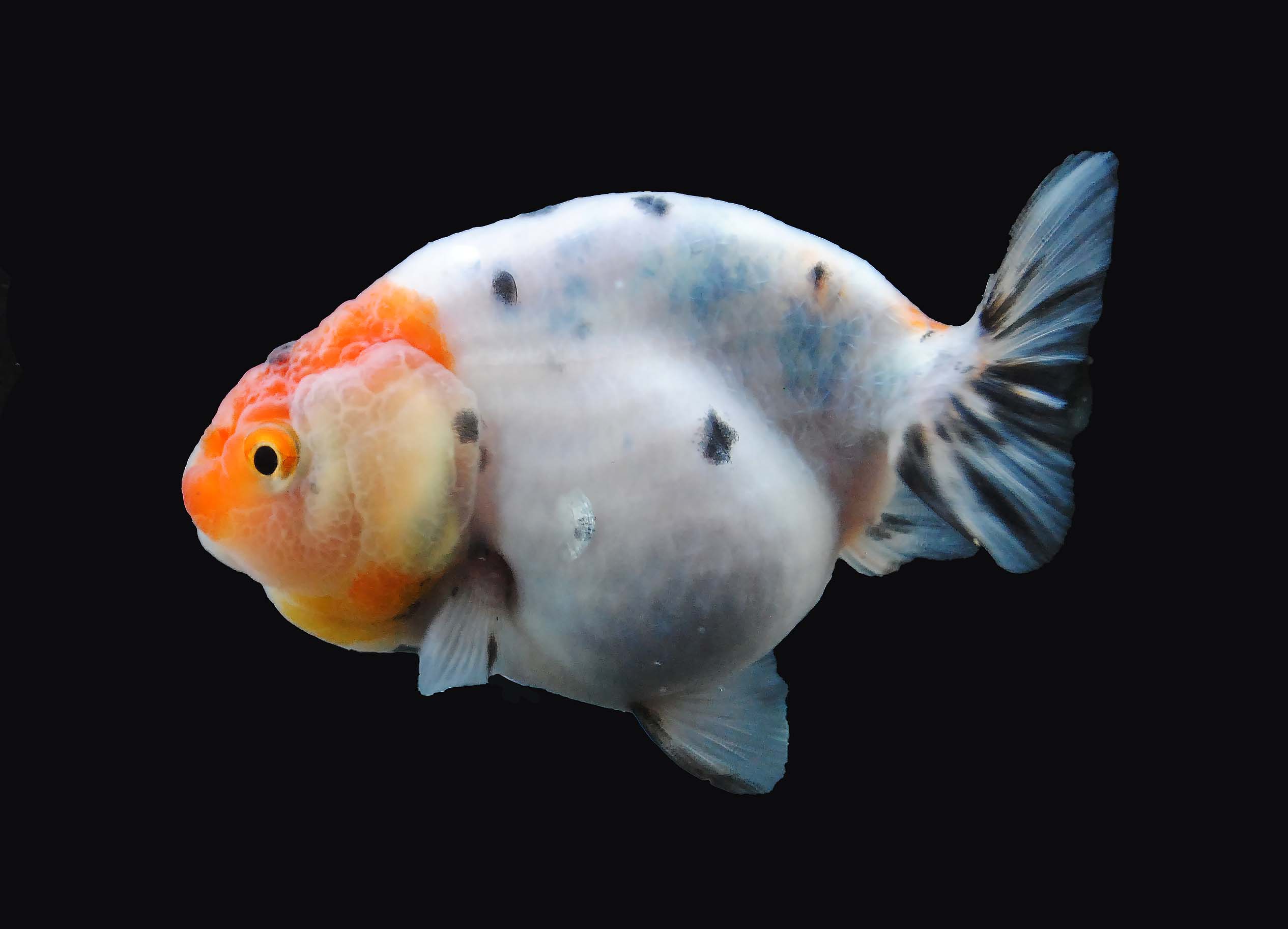
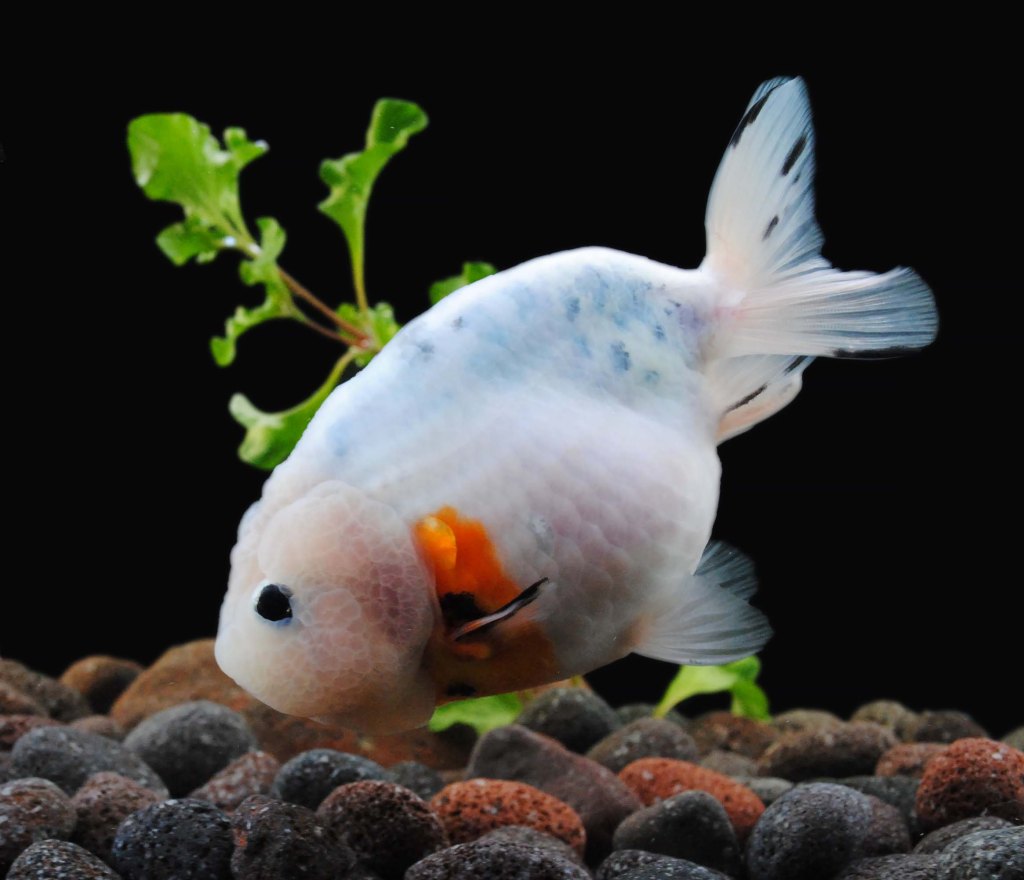
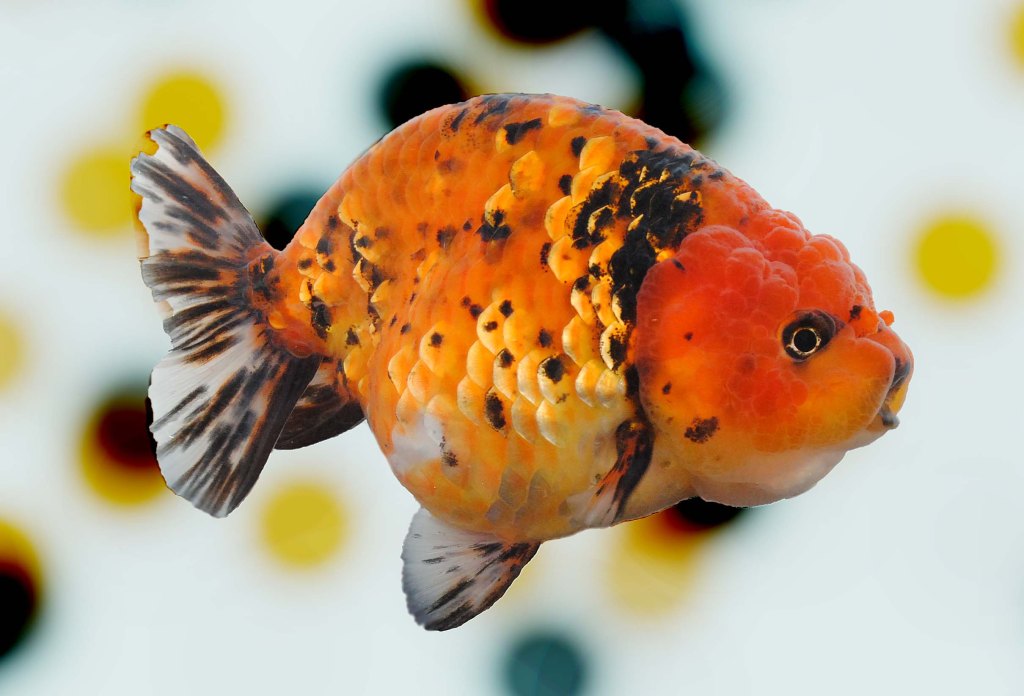
They are dominated by the white (or pink) fishes. Some develop red color to become calico. Some have black patches, some black dots. And the black coloration grows. None are purely white (or Casper the ghost) – all have some hints of black coloration. I have high confident that they will be beautiful color as the melanin develops more intense.

Here are some close ups:

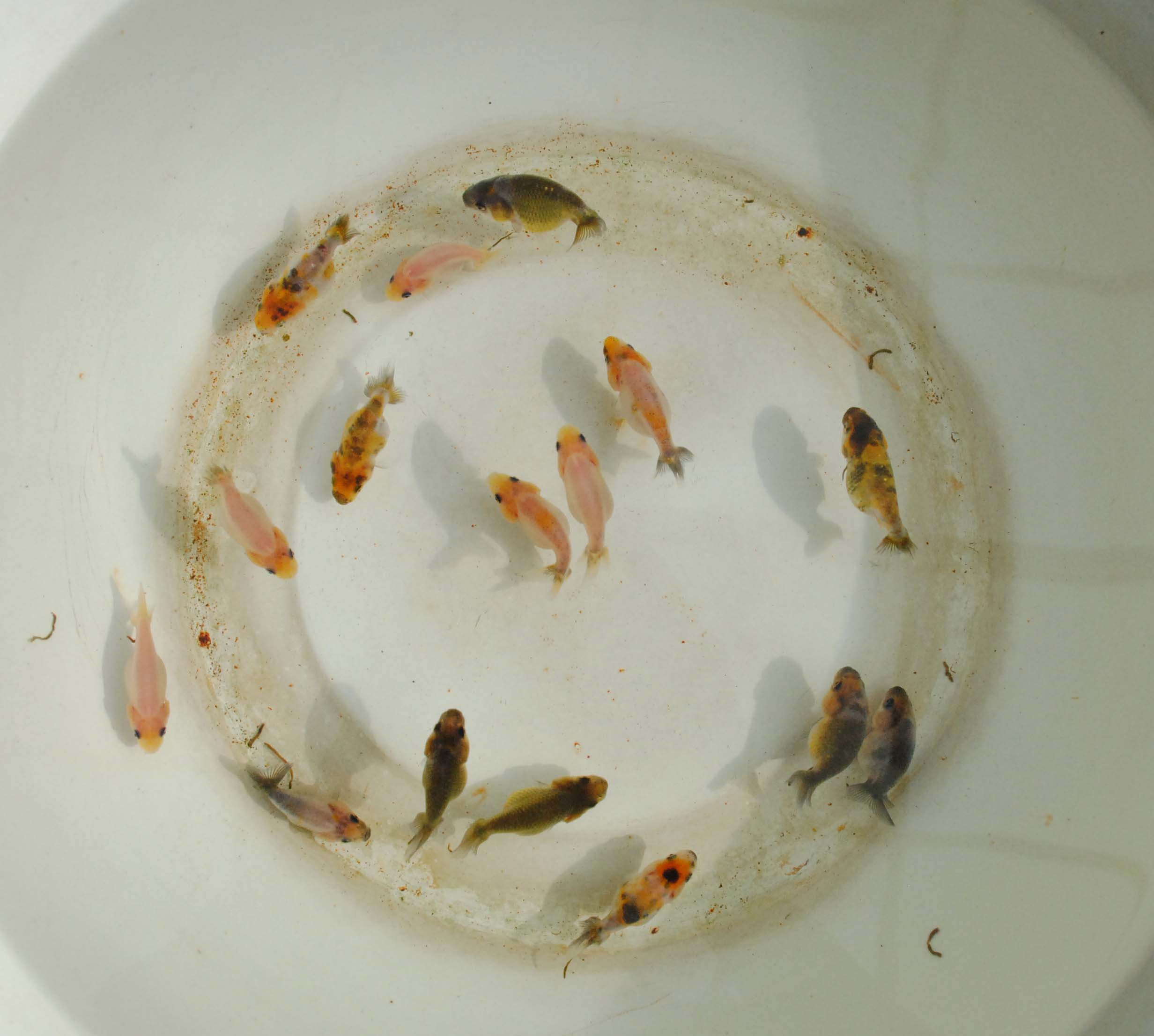
But the second match shows different result:

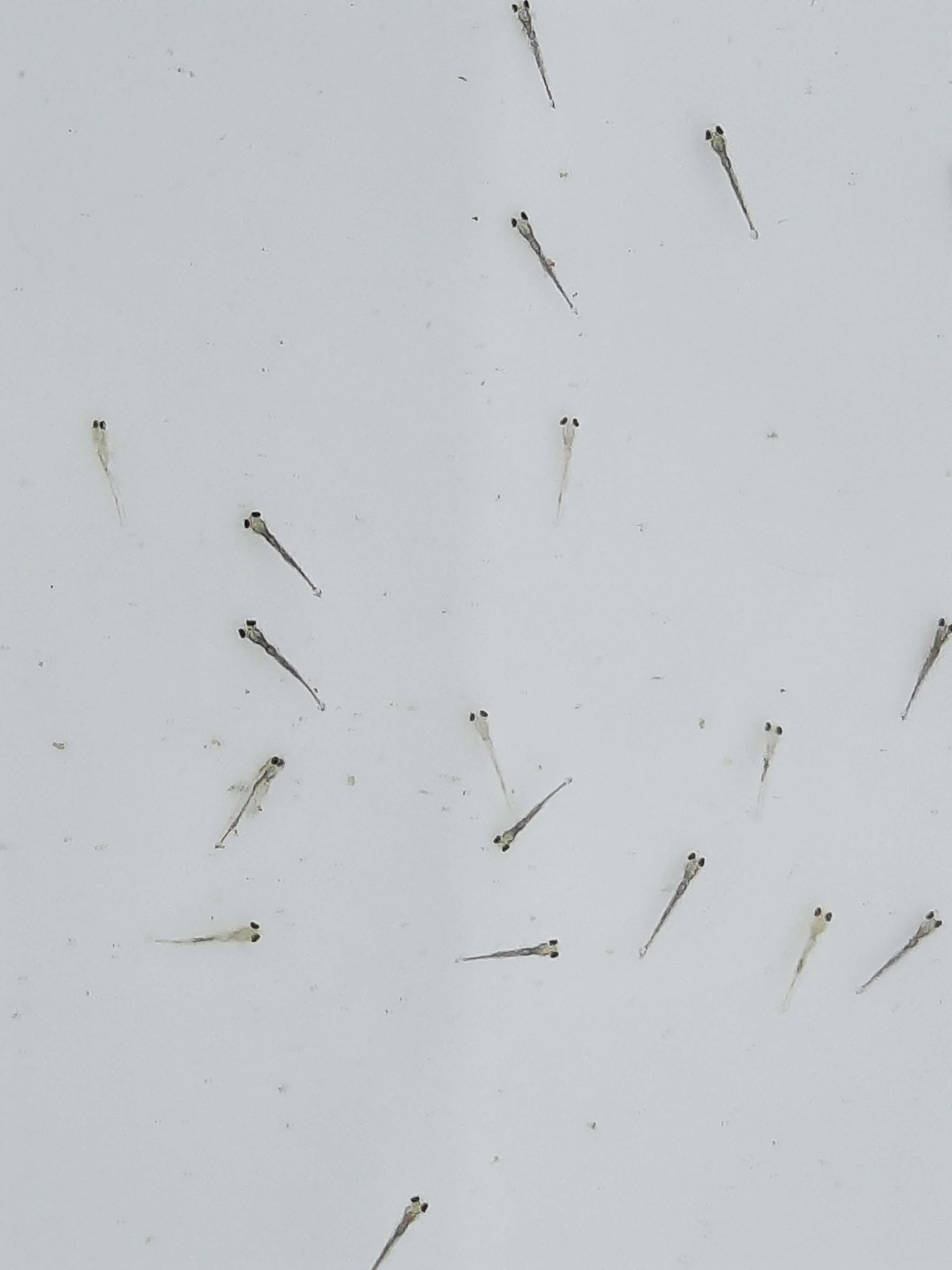
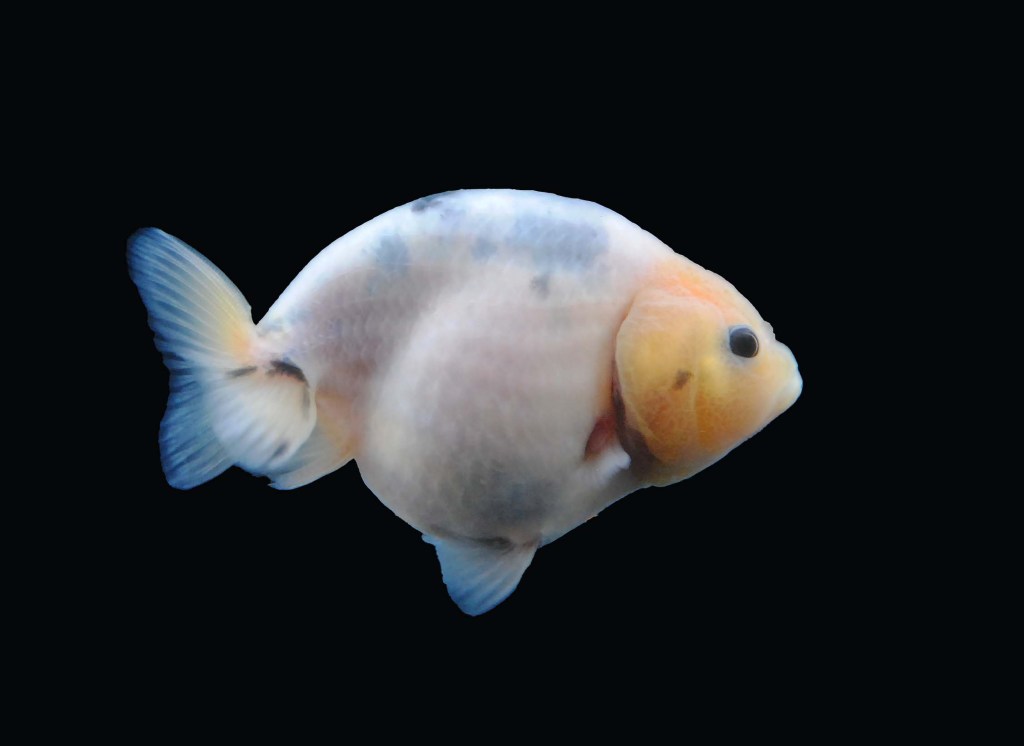
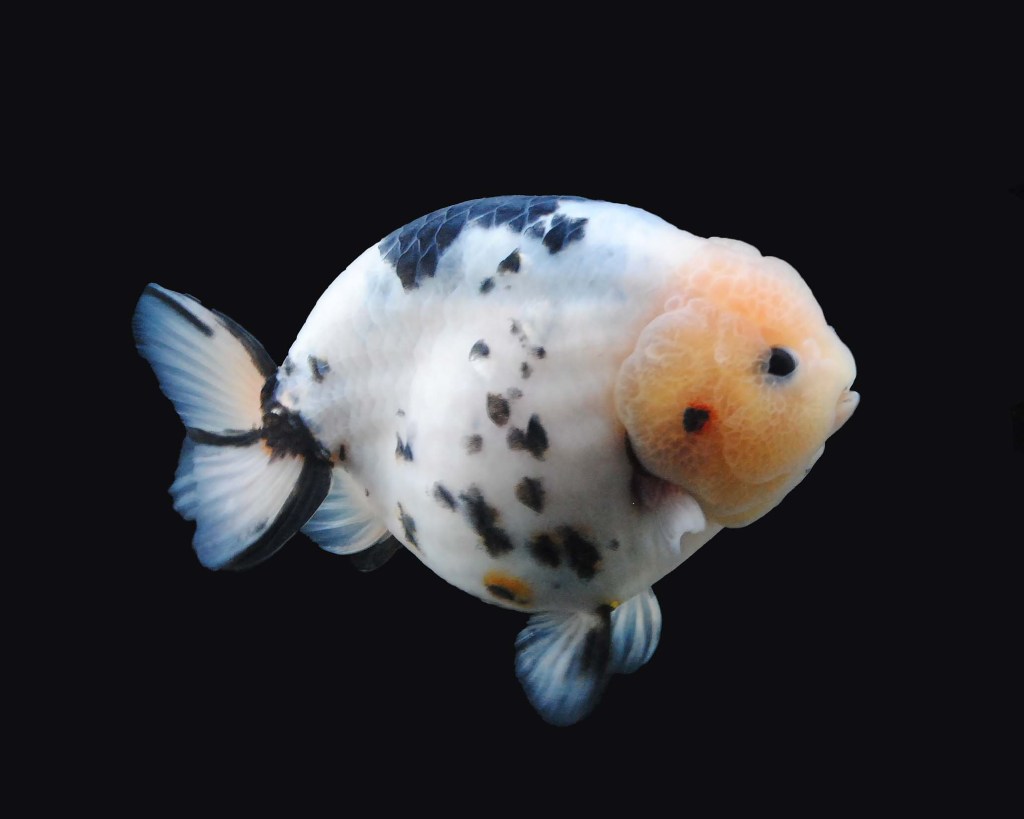
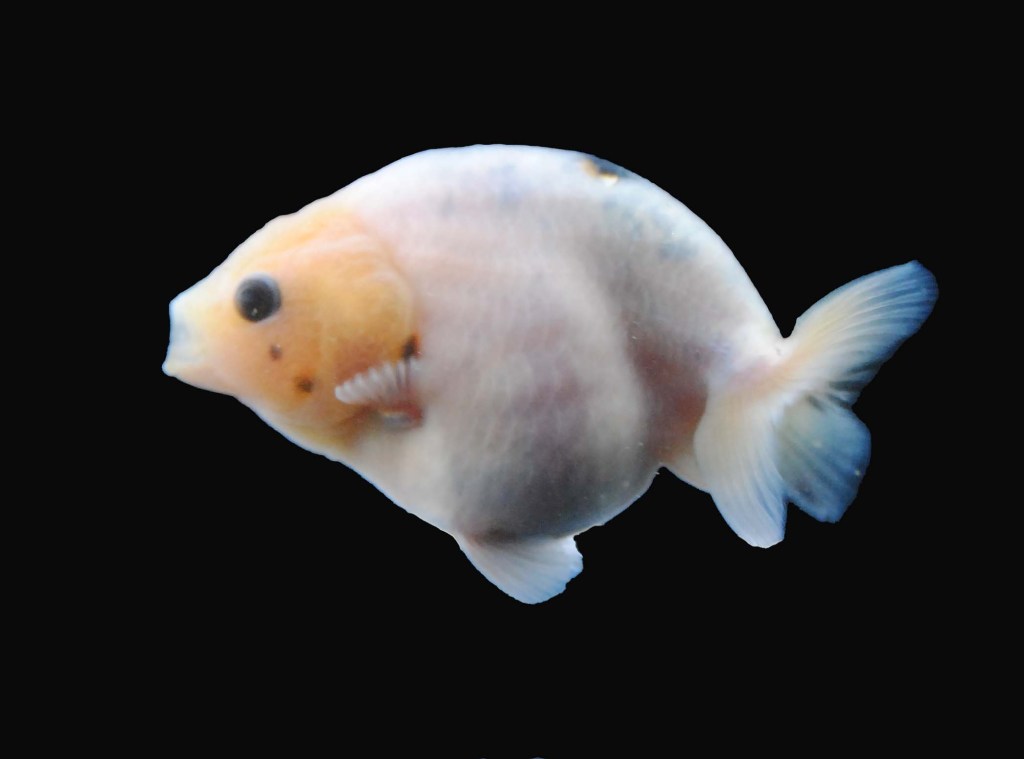
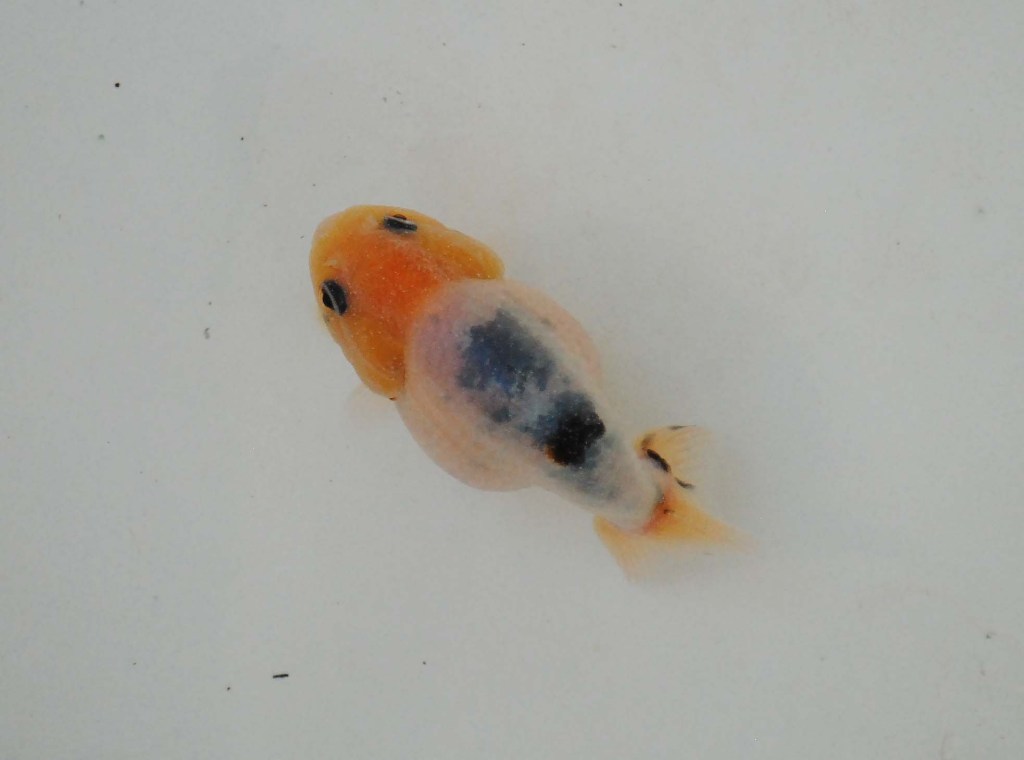
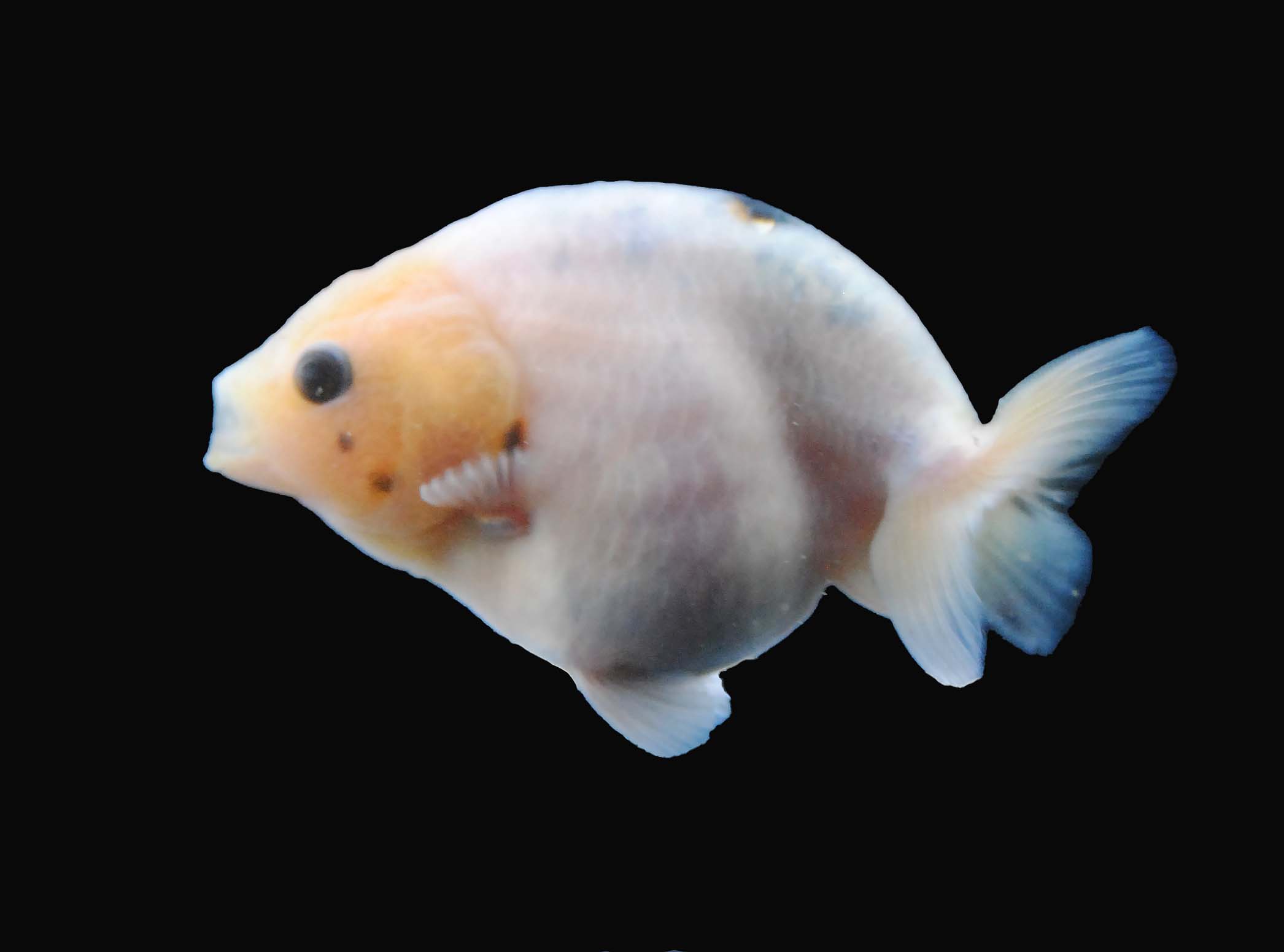
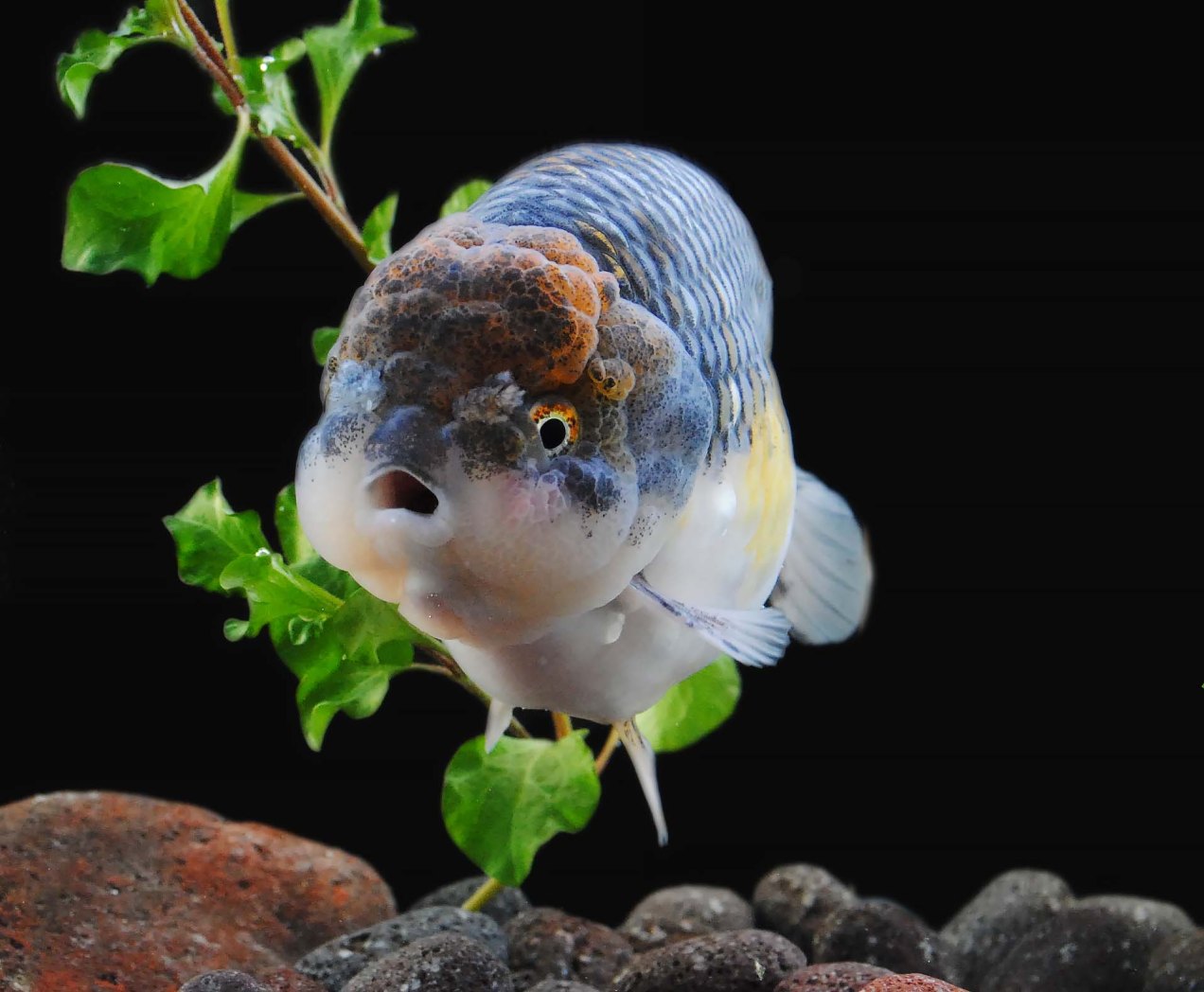
There are the white (pink) with hints of black pigments as well as the calicos. But there are also the Casper (without any black pigment in the body), the Tiger (with red pigment dominates the body), and also three more unidentified variants.

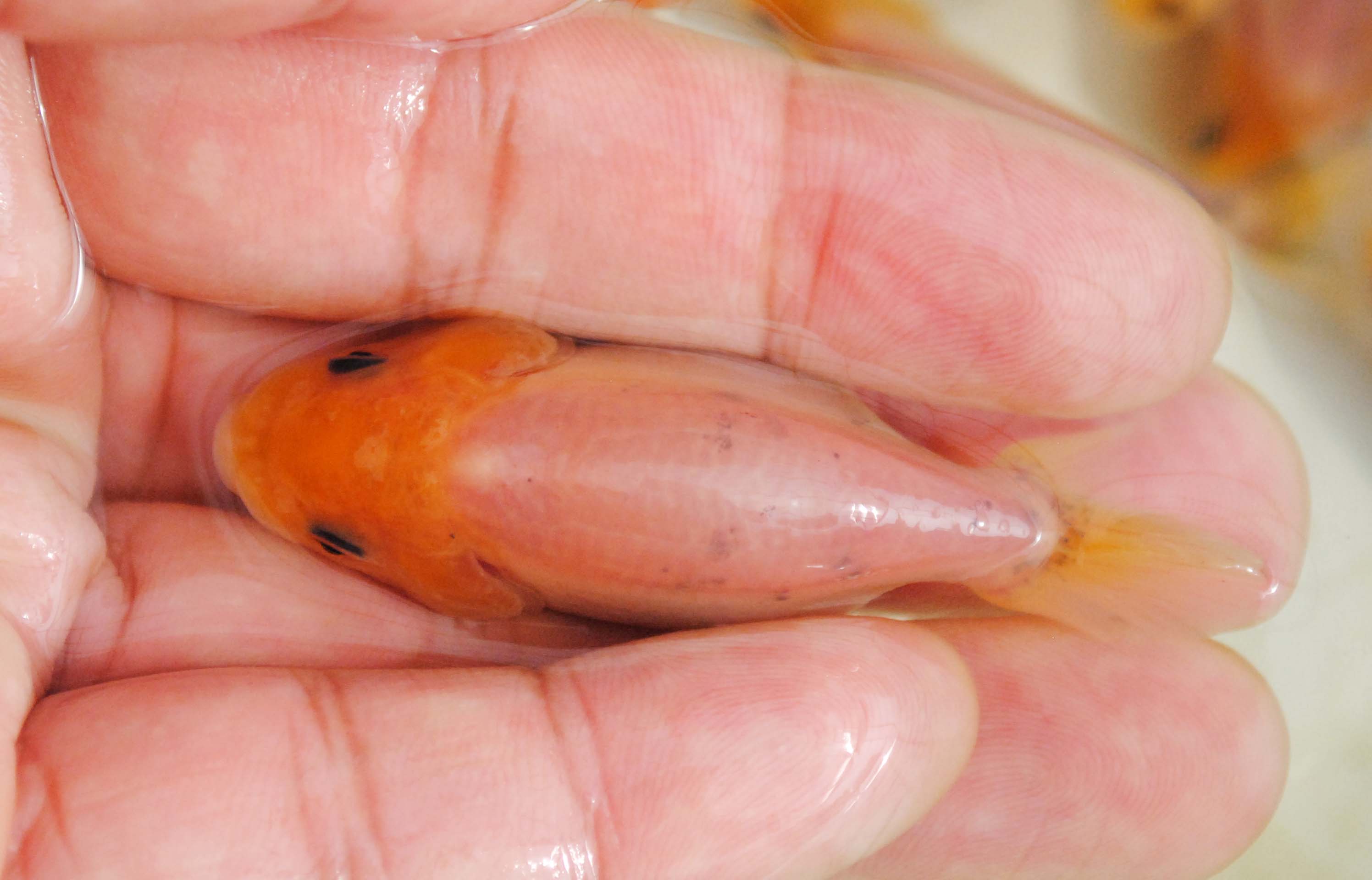
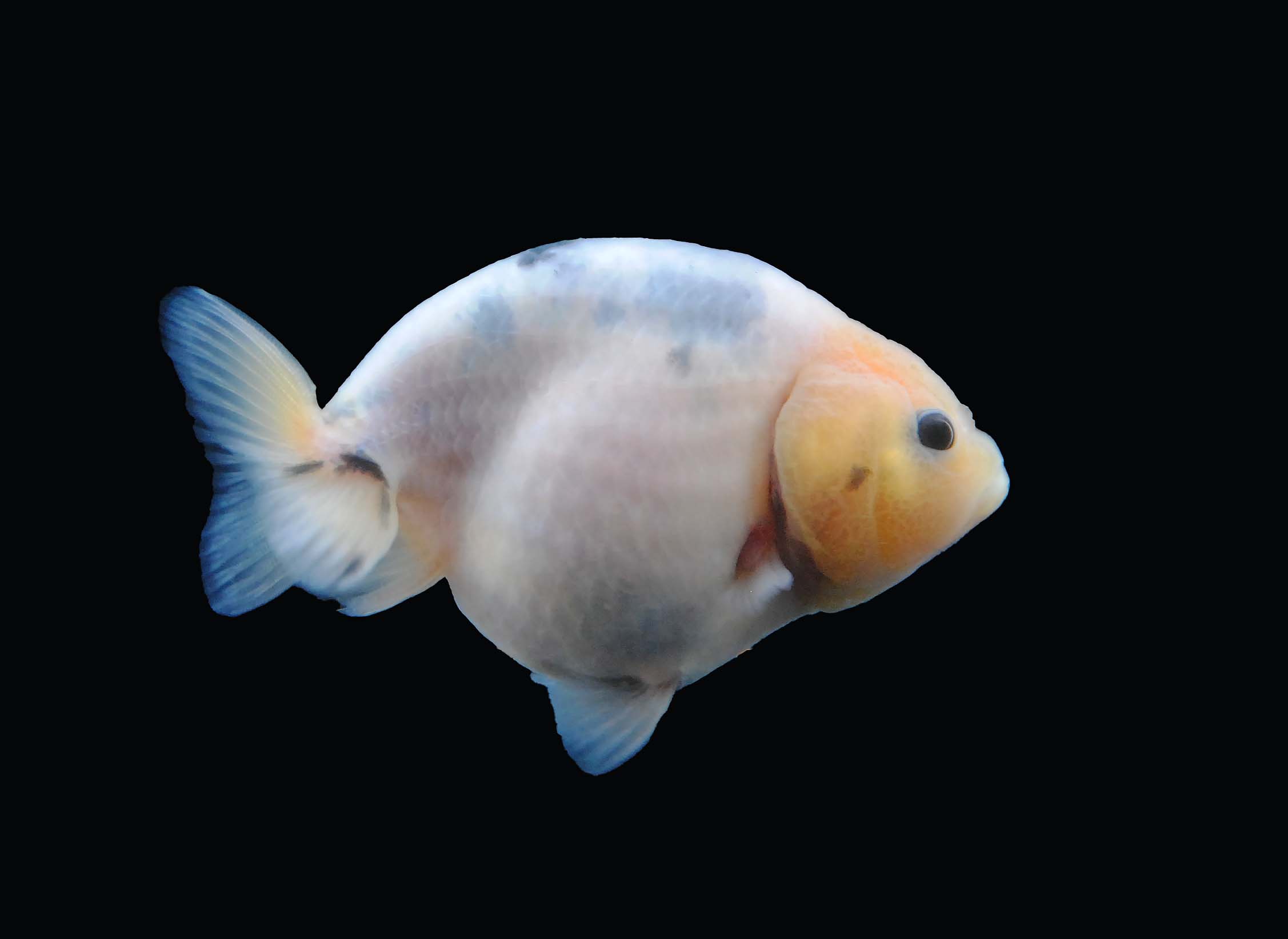
This is the Casper:

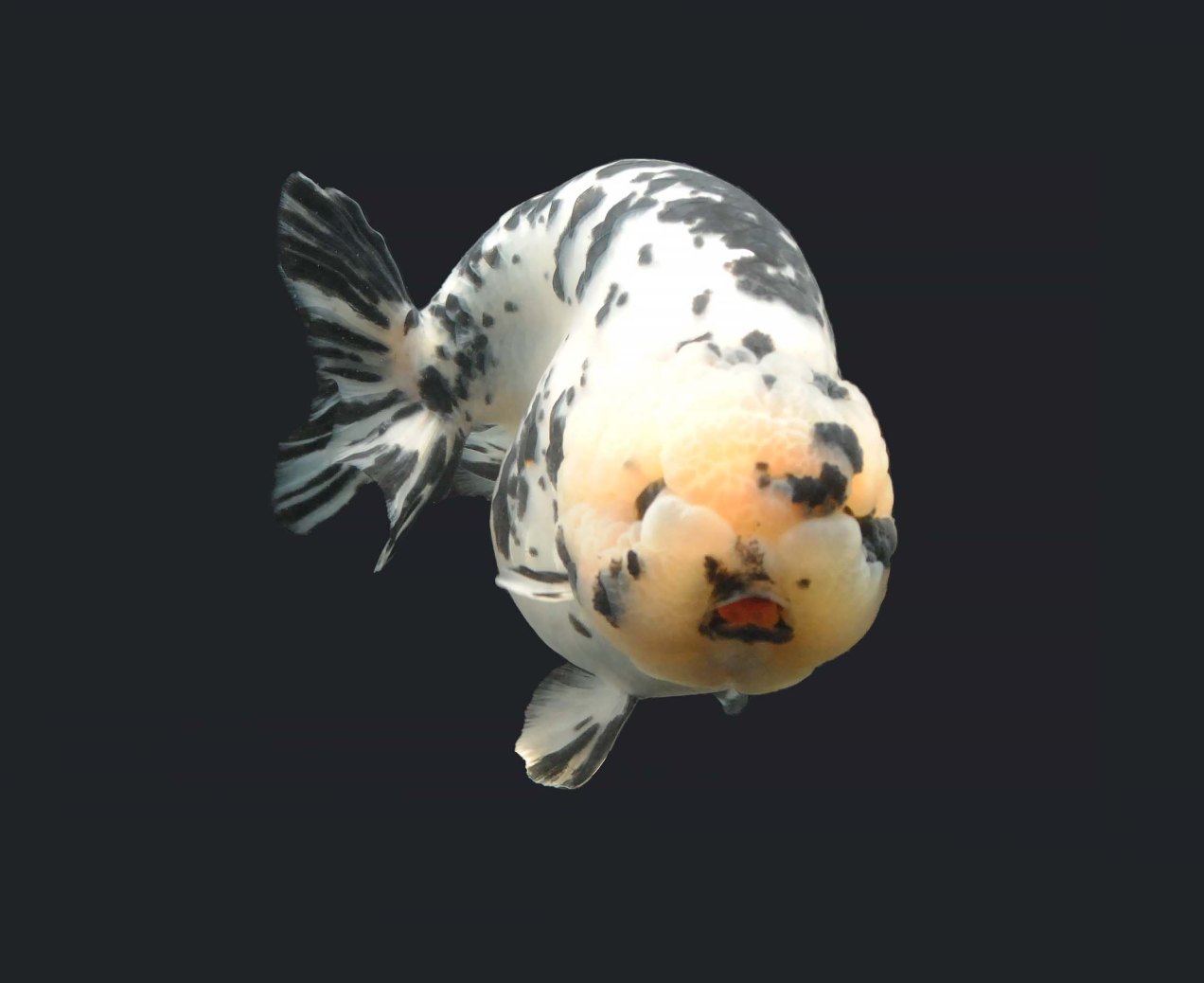
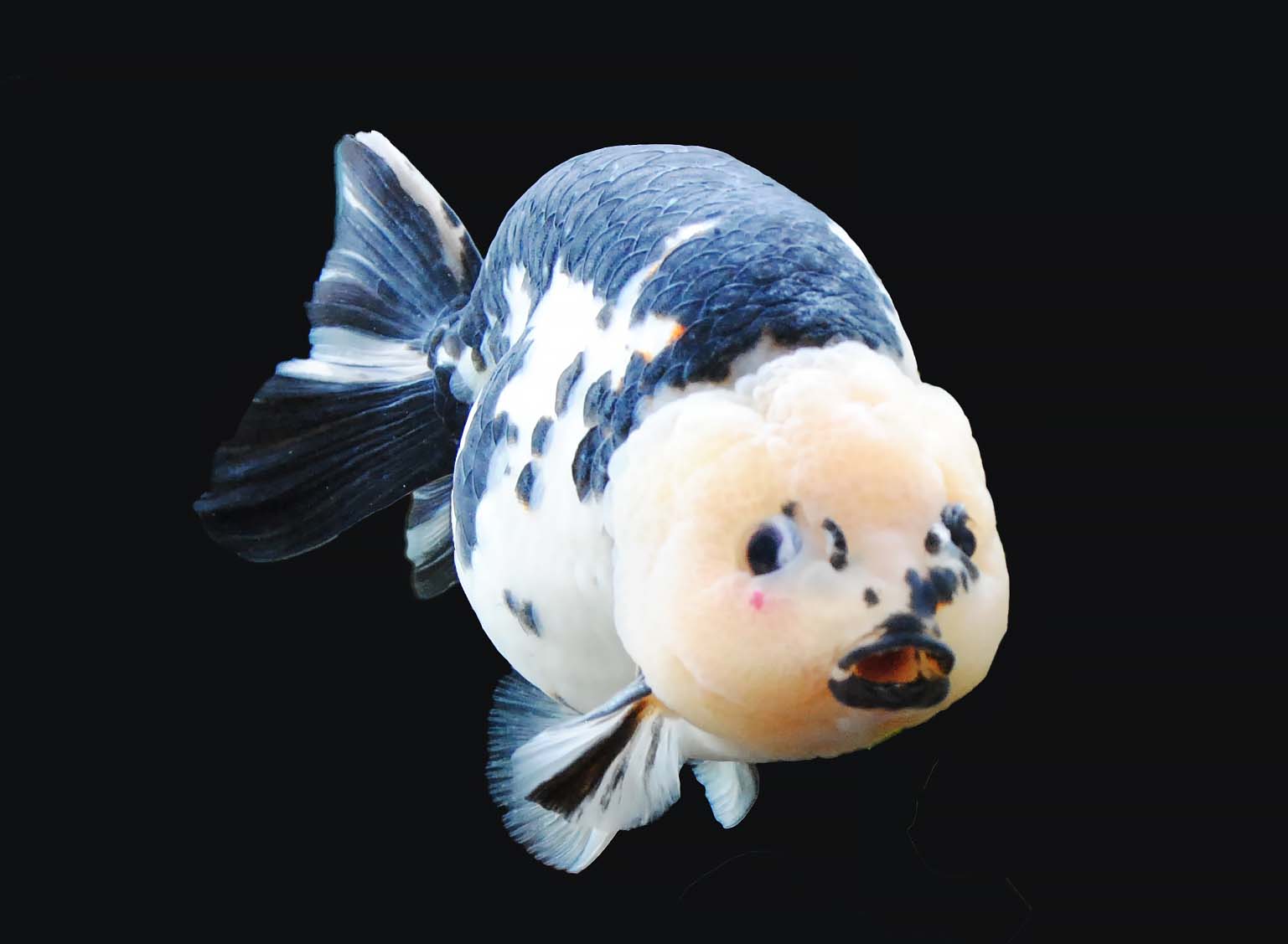
This will be the Cow, I guess:

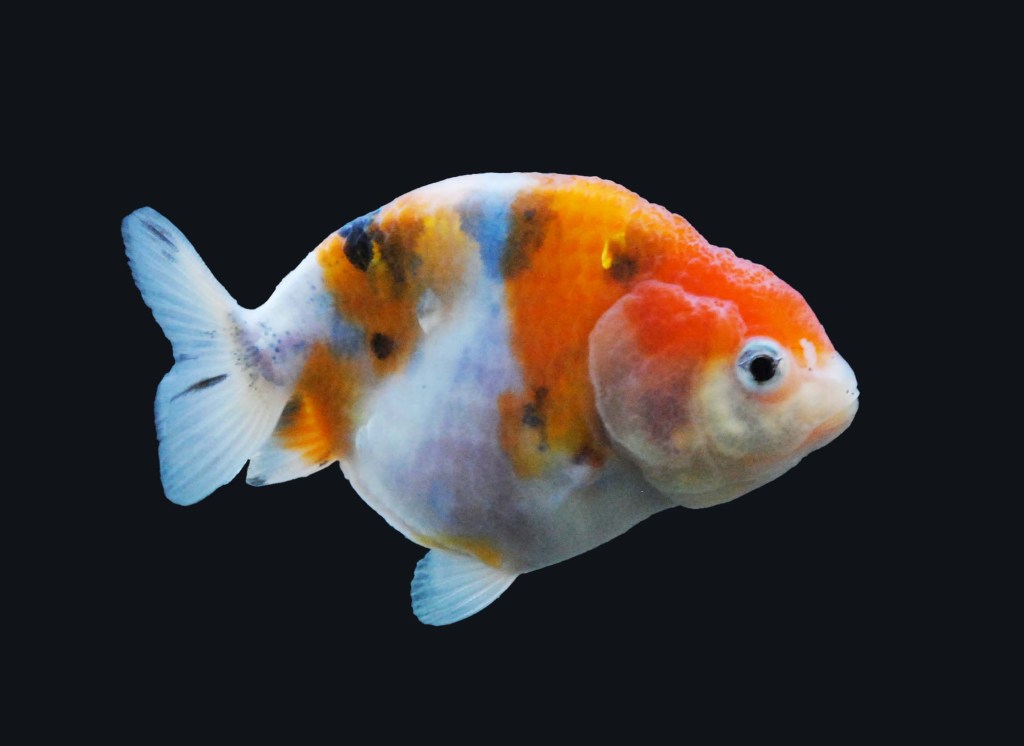
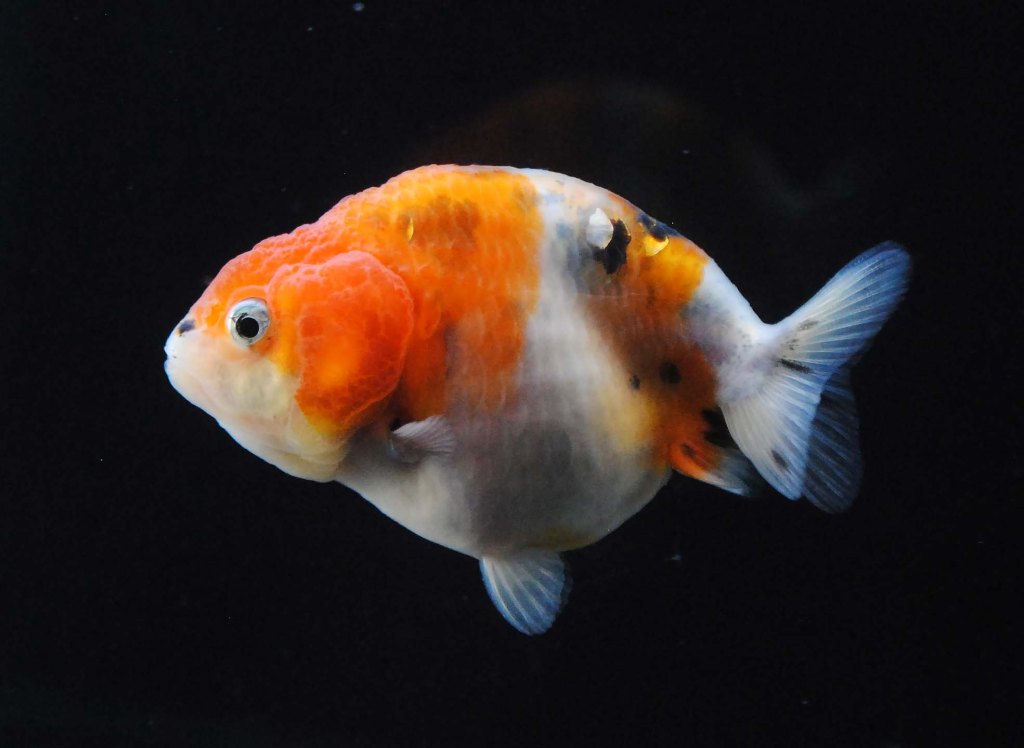
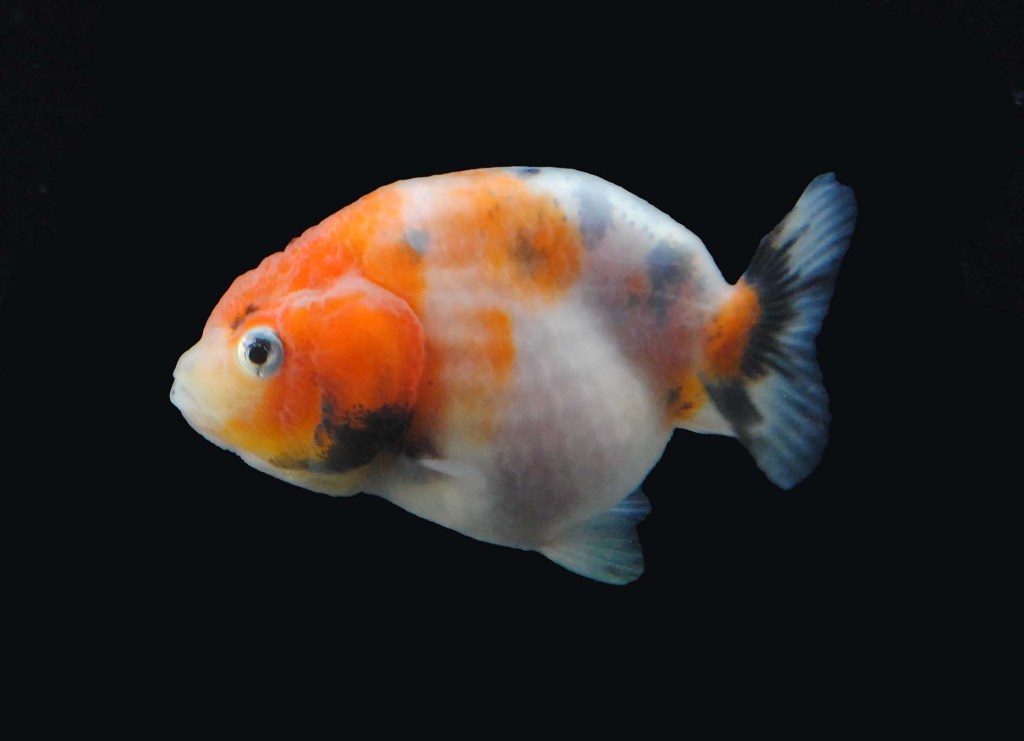
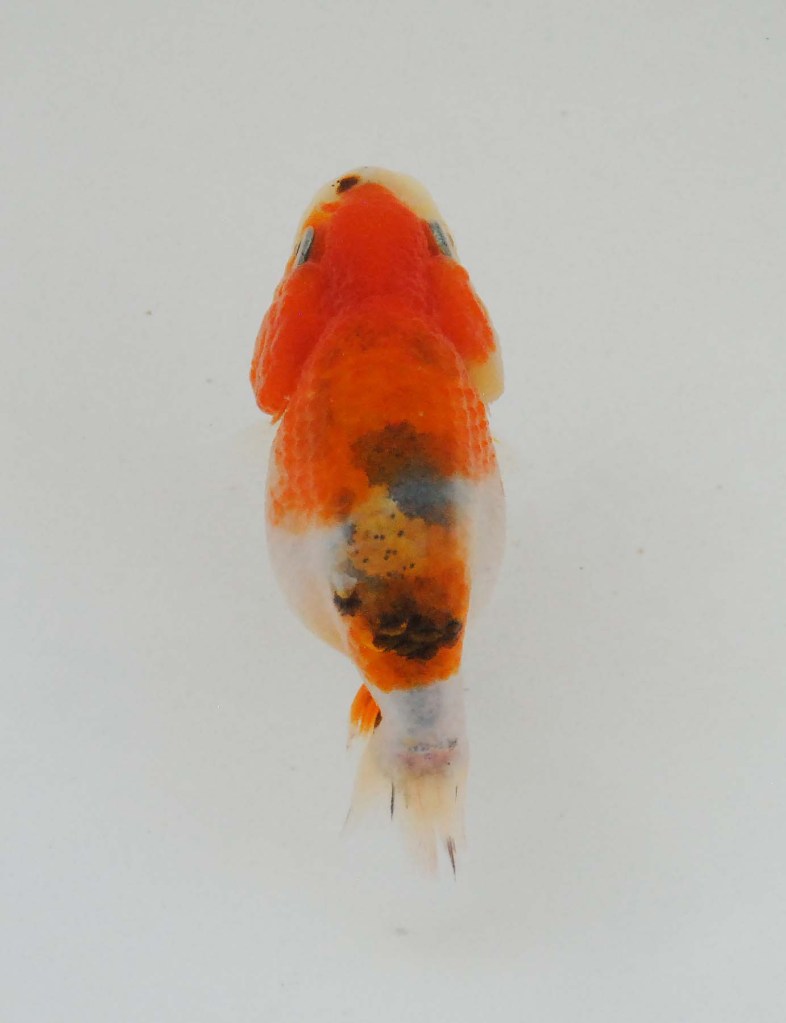
This is the Calico:

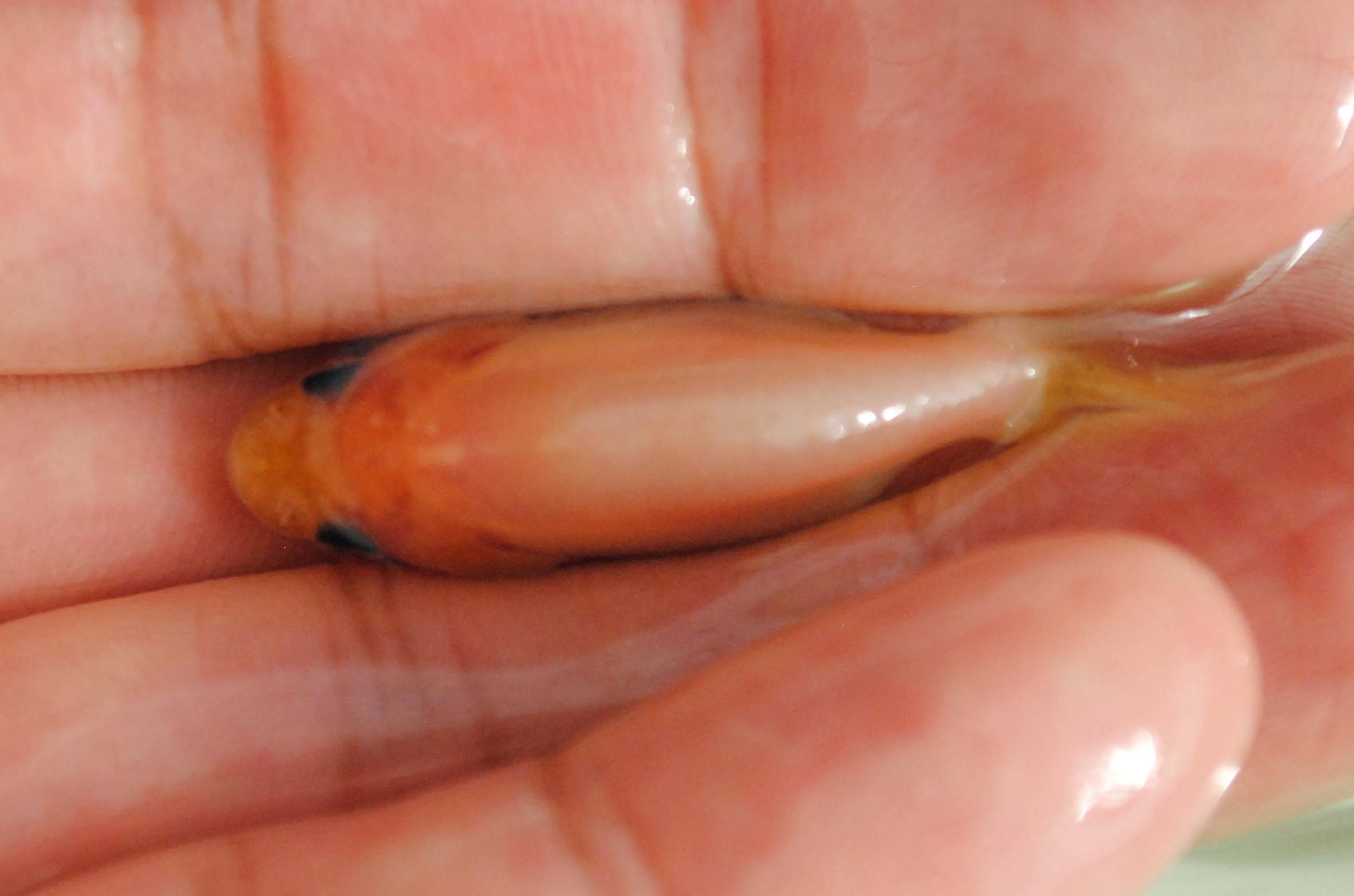
This is the Tiger, and I am sorry I forget to take the topview picture:

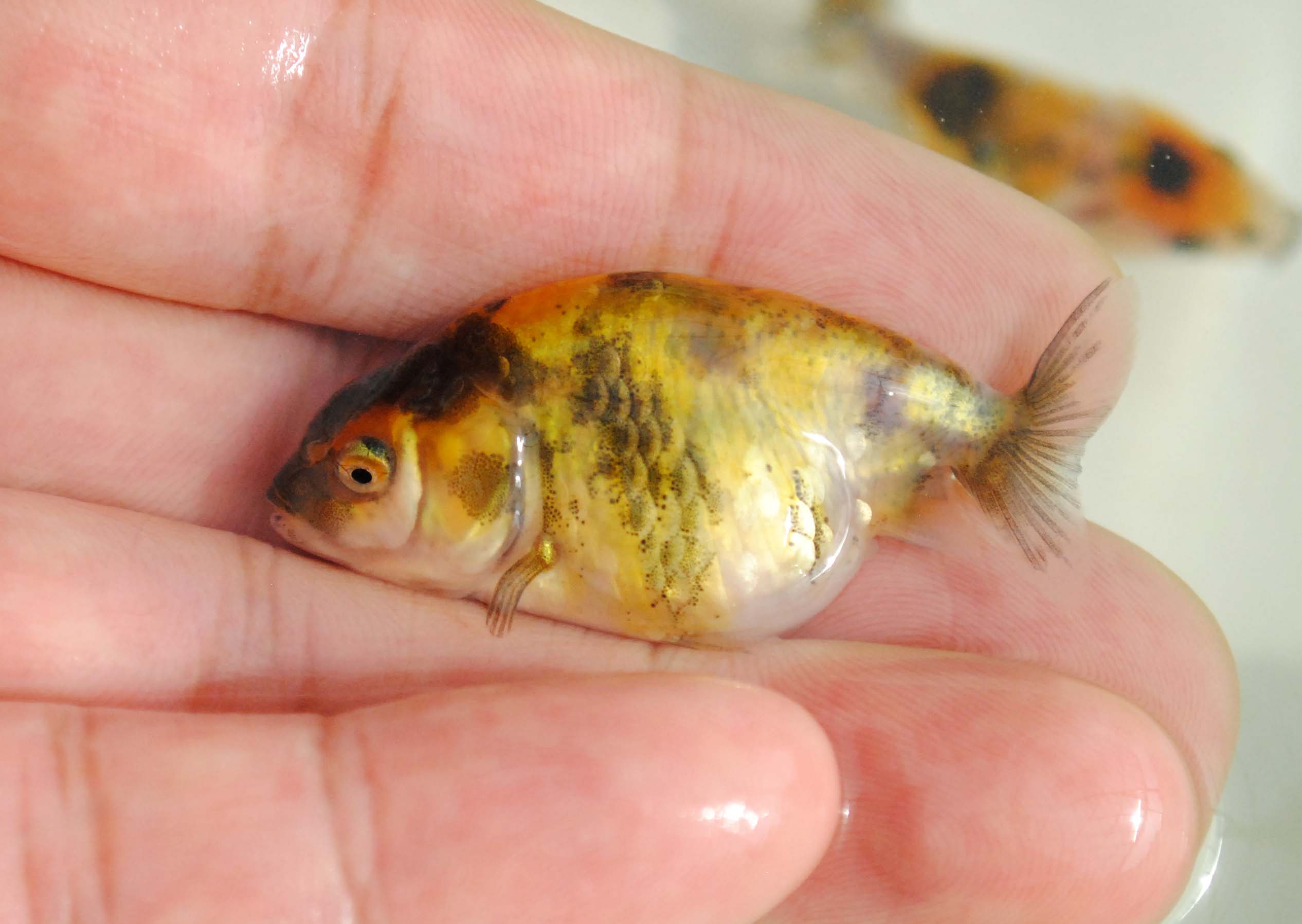
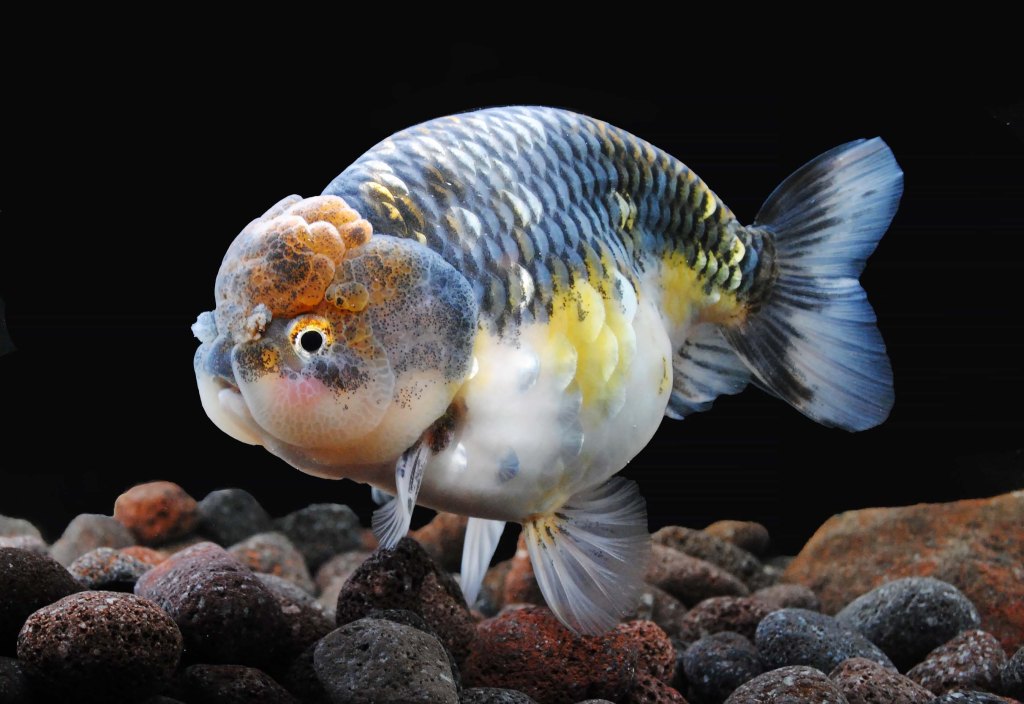
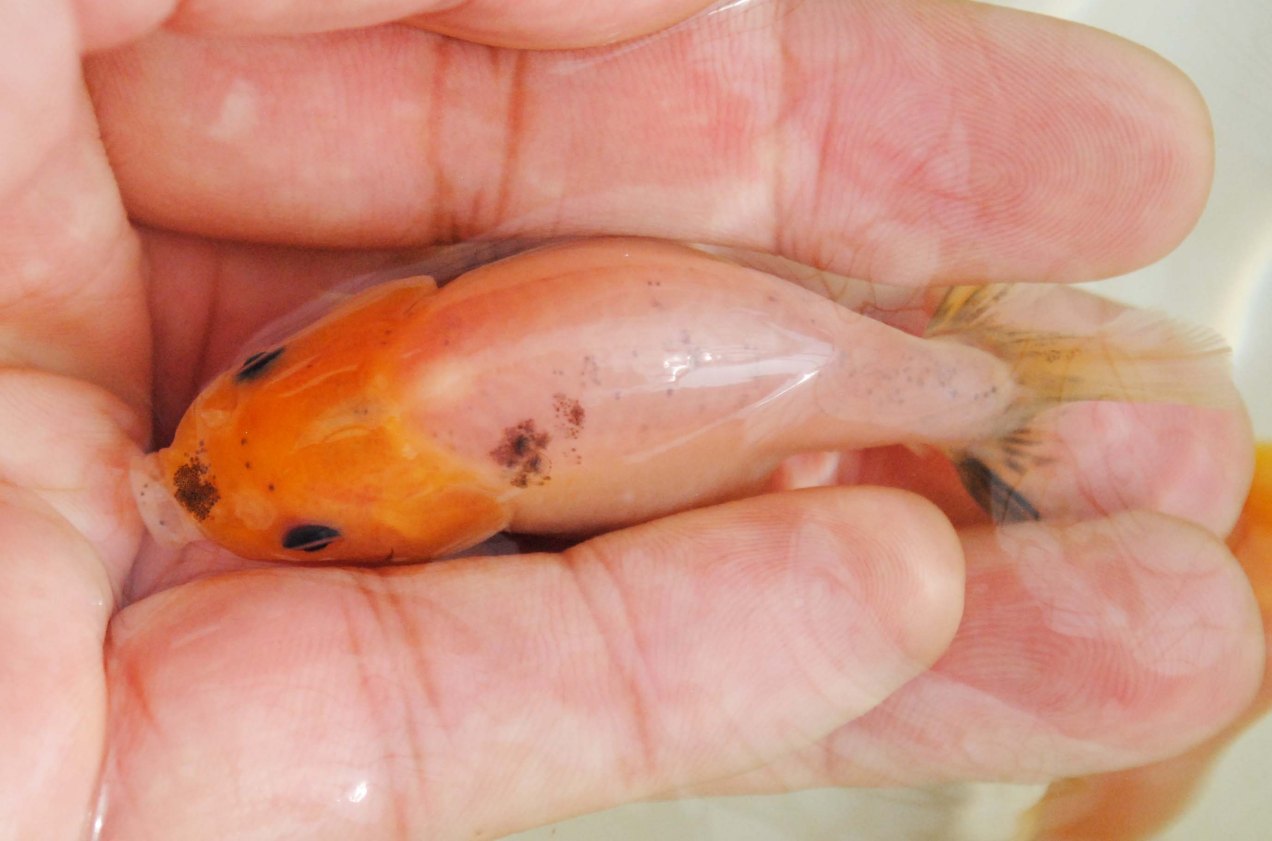
These two are the first unidentified variant. They have white and purplish coloration with black dots:

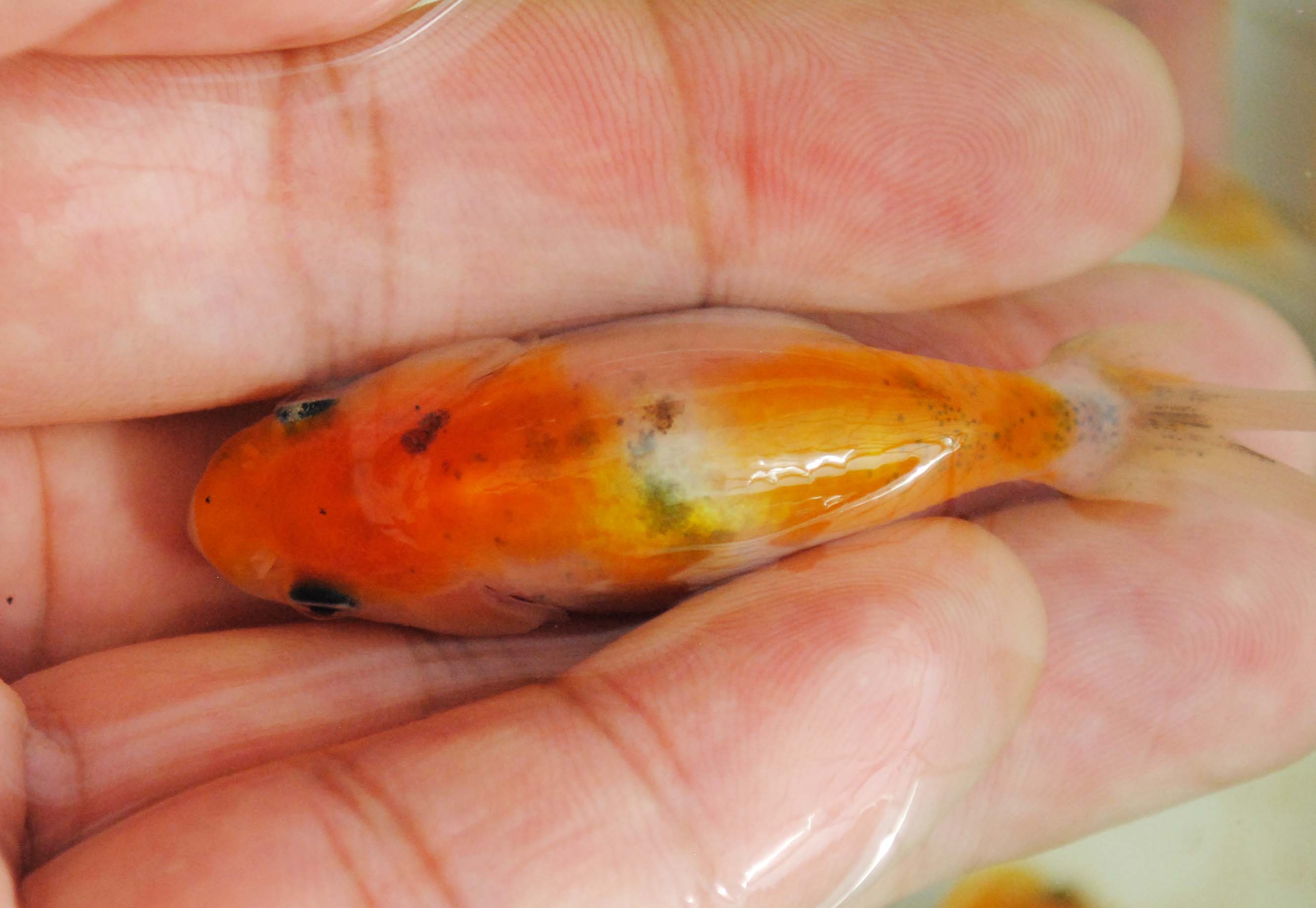
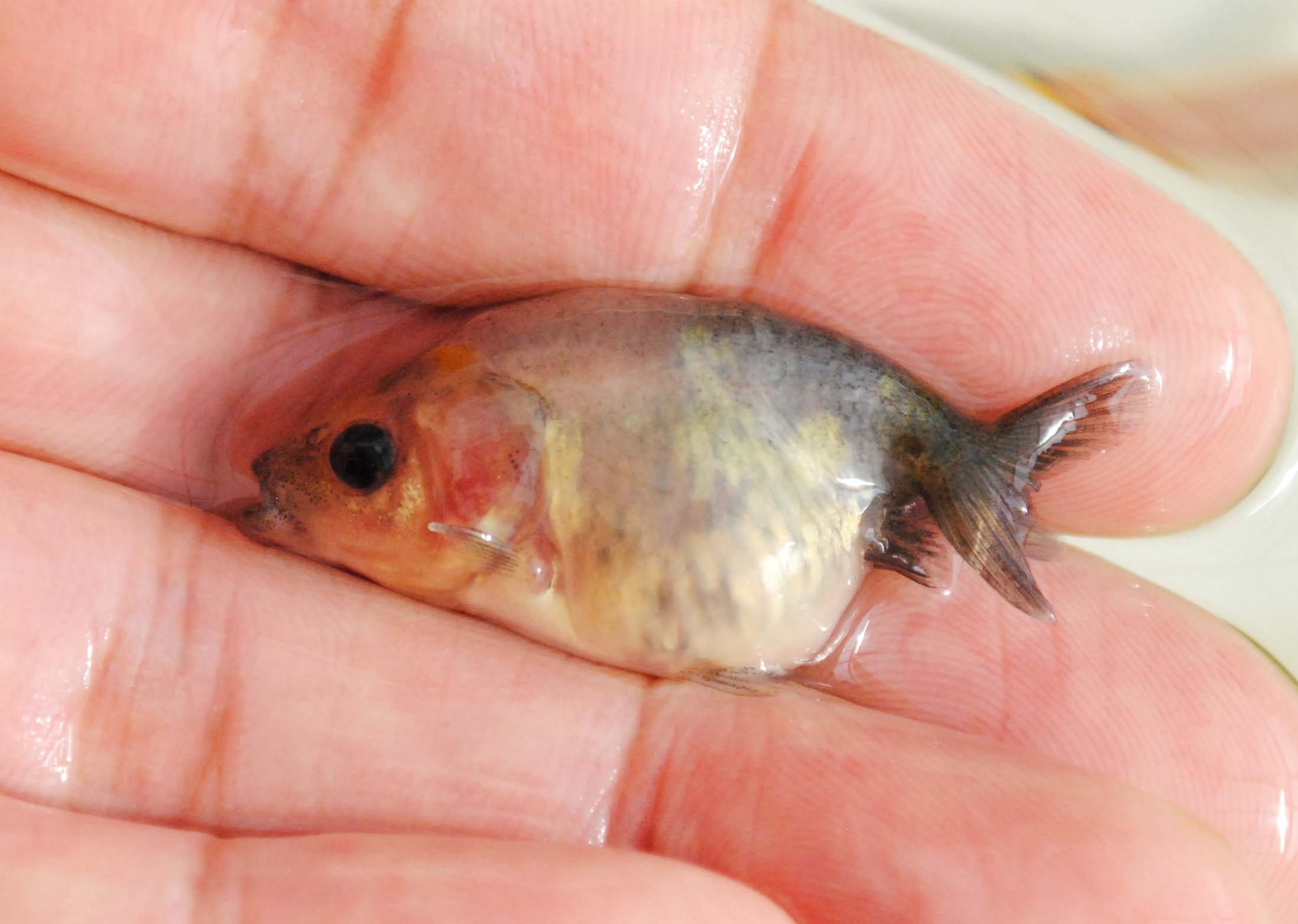
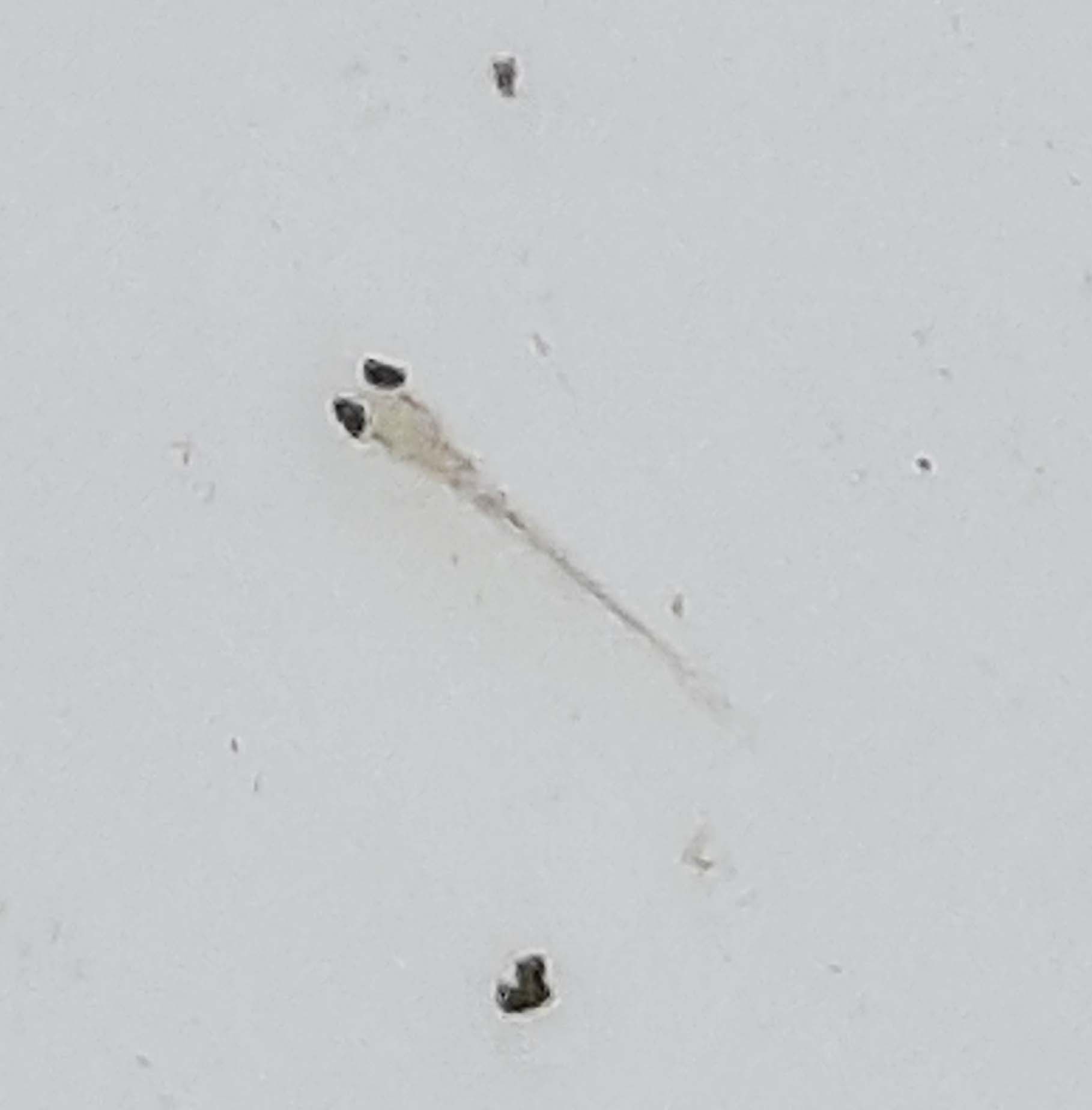
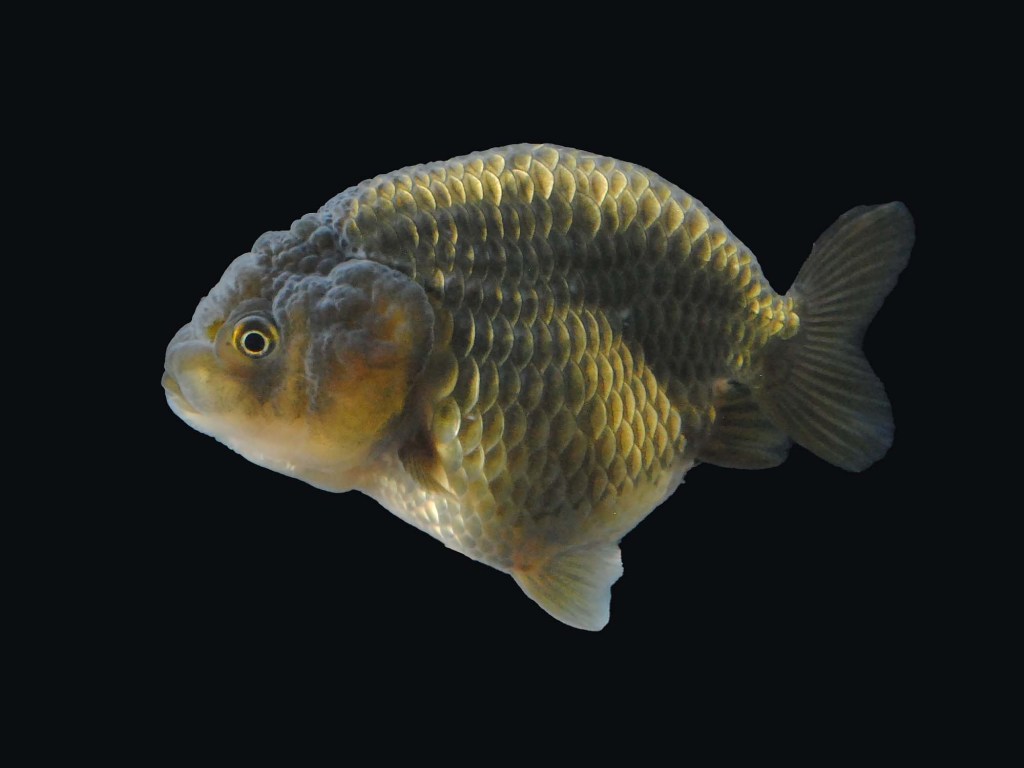
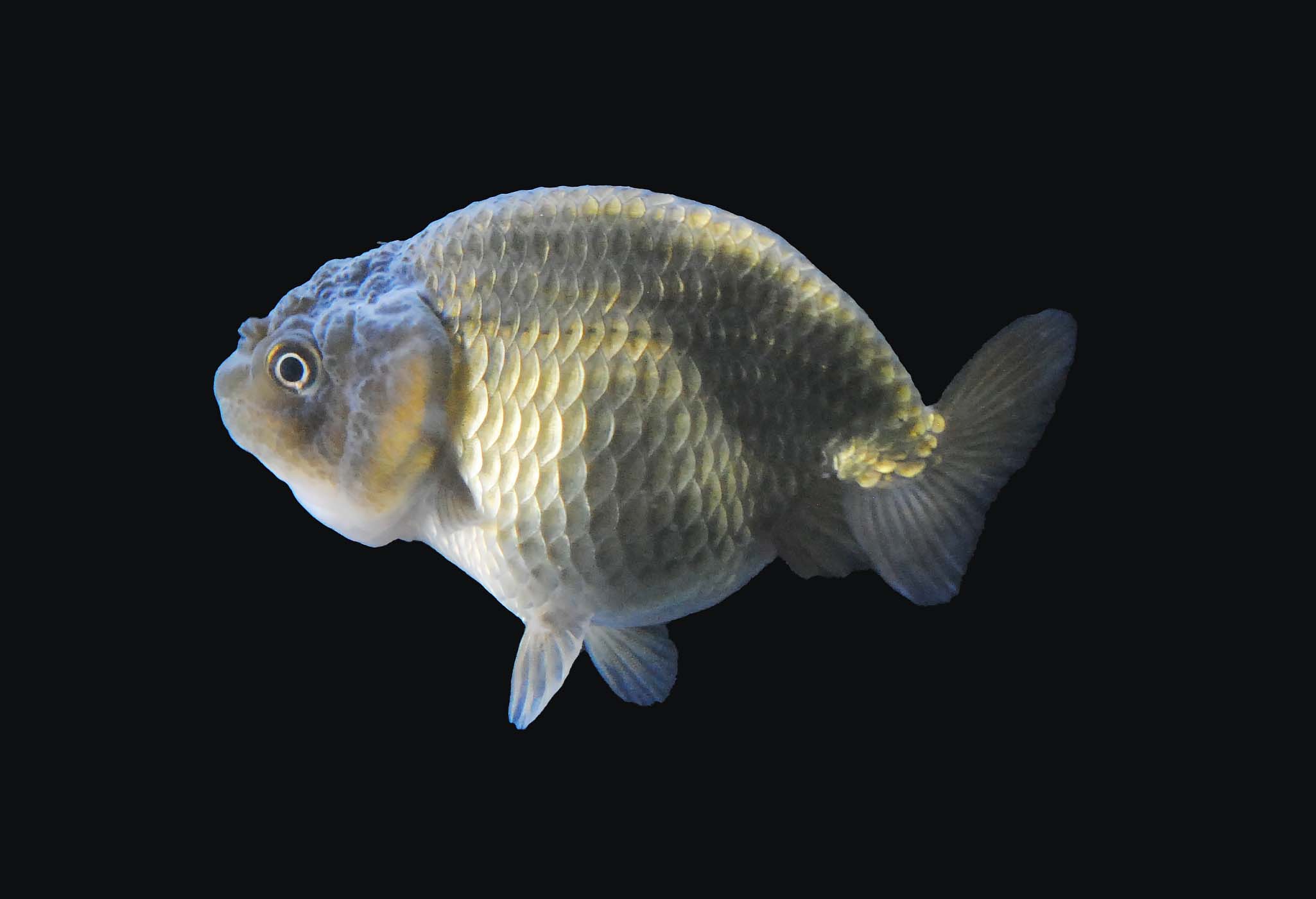
These two puzzles me, since they have green color (like wild fish) but with some part of the body being purplish. And their scalations are transparent:

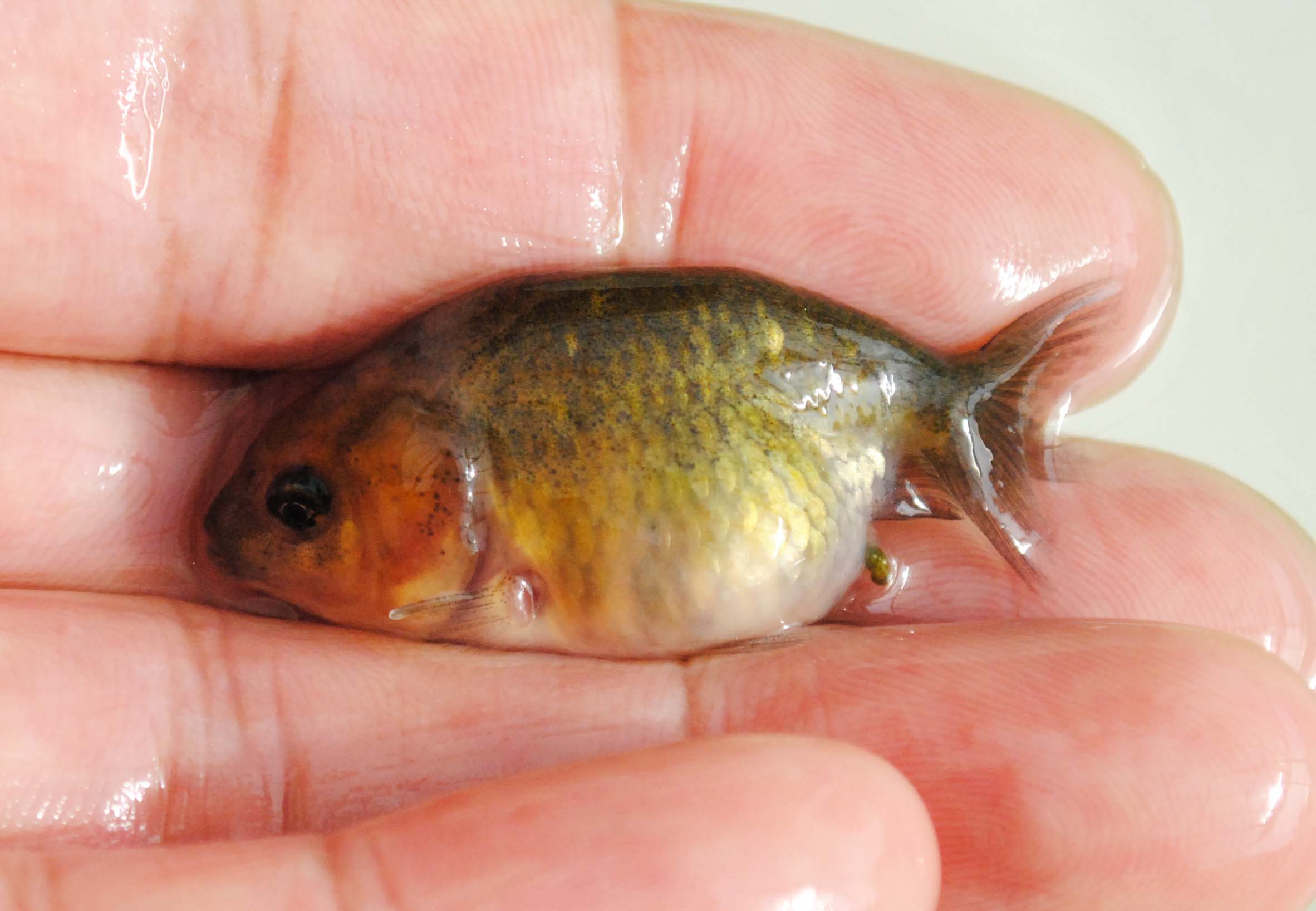
And the last one is similar to the previous two but without any purplish color. And at first, I thought the color was metallic scale with wild color. But now it develops transparent scale in its stomach, and the metallic scalation becomes blur. I am not sure how will it develops:

For me, it is interesting to see that these two matches produce different result. It shows that many fishes labeled as Cow Ranchu might carries different genes. Some can yield true cow coloration (with small percentage of calico) just like my first match, but some can produce all sorts of transparent scale variations as the second match shows.

The greenish ranchu is another interesting case to watch. I am enthusiastic to see what they will become. Will they produce interesting color? Or will they be just dull coloration subject to cull out?

Standard
Purple goldfish, purple ranchu, The Diary of a Goldfish Breeder 2022

The Diary of a Goldfish Breeder 2022 (2)

Last year I made a plan to focus on improving my lines of Oranda. This year I will focus on ranchu breeding. Although I was preoccupied with Oranda last year, I managed to start early with my Purple Oranda improvement project. I bought a very bulky male ranchu. Unfortunately I did not document him well before he died. He was a large red white fish, with a very thick backbone. In fact, it was the backbone feature that attract me to buy him. The headgrowth was minimal, and no funtan. I mated him with a small, weak, and thin purple ranchu from my own line. But she had funtan feature in her headgrowth. I am sorry I take no picture of her, either. At that time, my purple ranchu vigor has decreased drastically, perhaps due to successive generations of inbreeding. My bad. I should be more responsible with my lineage.

Anyway, I took only one shoot from that mating pair. As expected, the results are all red white or red / orange fish. I selected the best few to prepare them for breeding. They looked promising. Most of them had strong and thick backbone. The majority also had wide body depth. Those are two features I am looking for. The back shape can be categorized into two: the round one and the flat one. The headgrowth is varied between minimal and lushly. Some might be categorized as hybrid or lionchu type of headgrowth. Satisfying stocks!

However, there is an alarming development. They have come of age, and no sign of mating activity! I have tried to induce the mating with no avail. At this point, I have no more purple ranchu in my collection. So, if these semi-purple fishes are sterile, then this purple ranchu project is doomed. My mind wanders far away. I already think about mating the male semi-purple with my female brown ranchu. This strategy can surely revive the purple ranchu. But, I only have two female brown ranchu left. And the same problem occurs. They have become so big with no sign of being productive. The most extreme thought I have is to start from zero again: to cross my purple oranda with ranchu. It will be another painful and long process..

Here are three male semi-purple ranchu:

There are two female, yet one is not in the best condition when I take these pictures. So, I only take this one:

This female has a problem with swimming straight. And she has a small tumour in her back. Yet, she is full of vigor, especially in the feeding time 😊 She is always the first one to devour the pellets.

Last month (Januari) I started to renovate my breeding area. I was compelled to move many tubs indoor. These fishes are among those I put indoor. It came as a surprise when in a certain morning I found them chasing this female! I was very happy.

I usually operate under the principle that the first eggs are weak. So, it is my custom to let go the first eggs. But in this case, I decided to collect the eggs. I fear that I might not have the second chance.

I hand-spawned them. I only used the first and second male, since they have the desirable round back bone shape. And they hatched well several days ago! Thank God!

After this first mating, they do not mate anymore. I quickly realize that they are not in a healthy condition. Perhaps due to the unfavorable climate. Many fishes fall ill at this moment. Right now, they are in quarantine. I am so glad I make the right decision to collect their first eggs.

These are some of the offspring:

I want to point out that the offspring of semi-purple goldfish will consist of two different color: the light one and the dark one. The light one is the purple color, which usually falls into 25% of the offspring. The dark one will become red or red white (50% of them are semi-purple and another 25% are true red / red-white). The following two pictures show the color comparison:

These two colors must be separated as early as possible since the light ones are usually weaker and cannot compete for food well with their darker siblings. I separated them one by one as soon as they are able to swim (the 2nd or 3rd day after hatching).

Yet, there is always one type of offspring that puzzles me. It has light color but there is a dark area in its body. I encounter this phenomenon always. Yet, I have never separated them to see what they become. I usually put them under the light color variation. But I cannot trace what they become when they grow into adolescence. I hope someday somebody can look into this in more detail. This is the appearance of the fish:

The latest update is that I have done my first culling yesterday. I have with me about 50 light color ones and 50 dark color ones. I am excited to see how their body quality will turn out.

Thank you for reading 😊

Standard
cow ranchu, The Diary of a Goldfish Breeder 2022

The Diary of a Goldfish Breeder 2022 (1)

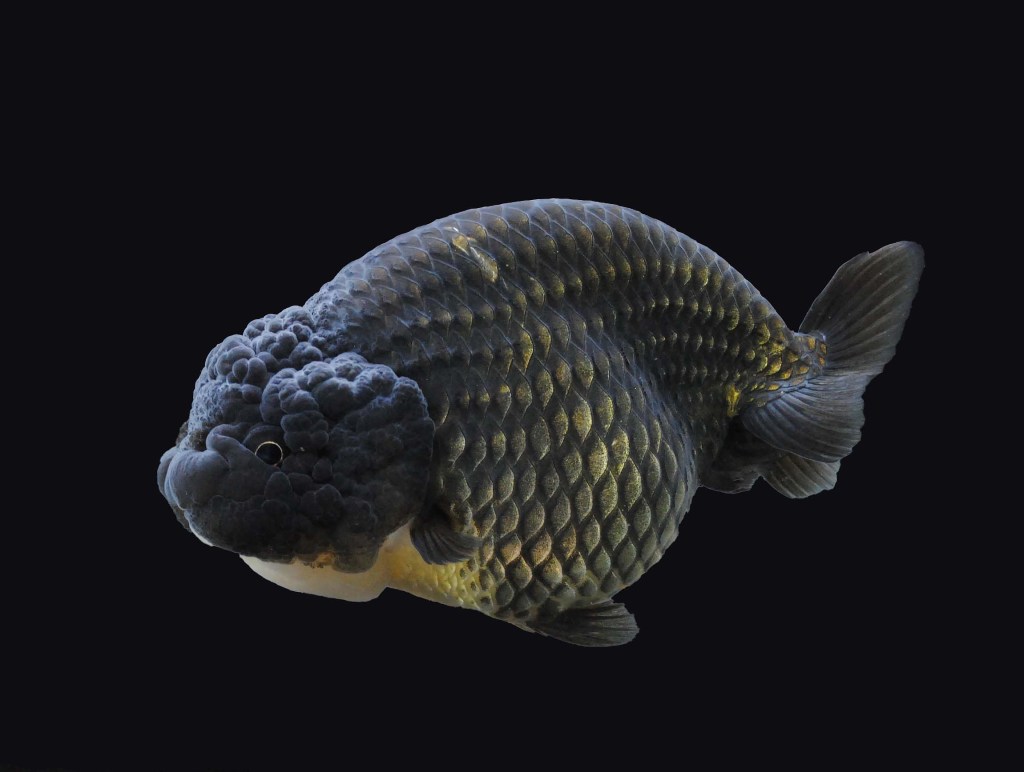
This new year I got a pleasant surprise that could propel my cow ranchu project. But first, let me update the color development of my cows. It is interesting to see how the black pattern grows.

This is my Alpha male. He is my own breed – my only success so far. The last time I took his pictures (last year), he looked like this:

And now, he turns into this beauty:

Impressive, right?

Last year I bought several more. The seller called them Milk Cow Ranchu since they were dominated by white color and the black came in few large patches. But the color progress proved them not so much different from my own breed. This makes me wonder whether I do something wrong in my keeping or it is the genetics. Here are their pictures before and after:

Male fish (Before):

After:

Female fish (Before):

And she turns into:

The transformations are almost magical! That is the wonder of Cow Ranchu!

Yet, this Cow Ranchu project proved to be quite a challenge for me. Three years of trial yields only a single good fish (the Alpha Male). During these years I have acquired many cow ranchu from different lines (and they are expensive!), and still no success. The female above gives me no satisfaction, either. It yielded few eggs. Most of the eggs did not hatch. Some of the hatchlings remained at the bottom, unable to swim. And those who could swim and grow, had so many problems with the quality and swimming ability.

Dec 29, 2021. A Friend notified me about a local online auction featuring cow ranchu. So far, there were rumor about local farmers being successful in breeding cow ranchu. But as far as I knew, none had been released into the market. When I took a look at the auction, I immediately realized that was a genuine cow ranchu since I saw her resemblance to one of the line of cow ranchu I acquired so far. Many local farmers tried to create cow ranchu from the local calico available here, but none was successful. The only option was to breed from imported parents, just like I did so far. When I saw the fish in auction, I could not determine whether it was an import fish or a local breed. But it did not matter to me. Then friends told me that it was a “tired fish.” They said the fish had been used as female parents exhaustively to the point of being unproductive anymore, and that was the reason it was on auction. Well, I did not buy that story. The news that she had been used in breeding was a good news to me! Concerning the fish being tired, I had a determination to treat her well to induce her to breeding again. So, without further ado, I won the auction. Concerning her real background, I felt no need to investigate. There are things better left unquestioned. Here she is:

She turns out to be very productive! When she came to my place, even in the quarantine stage, she laid thousands of eggs! What a blessing! Of course I did not hatch the eggs since she was still in quarantine alone. After that, she laid lots of eggs again. In my rough calculation, the hatching rate was around 90%. And the fry were healthy and able to swim well. Two days ago, I examined the two weeks old hatchlings and I found their quality satisfying (in terms of the smooth curve and erect tail). Now, I am waiting for the color to develop into true cow or not. In my heart, I am very satisfied. Perhaps this is a bit too early, but I feel that my cow ranchu project has already been successful, and I need to move on to a new project. I will tell you what is in my mind at the end of this essay.

The fish laid another thousand of eggs for the third time last week. I know I could not take care of them. My farm is small, and I need to do some renovation next months. I have dried lots of my tubs for now. This will pause my breeding activity for at least a month.

But I felt reluctant to let the fry go to waste. What to do?

In this case, I decided to share. I clarify my thinking that this breeding activity is mainly a hobby for me, not so much for profit. Yes, I sell my fishes when I had too many, but selling is not my main purpose. So, I send all those thousands of new hatches into a farmer in the village. He will be able to raise the fry better than me. This is also an opportunity for me to learn not too attach to selfishness.

What is the new project I have in mind?

I am thinking of crossing my sakura yellow goldfish with the cow ranchu!

When the cow ranchu become more available in the market and not unique anymore, I will be on my way to create yellow cow ranchu! Let’s picture cow ranchu but replacing the white color with yellow! Another two years of project 😊

Standard
cow ranchu, The Diary of a Goldfish Breeder 2021

The Diary of a Goldfish Breeder 2021 (16)

I am really enchanted by Cow Ranchu. Producing one good quality after several years of effort cannot be considered as a success. I might need new ammunitions. Gladly, a seller friend (Kwan Goldfish, Jakarta) imported several beautiful Cow Ranchu several months ago. I observed that they have different characters from mine. I quickly bought some of them. I selected the fishes with least red pigmentation since I could not find any without any red color. I also chose the ones with minimal black patches. Well, this is a personal preference. I believe the black color will grow.

This is the suspected male.

The next one below is a female. She does not lay eggs yet.

And the last one is surprisingly productive. She lays eggs from the start. The eggs are not many, and some are infertile. I guess this is the first time for her to lay eggs. She is a bit too young. I expect better result from her in the coming weeks. I mated her with my current male Cow Ranchu (from Diary #15) since the male sibling does not produce enough sperm yet. Probably he is still very young.

And these are their pictures from top-view:

Wish me the best to be able to breed them 😊

Standard
cow ranchu, The Diary of a Goldfish Breeder 2021

The Diary of a Goldfish Breeder 2021 (15)

My Cow Ranchu babies that I mentioned in the Diary #10 this May have matured and are ready to spawn. This activity takes away a lot of time and space from my Oranda projects for the last several months.

One surprising update is the transformation of one particular baby. As I looks back to his pictures in May, I marvel at his current transformation. These are the before and after pictures:

The black pigment has grown significantly in just several months. This transformation happened also in his father. (https://hermantogoldfish.com/2020/10/31/the-transformation-of-my-cow-ranchu-2019-2020/) I can confidently conclude right now that Cow Ranchu has the ability to grow their black color. This conclusion comes with a note. In my observation, when the young fish has black pigment, be it a black dot or a large black pattern, which exists on the surface of the skin, then the black pigment can grow. But if the fish is totally white without any melanin present in any layer of its skin (some call it Casper) as in Casper the ghost), or if the black pigment exists only under the skin (some call it blue-based / bluish color), my conclusion does not hold. I am not sure yet if the outer black pigments can emerge in such fish.

This cow is a male. There was another male I mentioned in the Diary #10. But since the tail was too widespread, I discard him as a male parent.

The female is the only grey one. She was the offspring of a different version of Cow Ranchu (which I have not documented well – sorry for that). She does not change her color. These are the before and after pics:

The tail is a bit widespread, but I still use her for lack of choice.

What is interesting in both fishes is the small tail size. The current market names it the Tiny Tail. And this feature carries forward to the next generation

I mated the Cow with the Grey several times. As happened many times before, the result is far from satisfying. All of them are calico (no cow color), and mostly come with all sorts of defects. Yet there is an improvement this time. From the first batch, I keep five of them. This is better than before where I discarded all of the offspring. From these five, only the first two I consider as my prize. The rest are just backups. Here they are:

Though the back curves are not very smooth, the shape of the curve is good. There might be some improvement later on, I hope. And they already have black pigments on the outer skin. I hope to see the black pigment grow. I consider calicos with such quality (the growing black pigment) as an interesting quality. These are the pics from top view:

I will see how the fishes develop and decide later onwhat to make out of them. Perhaps they can be my line of Calico Ranchu. Perhaps I can use them in my Cow Ranchu Projects. I have not documented the younger batches, since they are too small to take picture. But the second and third batches are all calicos.

I would like to conclude this Diary with the pictures of the three backups. Have a good day.

These are the backups:

Standard
The Diary of a Goldfish Breeder 2021

The Diary of a Goldfish Breeder 2021 (10)

I think it has been more than two years I have tried to breed Cow Ranchu but with no success. Not only it is rare to obtain the expected color, to get a decent body quality in the offspring needs lots of luck. Most of them are defected, either totally missing the anal fin or having ugly backbone. I was tempted to give up many times.

Last week I lost the first Cow Ranchu I bought due to disease. It was a handsome Cow.

I was thinking about trying to breed him one more time, pairing him with his own offspring that show decent color. But now that hope is lost.

Well, after so many failures, I currently have four offspring. One does not count, since it is such an ugly fish though the color is decent. I will just keep it as back up. I do not take her picture. The other three are promising, though they are far from perfect. All of them are female.

This one is the best:

The black marking is visible clearly from the top. Based on my experience with the parent, the black marking will continue to grow. I am excited to see what she will become. Hopefully this fish is fertile. It will take another two months or more for her to start producing eggs.

Another one is this:

The tail of this fish is too wide and flat. This tail type hinders the fish to swim well. The curve is not smooth enough. Yet the color is lovely. Yes, it has red color, which make her unqualified to be called Cow. Yet, the black dots look beautiful. I am certain this black dots will also grow.

I have a suspicion that this fish is not the offspring of my first ranchu I posted above. During this two years I bought some more Cows from different lineage. And they look different from my first purchase. I am sorry I have not taken pictures of the 2nd type of Cow Ranchu. From this observation, I conclude that there are more than one lineage of Cow Ranchu in the market. This 2nd fish looks closer to the second lineage I keep.

If we examine the 2nd fish closely and compare it with the 1st, we will see that the eyes are different. The 1st fish has totally black eyes, just like her father. The 2nd one has normal eyes. The behavior of the black markings look different, also. The black marks in the 1st fish tend to be whole, forming a large block, while the black marks of the 2nd fish tend to be in the shape of dots. Those are two differences I observe.

The third fish is interesting:

Yes, this is a wild color metallic ranchu. And this is also the offspring of Cow Ranchu! I begin to speculate that the making of Cow Ranchu might involve metallic scale fish! Perhaps a wild color one, or even black ranchu! Well, this is still my guess. Hopefully my future projects will give me a more solid answer.

So much is the update of my Cow Ranchu project. At this point, I can not do anything other than waiting for them to mature sexually. I will post the update. Wish me success.

Standard
kehidupan dalam air

SEKILAS TENTANG TOPVIEW RANCHU

               Jika berbicara tentang TVR, sy pikir dua hal yang mendasar untuk diketahui adalah tentang apresiasi dan pemeliharaannya.

APRESIASI

               Berkenaan dengan apresiasi, kita sudah sering mendengar bahwa TVR dijuluki sebagai The King of Goldfish. Jadi TVR menempati prestise teratas dalam dunia ikan mas koki. Saya pikir itu sudah cukup untuk membuat banyak orang ingin tahu seperti apa sih ikan yang menyandang gelar bergengsi itu.

               Namun dalam kenyataannya, tidak jarang penghobi bingung ketika melihat ikan tersebut. Muncul pertanyaan seperti: apa bedanya TVR dengan SVR? Dimana letak indahnya? Ada ketidakmampuan mengapresiasi ikan yang notabene mahal ini.

               Yang harus dipahami adalah bahwa apresiasi TVR adalah sesuatu yang perlu dipelajari. Jadi ikan ini memang bukan jenis yang keindahannya gamblang bagi siapa saja. Hanya dengan semakin mempelajari, baru keindahannya akan semakin nampak dan perlahan-lahan lapis demi lapis kedalaman apresiasinya akan makin terbuka. Perlu juga dimengerti bahwa masalah apresiasi adalah masalah seni, jadi ada unsur preferensi / subyektivitas pula dalam menghayatinya. Tidak jarang informasi yang didapat seseorang tentang TVR dari berbagai sumber memiliki perbedaan. Ini dapat dipahami karena adanya masalah subyektivitas tadi, dan juga masalah ada di lapis mana pemahaman suatu sumber. Hal ini tidak perlu menjadi sumber konflik, melainkan dapat dianggap sebagai suatu perjalanan bersama. Kita perlu memaklumi bahwa perjalanan pembelajaran tiap orang ada di titik yang berbeda-beda.

               Secara umum, TVR adalah seekor ikan yang dinikmati dari atas. Orang biasa memeliharanya di bak atau kolam sehingga yang nampak adalah bagian atas dari seekor ikan. Jika ditanya apa bedanya dengan SVR, tentu jelas sekali bahwa apresiasinya berbeda. Mungkin TVR dan SVR sama-sama ranchu dan memiliki banyak kesamaan, tapi yang satu dilihat dari atas sedang yang lain dilihat dari samping. Perbedaan apresiasi ini saja sudah cukup untuk membuat kedua ikan ini memiliki kriteria-kriteria yang berbeda terkait keindahan yang ditonjolkan. Sebagai contoh, ekor yang baik adalah ekor yang dapat menampakkan seluruh penampangnya secara maksimal. Jika seekor dilihat dari atas, maka ekor yang baik adalah yang mekar ketika dilihat dari atas (atau agak datar sejajar dengan lantai). Namun tentu saja jika dilihat dari samping, ekor seperti itu tidak dapat menunjukkan keseluruhan ekornya dengan maksimal karena terlalu datar, sehingga menjadi tidak baik jika dilihat dari samping. Perbedaan apresiasi ini mendikte kedua kategori ranchu tersebut menjadi sangat berbeda.

               Pada dasarnya, fitur-fitur yang diapresiasi dalam TVR dapat dipecah menjadi 5 poin, yaitu:

  1. Kepala
  2. Bodi
  3. Ekor
  4. Aksesoris
  5. Gaya renang

Dalam apresiasi yang paling sederhana, kepala perlu berjambul, bodi perlu tebal, ekor perlu mekar, jika ada aksesoris akan lebih baik, dan gaya renang perlu bagus. Jika lebih diperinci lagi, maka aturannya menjadi makin rumit. Bentuk jambul yang sedang trend adalah tipe funtan (sering disebut dragonhead atau buffalo head). Dalam kategori jambul ini, ikan muda perlu memiliki jambul minimal saja di bagian topinya, dan minim / tidak berjambul dibagian kanan dan kiri kepala. Hanya funtan saja yang diharapkan sangat menonjol (Funtan = bagian jambul yang mencuat ke depan, di sebelah kanan dan kiri mulut). Kepala diharapkan berbentuk kotak, selebar mungkin dan sepanjang mungkin. Artinya, jarak antara kedua mata diharapkan sejauh mungkin, demikian juga jarak antara mata dan hidung. Mata harus simetris sejajar satu sama lain, dan tidak boleh tertutup jambul. Bodi diharapkan tebal dari punggung hingga ke pinggang. Perut diharapkan tidak keluar ke samping. Jadi jika ada garis imajiner yang memagari kanan dan kiri kepala, dan garis ini ditarik ke belakang, maka perut kanan kiri diharapkan tidak keluar dari garis tersebut. Bentuk dasar bodi TVR diharapkan seperti bentuk koin kuno Jepang (koin Koban). Ketebalannya diibaratkan seperti ketebalan seorang pegulat sumo. Perut dan ekor diharapkan sangat dekat. Ekor diharapkan mekar ketika ikan sedang diam, dan memiliki perpaduan antara kaku dan lentur ketika sedang berenang. (Hal ini mungkin tidak semua akan setuju dengan pemahaman saya, ada yang memilih ekor tetap mekar sempurna ketika berenang.) Ekor juga ada dalam kategori kecil namun nampak besar. (Tentu saja ada teman-teman yang lebih memilih ekor yang besar.) Ekor bagian tengah memiliki sedikit sudut sehingga berbentuk seperti spoiler sebuah mobil. Ekor diharapkan memiliki belah namun belahnya hanya seperempat atau setengah saja, sebaiknya belahnya tidak sampai mencapai pangkal ekor. Sisik diharapkan serapi mungkin. Oza, yaitu sisik-sisik di sekitar pangkal ekor (ada yang menyebutnya dgn istilah lain) diharapkan sangat banyak / besar. Sedangkan sisik semacam itu yang ada di bagian bawah ekor, yang disebut dengan ozara, diharapkan juga sebesar mungkin supaya dapat menopang kemekaran ekor dengan lebih baik. Jika ozara ini berbentuk hati, itu menjadi sebuah bonus yang menarik. Gaya berenang haruslah anggun, di mana ikan minim / tidak banyak menggerakkan kepala dan badannya, melainkan cukup dengan santai mengibaskan ekornya saja sudah bisa membuat ikan meluncur dengan baik. Gaya renang ini memberikan kesan santai, anggun, namun powerful.

Kiranya panduan singkat di atas dapat menjadi panduan bagi pemula TVR untuk memulai perjalanan pembelajarannya. Pengalaman saya dahulu sebagai pemula, mendapatkan informasi seperti ini sebenarnya kurang memadai. Sulit membayangkan apa yang dimaksud. Maka tidak ada jalan lain, pembelajaran yang paling baik adalah dengan banyak melihat, atau bahkan memelihara sendiri, sehingga dapat terus mengamati dan memahami. Dan tentunya panduan di atas tidaklah komprehensif apalagi mendalam. Masih banyak hal yang dapat dipelajari lebih lanjut tentang TVR, seperti tentang aerodinamika tubuh ikan, apresiasi kurva, pengetahuan tentang kategori usia ikan (tosai, nisai, oya), pengetahuan tentang istilah-istilah kontes, pengetahuan tentang breeder-breeder / garis keturunan (bloodline) yang populer, keragaman jenis kepala, apresiasi yang berbeda (Uno), tentang body size, tentang melihat bakat ikan, dll.

PEMELIHARAAN

               Jika bicara tentang pemeliharaan, pengertiannya ada dua. Pertama adalah mempertahankan supaya ikan tetap hidup. Kedua adalah membentuk ikan supaya mencapai potensi maksimalnya.

               Seringkali yang menjadi masalah bagi pemula adalah yang pertama. Akhirnya muncullah kesimpulan bahwa TVR mudah mati, mempertahankannya hidup saja sulit. Dan ini tentunya membuat orang kuatir. Bagaimana tidak kuatir jika membeli ikan mahal lantas mati? Memang mempertahankan ikan supaya tetap hidup adalah pintu pertama dalam memelihara tvr, tapi keasyikan utamanya bukan di sana. TVR disebut sebagai The Living Art. Ini berkaitan dengan pengertian yang kedua yaitu bagaimana menumbuhkan ikan supaya mencapai keindahan maksimalnya. Di sinilah seninya. Ibarat seorang pengrajin yang sedang membentuk tanah liat menjadi sebuah pot yang indah, memelihara TVR adalah seperti orang yang sedang membuat sebuah karya seni. Namun obyek yang dikerjakan bukanlah barang mati seperti tanah liat, melainkan makluk hidup. Dan waktunya bukanlah sesaat, melainkan berbulan-bulan, bahkan tahunan. Seekor TVR dipelihara oleh orang yang berbeda dapat menjadi berbeda hasilnya. Jika kita tidak bisa melewati tahap mempertahankan hidup TVR, maka kita tidak dapat masuk ke dalam level selanjutnya ini.

               Nah, apakah benar TVR mudah mati? Saya ingin mengulasnya melalui ilustrasi berikut:

               Ketika seorang teman yang tinggal di Amerika datang berkunjung ke Indonesia, saya mengajaknya makan soto di pinggir jalan. Malam itu juga ia sakit perut dan diare selama berhari-hari. Hal seperti ini sering dialami oleh orang Amerika yang datang ke Indonesia. Apakah saya dapat mengatakan bahwa orang Amerika itu mudah sakit? Tentu tidak. Teman saya itu, selama dia di Amerika, tidak mudah sakit. Lantas mengapa ketika datang ke Indonesia dia mengalami diare? Yang sebenarnya terjadi adalah perbedaan lingkungan (dan standar kebersihan) di dua negara tersebut menyebabkan teman saya itu tidak tahan ketika makan sembarangan di Indonesia. Hal ini dapat disiasati dengan menjaga diri dari makan sembarangan ketika baru datang, menjaga stamina tubuh dengan vitamin-vitamin, dan segera melakukan pengobatan ketika mulai tidak enak badan. Dengan berjalannya waktu, daya tahan tubuhnya mulai beradaptasi dengan kondisi yang baru, dan ia dapat mulai mencoba makan soto, rujak, dan makanan enak lainnya.

               Demikian juga dengan TVR. Ikan ini biasanya dipelihara di bak dengan sistem kuras. TVR sejak lahir tidak pernah dikenalkan dengan sistem filter biologis. Ia tidak terbiasa hidup bersama bakteri, meskipun itu bakteri baik yang ada di filter. Ia juga tidak dipelihara bercampur dengan ikan lain. Jadi pemeliharaannya berbeda dengan umumnya orang memelihara ikan mas koki jenis lainnya. Jika kita naif, membeli TVR lalu memeliharanya di kolam dengan filter biologis seperti memelihara ikan koki umumnya, maka TVR itu akan tiba-tiba dibombardir dengan bacterial load yang tinggi, dan daya tahan tubuhnya tidak kuat menerima itu, ia pun mati. Seorang dealer koi yang saya kenal pernah mendatangkan wakin dan TVR dari Jepang. Dengan pengalamannya mendatangkan dan mengkarantina koi, ia dengan percaya diri mengkarantina ikan-ikan koki itu layaknya koi. Alhasil, wakinnya bertahan hidup, namun TVR nya musnah. Kejadian-kejadian yang dilandasi oleh ketidakmengertian seperti inilah yang menimbulkan kesan bahwa TVR itu mudah mati. Mungkin yang lebih tepat adalah TVR membutuhkan cara khusus untuk karantina dan melakukan penyesuaian terhadap kondisi di Indonesia.

               Jadi pengetahuan tentang karantina, dan cara menyesuaikan dengan kondisi yang baru, termasuk juga cara mengenali ikan sakit dan mengobatinya, adalah sangat penting untuk dimiliki terlebih dahulu. Hal-hal ini dapat disebut sebagai prerequisite sebelum seseorang bisa memelihara TVR. Namun pengetahuan yang dibutuhkan sebenarnya bukanlah pengetahuan yang advance. Cukup pengetahuan yang sederhana saja, yang harus dijalankan dengan disiplin yang ketat.

               Tadi saya menyebutkan sebuah faktor beresiko yaitu penggunaan filter biologis untuk TVR yang baru datang. Ada banyak lagi faktor yang beresiko, dan sangat baik bagi penghobi untuk mengetahuinya. Ketika kita tahu faktor-faktor apa saja yang beresiko, maka dalam masa karantina, kita cukup menghilangkan semua faktor itu, niscaya TVR akan jauh lebih tinggi kemungkinan hidupnya. Setelah masa karantina, jika kita hendak memperkenalkan beberapa faktor tersebut demi pembentukan ikan (grooming), maka kita dapat menerapkan strategi memperkenalkan faktor-faktor tersebut satu per satu sembari memantau kesehatan ikan dengan teliti. Jika ada tanda-tanda sakit, jangan lengah atau menunda, langsung karantina lagi dan diobati dari awal. Seringkali penghobi tidak waspada dan ikan sudah sakit parah hingga tidak terselamatkan. Dengan disiplin karantina dan strategi penyesuaian ini, maka perlahan tapi pasti TVR akan dapat hidup sesuai dengan kondisi yang kita inginkan. Pengalaman saya pribadi, saya pernah membuat adaptasi ini hingga tahap TVR mampu hidup nyaman di filter biologis bercampur dengan ikan koki jenis lain, di kolam yang kena panas dan hujan, dan mengkonsumsi pakan alami. Tapi kini, saya merasa adaptasi sampai tahap ini sebenarnya tidak diperlukan.

               Faktor-faktor yang beresiko tersebut adalah: filter biologis, pakan hidup / pakan beku, ikan lain, tanaman, air hujan, panas sinar matahari, lumut, suhu air yang berbeda dgn suhu daerah asal, dan parameter air yang berbeda (contohnya, air sumur), peralatan bekas, dll.

               Cara saya melakukan karantina sederhana saja. Sy menghilangkan semua faktor-faktor beresiko itu dengan mengkarantina ikan di bak tanpa filter biologis. Saya hanya menggunakan aerasi saja. Jika tidak yakin bahwa selang dan batu aerasi kita steril, maka gunakan yang baru. Demikian juga dengan bak, jika tidak yakin steril, maka dapat disterilkan dulu, misalnya dengan kaporit. Saya biasanya tidak sampai melakukan hal-hal tersebut. Bak karantina sy letakkan di tempat yang teduh, tidak terkena sinar matahari langsung maupun air hujan. Pakan alami adalah absolutely no. Saya memberikan pakan pelet dalam jumlah sedikit saja supaya tidak merusak kualitas air. Saya menggunakan air pdam yang telah melalui dua tandon, jadi setara dengan air yang telah diendapkan. Obat-obatan yang saya gunakan adalah garam dan methylene blue. Tentunya ada teman yang menyarankan untuk tidak menggunakan obat sama sekali, ada yang menyarankan cukup garam saja, dan ada yang menyarankan menggunakan obat-obatan canggih lainnya. Tidak masalah. Saya akan mengkarantina TVR seperti ini selama minimal 5 hari tanpa melakukan penggantian air. Jika ikan nampak sehat, maka saya akan melakukan penggantian sebagian air dengan air yang baru. Demikian selama beberapa hari ke depan sampai akhirnya saya melakukan penggantian air total. Di tahap ini ikan sudah dapat dikata selesai masa karantina. Jika kondisi yang relatif bebas resiko ini terus dipertahankan, maka mempertahankan TVR tetap hidup bukanlah sebuah masalah.

               Tahap selanjutnya adalah tahap adaptasi di mana kita memperkenalkan faktor-faktor yang beresiko. Ini adalah tahap yang riskan dan perlu dipantau dengan ketat. Bagi saya, karena saya memang tidak berencana memelihara TVR di filter biologis atau mencampurnya dengan ikan lain, maka faktor beresiko yang saya perkenalkan adalah pakan hidup saja, yaitu frozen bloodworm.

               Berkaitan dengan masalah grooming, tentunya banyak hal yang dapat dipelajari. Tujuan dari grooming adalah memaksimalkan potensi pertumbuhan seekor ikan. Saya tidak akan mengulas secara lengkap, namun akan memberikan beberapa tips yang dapat dicoba. Secara sederhana yang paling dasar untuk dimaksimalkan adalah pertumbuhan ketebalan pinggang dan kepalanya. Jika terlambat, maka akan lebih sulit menumbuhkannya. Bagaimana menumbuhkan ketebalan pinggang? Yaitu dengan membuat ikan terus aktif bergerak. Ini menjadi semacam fitnes bagi ikan. Dengan ia terus berenang, maka otot-otot pinggangnya terus dilatih dan diharapkan akan menjadi tebal. Bagaimana caranya? Sangat bervariasi dan tentu saja terbuka pada inovasi baru. Bagaimana menumbuhkan funtan? Pakan tentu sangat berpengaruh. Ada yang mengandalkan pemberian kutu air sejak kecil, ada yang mengatakan cacing darah adalah mutlak bagi pertumbuhan kepala TVR. Kita mungkin sering mendengar bahwa orang memelihara TVR tanpa dikuras selama beberapa hari untuk kemudian dikuras total. Logika dibalik cara ini adalah bahwa air kotor (selama beberapa hari tidak dikuras) akan membantu menumbuhkan jambul, sedang air baru (ketika dikuras) akan membantu menumbuhkan size. Jadi penghobi dapat bereksperimen dengan hal ini untuk memaksimalkan potensi ikannya. TVR tidak membutuhkan air yang tinggi dalam pemeliharaannya, karena ia diharapkan berenang hilir mudik, bukan berenang naik turun. Namun air tidak boleh terlalu rendah juga sehingga membuat ikan terpenjara. Cukuplah ada ruang di atas dan di bawah ikan untuk ikan berenang dengan normal. Luas wadah perlu disesuaikan dengan besar ikan. Wadah yang cukup luas akan memberi ruang bagi ikan untuk terus bergerak. Namun wadah yang terlalu luas dapat berdampak negatif pada kemekaran ekor ikan. Tentu saja tiap orang dapat memiliki cara grooming yang berbeda-beda. Dan semua ini adalah merupakan sebuah seni. Menumbuhkan potensi maksimal seekor TVR adalah sebuah seni.

Demikian sekilas yang dapat saya sampaikan. Kiranya dapat wet the appetite untuk teman-teman mempelajari lebih dalam dan mencoba memelihara TVR.

Standard
cow ranchu

The Transformation of my Cow Ranchu (2019 – 2020)

As I mentioned before, I bought five cow ranchu from an importer in Indonesia (Jakarta Goldfish Centre). They came from De Quan Farm in Fu Zhou, China. Only one male survives until now and he has been my favorite so far. One amazing feature of the fish is the growth of its black pigment. When I compared the fish before and after, I can hardly recognize him. So, it is confirmed that the black pigment in cow ranchu can grow.
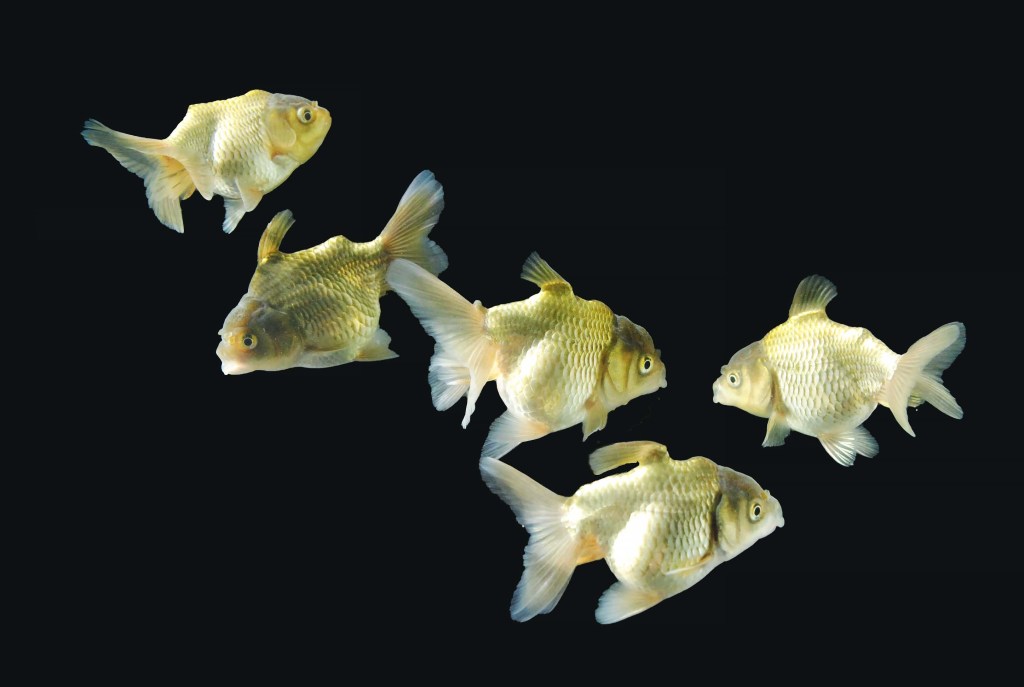
This is the picture taken on December 2019:

And this is him in October 2020:

Marvelous, isn’t he?

However, the growth of the black pigmentation on the offspring is quite challenging. Until now (almost 4 months old), the black pigment does not seem to grow at all. Most of the offspring are white with some black spots underneath the transparent scale, which look like bluish or shadowy color. I am hoping that the black pigment can come out to the outer layer of the transparent scale. Some people reported that it usually happens late on the fish. Hopefully they are correct. The rest of the offspring resemble calico. I will post their pictures on the next posting.

Feel free to share what you think about the transformation of this cow ranchu on the comments below 😊 Thank you.

Standard
tricolor ranchu

Towards Tricolor Ranchu

After marveling and experimenting with the tricolor oranda for some times, I began to think about creating ranchu with such coloration. This specimen I am thinking of has been seen in Thailand, so it will not be a surprise that it will become available in the market in the next one or two years. It is still rare today, though. Instead of waiting them to be available in the market, I think it will be more satisfying for me to create one of my own. When I succeed, perhaps it will not be rare anymore. But it will still be a pride for me.

The first thing I did was to cross my tricolor Oranda with a ranchu. I did not think carefully about what ranchu would be best to use at that time. This might be my mistake. I did not remember it well, perhaps I used blue ranchu since they were abundant in my pond or grey ranchu which carries the recessive blue ranchu gene since I made many crossing using blue ranchu. The results were all grey fish (wild color) with predictable defects on the dorsal.

My plan was to do the F1 x F1. I was certain that I would get several tricolor fish with defect dorsal. I did not expect to get a smooth ranchu back curve at that stage, which was reasonable. What surprised me was that I got some blue offspring. It made the project complicated. I should use pure red or red-white color, instead. But it had happened. I sorted out all the blue. I kept only the grey color, in the hope that some of them will turn into tricolor. I purposely rejected the fish with full dorsal and kept only the ones with defected dorsal. Yet, I must admit, those fishes with perfect dorsal were cute. Some of them resemble Yuan Bao. I could not help to keep one of them alive. Here is the lucky guy:

The second surprise I got was that the expected tricolor never appeared. I waited for four or five months, and these F2 were still grey. I lost hope in them turning into tricolor or any other color. I realized that this was a failure.

But I did not give up. I started the project still using the same F1. But this time I did not do F1 x F1. I crossed the F1 back to the tricolor Oranda! I expected this move to produce a better chance of having tricolor fish. Yet, I worried about the shape turning back into fishes with full dorsal. So, I tried to keep all the offspring alive as many as possible till I could see the dorsal clearly. Thank God, I ended up with enough defect dorsal fishes. They look like this:

And yes, I faced the same problem again. I have kept them close to four months right now and the majority are still grey! I could not explain this. Yet, this time I am lucky to have two fishes mutated into tricolor! Some more mutated into red-white fish with no trace of melanin – I will wait for a little while for them since sometimes the melanin can appear again.

From the two tricolor I get, one has minimal black pigmen. She will be used as my plan B. She looks like this:

But the other one has a lot of black pigment and the color looks strong! I don’t mind about the lack of red color. Tricolor usually comes in either tricolor or panda color. No problem for me. This fish will be my main parent fish. This is the beauty:

My plan is to mate her with ranchu again. And the new F1 will be crossed back to its mother. The new F2 will be a tricolor fish that looks closer to ranchu, yet with imperfect back curve. I will need to repeat the whole two step process again to create a better quality of tricolor ranchu. So, the total time I need from now will be four generation, or approximately two years. Well, I think I will just enjoy the process.

Wish me the best 😊

Standard
cow ranchu

Update on Cow Ranchu Project 2020

In the previous blog (see: https://hermantogoldfish.com/category/cow-ranchu/) I talked about buying several cow ranchus and crossed them with several ranchu variants. Since then, most of my cow ranchus have died due to illness and accident. I was left with one beautiful male and one unproductive female. This female laid eggs often, but none hatched. After several failures, I let the female go (I sold her). It occurred to my mind the possibility that the female had undergone a certain treatment to make her unproductive. I was glad to have two pure offspring which I posted on the previous blog.

I must admit that the two offspring were weak. One of them could not keep her balance which resulted in stunted growth. I was forced to terminate it early. The remaining one was female, which I keep until now. It had slight imbalance which grew more and more acute. It might not survive long. Here she is:

The good news is I had the chance to mate her with her uncle (the remaining male cow ranchu that I bought in the first place). I am raising two batches right now and will post them in the coming months when they are ready. It is my interest to see if they will breed true or if they will just be calicos.

From the cross between the cow ranchu and the common calico, I kept one female:

For sure the deportment is better than the pure cow ranchu offspring. She grows well, yet she lays no eggs until now. It has past her due time. I still hope she will lay eggs soon. My plan is to mate it back with the “uncle” (the initial cow ranchu).

My pride so far goes to the cross between the cow ranchu and the blue ranchu. I keep only one, also. He is a male with the kirin style pattern. He looks handsome now. My plan is to mate him with a blue ranchu. I would like to see what offspring will they produce. This is the pictures of the handsome guy:

It is interesting to compare them with their childhood pictures (in the previous blog).

Well, these are the updates for now. Hopefully they bring happiness to your days.

Standard