Panda Ranchu

Panda Ranchu Update April 2014

Image

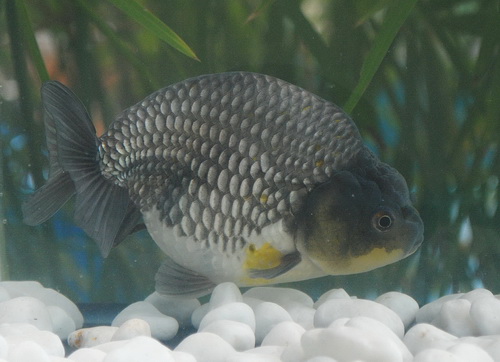
Right now I am working on the improvement of the body, head and tail shape of my panda ranchu by crossing it with svr once again. There will be at least nine more months before we can see the result. Meanwhile, I have selected the best in the last batch, and this is the update. The picture above shows the best panda ranchu I have so far.

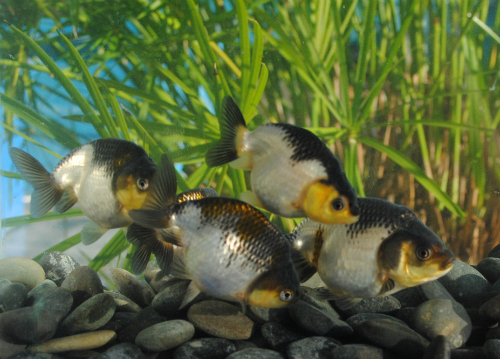
Few retains the panda coloration, few becomes blue ranchu, and many turn into white or white stainted with red pattern. The pictures below show the three types occurred in the batch.

Image

It is still a question whether there is a difference between black pigment behaviour in the blue and in the panda. I am not ignorant that some people conclude them to be the same. I was of the same opinion. I was thinking that when there is no white color appearing, then the color is blue. When the white appears, then the color of black pigment become darker to give the impression of black and white. But lately, I encountered some fishes that when the white appears, the black pigment does not get darker but stays blue, to make the fish into a blue white fish instead of black white fish. This makes me open once more to the possibility that there is a difference between the melanin composition and or its behaviour in the blue and in panda.

This is the blue and white ranchu from the same parents. It is true that in the picture I use the white background to highlight the blue coloration. But the keeping environment is the same.

Image

Standard
Panda Ryukin

Panda Ryukin

Image

Sometimes we get an unexpected gift. It is the case with the fish in the picture. When I crossed my panda moor (telescope eyes) with panda oranda, I got this piece! It has a plain head, without headgrowth nor telescope eyes. And it has a little hump! So this piece is best categorized as panda ryukin, though it has no ryukin bloodline so far. Yes, the head is still too big for a ryukin and the hump is too small. It is not yet a decent ryukin.

Its sibling is varied. The dominant outcome is the telescope eyes. This is understandable, since my panda oranda actually already had the genetics of panda moor. Very few have both telescope eyes and headgrowth. The rest of the offspring do not have telescope eyes nor headgrowth, some without hump, some with a small hump. I guess the hump characteristics comes from the moor, which we know is closely related to demekin.

At first, I did not know what to do with this piece, except to sell it. I was concentrating on panda side view ranchu and panda oranda. I did not think I have the appetite to create panda ryukin. However, this piece has a strong color. It has been three months and the pattern stays. While some other have a fading black color, this one does not. I continually marvel at its pattern, and am unwilling to sell it. The notion of creating panda ryukin keeps on coming to my mind. It should be an easy project to create panda ryukin from this piece. This is a gift from heaven. Why don’t I take the chance? I continually feel the urge whenever I see her mating in the morning. Yes, this one is a very productive female. So, I am glad that at last I have a free capacity to allocate to this project.

I crossed this piece with a long tail ryukin that I bought from China. The offspring are two cm long right now. Based on my experience with panda coloration, I know that this batch will be a transition fish. There will not be a single panda color exists in F1. The aim is to create a decent ryukin shape in this F1. The panda ryukin will show up in the F2, as a result of F1 x F1. So I do not need to make the cross between this mother with ryukin anymore. One time cross is enough. And I do not need many offspring. Just a male and a female will be enough. So I cull out this batch strictly every day to reduce the quantity of the fish. I even cull out the flat tail and those who take longer to show the split tail. I keep 24 of them right now, and am still thinking of a way to reduce them again. I might consider to sell this mother since I have no use of her anymore. Who knows someone else will want to do the same project.

The next update will be in a few months, to see whether this project yields a decent ryukin body or not. We must wait for six to nine months to see the real panda ryukin from this project. Hopefully things will work as planned.

Standard
Panda Ranchu

Panda Ranchu

Image

I have many breeding projects. My current priority is to create the panda ranchu.  I started this project about 3 years ago, after strengthening the color of my panda telescope line (also known as panda moor). I began by crossing the panda telescope with an orange Thai sideview ranchu. This is a fifth level difficulty, which means that there are five contradicting features that I must tackle with. First, I must get rid of the telescope eye feature from the panda moor. Second, I must get rid of the dorsal fin in order to create a ranchu back curve. Third, I must tackle the long tail feature  in order to create a short ranchu tail. Fourth, I must develop the ranchu headgrowth in the new fish. Fifth and most important, I must inject the panda color into the new fish. In my plan, this is a 5 years project.

My first focus was to produce the panda color in the offsprings of the cross without regarding much yet about the shape. This was achieved in two generation. Following Mendellian law, I got some percentage of blue/panda fish, with all sorts of horrible shapes. I concentrated on the ones which closely resemble ranchu shape. I did some inbreeding program to stabilize the color in the third generation.

Things did not go smoothly at that time. There was an outbreak in my facility, and I was left with only two blue offsprings. One is a sterile female, and the other one is a male with weak health. The whole project was in jeopardy. The actual plan was to cross back this third generation offspring to another Thai sideview ranchu in order to strengthen the ranchu shape character. So I paired the weak blue male with a Thai sideview ranchu.

Thanks to God, I could collect the eggs the next morning. And the next day, the male died. So this project relied solely on those eggs. I could not redo it again. In fact, I was so desperate at that time that I started to cross panda moor again with a black ranchu, as a back up plan. But I felt so much relief when the eggs hatched, and they turned into healty, fast growing ranchu. All of them were grey that slowly turned into orange. There were no blue of panda among them. But that did not bother me at all. I knew that the blue or panda color was recessive, and would appear when I did an inbreeding again. The only drawbacks were the bald, small head of the ranchu and the hump that appeared right after the head. Fortunately, as I grew them, the headgrowth appeared, though very late compared to usual ranchu, and the headgrowth slowly covered the area between the head and the hump, which help to improve the appearance of the fish as a decent ranchu. The back curve was good already. My only concern was whether I would get panda or just blue.

The picture I post here is the offsprings of those orange fishes. So this is the fifth generation. Some percentage became the usual grey color which turned into orange, some turned into blue. Among the blue, some stayed blue so far, some turned early into panda, and some turned quickly into white. I tell myself, “It is ok.” I just need to repeat the first step again in order to stabilize the color. This makes me glad.

Concerning the shape, I get two kinds. First, I get ranchu, and second, I get a small percentage of deme-ranchu, or nymph, which is a ranchu with telescope eyes. Somehow the ones with telescope eyes grow darker coloration compared to their ranchu sibling. The ranchu shape carried the weaknesses of the parents from the fourth generation, namely the small head, the hump, and the late headgrowth. Other than that, the shape is perfectly ranchu. I need some more years to improve on the head shape and color.

So actually this is a premature publishing. Four more steps need to be done to create a decent ranchu shape with a stable panda color. I just get too excited to share the progress now. Two more years to go. 🙂

Standard