cow ranchu

Cow Ranchu Crossing

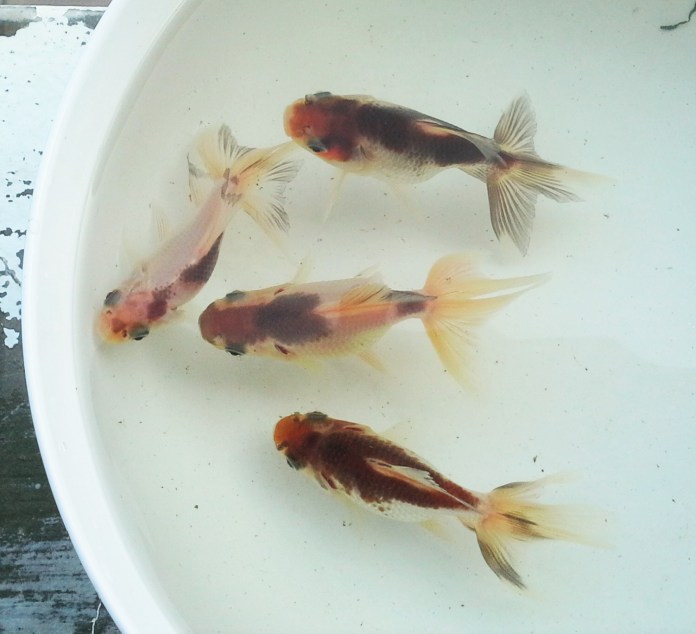
Cow Ranchu is a variant of the transparent scale ranchu that has black and white color. Sometimes the black pattern can expand. The black comes in large patterns and small dots. Red color might be present in small areas of the body. If the red is too much, it cannot be called cow ranchu anymore. I do not know if it is the International standard name of not, but we Indonesian calls it Cow Ranchu since it resembles the color of black and white cow. This breed was rare before (especially in Indonesia), but it is available recently through imports from Fuzhou, China (if my information is correct). How people come up with this pattern is still a mystery for me. A breeder friend told me once that when he bred them, he got a variety of transparent color ranchu including calicos. So, in his view, the cow is just the offspring of the usual calico which then being separated purposely based on the color. So, it will not breed true. I doubt this explanation. In my understanding, the usual calico does not have the ability to expand its black pigment like this cow ranchu. And the black in calico usually comes in dots, not large patterns or blocks as in this cow ranchu. So, I decided to buy some cows at the end of 2019 with three purposes: first, to breed them to see if they breed true, second, to observe the expansion of the black pigment, and third, to cross them with other colors to see what will happen. Well, the 1st and 2nd purposes was facing hindrances. My first attempt to breed them resulted in so few offsprings. I think I need to breed more of them. And then, three out of five that I bought died, sadly. Gladly, I managed to crossbreed them with the common calico and with the blue metallic scale ranchu. This writing will mainly talk about the crossbreeding result.

These are the five I bought (I show them the left and right side for each):

The first three are the males. And the last two are the females. My favorites are number three and four. Too bad, they are gone. The remaining two are number one and five. I am trying to buy some more to replace them.

Their offspring in my first attempt to breed them was few, and they were weak in quality. Yet, my initial conclusion is that they breed true. Majority of the offsprings were cow ranchu. Few had minor red stains. No calico observed. Yet, I need to confirm this with my next breeding. I could not stand the quality of the offspring, so I culled most of them. I come out with these two left:

The first one has a yellowish stain in the area of its left pectoral fin. The rest are white with black pigment under the skin. The first one also has an outer black pigmen in its pectoral fin. I think they are good specimen to observe whether the black pigment will expand or not. These two are the reason for my initial conclusion that they can breed true.

Next, I mated the cows with these calicos:

I bought them from an importir friend who acquired the parents from China. So far, he has bred them true. I saw myself the offspring in his pond was pretty much similar in color characteristic. I asked for one female and two males. Too bad, he mistakenly sent me all females. Anyway, I could still pair them with my cows.

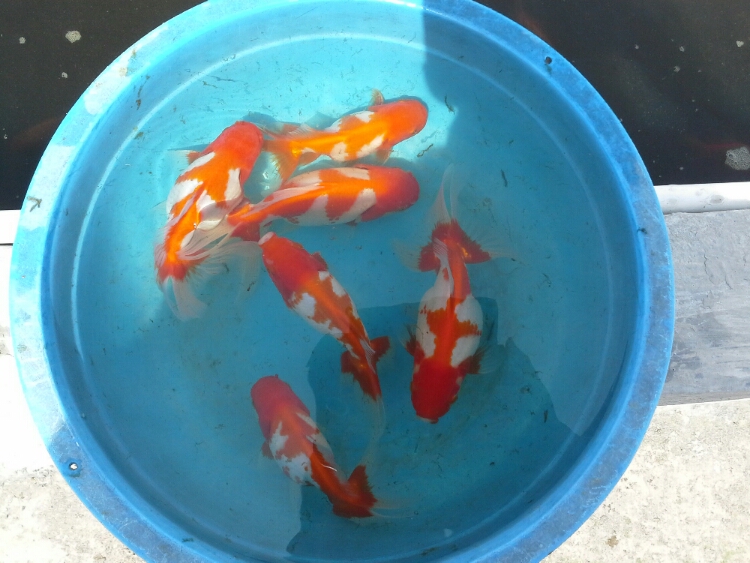
Here are the results of the cross between the calicos (female) and the cow (male) – after hard culling, ten of them remain:

The quality is far below my standar, so I cull them hard. Even these ten will be culled again after they serve the illustration purpose. (Mostly, my wife’s pupils will adopt them.) The offsprings resulted in different eye type, and different color variation: tiger, calico, sakura, and cow (the last one). I kept the cow one to see the progress of the black pigment.

I also use this blue metallic ranchu which comes from my own previous project to breed with the cows:

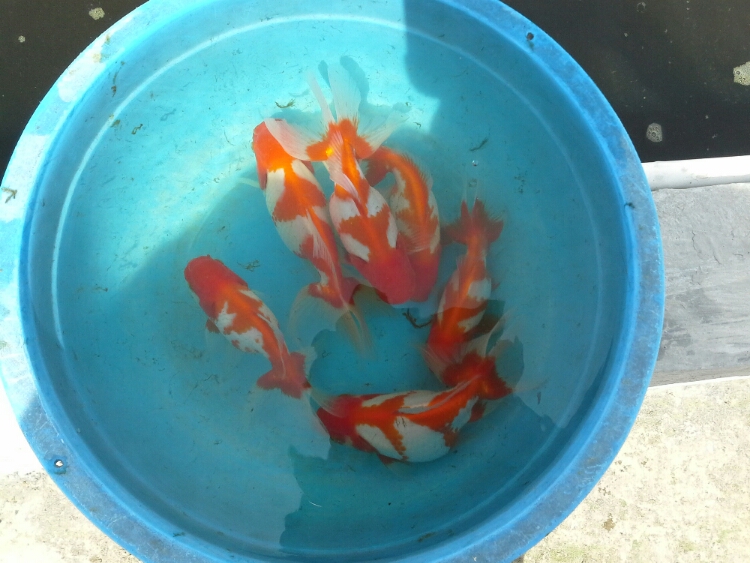
And the result of the cross between the blue metallic (female) and the cows are:

cowblue 7

The offspring consists of blue metallic scales and grey metallic scales, but I want to focus on the transparent scale offspring. After much culling due to the low quality, I keep these to represent the range of transparent color emerged from this cross: tiger, calico, and kirin-like ranchu (the last one). Kirin is another variation of transparent color where the dark color and the light color seemed to separate in half. The dark color (purple, blue, grey, black) always dominates the upper part of the body, while the light color (white, yellow, red, orange) is more in the lower part. Actually, a more accurate description I think is that the light color is all over the body in the background, while the dark color exists in the foreground and occupies only the upper part of the body. The dark color usually looks with scales, or looks like a net, while the light color is transparent. Some shiny and big metallic scales are usually seen scattered all over the body.

Comparing the two crossing, it is obvious that there are overlaps: the tiger, calico, and sakura (perhaps some of the calico will turn into sakura when they lost their black pigment, or it will never happen in this cross, I do not know and do not focus on that). But interestingly, the cross between the cow and the calico produces cow-like offspring, where the other cross does not. And the cross between the cow and the blue metallic produces the kirin-like offspring, where the other cross does not. It is a hint, I think, that kirin pattern involves the blue metallic scale in the making. I kept the kirin-like one to see or use in further project.

That’s all that I can report so far. Thank you for reading. Enjoy!
Standard
Panda Oranda

Re-melanization process

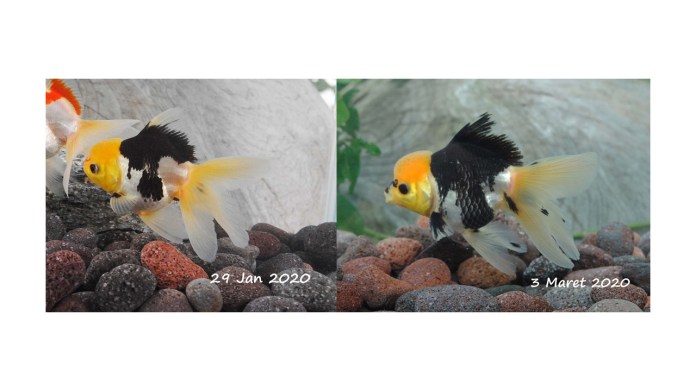
Some people complain about their black and white goldfish losing their black pigment. This is common in goldfish and the process is called de-melanization process. Well, my late experiment with breeding black and white oranda from Thailand (not from the blue metallic scale, but from the grey metallic scale as I wrote in my last post) shows quite a strong character of melanin (black pigment). The black pigment can reappear or grow. This is different from stress fish which often shows some temporary black pigment which will be gone on several weeks (or months). I am tempted to call this phenomena as re-melanization process. I notice that this changing pattern also happens in koi world in the kumonryu variety.

Well, not all black and white oranda from Thailand shows this characteristics. It just happen that the line on my hand is very strong in this unique character, and it happens in my ponds at least five times (as I noticed), which is quite often compared to my previous twenty years of experience in the goldfish world. I think I should preserve this gene and hopefully introduce it to other goldfish varieties. Below shows two fishes, one had lost all its black pigment and then regained it in just one month, and the other had a growing black pigment in the same time period.

remelanization process 2 mar 2020remelanization process mar 2020


Standard
Panda Oranda

Panda That Humbled me down

Years of my experiment brings me the conclusion that the panda coloration (or the tricolor as its side effect) is actually the blue coloration in metallic scale fish that undergoes demelanization process. That process can happen quickly in certain blue fish, turning it into a totally white fish or red and white one. But it can also happen slowly, even to the point of being halted forever, producing the beautiful panda / tricolor goldfish.

Recently, since 2018, breeders from Thailand storm the market with panda / tricolor oranda which seems to be strong in its coloration. I acquired some and breed them to see if they conformed to my understanding. And what did I find?

The offspring were not blue in color!

They were grey just like the common metallic goldfish!

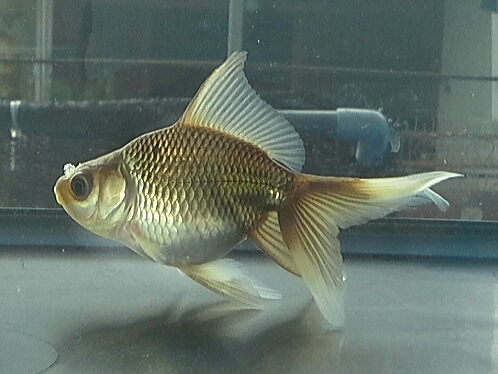
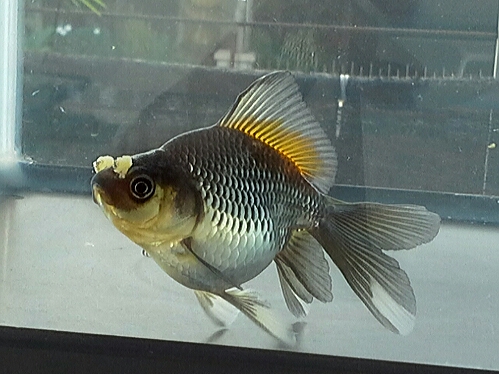
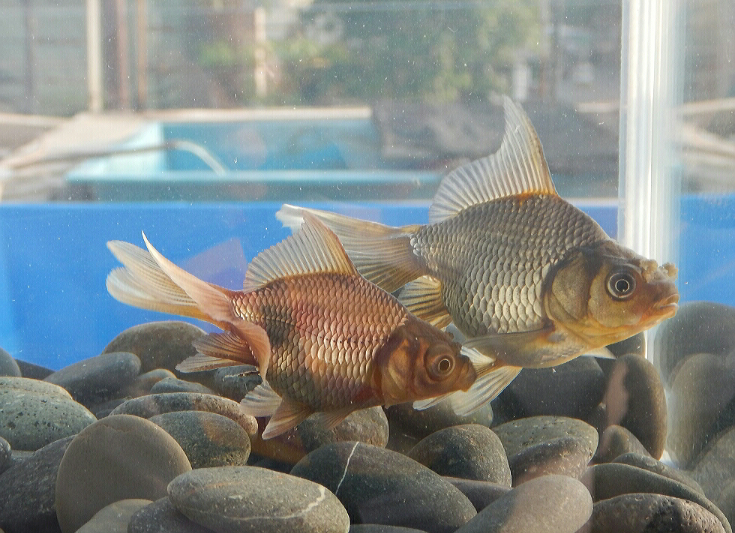
I raised them to see if they will become panda like their parents. And yes, with mix results, I got several decent panda oranda. The results consist of grey (which does not seem to turn into black nor panda), black, panda, tricolor, and some who loses the melanin totally.

Here are some of the results that I raised until maturity:

DSC_9166DSC_9362DSC_9467 (2)

So, panda does not come from blue fish only. My previous conclusion was wrong. I still does not know how the grey fish can become panda, since the common grey fish (red white fish) cannot do so. Actually, I experience this once a long time ago. But I dismiss it as an exception. Perhaps next time I can find my documentation and write about it. For now, I must humbly admit that there are panda color that does not come from blue fish.

Standard
Brown Oranda

Brown Oranda

DSC_6510 (2)

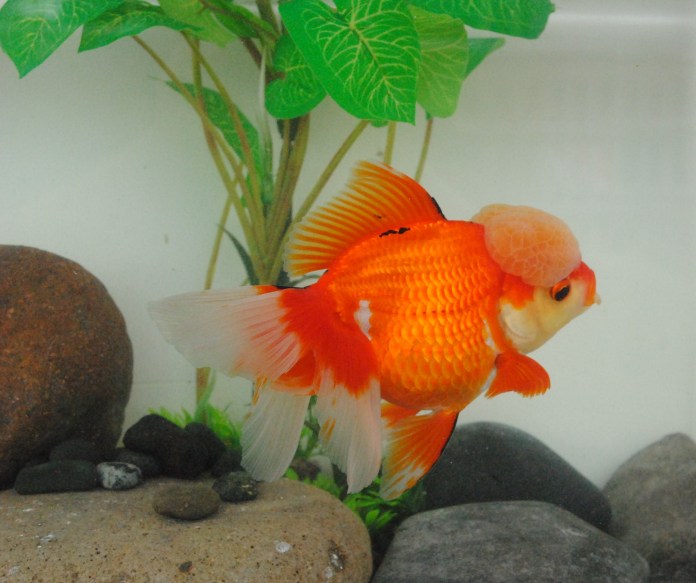
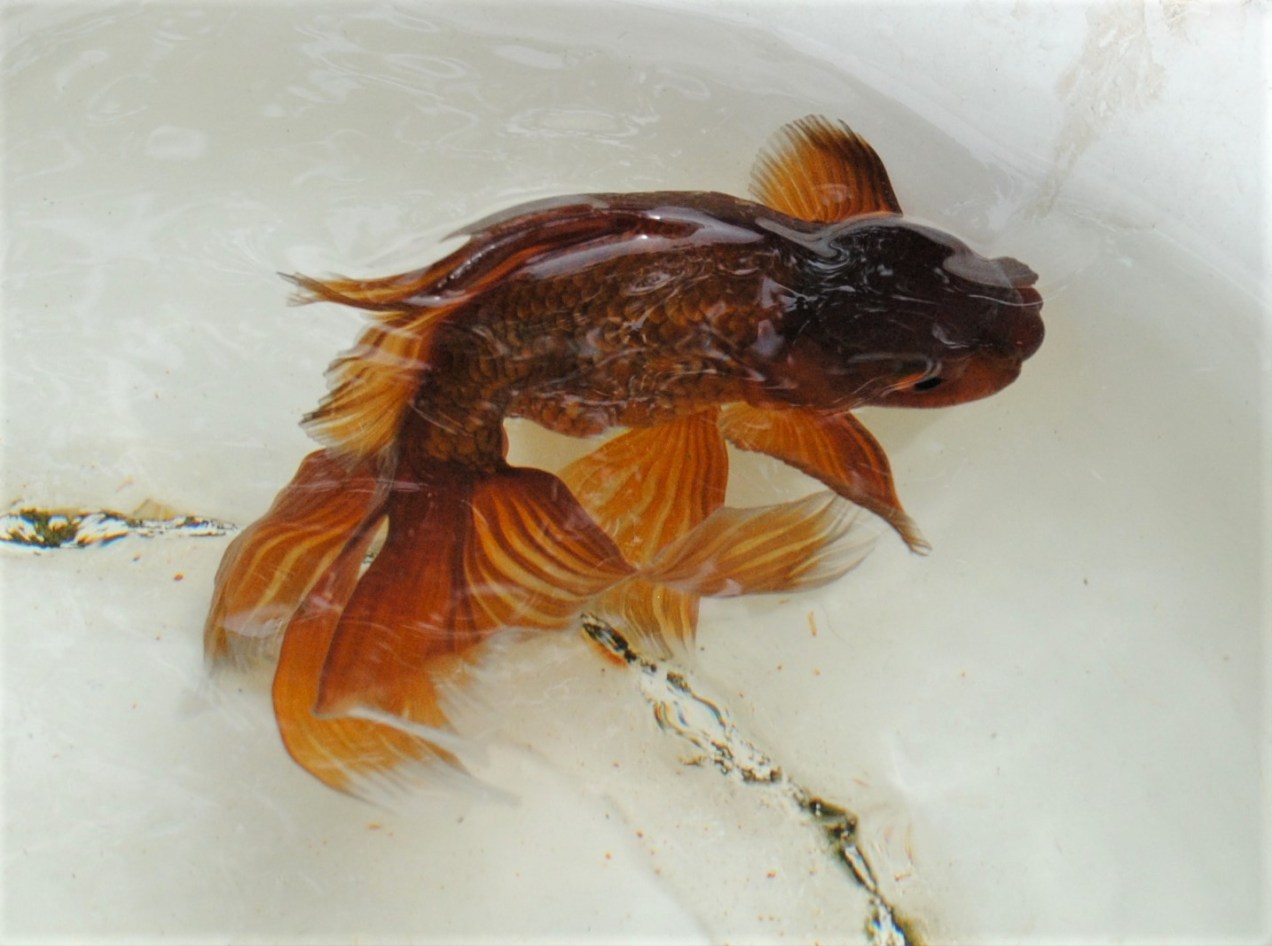
It all started with some chocolate pompom I bought from China. The brown color captivated my attention. Most of them had orange fluffy nostrils to make them adorable. To my knowledge so far, chocolate color like this was rarely found in other goldfish variety. Well, I saw a brown butterfly sometimes on the internet, but I have never seen one alive. I remembered seeing a brown oranda nicknamed chakin in an encyclopedia I had during my childhood. But I cannot find one live specimen of chakin (teh-kin, or tea-kin, the tea colored goldfish) here in Indonesia. Even the chocolate pompom had to be imported from China. I was entertaining a project to recreate brown oranda from this chocolate pompom I had.

This is one chocolate pompom I bred from the imported parents. I had many of this several years ago.

DSC_7809R

I crossed it with an oranda. I am sorry I forget about an important fact regarding this matter. I could not recall whether I used a common oranda or a redcap oranda for this cross. The result was all orange goldfish, with small head growth, and the small pompom in some. Those were my transition fish. I did not bother to take a picture of them.

Then I inbred those transition fish to get the desired result. I chose the few brown colored offspring and mated them with oranda again to improve the oranda characteristic. Once again, I got all orange color, but this time, they were decent oranda, with no or insignificant pompom. My final result should come from inbreeding them.

And yes, I got what I wanted! The brown oranda! From the start, I picked up the fry which showed light brown color right after they hatched. I grew them up. Yet, to my disappointment, only one remained brown until maturity. The rest turned into orange.

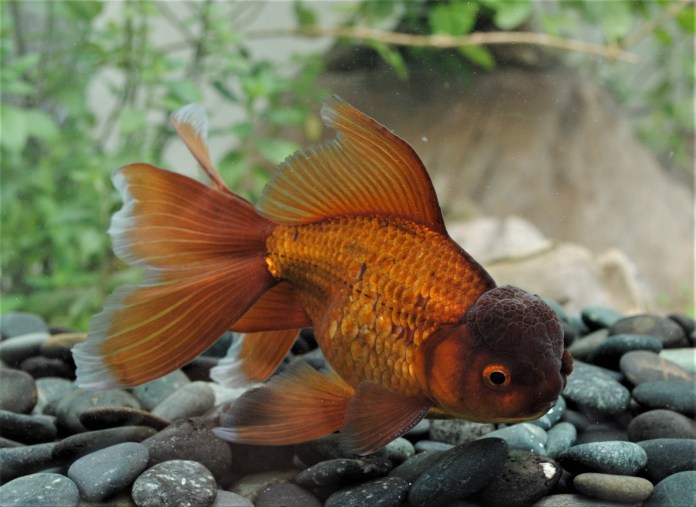
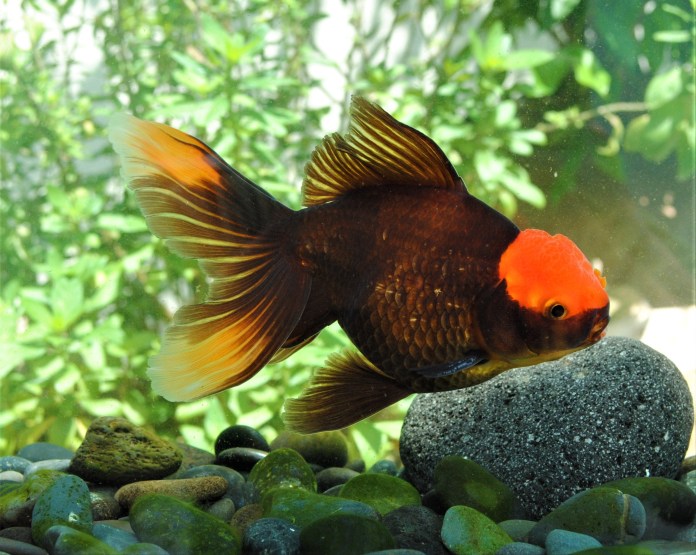
I mated this only brown with its orange sibling. The hatchlings were all brown in the beginning. And only two remained brown until now. I still keep them and now they are roughly 20 cm long with no hint of turning into brown. Unfortunately, both of them are male. All the female has turned orange. Below is one of current brown oranda I had, which I consider as my throphy.

DSC_6474 (2)

One strange phenomenon is this. Actually, there was a third male brown oranda, which slowly turned into orange. It retained less than 10 percent of its brown color. I was about to cull it out. Yet, I did not know how, it started to regain its brown color. This is one of the phenomenon I call the reverse demelanization. I managed to take the picture when it regained its brown color after being almost all orange:

DSC_6516 (2)

At first, I thought the increasing brown color might due to stress. If that is the case, the brown color will be temporary. But, it continued to grow to cover the whole body of the fish, leaving out only its cap. It grew into a beautiful fish: a brown red cap, if I may say! And then the reversing process stopped. Until today the fish is still alive, and has been almost a year in this state of pattern!

DSC_6633 (2)

Beautiful, isn’t it?

Any explanation?

That is my project to recreate the brown oranda. I think the project is finished. The only thing left is to multiply them, and to get the market to appreciate them.

Have a good day!

Standard
Yellow goldfish

Big Progress on Yellow

It has been sometimes I dream of yellow goldfish. It all started when I accidentally acquired a yellow tosakin. I was unaware at that time if the color was yellow. I thought it was just a pale fish due to the lack of sunlight.

I did make a cross between that yellow tosakin and a wakin, as part of my another project. Most of the offspring were red – really deep red – in color. But few show different color. It took a while for me to realize that they were yellow and mandarin orange color. I was inspired to create more of them. But unfortunately, there were too few of them. Usually from the same batch, all of the yellow were of the same sex. And most of the female were infertile. What to do?

This is my yellow female infertile goldfish

semi lemon 2

my semi lemon

I remembered from my last trip to Japan, I saw that Japan has yellow commets. I also heard that they are common in America, Israel, and some more parts of the world. But Indonesia has none. So I planned to import some yellow commets from Japan. Thanks to Limas who made it possible. I did not have any yellow male. I only had some mandarin orange male fish. So I planned to breed my male mandarin orange goldfish with female commets from Japan.

These are what I call the mandarin orange:

mandarin orange

Upon the arrival of the yellow commets, I noticed that the yellow color was a bit different from my yellow goldfish. The commets were more like lemon color. My yellow goldfish had a bit of orange flavor in it, though I will still consider it yellow.

This is the comparison:

lemon cross

Alas, the yellow commets did not lay any eggs yet, though it has been months since I bought them. But the BIG SURPRISE is that, yesterday, my infertile yellow female suddenly laid eggs! And lots of them. I was tempted several times to let go the fish. Glad I did not do it. It has been a year or more without any eggs, but suddenly it laid the eggs yesterday. I matched her with the male lemons from Japan. And I am very enthusiastic to see the result.

If the yellow goldfish project was in jeopardy from the start, now I begin to see a big hope. And from this, there is a possibility to create yellow oranda, and even yellow ranchu in the future. Certainly this will enrich the goldfish diversity. Yellow goldfish will not be limited to yellow commets anymore 🙂

Wish me the best!

Standard
Purple goldfish

Updates on purple goldfish (Dec 11th, 2015)

As an overview, I was repeating the classic experiment by Shishan C. Chen. The experiment was crossing a blue metallic scale goldfish with a chocolate metallic scale goldfish. My slight modification was that I use the panda metallic scale goldfish instead of blue, noting that panda and blue color has a close relationship. I crossed a panda tosa with a chocolate pompom. I got the panda tosa from crossing panda telescope eyes (which is available in the market) with blue oranda.

The F1 was wild in color. Some turned into wild and orange, and some turned into totally orange color. No blue, no panda, no chocolate appeared at this stage. All have small pompom balls. Interestingly, their size became giants! I took my lesson that crossing far related types of goldfish may trigger the production of large sizes. (This inspires the possibility of doing projects on giant sized goldfish!)

This is the picture of the F1. Picture was taken 5 months ago, and the fishes have grown larger since. The bowl is 40cm in diameter.

20150811_061647

Then I did F1 x F1. The results were amazing! I got:

1st category: blue, blue-white combination (or we call it panda) and white (as the blue color totally disappeared)

2nd category: chocolate, chocolate-orange combination, and orange

3rd category: purple (the color in between blue and chocolate), chocolate-white combination (!), and white (as the chocolate color totally disappeared)

4th category: wild color

The shape were all pompom goldfishes. Some with large pompom balls, some with small ones.

I got rid of the wild color early. (And now I regret it, since I would like to know whether it can be used to create red-white pompom combination or not). So, I focused on in-breeding those 3 categories. My utmost desire was to breed and stabilizes the chocolate-white combination, since it is a rarer color compared to the panda. Unfortunately, they do not lay eggs till now even when all the other categories have spawned. My project of creating chocolate-white is in jeopardy! It is not funny to start all over again from the beginning.

The first pair to spawn was the panda. I am happy, since panda pompom is nowhere to be seen nowadays. I was thinking that these panda will produce 100 percent genuine panda color. That is what happen when I crossed panda color with red-white. When I crossed panda with red-white, the F1 was red-white/red. The F2 yield roughly 25 percent of panda. And when I crossed these panda with its panda sibling, the result was 100 percent panda / blue. So, I was hoping the same to happen in this project. Interestingly, the result is different!

Panda color produced from the cross between panda and chocolate, when mated with its panda sibling, does not only yield panda / blue color, but also purple / chocolate-white color in small percentage! I think this is an important matter. It needs someone knowledgeable in genetics to explain this. I do not have that expertise.

These are the chocolate-white goldfish aged roughly three months old. Some have turned totally white. These are the ones that still retain the chocolate color. Aren’t they lovely?

20151209_061256 (2)

20151209_061251 (2)

First, I am glad that I do not need to rely on my 3rd category that do not spawn till now. I can still get chocolate-white combination from the panda pair.

Second, let me make clear of the relationship between purple and chocolate-white. For the start, it is better to understand that there are three color involved here: blue, chocolate and purple. Shishan Chen has discussed the difference between them. It involves the black pigmen, the red pigmen, their combination and distribution. Though I do really want to understand more about it and what involves that create the difference between blue and black, chocolate and red, they are not really my stuffs. (I am too stupid for that.) It is enough for me to know that purple is a color between blue and chocolate.

It is also important to understand that there are “base” color in goldfish. I have never read about this. This is my own terminology, that will need help from friends who understand more. This “base” color is what makes the difference betwen black and blue, and between chocolate pompom and purple. Let me explain. In the case of black and blue, we know that differences happen in the melanin pigment. Black ranchu has melanin pigment, so also blue ranchu. But somehow, that same pigment behaves differently in those two. One factor is the different pigment distribution. Is it the only factor involved? I do not think so. But I cannot say anymore about this. There is a second important differentiation between the black and blue, and I want to draw the attention to this. Their “base” color is different. In black ranchu, if the black color fades, we will see an orange color. That is what I mean by base color. Even in Thai black ranchu where the black color does not fade, if we try to scratch the black skin, we will see the orange color underneath the black coat. But in blue color, if the black (or blue) pigment fades, what we will see is white color. So, this is the base color of blue fish. In black ranchu, as the melanin fades, we will have black-gold color (or black-orange), while in blue ranchu, as the melanin fades, we will have black-white color (or panda). So, the base color is different.

The relationship between chocolate pompom and purple pompom has something to do with this “base” color. The base color of chocolate pompom is orange. That’s why, when the chocolate color fades, we will see the orange as the base color. The fish can turn into chocolate-orange,or totally orange fish. We witness the same behavior with black and black-gold fish. In purple goldfish, the base is not orange, but white! So, when the purplish color fades, the fish will have purple-white color combination. And in this kind of combination, the purple color will be more intense, the pigmen distribution will be thicker, and the purple will look like chocolate. That is why I call the purple-white color combination as the chocolate-white. It is the same case with panda, where the blue-white combination is called black-white since the blue is getting thicker and looking like black.

This answers my second point, that is about the relationship between purple and chocolate-white. When the purple color does not fade, the fish will stay purplish. When the purple fades, the fish will become chocolate-white, and some will even turn into totally white.

Third, there seems to be several spectrum of chocolate color in the chocolate-white combination. I am still not sure about this. I am not sure of whether they are worthy to be identified separately.

Fourth, the good news is, when I crossed chocolate pompom with chocolate pompom resulted from this project, the result is not 100 percent chocolate, either! There are purple color also! The same behavior I examined from crossing panda with panda from this project.

Fifth, I have not had chance to cross purple with purple, or purple-white with purple-white. If I do this, will the result yield several panda and chocolate also, or will they be 100 percent purple and purple-white?

Sixth, it will be nice to create purple-white ranchu! A project that is enough to occupy my time for several years ahead!


Standard
Purple goldfish

What color is this?

This is the most unique color I find in this purple goldfish project. It started as purple fish. But then it develops white coloration. The purple color becomes darker, to make it look like light brown. I do not know what to call this combination. Purple and white? Chocolate and white? It surely looks like brown magpie bird to me.

20150723_072508(2)

20150723_072449(1)

Many of the purple develop the white color, but most turn into totally white. So, I guess the behavior of this pattern is basically similar to the panda. That means there is a room for stabilizing the pattern through selective breeding.

unfortunately, there is only one with this kind of pattern. I hope the pattern will stay, though it is very probable that it will fade. And the purple goldfish is always the smaller compared to the blue and brown in the same batch.

My plan is to strengthen this pattern and multiply them in the form of pompom goldfish. Next, I would like to develop ranchu in this pattern. Wish me the best 🙂

Standard
Panda pompom

Panda pompom

From my experiment to create purple goldfish, I accidentally create panda pompom. This is predictable, since I use chocolate pompom and metallic blue fish as the grandparent. Some blue fishes appear in the offspring. Some have pompom, some do not. But most of the pompom feature are blue also. This one is extraordinary since the pompom feature is white, giving it a good contrast. If today we usually find pompom goldfish with chocolate body and orange pompom features, hopefully we will see more of blue or panda body and white pompom features. I can’t wait to see this piece mature. Enjoy.

20150723_072638(1)

Standard
Purple goldfish

Purple goldfish update on July, 2015

DSCN2583(1)

DSCN2601(1)

The above picture is the same purple goldfish in a lighter and darker background. This color is distinguishable from the blue and chocolate below:

Blue goldfish

Blue goldfish

Chocolate goldfish

Chocolate goldfish

The pictures below show the differences between purple and blue

DSCN2607(1)DSCN2619(1)

and this shows the difference between purple and chocolate

DSCN2635(1)

The picture below shows the fishes with respective colors from left: purple, green, blue and brown

DSCN2652(2)

Below are the highlights

Blue scale on top, purple scale below

Blue scale on top, purple scale below

Purple scale on top, chocolate scale below

Purple scale on top, chocolate scale below

So far I think I have succeeded in producing purple goldfish, or purplish one, or any other name differentiable from blue and brown (chocolate). At this point, I think I can wrap up this project and consider it done. What remains is to try the same project again but with different type of fish. What I have in mind is ranchu. I would like to create purple ranchu. But first, I need to create the chocolate ranchu, which is still my ongoing project. It will be a challenging project!

There is another observation coming from this purple goldfish which I am not ready to share yet. Let see for another year or more if this observation really yields something interesting.

Have a good day!

Standard
Playing with patterns

Playing with pattern

Pattern is not one of the judging criteria in competition nowadays. However, pattern always has its own way to fascinate hobbyist all the time, from beginners to experts. History shows that some breeders had focused on pattern appreciation all along. Red cap oranda is one famous pattern that still exists until today. Jikin breeders are masters of pattern creation with their 12 red goldfishes. I am sure pattern will always find its way in the heart of goldfish hobbyist.

There is a science to the pattern manipulation. Unfortunately, this science is mostly unkown. I believe much of the knowledge is lost. Some who know tend to keep it secret. Most hobbyist are not aware that this can be an area to pursue. The undermining of pattern criteria in competition might contribute to this ignorance. The ethical assault faced by those who practice this art also contribute to the secrecy of this knowledge.

For me, I tend to think that this is interesting. My own experiment has led me to conclude that water parameter, food content, and background color can be used to manipulate the pattern. Other things such as whether it is outdoor or indoor, whether to use biological filtration or routine water change, the density of fishes, the PH parameter, and so on, seem to contribute to the pattern building. Tricks employed by Jikin breeders also seem to work but not to all goldfish. Some goldfish are easier to manipulate while some seem to resist manipulation. This need to be explained genetically.

Wakin and jikin are among the easiest to manipulate. Some oranda react well to manipulation tricks, while some like orange oranda are harder to manipulate. In my experience, ranchu is more difficult to manipulate.

Below is the results of my experiment on pattern building. I am not in the position yet to tell readera what I have been doing. I am still learning. Perhaps later on as I understand more, I will tell. The fishes I used are the oranda that have wakin genetics. They are my F3 from my oranda – wakin cross, which have been crossed back to oranda. I find that most of them are easy to manipulate, but not as easy as wakin. Some from the same batch cannot be manipulated, no matter what I do. Seems that the fish that mutate earlier from its wild color state into red and white is easier to manipulate. The one that takes longer to mutate is harder.

Enjoy.

20150609_103254(1) 20150609_103246(1) 20150609_103244(1)

Standard