Uncategorized

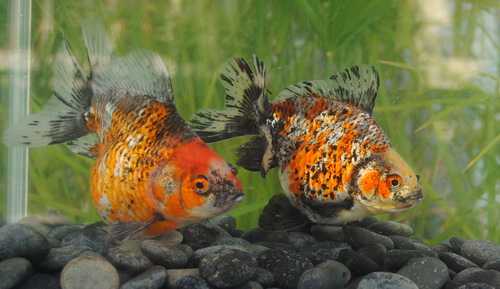
Tricolor Metallic Scale

Image

I have never paid any attention to this type. I worked on calico color for some times to understand it, then I tried to work on the kirin color (a subvariation of transparent scale goldfish) with no success. It is a fortunate event that a breeder friend introduced me to these two fishes. They caught my attention because I think they are unique. Their color looks like that that can only appear in transparent color scales, but their scales are metallic scales! It is amazing!

I know this kind of color is seen mostly in ryukin. I have never seen it in other goldfish variety. So it is possible that the specimens I have here are ryukin’s reject.  Or they might be a stable variety of its own. I do not know what to call them, other than tricolor metallic scale goldfish. The Indonesian might call it tricolor metallic scale tosa, since we use the term tosa to refer to a ryukin without hump. I also know the term “mock metallic” used by American hobbyists, but I don’t really know what they mean. Could this be the mock metallic?

I am pretty sure now that this type of color is also a subvariant of transparent scale goldfish color. But I am not sure how this color come up in the first place. Usually, when we crossed a calico with a metallic scale, we will end up with many kinds of offsprings. I usually keep only the fully transparent scale that has no or minimal trace of metallic scale. I get rid of the rest. But some breeders usually keep those with more metallic scales on the body, for this kind of fish still have selling value. Both are commonly seen. But those that the breeders rejects, such as the seemingly grey metallic scale that does not seem to mutate,  and I don’t know what else, maybe the tricolor metallic scale evolved from these rejects. I don’t know yet, this is only my guess.

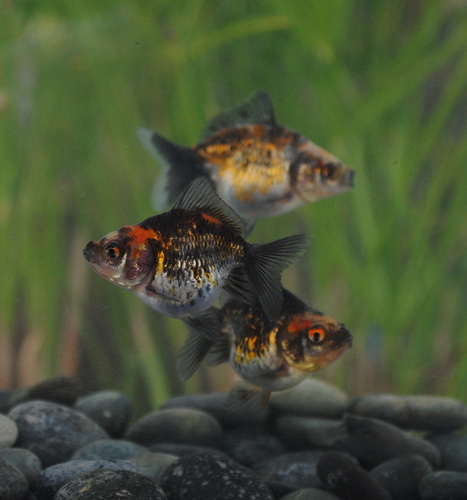
The good thing is that this genetic is pretty stable. I mated these two, and this is the picture of the offsprings that I took yesterday.
Image

From these offsprings, the metallic scale types, and the black color look solid. There are few offsprings that look like transparent scales with few metallic scale. I reject them. I keep only the full metallic scales. So, the only thing I know so far is that the genetic is stable enough to pass on to its generation.

And this is the interesting thing. What I would like to do is to see whether this color can be transferred to sideview ranchu! Yes, it sounds crazy. But a tricolor metallic scale sideview ranchu will be quite nice, isn’t it? Yet it is also quite a challenge.

When I work with panda coloration, I was working with metallic scales only. Now I am going to work with metallic scale – transparent scale cross. I have no idea of how big is the problem. In my experience, when we cross a metallic scale with transparent scale, the black coloration is lost. Some show black marks when young, which will soon disappear as they grow. If this happen, I do not know how to introduce the black color again. I have tried to cross it with black fish (black ranchu) which created a different black marking from calico color. I also do not know how to create the appearance of full metallic scale like this since the cross usually creates partially metallic scale only. So, I think I should separate the color (black coloration) and the scale into two problems.

So to count the difficulties if I cross this fish with a metallic scale sideview ranchu, then it is a level 4 difficulty. First concerns the headgrowth, which is nothing to worry. Second concerns the dorsal fin, which I have the experience already and I will not worry about it. Since the fish is already a short tail one, then it does not count as a difficulty when being crossed with ranchu. Third and fourth is about the color and the scale appearance, which is a territory unknown to me. So eventhough the difficulty is only level 4, it is much more difficult than it appears, I think.

Actually, the cross has been made this morning. Now I am waiting for the eggs to hatch. I am very excited 🙂

I welcome any advice on this.
Standard
Panda Ranchu

Panda Ranchu

Image

I have many breeding projects. My current priority is to create the panda ranchu.  I started this project about 3 years ago, after strengthening the color of my panda telescope line (also known as panda moor). I began by crossing the panda telescope with an orange Thai sideview ranchu. This is a fifth level difficulty, which means that there are five contradicting features that I must tackle with. First, I must get rid of the telescope eye feature from the panda moor. Second, I must get rid of the dorsal fin in order to create a ranchu back curve. Third, I must tackle the long tail feature  in order to create a short ranchu tail. Fourth, I must develop the ranchu headgrowth in the new fish. Fifth and most important, I must inject the panda color into the new fish. In my plan, this is a 5 years project.

My first focus was to produce the panda color in the offsprings of the cross without regarding much yet about the shape. This was achieved in two generation. Following Mendellian law, I got some percentage of blue/panda fish, with all sorts of horrible shapes. I concentrated on the ones which closely resemble ranchu shape. I did some inbreeding program to stabilize the color in the third generation.

Things did not go smoothly at that time. There was an outbreak in my facility, and I was left with only two blue offsprings. One is a sterile female, and the other one is a male with weak health. The whole project was in jeopardy. The actual plan was to cross back this third generation offspring to another Thai sideview ranchu in order to strengthen the ranchu shape character. So I paired the weak blue male with a Thai sideview ranchu.

Thanks to God, I could collect the eggs the next morning. And the next day, the male died. So this project relied solely on those eggs. I could not redo it again. In fact, I was so desperate at that time that I started to cross panda moor again with a black ranchu, as a back up plan. But I felt so much relief when the eggs hatched, and they turned into healty, fast growing ranchu. All of them were grey that slowly turned into orange. There were no blue of panda among them. But that did not bother me at all. I knew that the blue or panda color was recessive, and would appear when I did an inbreeding again. The only drawbacks were the bald, small head of the ranchu and the hump that appeared right after the head. Fortunately, as I grew them, the headgrowth appeared, though very late compared to usual ranchu, and the headgrowth slowly covered the area between the head and the hump, which help to improve the appearance of the fish as a decent ranchu. The back curve was good already. My only concern was whether I would get panda or just blue.

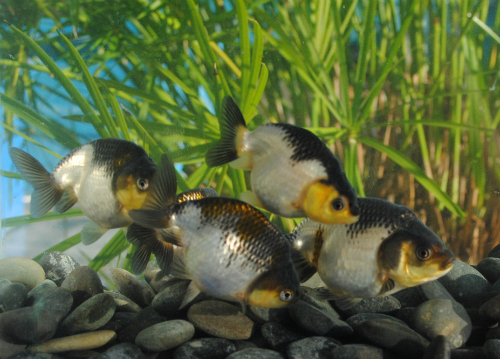
The picture I post here is the offsprings of those orange fishes. So this is the fifth generation. Some percentage became the usual grey color which turned into orange, some turned into blue. Among the blue, some stayed blue so far, some turned early into panda, and some turned quickly into white. I tell myself, “It is ok.” I just need to repeat the first step again in order to stabilize the color. This makes me glad.

Concerning the shape, I get two kinds. First, I get ranchu, and second, I get a small percentage of deme-ranchu, or nymph, which is a ranchu with telescope eyes. Somehow the ones with telescope eyes grow darker coloration compared to their ranchu sibling. The ranchu shape carried the weaknesses of the parents from the fourth generation, namely the small head, the hump, and the late headgrowth. Other than that, the shape is perfectly ranchu. I need some more years to improve on the head shape and color.

So actually this is a premature publishing. Four more steps need to be done to create a decent ranchu shape with a stable panda color. I just get too excited to share the progress now. Two more years to go. 🙂

Standard
Ryukin

Ryukin

My relationship with ryukin is not always good. I remember my first encounter was when I was 10 years old. There were two ryukin imports in the local fish shop. I was amazed by the hump of the fish, and it got carried away into my dreams for weeks. The price was rp 25.000 (the equivalent of usd 2.5), but it was too expensive already for a school boy at that time. As I grow up, my esteem of ryukin gets lower and lower. I was into sideview ranchu at that time and was thinking that sideview ranchu was everything. My first breeding project was ryukin, since I think it was easy. And indeed, the breeding confirmed me that ryukin breeding was too easy. After that, I abandoned ryukin altogether and focused on sideview ranchu.

Now, as I am preparing to write a book on goldfish appreciation as a joint effort with a friend, I begin to relearn about ryukin and is breeding it again to collect sufficient amount of illustration. So, after 13 years, I come back to ryukin! My friend teaches me humility by showing me so much that I don’t know about ryukin. Now I begin to appreciate ryukin again.

Maybe I want to be like Tom Bombadil in the goldfish world. I care less about the trend, the market, etc. I like to work on my own terms. The trend on ryukin today is the short tail ryukin. I do not have an interest on it. My interest is to create a sideview broadtail ryukin since the older tradition consider it to be the most valued in the ryukin category and it is not easy to find anymore.

I bought a pair of sideview broadtail ryukin from China. If they breed true, then this would be an easy project. To my surprise, the genetic of those two were not stable. The genetic of topview broadtail was thick on them. So, to my dislike, I ended up with topview broadtail offsprings. Please don’t get me wrong. Topview broadtail has its own beauty. Just that it is not my goal right now. The second weakness was in the hump. Very few have decent humps. So I suspected that American veiltail bloodline might be thick on them. To produce true sideview broadtail ryukin turned out to be not easy.

My solution was to cross the broadtail I had with long tail ryukin, as I am convinced the genetic of long tail ryukin should be stable already. So I bought some long tail ryukin from China. The purpose is to strengthened the genetic of sideview tail, but retaining the broadtail (fan-like) characteristic.

To my surprise, I found out that there was a genetic of short tail in my long tail ryukin parent! I was puzzled to the reason why should the Chinese cross the short tail and long tail ryukin in the first place. So, from this cross I get short broadtail, normal short tail, normal long tail, medium broadtail, and long broadtail! I am suddenly rich! But I will stick to my first priority, which is the medium brroadtail. So I will sell all the other types.

I am glad that so far the sideview appearance has been incorporated into the broadtail with success to some extent. In another month I will harvest them and be able to show some pictures.

Standard

Sketch11520510-1
The idealization of Wowkin, a new variety I try to create. This is meant to be a pond fish which can swim well. The body resembles wakin, with its large body size and deep red coloration. The tail is made to be more impressive than wakin but shall not restrict the ability of the fish to swim. What I have in mind is not a normal tosakin tail, but a semi tosakin tail. It is kind of smaller tosakin tail, retaining tosakin’s flip on its tips and a thousand ray flavor, but has a split in the middle of the tail and is more flexible, so the tail will be wide open when in stationary but close when swimming. This kind of tail is designed to help the fish swim better than tosakin, I hope.

Wowkin

Wowkin

Image